
Debt to Income Ratio Australia: What Lenders Look At
If you've ever applied for a home loan or investment property finance in Australia, your debt to income ratio has already played a role in what you were offered, even if no one told you that's what it was called.
Debt to income ratio in Australia is one of the most important metrics lenders use to decide how much they'll let you borrow. It sits alongside your credit score, your deposit, and your serviceability assessment as a core part of the approval process. And since APRA formally activated DTI limits as a macroprudential tool from 1 February 2026, it has become even more central to how Australian banks and lenders manage risk across their entire loan books.
This article breaks down exactly what DTI means, how it's calculated, where the limits sit, and what it means for your ability to borrow, whether you're buying your first home or building a property portfolio.
What Is Debt to Income Ratio and How Is It Calculated?
Debt to income ratio (DTI) is a simple formula. It compares the total amount of debt you hold to your gross annual income before tax.
The calculation looks like this:
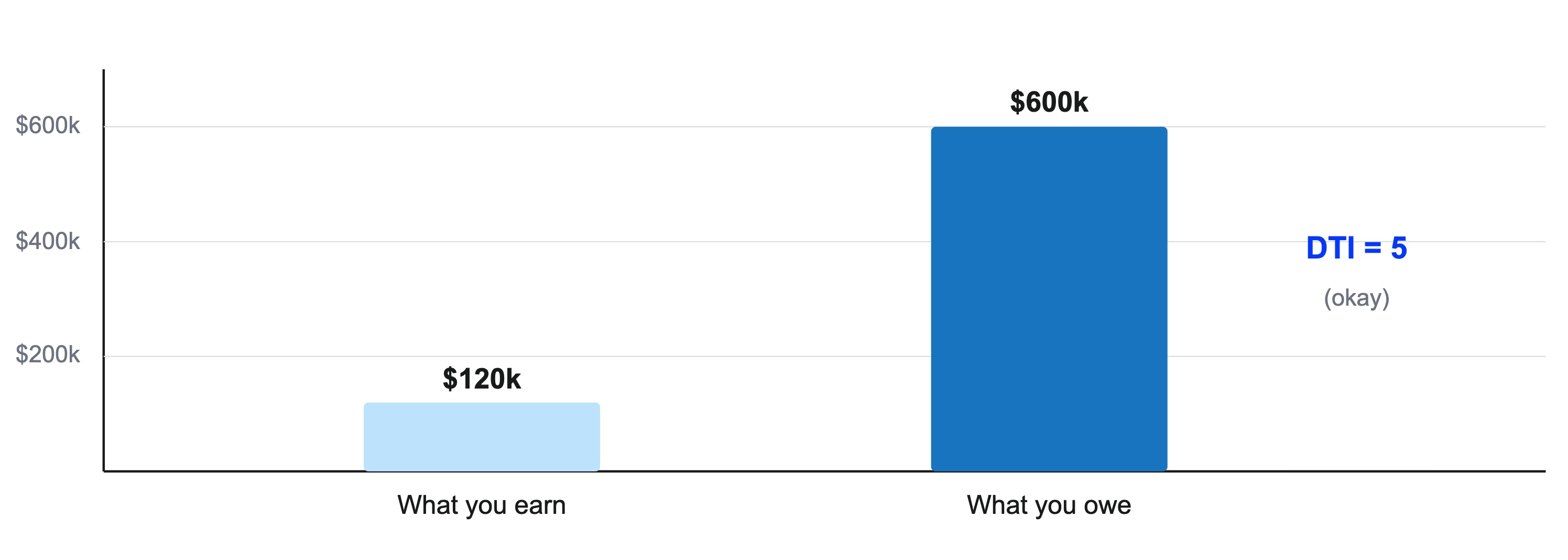
Total Debt ÷ Gross Annual Income = DTI Ratio
For example, if you earn $120,000 per year and you have $600,000 in total debt across your mortgage, car loan, and other borrowings, your DTI ratio is 5. That is considered moderate by current Australian lender standards. Not sure where you sit? Use our borrowing power calculator to get a clearer picture of your position before approaching a lender.
The "total debt" side of the equation includes:
Your existing mortgage or mortgages
Any new debt you are applying for
Car loans and personal loans
Credit card limits (not just the outstanding balance; lenders typically count the full approved limit)
HECS/HELP debt (depending on the lender)
Buy now, pay later balances with some lenders
The "income" figure generally refers to your gross (pre-tax) income, but lenders have different approaches to how they treat rental income, bonuses, and self-employed earnings.
Why Australian Lenders Use DTI Ratio to Assess Borrowing Power
Lenders don't just want to know whether you can repay a loan today. They want to understand your overall debt exposure relative to your ability to generate income over time.
A high DTI ratio tells a lender that a large portion of your income is already committed to servicing debt. That creates risk, not just for you, but for them. If interest rates rise, your income drops, or your circumstances change, a borrower with a high DTI has far less room to absorb those shocks.
The RBA's Financial Stability Review has consistently flagged that highly leveraged borrowers are significantly more likely to fall into arrears. The April 2025 edition noted that borrowers with high loan-to-income ratios have arrears rates that remain elevated compared with the pre-pandemic period, even as broader loan arrears have stabilised.
This is why the debt to income ratio in Australia has become a key part of the responsible lending conversation. It gives lenders a clear, standardised way to measure how stretched a borrower is, beyond just whether they can meet this month's repayment at today's interest rate.
Serviceability tests, where lenders apply a buffer rate on top of the actual loan rate, have existed for years. DTI adds another layer, one that looks at total debt position rather than just cash flow.
APRA's DTI Limits and What They Mean for Your Loan
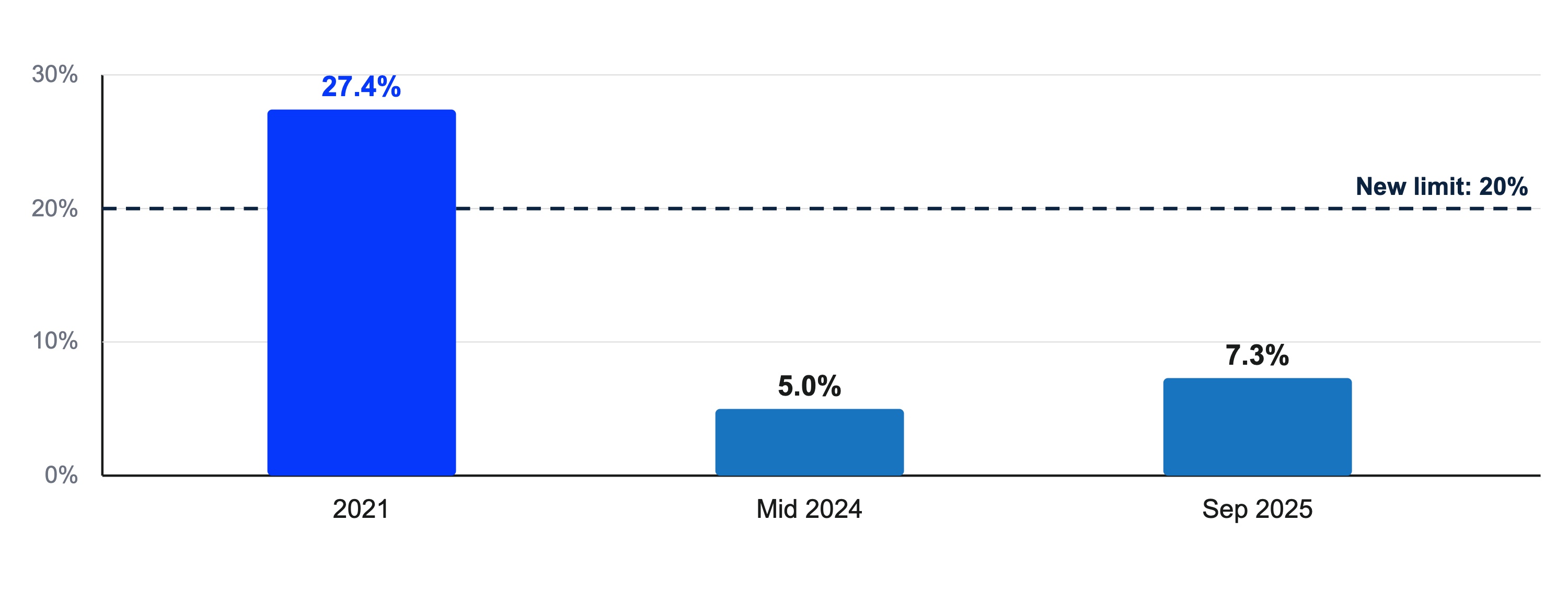
In November 2025, APRA announced the activation of formal debt-to-income lending limits, effective 1 February 2026. Under the APRA DTI framework, all authorised deposit-taking institutions (ADIs) are now capped at lending no more than 20 per cent of new residential mortgages to borrowers with a DTI of six times income or more. The limit applies separately to owner-occupier and investor loan books.
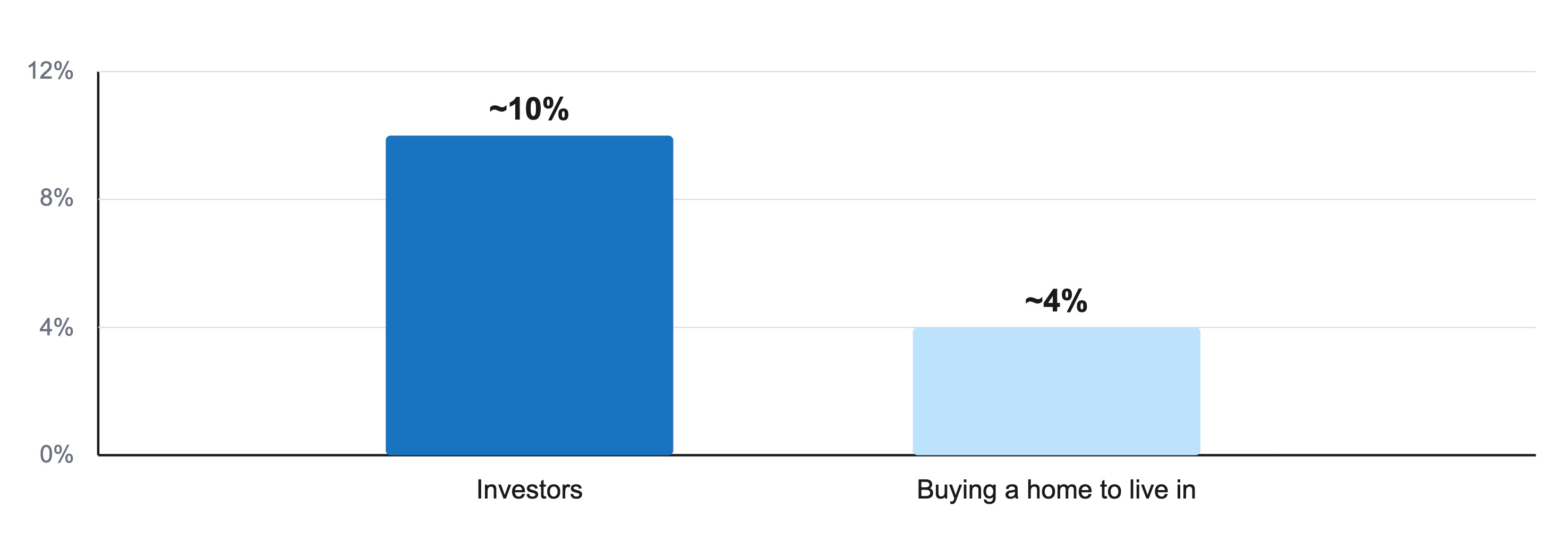
APRA's stated rationale was clear: high DTI lending had begun rising, driven primarily by investor activity, and the regulator wanted to act pre-emptively before risks built further. At the time of the announcement, around 7.3 per cent of all new loans had a DTI at or above six, up from a low of 5.0 per cent in the June 2024 quarter. For investor loans specifically, that share had climbed to approximately 10 per cent.
Why this matters for individual borrowers:
The 20 per cent cap is a portfolio-level rule, meaning banks manage it across their entire new loan book. But in practice, individual lenders translate that into tighter credit policies for high-DTI applications. A borrower sitting at a DTI of 6.5 is no longer just a marginal case. They are now a borrower that actively consumes part of a bank's regulated allocation.
Historical context adds important perspective:
During the low-rate environment of 2021, high-DTI loans peaked at 27.4 per cent of all new lending. That rapid rise is precisely what APRA's new limit is designed to prevent from recurring as interest rates ease again.
Source: APRA Quarterly ADI Property Exposure Statistics (December 2025). Investor DTI data from APRA information paper, November 2025. Intermediate quarters estimated from disclosed range.
How DTI Levels Are Classified by Australian Lenders
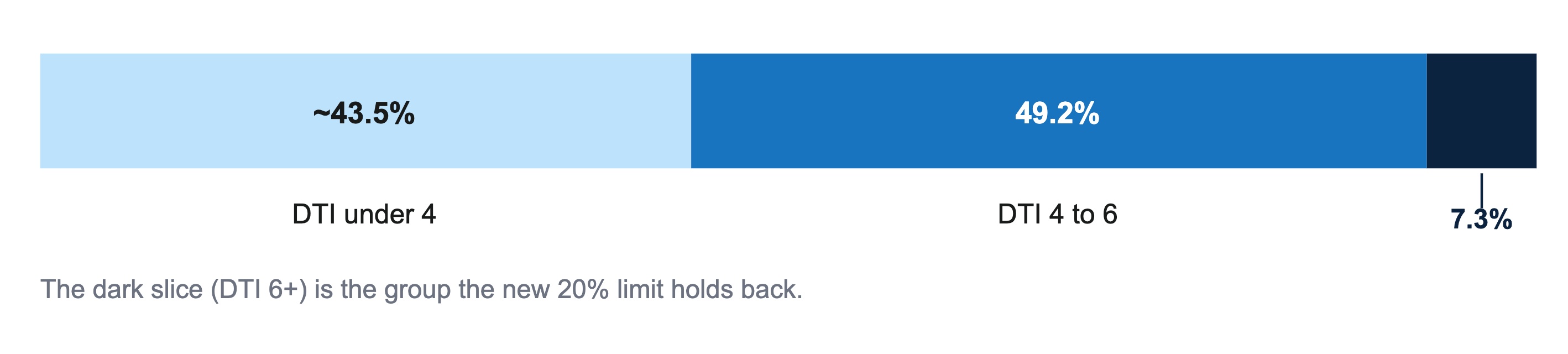
With APRA's DTI framework now active, here is a practical overview of how Australian lenders currently assess DTI risk. According to APRA data, as of September 2025, around 49.2 per cent of new loans sit in the 4 to 6 DTI range, while 7.3 per cent sit at six or above.
Source: APRA: Quarterly ADI Property Exposure Statistics; lender credit policy frameworks.
APRA's other active macroprudential tools sit alongside the DTI limit. The mortgage serviceability buffer remains at 3 percentage points above the loan rate, and the counter-cyclical capital buffer sits at 1 per cent of risk-weighted assets. These tools work together, not independently.
How DTI Affects Property Investors Differently from Owner-Occupiers
For an owner-occupier buying their first or only home, the DTI calculation is relatively straightforward. You have one loan, one income, and the ratio is easy to assess.
For property investors, the picture is more complex, and the interaction between DTI and tax settings makes it even more so.
Investors rely on leverage as a core growth mechanism. The ability to borrow against equity and add properties over time is what drives portfolio expansion. But every time you add a property, your total debt increases. Rental income offsets some of that, but it rarely eliminates the DTI impact entirely.
APRA's data shows that investor borrowers are over-represented in high-DTI lending. Around 10 per cent of investor loans sit at a DTI of six or more, compared with just 4 per cent of owner-occupier loans. This gap reflects the structural reality of portfolio investing: income stays relatively fixed while debt accumulates with each acquisition.
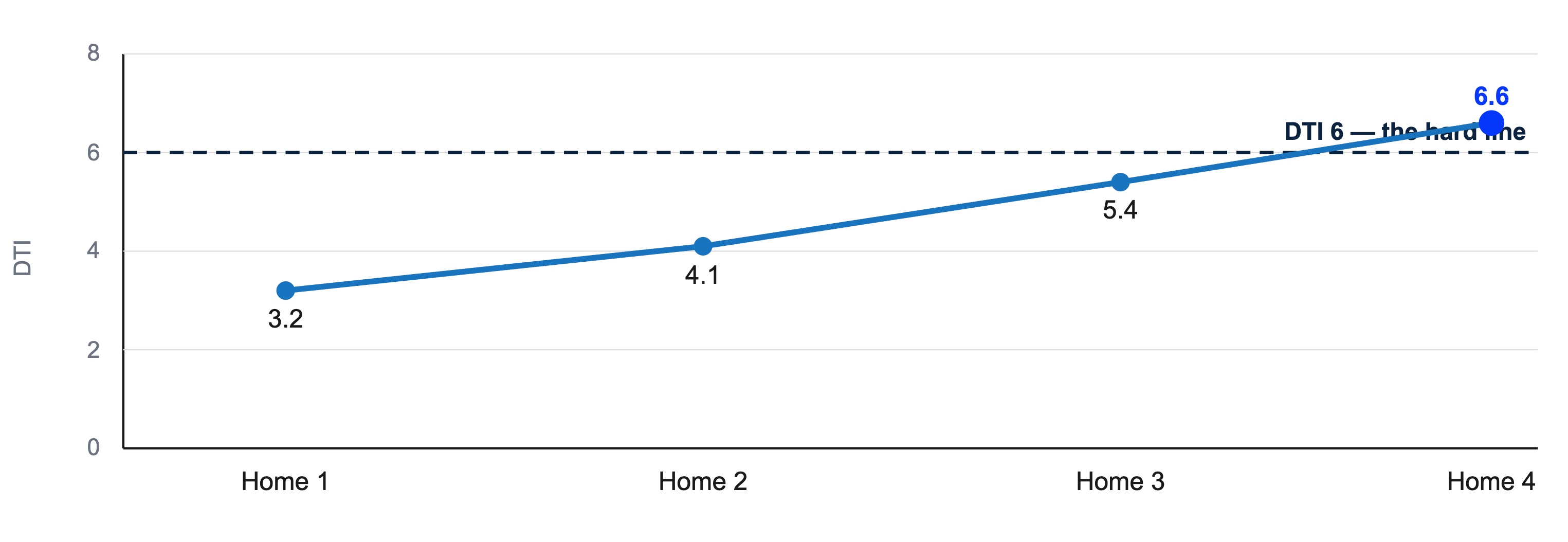
This creates a scaling problem. An investor might have a DTI of 4 on their first two properties, but by the third or fourth acquisition, they are approaching the limits that most lenders will comfortably fund.
Between 2002 and 2022, the share of owner-occupier borrowers with a DTI at or above six is estimated to have risen from 4.7 per cent to 7.5 per cent, according to RBA analysis of Australian financial system resilience. That long-run trend is part of why regulators acted now rather than waiting.
Understanding how your borrowing power and tax position interact is something most investors underestimate early in their journey. The two don't operate independently. Decisions made around structure and tax efficiency directly affect what lenders will approve.
How to Improve Your Debt to Income Ratio Before Applying
The good news is that DTI isn't fixed. There are practical ways to reduce your ratio before you approach a lender, or to structure your application more effectively.
Reduce existing debt: Pay down personal loans, car loans, and credit cards before applying. Even small reductions can shift the ratio meaningfully.
Lower your credit card limits: Many people carry card limits they never use. Lenders count the full limit, not just the balance. Reducing limits directly reduces your assessed debt.
Increase your documented income: If you have rental income, freelance work, or a side income that isn't being fully captured in your assessment, work with your broker to ensure it's properly documented and verified.
Wait before adding more debt: If you're planning multiple acquisitions, spacing them out can allow rental income to be seasoned and improve how lenders view your income-to-debt position.
Work with a specialist broker: Not all lenders apply DTI caps in the same way. Non-bank lenders, which currently account for around 4 per cent of total residential mortgage credit according to APRA, are not subject to the same cap and may have greater flexibility at higher DTI levels. A broker who knows which lenders have headroom in their high-DTI allocation can make a significant difference to your outcome.
What This Means If You're Planning to Grow a Property Portfolio
The debt to income ratio in Australia isn't just a hurdle to clear on your next loan application. It is a long-term structural consideration that shapes how quickly you can grow, how you should sequence acquisitions, and what types of assets make sense at different stages.
With APRA's DTI cap now active from February 2026, the regulatory environment has shifted. Lenders are monitoring their portfolio-level DTI exposure more closely than before, and investors, who represent the higher-risk segment of the market, will feel the effects first and most directly.
Investors who understand their DTI position early have more options. Those who hit the limit unexpectedly, usually at the third or fourth property, find themselves stuck with no clear path forward.
Planning around DTI means thinking about income growth alongside debt growth. It means understanding which lenders are more flexible at different stages. And it means treating your tax position and your lending position as connected, not separate.
The investors who adapt their strategy to these constraints tend to build more sustainably than those who push leverage as far as possible without considering the long-term implications.
If you want to understand where your current DTI sits and how it affects your next move, speaking with a property finance specialist is the best place to start. Book a free strategy session with our team today.