

How to Calculate Debt to Income Ratio Australia
Knowing how to calculate debt to income ratio in Australia before you apply for a home loan can be the difference between a smooth approval and an unexpected decline. Most borrowers focus on income, deposit size, or interest rates. But lenders are increasingly prioritising one metric above all others: your total debt relative to what you earn.
The number you calculate is only one part of the equation. What matters more is how lenders interpret that number, how it fits within their current risk thresholds, and how it shapes your borrowing capacity before you ever sit across from a lender.
What Is Debt to Income Ratio and Why It Matters for Your Home Loan
Your DTI ratio compares your total outstanding debt to your gross annual income before tax. It gives lenders a single number that represents your overall leverage position. Unlike serviceability assessments, which look at whether your cash flow can cover repayments, DTI looks at your total exposure regardless of repayment amounts.
This matters because lending decisions are no longer based purely on short-term affordability. Lenders now assess borrowers based on total exposure and long-term risk, which makes DTI one of the most influential metrics in the approval process. Two borrowers with identical incomes and identical monthly repayments can receive very different outcomes depending on their total debt position.
Understanding how lenders use the debt to income ratio in Australia is the first step toward managing it effectively.
The DTI Formula: How to Calculate It Step by Step
The formula itself is straightforward. The complexity comes from knowing exactly what to include on each side.
DTI = Total Debt divided by Gross Annual Income
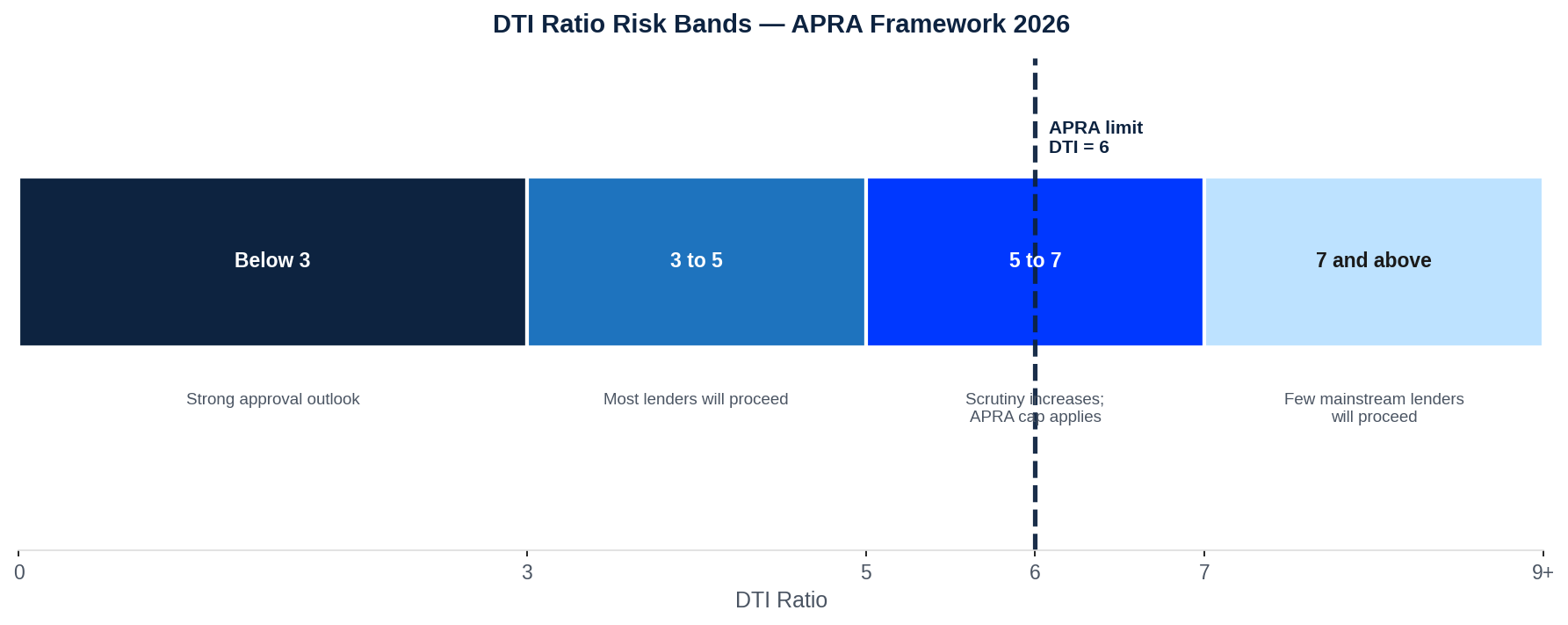
If your total debt is $720,000 and your gross annual income is $120,000, your DTI ratio is 6. That sits right at the threshold where APRA's lending limits begin to apply.
Step One: Calculate Your Total Debt Accurately
This is where most borrowers underestimate their position. Total debt includes every liability a lender will count against you, not just your mortgage balance.
Lenders include: all existing mortgages including investment properties, the new loan you are applying for, personal loans and car loans, credit card limits at the full approved limit (not the outstanding balance), unused credit limits, overdraft facilities, and HECS/HELP debt depending on the lender.
The credit card limit point catches many borrowers off guard. If you hold $30,000 in credit card limits across three cards you rarely use, lenders count the full $30,000 as potential debt. Reducing unused limits before applying is one of the most direct ways to lower your assessed DTI.
Step Two: Determine Your Gross Annual Income Correctly
The income side is not always as simple as your salary. Lenders apply conservative adjustments to certain income types, which means your effective income for DTI purposes may be lower than you expect. Rental income is typically assessed at 70 to 80 per cent of its actual value. Bonuses and commission may be averaged or partially excluded. Self-employment income often requires two years of verified tax returns.
Learning how to increase your borrowing capacity often starts with how income is presented to the lender.
Step Three: Calculate and Interpret Your Ratio
Once you have both figures, divide total debt by gross annual income.
For Example
Existing mortgages: $1,100,000. New loan: $400,000. Car loan: $30,000. Credit card limits: $25,000. Total debt: $1,555,000. Salary: $150,000. Rental income at 80% of $60,000: $48,000. Lender-assessed income: $198,000. DTI = $1,555,000 / $198,000 = 7.85. At 7.85, this investor is in high-risk territory. Mainstream lender options narrow significantly.
DTI Ratio Risk Bands — APRA Framework 2026
Custom HTML/CSS/JAVASCRIPT
Source: APRA — Activation of Debt-to-Income Limits as a Macroprudential Policy Tool, effective 1 February 2026. APRA Quarterly ADI Property Exposure Statistics.
What APRA's DTI Limits Mean for Your Application
In November 2025, APRA formally activated DTI lending limits, effective 1 February 2026. Under the framework, all authorised deposit-taking institutions can lend no more than 20 per cent of new residential mortgages to borrowers with a DTI of six times income or greater. The cap applies separately to owner-occupier and investor loan books.
The practical effect: even if you qualify on paper, your application may be affected by how it fits within a lender's remaining high-DTI allocation for that quarter. A lender that has already issued a high share of DTI 6-plus loans may apply stricter criteria to subsequent applications, even from borrowers who technically meet the threshold.
APRA acted to pre-emptively contain housing-related vulnerabilities, with high DTI lending rising from 5.0 per cent in June 2024 to 7.3 per cent of all new loans by September 2025. The ABS lending finance data tracked the corresponding rise in investor borrowing through this period.
What a Good DTI Looks Like in Australia Right Now
There is no fixed threshold that guarantees approval. Lenders operate within risk bands, and your outcome depends on where within those bands your number sits, as well as the quality and stability of the income and assets behind it.
Source: APRA Quarterly ADI Property Exposure Statistics; lender credit policy frameworks.
Why Calculating Your DTI Early Changes Your Position
Most borrowers only think about their DTI once they are already mid-application. By that point, any issues tend to result in delays, reduced loan amounts, or declined applications.
Calculating early gives you time to act. A borrower who identifies a DTI of 6.4 three months before applying has real options. Understanding how lenders assess DTI in Australia before committing to a purchase price or timeline is the difference between managing the outcome and managing the damage.
The RBA's cash rate decisions also feed into this calculation indirectly. Rate movements affect the serviceability buffer assessment, which sits alongside DTI as a parallel constraint. Monitoring both gives you a more complete picture of your approval outlook.
How to Improve Your DTI Before Applying
If your calculated DTI is higher than you would like, there are practical steps to take before approaching a lender.
Reduce credit card limits before applying. Contact your card providers and request reductions. This directly lowers your assessed total debt without affecting your credit score and takes effect immediately with most lenders.
Pay down high-balance personal loans. Eliminating a personal loan or car loan reduces your total debt figure and improves your ratio straight away. Even a partial reduction can shift you from one risk band to the next.
Avoid new credit in the months before application. Any new credit inquiry, even for products you do not use, can affect your assessed position. Hold off on any new finance until after your home loan settles.
Document all income properly. Work with your finance specialist to ensure every eligible income stream is verified and presented correctly. Understanding how to improve your borrowing position often starts with how rental income and secondary income sources are declared.
Final Thoughts
Calculating your debt-to-income ratio before applying for a home loan in Australia is now one of the most practical steps you can take to protect your position. It tells you where you stand, gives you time to adjust, and removes the risk of discovering problems during the approval process.
In today's lending environment, preparation is not optional. Understanding your DTI before you apply is how you maintain flexibility as you move forward, whether you are buying your first home or continuing to build a property portfolio.
Frequently Asked Questions
Recommended Reading
Two pages selected based on what readers of this article are most likely to need next.
Watch: RBA rate hikes… but this is what actually matters for property investors
As rates rise, many people immediately assume it is no longer a good time to invest.