

How to Use Equity to Build a Property Portfolio in Australia
Most Australian property portfolios are not built solely through accumulated savings. They are built through the strategic use of equity.
Equity is one of the most powerful financial tools available to property owners, yet it remains widely misunderstood. When applied correctly, it enables progression from one property to the next without the need to liquidate assets or exhaust cash reserves. When applied poorly, it increases financial pressure, weakens serviceability, and restricts future borrowing capacity in ways that may not become evident until the next acquisition attempt.
In the 2026 lending environment, where assessment rates remain elevated and debt-to-income ratios are closely scrutinised, the margin for structural error is narrower than in previous cycles. Understanding how equity functions, and how to deploy it with discipline, has therefore become increasingly important for investors seeking long-term scalability.
This article examines how equity operates within the Australian property system, the distinction between total and usable equity, and the role structured lending strategy plays in transforming equity from a passive gain into an active wealth-building mechanism.
What Equity Represents in Practical Terms
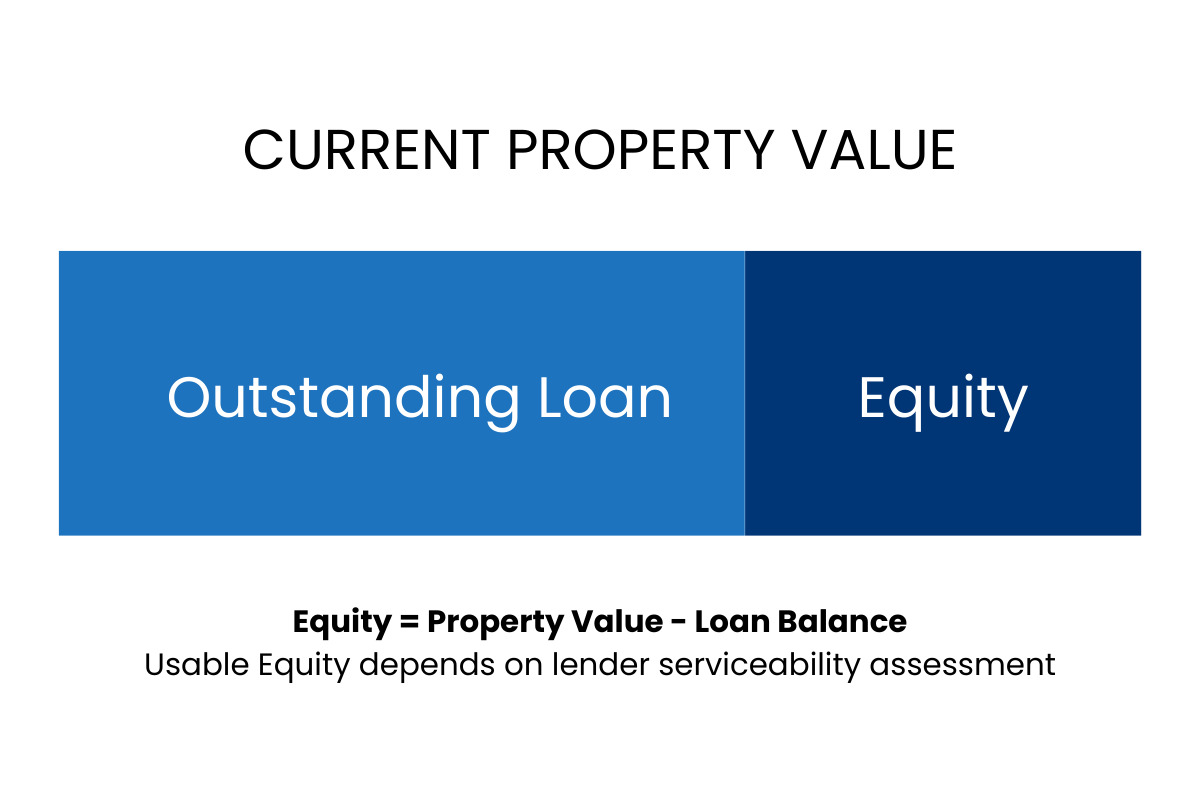
At its simplest level, equity is the difference between a property’s current market value and the outstanding loan secured against it. As property values increase and loan balances gradually reduce, equity accumulates. In many cases, equity grows more rapidly than personal savings, particularly during sustained growth cycles.
However, equity only becomes relevant from an investment perspective when it is accessible and serviceable. A rising valuation alone does not guarantee borrowing capacity. Lenders assess income, expenses, existing liabilities, and repayment buffers before releasing additional funds. As a result, equity is both a valuation concept and a lending concept.
For investors seeking to move beyond their first property, this distinction becomes critical. Multi-property portfolios are rarely constructed by repeatedly saving new deposits from employment income alone. Instead, they are typically structured through the controlled release and redeployment of accumulated equity, supported by appropriate serviceability.
Sustaining this progression also depends on disciplined asset oversight, which is why professional Property Management plays an important role in preserving rental stability, protecting cash flow, and supporting long-term serviceability.
Total Equity Versus Usable Equity
A common misconception is that all equity is available for reinvestment. In practice, this is not the case. Total equity reflects the difference between market value and loan balance. Usable equity reflects what a lender is prepared to advance under prevailing loan-to-value ratio guidelines and servicing assessments.
In most cases, lenders allow borrowing up to 80 percent of a property’s value without triggering lenders mortgage insurance. The amount between that 80 percent threshold and the existing loan balance represents potential usable equity. However, potential does not equal approval. Access remains contingent on income stability, expense position, and overall credit profile.
For this reason, equity decisions should begin with borrowing capacity analysis rather than property selection. Attempting to identify the next purchase before confirming lending flexibility often leads to frustration, particularly in a tighter credit cycle such as 2026.
Using Equity Within a Structured Framework
Releasing equity should not be viewed as a mechanism to maximise leverage. Instead, it should be considered a method of enhancing flexibility while preserving financial resilience. A structured equity strategy typically incorporates conservative servicing buffers, stress-testing at higher interest rates, clear separation between personal and investment debt, and a defined strategic purpose for the funds.
In this context, equity functions as a tool rather than an objective. The objective remains sustainable portfolio progression. Equity that increases financial strain undermines this objective, whereas equity deployed within disciplined parameters strengthens it.
Practical Applications of Equity in Portfolio Growth
Investors commonly utilise equity in three principal ways. The first involves funding deposits and acquisition costs for subsequent investment properties. Rather than saving an entirely new deposit, investors may draw against accumulated equity, provided servicing supports the additional borrowing. When structured appropriately, this approach accelerates portfolio expansion without requiring asset sales.
The second application involves strategic refinancing. In some cases, the most effective use of equity is not immediate expansion but structural optimisation. Refinancing may improve cash flow, introduce offset functionality, consolidate inefficient debt, or reposition loans to enhance flexibility before the next acquisition. In a lending environment characterised by tighter scrutiny, strengthening the foundation often precedes growth.
The third application relates to targeted value-add activity. Renovations that materially improve rental income or valuation outcomes may create additional equity capacity. However, this approach requires rigorous financial analysis to ensure that uplift exceeds cost and aligns with lender recognition standards.

The Risks of Unstructured Equity Use
Equity becomes problematic when it is applied without a broader portfolio framework. Over-leveraging without adequate buffers, cross-collateralising properties in a manner that limits future flexibility, blending personal and investment debt, or pursuing maximum loan-to-value ratios without sustainability analysis can all restrict long-term progression.
These issues do not always manifest immediately. They often surface when an investor attempts to acquire an additional asset and encounters borrowing constraints. At that point, the earlier structural decisions reveal their long-term implications.
A Structured Perspective for 2026
In 2026, equity strategy must be approached with heightened discipline. Lending buffers remain significant, serviceability calculations are conservative, and regulatory oversight continues to influence bank policy. Under these conditions, equity release decisions require integration with long-term portfolio design rather than opportunistic action.
Effective equity use therefore depends on sequencing. Each release should support not only the immediate acquisition but also the viability of subsequent steps. Portfolio momentum is rarely achieved through isolated transactions; it is achieved through cumulative, structurally aligned decisions.
Equity as a Strategic Enabler
Equity on its own does not create wealth. It represents latent capacity. Wealth creation occurs when that capacity is deployed within a coherent strategy that aligns asset selection, borrowing structure, and long-term objectives.
Investors who progress consistently across cycles are typically those who understand how to use what they already hold in a controlled manner. They treat equity as a renewable resource within a structured framework rather than a one-time opportunity.
For those seeking clarity on how much equity may be available, whether current loan structures support future growth, and how to align borrowing capacity with long-term objectives, the next step is strategic review. Book a Strategy Call to assess your current position and map a scalable pathway forward in 2026 and beyond.