

RBA “Three More Hikes by August” - What Happens to Investors Who Waited
Interest rate expectations tend to influence behaviour long before any official movement occurs. As forecasts begin pointing toward further hikes, particularly within a short timeframe, many investors instinctively step back and wait for more certainty.
At a surface level, this feels like a controlled approach. If borrowing costs are expected to rise, delaying a decision appears to reduce risk and avoid entering under unfavourable conditions. It creates the belief that clarity will lead to better timing and, ultimately, better outcomes.
What is often underestimated is how quickly the environment adjusts to those expectations. By the time the outlook becomes clear, the conditions investors were waiting for have already shifted.
Expectations reshape the environment early
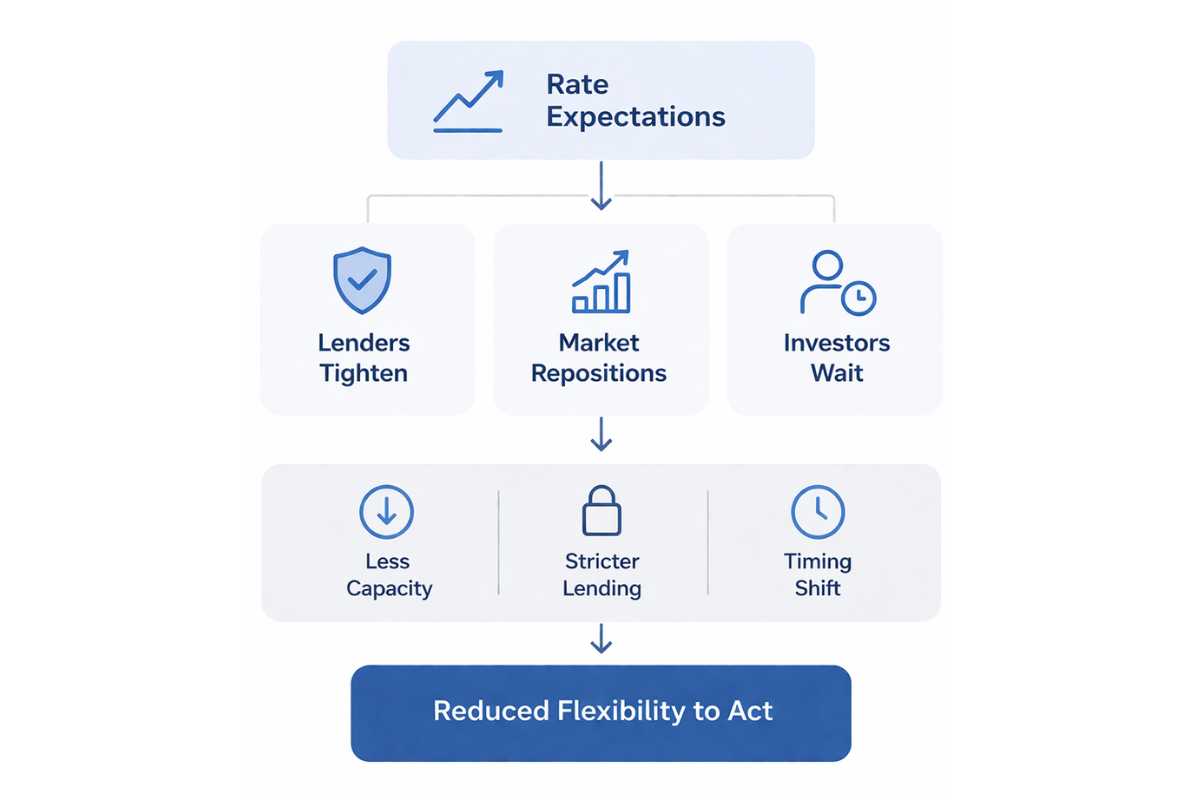
Forecasts around interest rates do more than influence sentiment. They begin to shape behaviour across lenders, borrowers, and the broader market well before any official change is announced.
Recent forecasts from major banks continue to point toward the possibility of further rate increases as inflation remains persistent, reinforcing expectations of tighter conditions ahead (Australian Broker News).
Lenders typically act first. As expectations of further hikes build, they adjust buffers, tighten assessment criteria, and become more selective in how lending is allocated. These changes are subtle at first, but they directly affect borrowing capacity and access to finance.
Why waiting feels like the safer option
For many investors, waiting is framed as a disciplined move. It feels like stepping back from uncertainty and choosing to act only once the direction of the market becomes clearer.
There is also an expectation that better opportunities will emerge. Lower competition, improved negotiation leverage, and more predictable lending conditions are often seen as the natural outcome of a shifting rate environment.
The challenge is that these assumptions rely on all factors moving together. In reality, they don’t. Borrowing capacity, lender policy, and market behaviour all adjust at different speeds, which means waiting for one variable to stabilise does not ensure the others will remain unchanged.
Borrowing capacity moves before the headline rates
One of the earliest shifts occurs in borrowing capacity. This is where the impact is often felt first, even if it is not immediately visible.
As lenders anticipate potential rate increases, they begin adjusting how loans are assessed. This includes increasing serviceability buffers and applying more conservative lending standards. These changes can reduce borrowing capacity before any official rate movement takes place.
Lenders have already begun adjusting mortgage pricing and lending conditions in response to rate expectations, not just confirmed changes (Loanfin).
This creates a disconnect for many investors. Income may remain stable, or even increase, but borrowing power declines due to changes in assessment criteria. As explored in Borrowing Power vs Tax Concessions: The Silent Relationship Most Investors Never Model, structural factors within a portfolio can already be influencing capacity, and these shifts only amplify that effect.
Lending constraints are becoming more structural
Beyond rate expectations, lending itself is becoming more controlled at a system level. Access to debt is no longer determined purely by individual income or serviceability, but also by how lenders manage overall risk exposure.
At the same time, the RBA has already implemented rate increases in 2026, with further hikes still under consideration as inflation remains above target (The Guardian).
This shift is becoming more visible as policy frameworks tighten. As outlined in APRA’s 2026 Lending Cap: Why High-Income Investors Are Suddenly Hitting a Wall, even high-income borrowers are now encountering limits based on debt levels rather than earnings alone.
As these constraints become more defined, timing becomes less about waiting for better conditions and more about whether access remains available at all.
The market does not pause alongside you
While some investors step back, the market continues to move. It does not slow uniformly but instead adjusts in uneven ways depending on how participants respond to expectations.
Some buyers move earlier to secure finance before further tightening occurs, while others delay. This creates short-lived windows of opportunity, rather than a sustained period of reduced competition.
Forecasts have also been shifting rapidly, with economists revising expectations multiple times in response to inflation data and policy signals (Finance Directory).
By the time conditions feel more certain, those windows are often gone. What remains is a market that has already repositioned, where opportunities are shaped by readiness rather than timing alone.
The cost of waiting builds over time
Delaying a decision rarely affects just one point in time. It shifts the sequence of future opportunities and changes how a portfolio evolves.
A delayed purchase impacts when the next one can occur, how borrowing capacity develops, and what options remain available later. Each step becomes more dependent on stronger positioning, particularly as lending conditions tighten.
Over time, this creates a gradual constraint. What initially felt like a cautious decision begins to influence long-term flexibility, often without being immediately obvious.
How experienced investors approach this differently
Investors who navigate shifting rate environments effectively do not rely on forecasts to determine when to act. Instead, they use those forecasts to understand direction and adjust their positioning accordingly.
They focus on maintaining borrowing capacity, structuring their portfolio to remain flexible, and acting while access to finance is still available. This allows them to move ahead of constraints rather than reacting to them.
They also recognise that forecasts are not fixed outcomes. Markets tend to adjust ahead of confirmation, and by the time certainty arrives, the advantage has often already shifted.
Where this leaves you
If expectations around further rate hikes continue to evolve, the impact will extend beyond interest rates alone. Borrowing capacity, lender behaviour, and market dynamics will all adjust, often ahead of official changes.
Waiting may feel like a way to reduce risk, but it can introduce a different type of limitation. One that is less visible in the moment, but more restrictive when it comes time to act.
Because by the time certainty arrives, the environment you were waiting for is no longer the same. And what remains is a narrower window that requires stronger positioning to move forward.