

How Tenant Selection Impacts Borrowing Capacity in 2026
Most property investors still think of tenant selection as just another step in the leasing process. You advertise the property, you review applications, you pick a tenant, and rent starts coming in. On the surface, it feels administrative.
But in 2026, who lives in your investment property has a much bigger financial impact than most investors realise.
The stability of your tenant directly affects how consistent your rental income is, how lenders view your portfolio, how usable your equity is, and how soon you can move forward with your next purchase. In other words, tenant selection does not just affect this lease. It affects how fast or smoothly your portfolio can grow.
Right now across Australia, vacancy in many areas is tight and rental demand is strong, so it is natural for investors to focus on getting a tenant in quickly. Empty weeks feel expensive and uncomfortable. However, the timing of when rent starts is usually not what determines long-term performance. The more important moment is the decision about who you place in the property, because that choice sets the stability of the income for the years ahead.
In today’s lending environment, where borrowing capacity is assessed carefully and buffers remain high, even small instability in rental income can slow down borrowing progression. That is why tenant selection now plays a much more strategic role than it did in earlier cycles.
Why Tenant Selection Matters More in Today’s Market
The rental market in 2026 looks quite different to how it did ten or fifteen years ago. Demand is still strong in many locations, but lending policies are tighter, insurers are more cautious, and lenders place more weight on consistent income when assessing serviceability. In some states, dispute resolution also takes longer, which increases the cost of tenancy problems.
Because of this, lenders are not just looking at what rent you could achieve on paper. They are looking at how stable and reliable that income appears across your portfolio. A property with steady, uninterrupted rent supports serviceability and lender confidence. A property with irregular payments, vacancy gaps, or repeated issues looks less predictable.
As explored in our article on How to Choose the Right Investment Property in 2026 location fundamentals shape demand depth, tenant quality, and rental resilience long before a lease is signed. Suburb selection determines the calibre of tenant pool you attract. Tenant selection then determines how effectively that demand converts into stable performance.
Borrowing capacity today is shaped not only by income and asset value, but by how durable that income appears over time. That is why tenant selection should be viewed as a financial decision, not just a leasing step.
The Hidden Cost of an “Acceptable” Tenant
Most investors do not choose poor tenants deliberately. More often, the issue comes from vacancy pressure. When a property has been empty for a few weeks and enquiries are limited, an applicant appears who meets the basic requirements. Their income is sufficient, documents are complete, and references check out. From a compliance perspective, they qualify, so the lease proceeds.
On paper, that decision looks reasonable.
However, qualifying for a lease does not always mean the tenancy will be stable. A tenant might meet affordability ratios but still be living close to their financial limits, with little savings buffer or inconsistent employment history. References may confirm rent was paid but also show frequent moves or short stays. These are not obvious red flags, but they can indicate fragility.
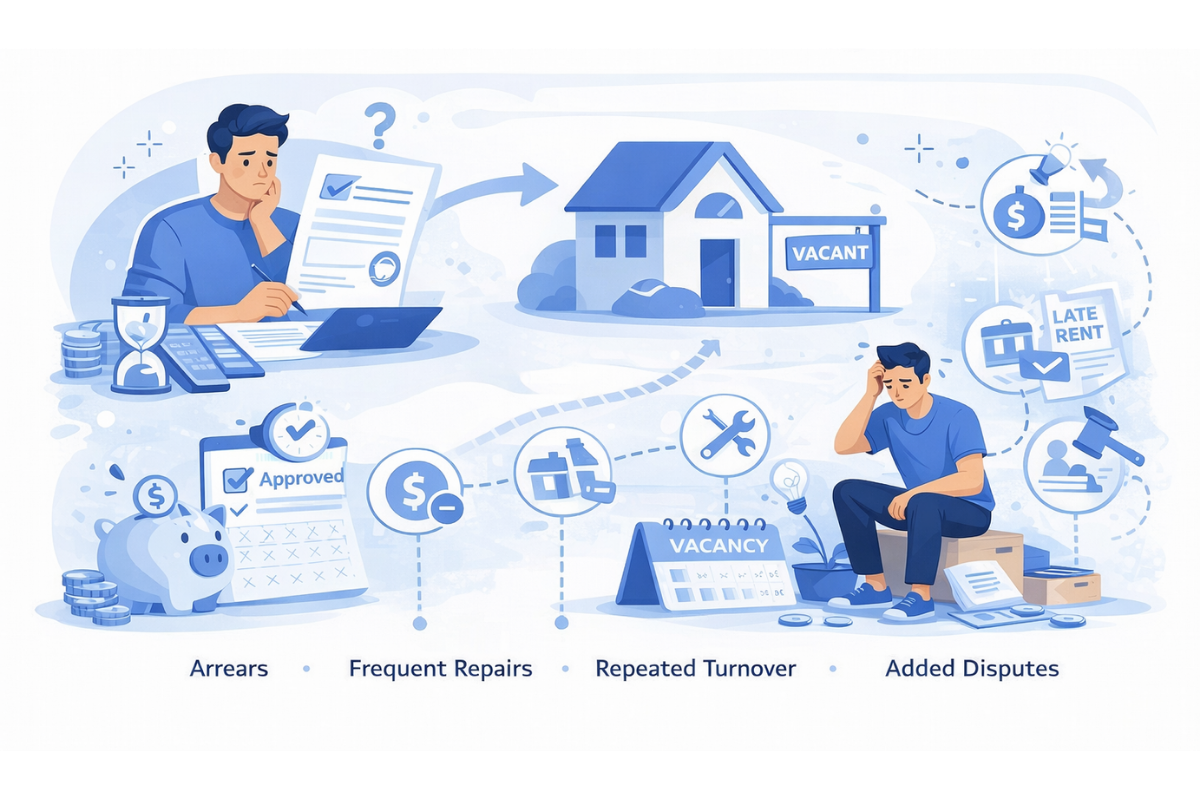
Over time, that fragility tends to show up as occasional late rent, uncertain renewals, reactive communication, or small maintenance issues that escalate. None of these on their own is dramatic, but together they introduce volatility into rental income. In a lending environment that values consistency, even mild volatility has consequences.
The real cost of an “acceptable” tenant is rarely immediate loss. It is gradual friction. Interruptions affect cash-flow modelling, turnover increases letting costs and vacancy exposure, and insurance events can influence future cover. Across multiple properties, this slowly reduces usable borrowing capacity. Predictability becomes more valuable than squeezing every dollar of rent.
Stability Versus Maximum Rent
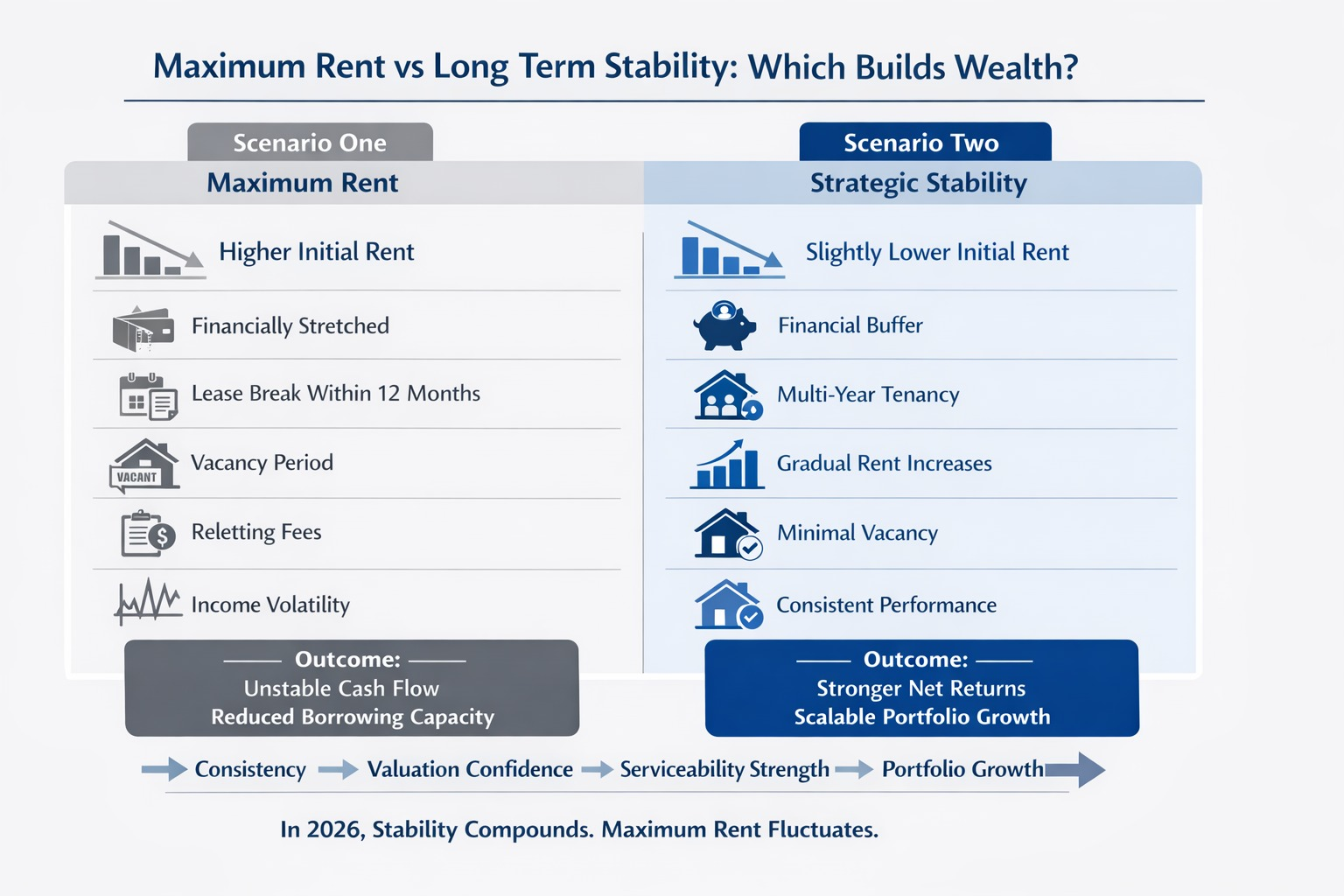
In strong rental markets, investors often try to achieve the highest possible rent. While rent optimisation matters, pushing to the absolute top of the market can sometimes attract tenants who are already stretched financially.
A tenancy set at peak pricing may look ideal initially, but financial pressure can increase the chance of arrears or early exit. By contrast, leasing at a sustainable level to a financially buffered tenant often results in longer occupancy, fewer issues, and steadier income growth through gradual increases.
Over time, consistent occupancy and reliable rent usually produce better financial outcomes than maximising the starting rent. Lenders also assess income stability across years, not just the highest rent achieved at one point. Stability therefore supports both valuation confidence and borrowing progression.
What Strategic Tenant Selection Really Means
Selecting the right tenant involves more than checking documents or confirming income. It is about assessing alignment between the tenant, their financial position, and the property.
Rent should sit comfortably within verified income, not just pass a minimum ratio. Evidence of financial buffer matters more than simple eligibility. Employment continuity and rental history provide clues about stability. Frequent moves or reactive relocations can signal volatility even when references are positive.
Communication during the application process also tells you a lot. Clear, timely, accountable communication often translates into better tenancy behaviour later.
Property fit is equally important. When a property suits a tenant’s lifestyle and foreseeable needs, they are more likely to stay longer. When it is only a temporary solution, turnover risk rises regardless of initial suitability.
These factors are not always obvious in an application form, but they strongly influence tenancy performance over time.
How Tenant Quality Affects Borrowing Capacity
Many investors underestimate how directly tenant stability connects to borrowing power. Lenders include rental income in serviceability calculations and consider how reliable that income appears across the portfolio. Lease strength and comparable rents influence valuations, and equity release depends partly on confidence in ongoing income.
A tenancy with irregular payments or repeated vacancy still produces rent, but its volatility reduces usable borrowing capacity. Across several properties, this compression compounds and can delay future purchases. Stable tenancies, on the other hand, support predictable income that strengthens lender confidence and progression.
Tenant selection therefore influences not only the current lease, but when and how you can acquire the next asset.
A Strategic Approach to Tenant Placement
From a portfolio perspective, tenant selection begins before advertising. Pricing and positioning should attract the right stability profile, not just maximise enquiry numbers. Screening should prioritise financial capacity, continuity, and alignment with the property rather than speed of placement.
If the right tenant is not immediately available, a short vacancy is often less costly than a placement that destabilises performance. This approach reduces volatility, limits turnover, and supports borrowing resilience over time.
After placement, proactive management is still essential. Regular reviews, early arrears response, inspections, and compliance oversight help maintain the stability created at selection. Acquisition strategy and management execution therefore operate together rather than separately.
Final Perspective
In today’s lending environment, property outcomes are shaped less by optimism and more by execution. Tenant selection is one of the few controllable factors that directly influences income stability, risk exposure, and portfolio scalability. Its impact is often subtle in the short term, but it compounds significantly over years.
For investors aiming to progress rather than stagnate, tenant selection deserves the same strategic attention as finance structure and suburb choice. Long-term property wealth is rarely built through speed alone. It is built through decisions that preserve stability and endure across cycles.