

Why Property Portfolios Stall and How Strategic Sequencing Drives Growth
The misconception about momentum
In property investing, momentum is often misinterpreted as acquisition speed. Investors frequently measure progress by the number of titles accumulated or by how quickly they can move from one purchase to the next. While expansion is visible and tangible, sustainable growth is rarely defined by volume alone. It is defined by whether each decision strengthens the conditions required for the next one.
Across Australia, many investors successfully secure their first property and sometimes even a second before encountering an unexpected plateau. Borrowing capacity becomes tighter than anticipated. Equity appears present but inaccessible. Cash flow begins to feel restrictive. The portfolio itself has not failed, yet forward movement becomes increasingly difficult. This outcome is seldom the result of market collapse or misfortune. More often, it reflects structural decisions that were made in isolation rather than within a coordinated progression strategy.
In 2026, where lending assessments remain disciplined and lender policy differences materially affect serviceability, the ability to sequence decisions deliberately has become one of the most valuable competencies an investor can develop.
Why portfolios lose velocity
When portfolios stall, the underlying cause is rarely dramatic. The properties may have grown in value. Rental income may be stable. Interest rates may not have shifted significantly. The friction instead arises from the cumulative effect of earlier decisions that were not designed to interact cohesively.
Investors often focus on discrete wins. A competitive purchase price. A favourable interest rate. A property located in a high-demand suburb. While each of these elements may be positive in isolation, portfolios do not expand through isolated outcomes. They expand through coordinated positioning.
A property that performs adequately on its own can still constrain the next purchase if it weakens serviceability. A loan that appears efficient today may restrict refinancing flexibility tomorrow. When viewed retrospectively, stagnation tends to trace back to decisions that were evaluated for immediate benefit rather than long-term interaction.
Understanding sequencing as a growth discipline
Strategic sequencing refers to the deliberate alignment of property acquisition, finance structure, and timing so that each step improves the conditions for subsequent expansion. It is less about reacting to opportunity and more about constructing a pathway that remains expandable under different market conditions.
In practical terms, sequencing requires evaluating how a purchase influences borrowing headroom, how loan structures affect equity accessibility, and how income durability supports lender confidence. It involves anticipating serviceability constraints before they materialise and structuring buffers to absorb volatility.
The core question shifts from whether a purchase is possible today to whether it enhances or limits the next move. This shift in perspective transforms portfolio management from reactive accumulation to strategic progression.
How early decisions shape long-term ceilings
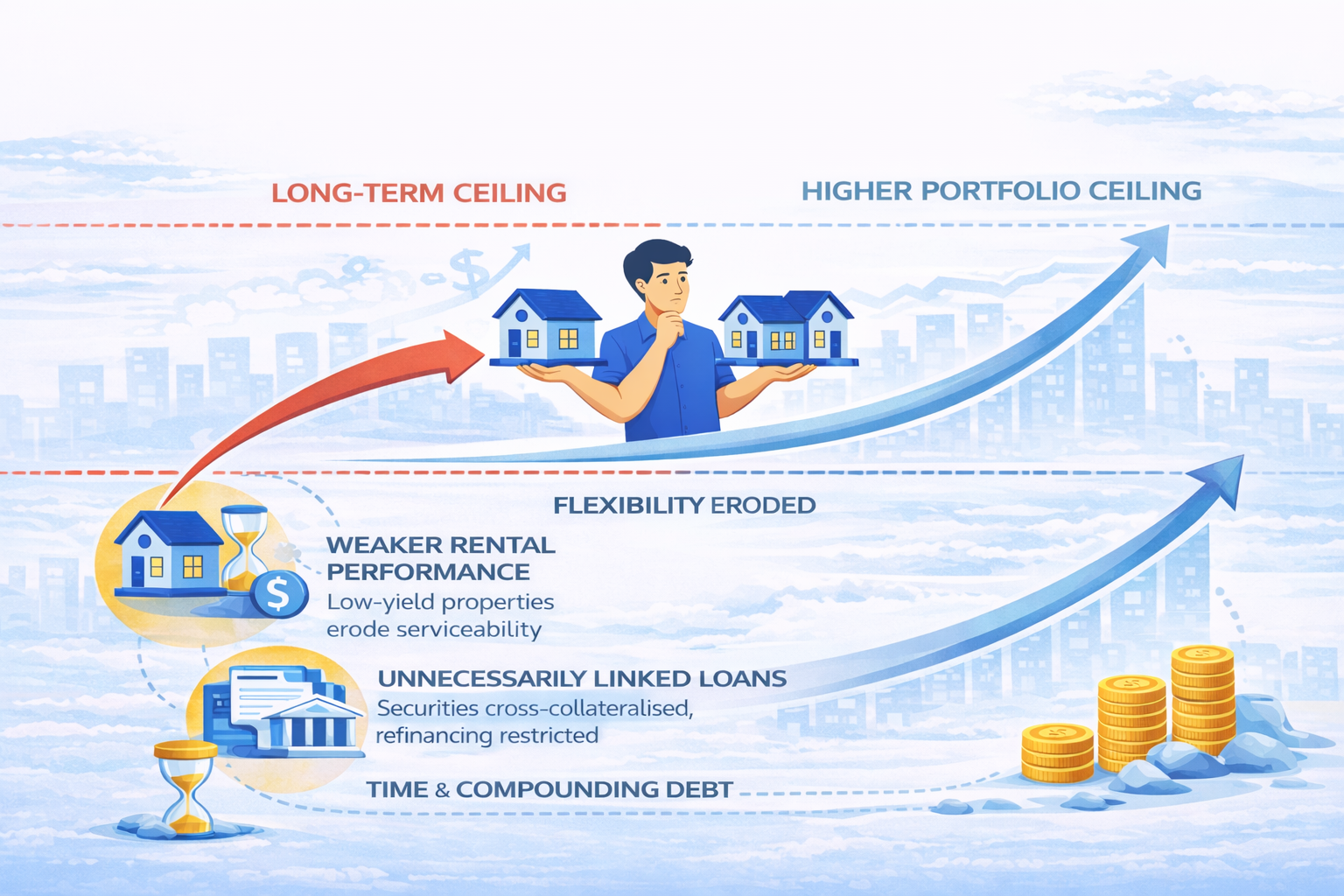
The first two properties in a portfolio often establish its structural boundaries. If these acquisitions are financed without regard to long-term lender diversity, equity accessibility, or income sustainability, future flexibility may narrow even as asset values increase.
For example, properties with weaker rental performance may place subtle pressure on serviceability calculations when compounded across multiple debts. Loan arrangements that link securities unnecessarily may reduce refinancing freedom. Delayed reviews of interest rates or rental positioning may gradually erode borrowing strength without immediate visibility.
None of these factors create instant disruption. Instead, they incrementally shape the ceiling within which the portfolio operates. By the time expansion slows, the structural limitations are already embedded.
When Small Oversights Quietly Reshape Long-Term Outcomes
A common but often overlooked cause of portfolio stagnation is not a single poor decision, but the gradual accumulation of unreviewed ones. Property markets evolve, lending policies adjust, interest rate settings fluctuate, and rental conditions shift in response to broader economic forces. When a portfolio is left unattended for extended periods, it does not remain neutral. It adapts passively to change, and that passivity can slowly reshape its performance profile.
Rental income may sit slightly below current market benchmarks, reducing assessable income in ways that are not immediately obvious. Interest rates may remain higher than necessary relative to competitive offerings, eroding serviceability over time. Loan structures that were once appropriate may no longer support the sequencing required for the next acquisition. This is where structured Property Management becomes a strategic lever rather than an administrative function, ensuring each asset continues contributing optimally to the broader portfolio.
None of these factors typically create immediate alarm. However, when layered together across multiple properties and debts, they begin to influence borrowing capacity, refinancing flexibility, and overall progression timelines.
Investors who implement structured, forward-looking reviews rather than reactive adjustments are better positioned to maintain momentum. Regular assessment allows usable equity to be identified earlier, refinancing opportunities to be captured under improved conditions, and structural adjustments to be made before constraints become embedded. Over time, disciplined review is less about optimisation for its own sake and more about preserving optionality in an environment where flexibility increasingly determines growth.
Sequencing in the current lending climate
In 2026, serviceability modelling remains conservative, and lender appetite varies significantly across institutions. As a result, the order in which lenders are engaged, the timing of refinances, and the buffering of cash flow all influence long-term scalability.
A deliberately sequenced portfolio can maintain lender optionality, enabling competitive refinancing and flexible equity release. It can absorb rate fluctuations with reduced stress and sustain borrowing confidence even when assessment criteria tighten. Conversely, portfolios built without sequencing may find that lender choice narrows, equity becomes complex to access, and expansion requires disproportionate restructuring effort.
Progression in this environment is less about predicting market peaks and more about ensuring structural adaptability.
How strategic sequencing is applied in practice
At FPW, sequencing is integrated into each stage of portfolio development rather than applied retrospectively. Borrowing capacity is modelled not only for current feasibility but for forward resilience. Lender selection considers future acquisition plans rather than short-term convenience. Asset performance is evaluated in conjunction with serviceability impact and equity deployment strategy.
Timing is also deliberate. In some cases, restructuring existing loans before acquiring an additional property may preserve headroom. In others, spacing acquisitions to align with valuation cycles or rental adjustments may enhance borrowing strength. The objective is not rapid accumulation, but repeatable progression.
When sequencing is applied consistently, investors experience fewer abrupt ceilings and more predictable expansion.
Why structure outweighs timing
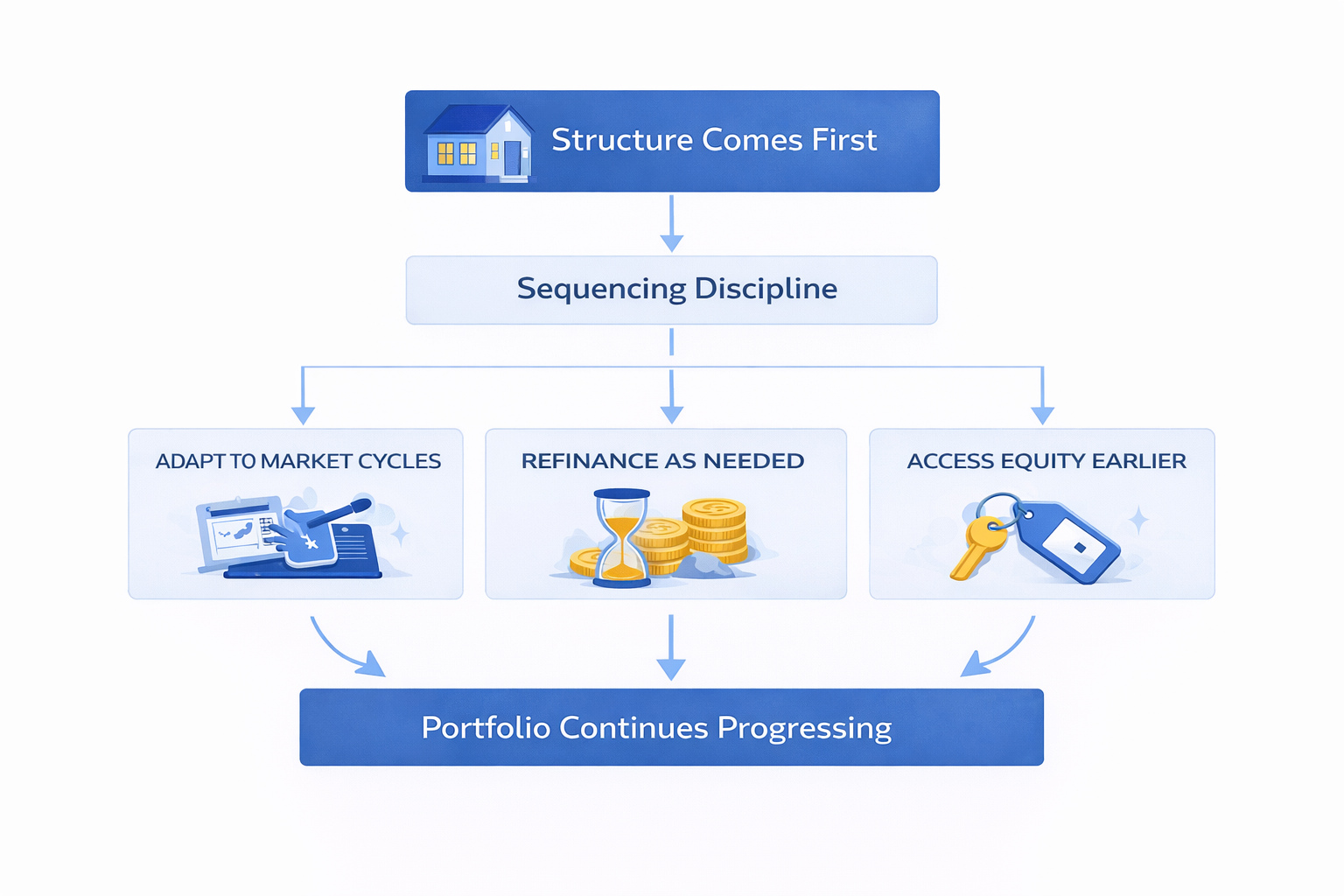
Market cycles will continue to evolve. Interest rates will adjust. Policy settings will tighten and loosen over time. Attempting to synchronise perfectly with these variables is inherently uncertain. Structural preparedness, however, remains controllable.
A portfolio designed with sequencing discipline can adapt to policy shifts and interest rate movements without compromising long-term direction. It retains the flexibility to refinance, release equity, or adjust exposure as conditions change. Portfolios lacking this design may struggle to progress even during favourable market phases.
In 2026, structural clarity provides more durable advantage than timing precision.
The Real Takeaway
Property portfolios rarely stall because of a single misstep. They stall because decisions were made without sufficient regard for how they would interact over time. Strategic sequencing ensures that acquisition, finance, and timing operate cohesively rather than independently.
When each decision is evaluated for its contribution to future flexibility, borrowing capacity becomes more durable, equity becomes more usable, and progression becomes more consistent. Momentum, in this context, is not accidental. It is engineered.
Asset quality, demand depth, rental resilience, and long-term growth drivers all influence how effectively a property supports serviceability and equity progression over time. If you are refining your criteria or evaluating future opportunities, our guide on How to Choose the Right Investment Property in 2026 outlines the fundamentals that underpin sustainable portfolio expansion in today’s lending environment.