

Does Property Value Always Equal Portfolio Progress?
For many investors, the first indicator of success in property is simple: the value of the asset. When a property appreciates, it feels like validation. Rising valuations confirm that the purchase was sound, the location was strong, and the market has moved in the right direction. Equity increases and confidence grows alongside it.
Yet property value and portfolio progress are not always the same thing.
An asset may increase significantly in price while doing very little to improve an investor’s ability to expand, refinance, or reposition their portfolio. The difference between perceived success and actual financial flexibility often lies in a gap that many investors only recognise once they attempt to take the next step.
In today’s lending environment, particularly in 2026 where serviceability modelling remains conservative and borrowing capacity is closely scrutinised, the true value of a property is not only measured by how much it is worth. It is also measured by what that value allows an investor to do next.
The difference between value and function
A property’s market value reflects what a buyer may be willing to pay at a specific point in time. While this figure is often used as a measure of success, it does not automatically indicate how effectively that asset contributes to long-term portfolio progression. From an investment perspective, value alone is only one dimension of performance. What ultimately matters is how that value interacts with the broader financial structure that supports the portfolio.
A more meaningful question is how the property functions within the lending framework that governs future borrowing decisions. Investors benefit from examining whether equity can be accessed without disrupting loan arrangements, whether rental income remains stable enough to support serviceability calculations, and whether the asset strengthens or constrains borrowing capacity. The functional role of a property therefore extends beyond its valuation and into the way it supports financial flexibility over time.
Two properties with similar valuations can behave very differently when assessed through a lender’s model. One may provide accessible equity and consistent income that supports additional borrowing, while another may appear valuable on paper yet contribute little toward expanding capacity. As portfolios grow and lending assessments become more complex, understanding the difference between property value and portfolio function becomes increasingly important for sustaining long-term progression.
Why rising valuations do not always translate into borrowing power

Many investors assume that capital growth will automatically translate into expanded opportunity. In practice, however, lenders assess much more than asset values when determining how much additional borrowing is possible.
As a result, a property that has experienced substantial capital appreciation may still contribute relatively little to borrowing capacity if its income profile is weak or inconsistent. The equity exists in theory, but accessing it safely requires the surrounding financial structure to support additional debt.
The quality and stability of rental income therefore become increasingly important. This is where effective Property Management plays a meaningful role, ensuring that rent remains aligned with market conditions, vacancies are minimised, and tenancy performance remains stable. Strong management helps protect the income profile that lenders rely on when assessing serviceability, allowing property value to translate more effectively into usable borrowing capacity.
This is often where investors encounter the unexpected gap between the value they see and the flexibility lenders recognise.
When equity becomes difficult to use
Equity is often described as one of the most powerful tools available to property investors. Yet equity is only useful when it is accessible and serviceable.
An asset may hold significant unrealised value, but if loan structures restrict refinancing pathways, if the lender already holds multiple securities, or if rental income does not comfortably support additional repayments under assessment rates, releasing that equity can become far more complex than expected.
In some cases, investors discover that while their portfolio appears strong on paper, the practical ability to convert that strength into new acquisitions is limited. The issue is rarely the value of the properties themselves. More often, it is the interaction between those assets, their financing arrangements, and the income they generate. The property may have grown in value, yet its functional contribution to the portfolio remains constrained.
A deeper understanding of how equity functions within a portfolio can help investors avoid this situation. As outlined in The Smart Investor’s Guide to Using Equity Property Investment, the ability to access equity effectively depends not only on property value but also on loan structure, serviceability strength, and lender positioning. When equity is approached strategically rather than reactively, it becomes easier to convert rising property values into usable capital that supports the next stage of portfolio growth.
The portfolio perspective lenders actually assess
Once an investor moves beyond a single property, lenders begin assessing the entire portfolio rather than evaluating each asset in isolation. At this stage, the interaction between properties becomes increasingly important, as financial institutions consider total debt exposure, income consistency, and how the portfolio performs collectively under serviceability models.
A property may show strong capital growth on paper, yet contribute less to borrowing capacity if rental income is modest or cash flow is inconsistent. From a lender’s perspective, stability often matters more than raw asset value. Predictable income, manageable liabilities, and flexible loan structures provide confidence that additional borrowing can be sustained over time.
This is where thoughtful financial structuring becomes particularly important. A well-designed finance strategy ensures that loan arrangements, lender selection, and debt sequencing work together to support long-term progression rather than inadvertently limiting it. Through our Finance service, investors can assess how their current portfolio performs under lender assessment models, identify opportunities to improve borrowing capacity, and restructure lending arrangements so that property performance translates into usable flexibility.
Designing portfolios around flexibility rather than valuation alone
Investors who maintain long-term momentum tend to view property through a broader lens than price appreciation alone. While capital growth remains important, experienced investors also consider how each asset functions within the wider financial structure of the portfolio. The focus gradually shifts from asking what a property may be worth in the future to understanding how it will support the next stage of portfolio progression.
Within this perspective, factors such as income stability, loan structure, and refinancing flexibility become increasingly important. Properties that generate reliable income and integrate well within the portfolio’s financing framework tend to strengthen borrowing capacity and long-term resilience. By balancing growth potential with financial flexibility, investors position each acquisition to support future opportunities rather than constrain them.
What investors should consider before their next move
For investors preparing to acquire another property, the most valuable step is often pausing to evaluate how existing assets are functioning within the broader portfolio. Expansion becomes far more effective when the current structure is clearly understood, because the performance of existing properties often determines the conditions under which the next purchase can occur.
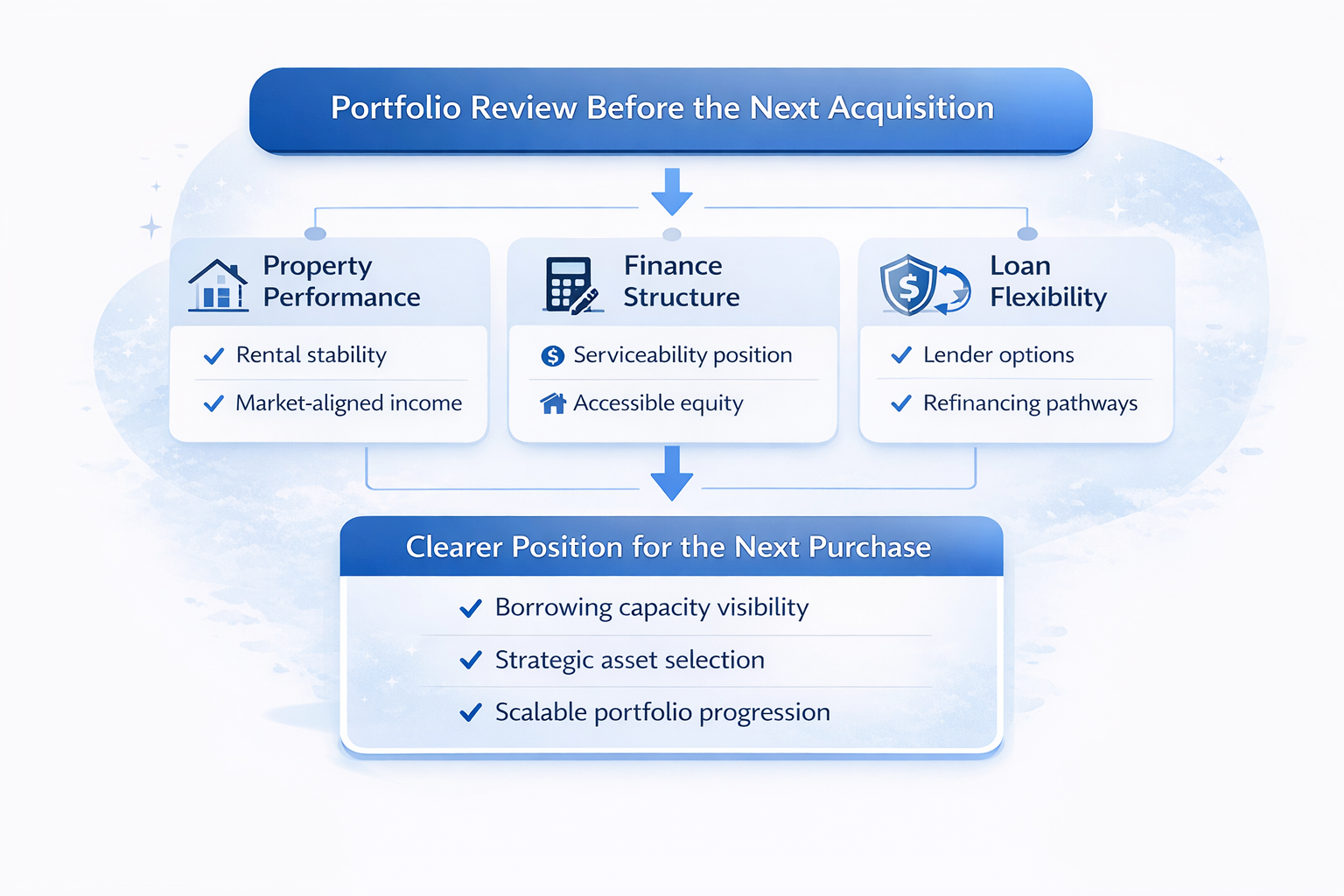
This review goes beyond property value alone. Investors benefit from assessing whether current assets support serviceability, whether rental income remains stable and aligned with market conditions, and whether loan structures allow equity to be accessed efficiently. In many cases, small adjustments such as refinancing, rental alignment, or structural changes can significantly improve borrowing capacity and unlock opportunities for the next acquisition.
This evaluation also connects closely with the balance between income and capital appreciation within a portfolio. As discussed in The Truth About Yield vs Growth and How Smart Investors Build Balanced Portfolios, long-term scalability rarely comes from pursuing growth alone. Assets that combine sustainable income with appreciation potential tend to support serviceability more effectively, creating the stability lenders look for when assessing future borrowing capacity. When investors review their portfolio through this lens, it becomes easier to identify whether the next acquisition should prioritise income durability, growth potential, or a more balanced combination of both.
What this means for long-term portfolio growth
Property value will always remain an important measure of investment success. Capital appreciation builds wealth over time and forms the foundation of long-term equity accumulation. However, value alone does not determine whether a portfolio can continue expanding.
In 2026’s lending environment, progression increasingly depends on income stability, structural flexibility, and the ability to convert equity into usable borrowing capacity. Properties that perform well within these dimensions strengthen portfolio momentum. Those that do not may still appreciate, yet contribute less toward future opportunities.
Understanding the distinction between value and function allows investors to view their portfolios more strategically. Instead of measuring success purely by price movements, they begin evaluating assets by the flexibility and resilience they create.
When this perspective guides decision-making, property investing becomes less about isolated wins and more about designing a portfolio capable of sustaining growth across changing market conditions.