
The Truth About Yield vs Growth and How Smart Investors Build Balanced Portfolios
One of the most frequently asked questions among Australian property investors is whether they should prioritise rental yield or capital growth. The question appears straightforward, but it often reflects a misunderstanding of how property portfolios actually scale over time.
Framing yield and growth as opposing choices oversimplifies the issue. In practice, long-term portfolio performance depends not on choosing one over the other, but on understanding how both interact within the constraints of borrowing capacity, serviceability, and lending policy. In 2026, where assessment rates are higher and credit conditions are more selective, this balance has become increasingly important.
A portfolio that leans too heavily toward either yield or growth can appear sound in isolation while quietly restricting future progression. The objective is not to win a debate between income and appreciation. It is to design a structure where each property contributes to both stability and scalability.
Defining Yield and Growth in Practical Terms
Rental yield represents the income a property generates relative to its value. It directly influences cash flow, out-of-pocket holding costs, and lender serviceability calculations. Strong yield can reduce financial pressure and support borrowing capacity, particularly in the early stages of portfolio construction.
Capital growth, by contrast, represents the increase in a property’s value over time. Growth builds equity, and equity underpins long-term portfolio expansion. Without sufficient growth, the ability to leverage accumulated value into subsequent acquisitions becomes constrained.
Yield influences short- to medium-term comfort. Growth determines long-term capacity. Both play distinct but interconnected roles within a well-structured portfolio.
Why Chasing Growth Alone Can Hold You Back
Properties selected primarily for capital growth often exist in tightly held, premium locations where rental yields are comparatively lower. While these assets may appreciate strongly over extended periods, their lower income profile can increase holding costs and place pressure on serviceability.
In a more accommodative lending environment, this imbalance may have been manageable. However, in 2026, lenders scrutinise income buffers and debt-to-income ratios more closely. A property that grows in value but restricts borrowing capacity may slow portfolio progression despite appearing successful on paper.
Many investors encounter this constraint after their first or second acquisition. Equity accumulates, yet serviceability limits prevent further borrowing. The portfolio grows in value but stalls in momentum. Growth alone, without regard to cash flow sustainability, can therefore create structural limitations.

The Risks of Pursuing Yield in Isolation
Conversely, prioritising high yield without regard for long-term growth drivers introduces a different form of constraint. Properties with elevated rental returns often exist in markets where supply is abundant or long-term demand drivers are less robust. While cash flow may feel comfortable initially, limited capital appreciation can restrict equity formation.
Without meaningful equity growth, portfolio expansion slows. Investors may maintain stable cash flow but lack the capital base required to scale. Yield provides stability, but stability alone does not create acceleration.
In this sense, a yield-only approach may reduce short-term pressure while limiting long-term opportunity. Sustainable wealth creation requires more than income efficiency; it requires compounding asset value over time
Balance as a Portfolio Design Principle
The most resilient portfolios are built on balance rather than extremes. This balance does not imply that every property must produce identical yield and growth characteristics. Instead, it reflects a deliberate sequencing strategy in which each acquisition supports the broader portfolio objective.
Early-stage investors may prioritise properties that preserve serviceability and minimise financial strain. As equity accumulates and income buffers strengthen, later acquisitions may tolerate lower yield in exchange for stronger long-term growth prospects. What matters is alignment between asset selection, borrowing capacity, and progression planning.
Each property should be assessed not only on its standalone metrics, but on how it contributes to the portfolio’s cumulative performance. Cash flow protection, equity creation, and borrowing flexibility must operate in tandem.
Ongoing performance does not end at acquisition. Even a well-balanced portfolio depends on disciplined execution after purchase. At FPW, our approach extends beyond strategy and selection to ensuring assets are professionally managed so rental performance, tenant retention, and compliance remain aligned with long-term objectives. Effective property management preserves the balance you design, protecting cash flow while supporting continued portfolio progression.
As equity builds and borrowing capacity evolves, understanding how to strategically access and deploy that equity becomes critical. If you want a deeper look at how this works in practice, read How to Use Equity to Build a Property Portfolio in Australia.
The Influence of Finance Structure
Yield and growth do not operate independently of lending structure. Loan configuration, offset arrangements, repayment strategy, and lender selection all influence how a property’s financial characteristics translate into real-world outcomes.
An asset with balanced fundamentals can become restrictive if structured poorly. Conversely, thoughtful finance design can enhance the performance of otherwise moderate assets. In the current lending environment, structure is not secondary to asset selection; it is integral to it.
Understanding how income, debt, and asset performance interact within lender policy frameworks is essential. The objective is not merely to purchase property, but to maintain flexibility across multiple acquisition cycles.
Our finance strategy at FPW is designed around borrowing capacity mapping, long-term flexibility, and lending structures that grow with you. We do not simply secure a loan. We build a finance plan that aligns yield, growth, and future acquisitions into one cohesive framework, so your portfolio remains scalable rather than restrictive.
How Yield and Growth Evolve Over Time
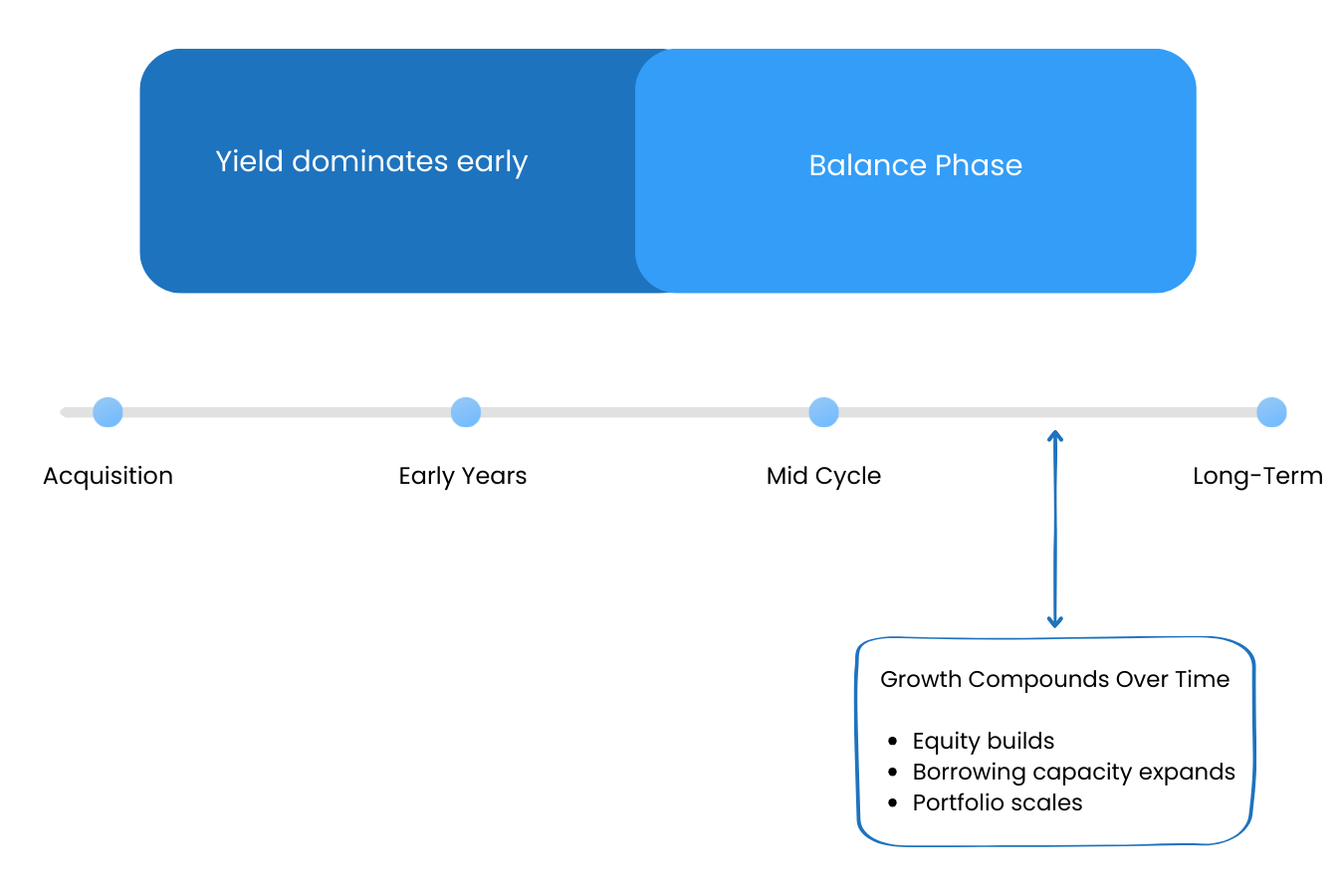
Importantly, yield and growth are not static variables. Rental income can increase over time, improving serviceability and reducing net holding costs. A property that begins with moderate yield may become increasingly supportive of cash flow as rents adjust to market conditions.
Similarly, growth compounds across market cycles. Equity built in earlier years may later fund additional purchases, amplifying overall portfolio scale. Effective investors anticipate this progression rather than expecting each property to achieve every objective immediately.
Sequencing, therefore, is as important as selection. A portfolio designed with time as a structural element is more likely to sustain momentum than one built around isolated metrics.
A Comparative Illustration
Consider two investors purchasing assets at similar price points. The first selects a premium, low-yield property in a tightly held location. Over five years, capital growth is solid, but cash flow strain restricts borrowing capacity, preventing further acquisitions.
The second selects a property with slightly stronger yield and sound growth fundamentals. Cash flow remains manageable, equity builds steadily, and serviceability is preserved. Within the same timeframe, this investor acquires a second asset, compounding overall exposure.
The divergence between outcomes is not driven by luck or timing, but by structural balance. Over longer horizons, disciplined balance compounds in ways that isolated performance metrics do not.
A Structured Perspective for 2026
In the current market environment, the yield versus growth discussion should not be treated as a debate. It is a portfolio design consideration shaped by borrowing capacity, long-term objectives, and risk tolerance.
Successful investors recognise that yield protects stability while growth expands opportunity. Overemphasis on either dimension can introduce friction into portfolio scalability. Balance, supported by appropriate finance structure and disciplined sequencing, enables progression across multiple acquisitions.
In 2026, where lending constraints are tighter and margin for structural error is narrower, clarity around this balance becomes even more important. The goal is not to chase the highest percentage return in a single metric. It is to construct a portfolio capable of sustaining momentum across cycles.
For investors seeking clarity on whether their current portfolio structure supports long-term scalability, a structured review is often the most valuable next step. Understanding how your yield, growth profile, and lending framework interact provides a clearer path forward. If you would like to assess whether your current strategy is positioned for sustained progression in 2026 and beyond, Book a Strategy Call and gain objective insight into your next move.