

Borrowing Capacity Formula Australia: How Lenders Calculate Your Limit
Most people preparing for a home loan ask one question: how much do I earn? Lenders ask a sharper one. They want to know whether your income, after every commitment and a built-in interest rate stress test, leaves enough room to repay a new loan safely.
That gap between what you earn and what a bank will approve is where the borrowing capacity formula Australia uses does its work. It is not a single sum. It is a layered assessment of income, expenses, existing debts, a regulatory buffer, and your debt to income ratio. Understanding each layer gives you a real edge before you speak to a lender, and it explains why two banks can look at the same borrower and offer very different numbers.
How Is Your Borrowing Capacity Calculated?
At its core, borrowing capacity answers a single question. What is the largest loan where your repayments, tested at a higher rate, still sit within an acceptable share of your income after expenses?
Australian lenders reach that number through four steps. They apply a debt service ratio cap to your gross income. They subtract your existing repayments and declared living expenses. They add the APRA serviceability buffer to the assessment rate. Then they reverse the loan repayment formula to find the largest principal you can support.
The output is your maximum borrowing under that lender's policy. Because each bank sets its own ratios and treats income types differently, the same applicant can receive offers that differ by six figures.
The Borrowing Capacity Formula Australia Lenders Use
The formula is layered, and each layer strips away part of what your income could theoretically support. Working through it in order shows where most borrowing power is lost.
Step one, the debt service ratio. Most lenders cap total debt repayments at 30 to 35 per cent of gross annual income. On $120,000, that ceiling is roughly $36,000 to $42,000 a year. Everything that follows decides how much of that ceiling is already spoken for.
Step two, existing commitments and living expenses. Lenders deduct current loan repayments, minimum credit card repayments (counted as about 3 per cent of your total limit each month, not your balance), HECS or HELP repayments, and declared living costs. Those costs are checked against the Household Expenditure Measure, a benchmark drawn from ABS spending data. Declare less than the benchmark and most lenders simply use the higher figure instead.
Step three, the serviceability buffer. APRA requires lenders to assess every new loan at a rate at least 3 percentage points above the actual product rate. A 6.0 per cent loan is tested at 9.0 per cent, and the maximum loan is based on what you can afford at that stressed rate, not the rate you pay.
Step four, the reverse repayment formula. Once the available monthly repayment at the stressed rate is known, lenders run the standard loan formula backwards to find the largest principal that repayment can support across the loan term.
Where a Borrower's Monthly Income Actually Goes
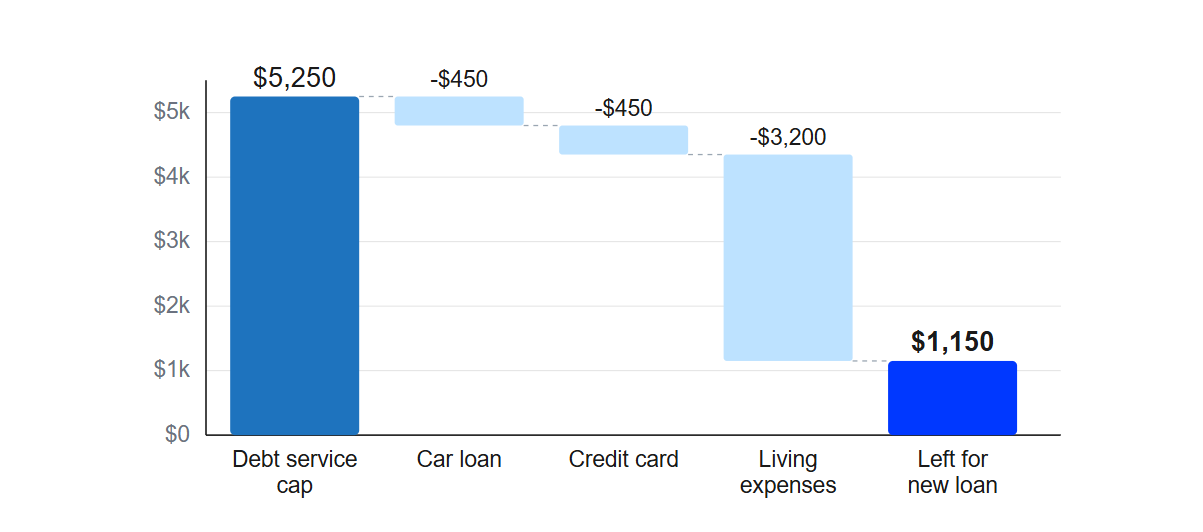
Source: MoneySmart, borrowing power and household expenses, 2026.
What Determines Your Borrowing Capacity?
The formula shows exactly which inputs move the result most. Five carry the most weight, and most of them are within your control.
Interest rates set the stress test. Every 0.5 per cent rise in the assessment rate trims capacity by roughly $20,000 to $50,000, depending on income. As rates fall, capacity rises, though the 3 per cent buffer limits how much of that relief reaches you.
Credit card limits cost more than people expect. Lenders count about 3 per cent of your total limit each month as a commitment, whatever your balance. A $30,000 limit quietly removes around $900 a month from your assessed capacity, so trimming unused cards is one of the fastest adjustments available.
Living expenses are benchmarked, not taken on trust. If your declared spending falls below the HEM figure, the lender uses the benchmark instead. Understating costs does not help, and overstating them only hurts, so accurate records matter most.
Income type changes how much actually counts. Base salary is assessed in full. Rental income is usually shaded to 80 per cent, overtime and bonuses to between 50 and 80 per cent, and self-employed income is averaged over two years.
How Much of Each Income Type Lenders Count
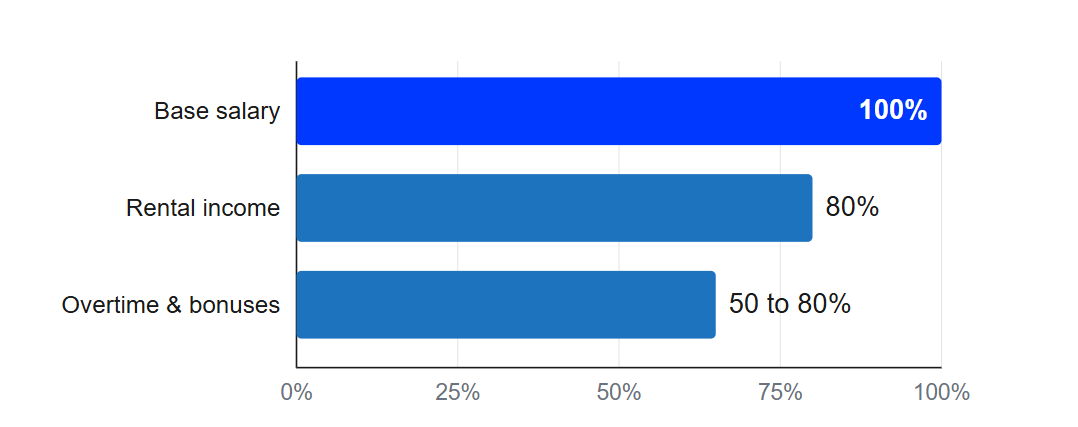
Source: APRA serviceability guidance, 2026.
Loan term shapes the result as well. A 30-year term spreads repayments across more months, which supports a larger principal than a 25-year term at the same monthly figure.
Most of these levers take weeks to move, not minutes, and the right order depends on your full position rather than any single number.
What Is Your Maximum Borrowing Capacity?
Passing the serviceability formula is not the end of the assessment. Since 1 February 2026, a second limit sits beside it, and for a growing number of borrowers it is the one that binds first.
APRA's debt to income rules cap how much a lender can write to borrowers whose total debt reaches six times their gross income, at no more than 20 per cent of new lending. The cap applies separately to owner-occupier and investor loans. In practice, your maximum borrowing capacity is the lower of two numbers: what serviceability allows, and what the debt to income cap allows. Both have to be satisfied at once.
Two Tests, One Limit: Serviceability Against the DTI Cap
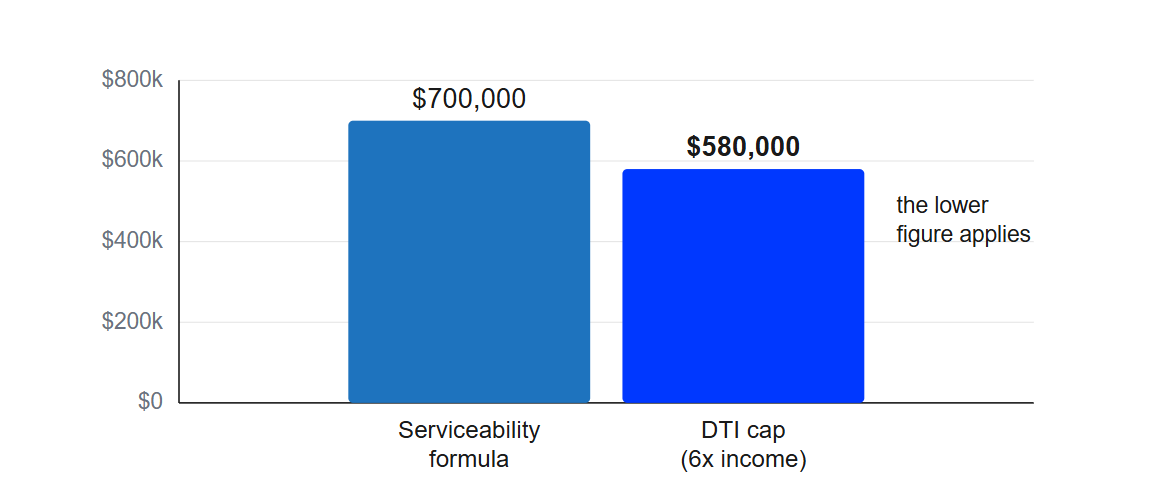
Source: APRA debt to income lending limits, 2026.
Common Borrowing Capacity Calculator Limitations
Online borrowing calculators are handy for a rough estimate, but they are not an approval, and the gap between the two can be wide. Most rely on simplified assumptions that no lender uses.
They rarely apply the Household Expenditure Measure, so they accept whatever spending figure you type in. They often ignore that lenders count 3 per cent of your full credit card limit rather than your balance. Few apply a specific lender's debt service ratio, and most use one generic buffer instead of the assessment rate a particular bank would apply.
The bigger blind spot is the debt-to-income cap. A calculator can return a figure that serviceability supports while ignoring the six times income ceiling that now binds many borrowers. For a clearer read on that side of the equation, a dedicated debt-to-income ratio calculator gives a more honest number.
How the Borrowing Capacity Formula Changes for Investors
For investors, the borrowing capacity formula compounds with every purchase. Each new property adds debt counted in full, while the rental income behind it is shaded. The debt-to-income cap then tightens with each acquisition.
An investor sitting at a debt-to-income ratio of 4.5 across two properties can find it climbs to 6.8 by the third, which pushes them into the restricted band of APRA's cap. The formula that approved the first two loans does not simply scale to the third. Income growth, debt reduction, or a different lender becomes necessary to keep moving. Working out how to increase borrowing capacity early is often what decides whether a portfolio stalls at two properties or keeps growing.
Final Thoughts
The borrowing capacity formula is not a fixed ceiling. It is the output of inputs you can shape: your credit limits, how your income is documented, your existing debts, and the timing of your application. Borrowers who prepare those inputs consistently access more than those who walk in cold.
The most useful move is knowing your real position before you apply, including which of the two limits, serviceability or debt to income, binds first. That clarity decides whether your effort is best spent on income, deposit, or debt, and it turns a borrowing figure from a guess into a plan.
Frequently Asked Questions
Recommended Reading
Two pages selected based on what readers of this article are most likely to need next.
Watch: The Real Reason Most Investors Get Stuck at One Property
Refinancing is no longer about chasing a lower rate, it’s about building wealth, structuring smarter, and making your portfolio work harder every single year.