

How to Get Approved for a Home Loan (2026 Guide)
Most people think the hard part of how to get approved for a home loan is filling in the application. It’s not. Approval is decided long before that, in the way a lender models your income, debts, and spending against a stress-tested interest rate.
This means that two applicants on the same salary can walk away with borrowing limits that differ by a hundred thousand dollars or more, simply because one prepared and the other did not.
In 2026, with the cash rate held at 4.35% and lenders assessing every loan at roughly 9.25%, the gap between what you earn and what a bank will lend has widened. The encouraging part is that most of the levers that move borrowing capacity are inside your control. This guide shows you how to increase your borrowing capacity before you apply.
What Lenders Actually Assess Before They Approve a Home Loan
Approval is not a single yes or no. It is a serviceability calculation, and five inputs drive it. Get these in shape and the rest of the application tends to follow.
Income and employment stability
Lenders want income they can rely on. Permanent salaried roles are treated most generously. Casual, contract, and self-employed income is often shaded down or averaged over two years, and overtime or bonuses may be counted at only fifty to eighty per cent.
Existing debts and financial commitments
Every active debt reduces what you can borrow. A car loan, a personal loan, or a buy now pay later account does not just cost its monthly repayment. It lowers the surplus a lender can see, and surplus is the part of your income that services a mortgage.
Credit history and living expenses
Your credit file shows repayment behaviour and current limits. Lenders also estimate your living costs using the Household Expenditure Measure, or HEM, a benchmark of typical household spending. If your real spending runs higher than the benchmark, the higher figure is what counts against you.
Deposit and loan-to-value ratio
A larger deposit lowers your loan-to-value ratio, which is the size of the loan measured against the property value. Below 80% you usually avoid lenders mortgage insurance, which widens your lender choices and can sharpen the rate you are offered.
Why Borrowing Capacity Decides Your Home Loan Approval
Here is the part most bank guides skip. You are not assessed at the rate you will actually pay. You are assessed at a much higher one, and that single rule reshapes everything.
The 3% serviceability buffer
Under APRA rules, lenders must test your repayments at your actual rate plus three percentage points. With variable rates near 6.25%, that means your loan is assessed as though you were paying about 9.25%. The buffer has stayed at 3% through 2026 even as the RBA held the cash rate at 4.35%.
How the 3% buffer reshapes borrowing capacity
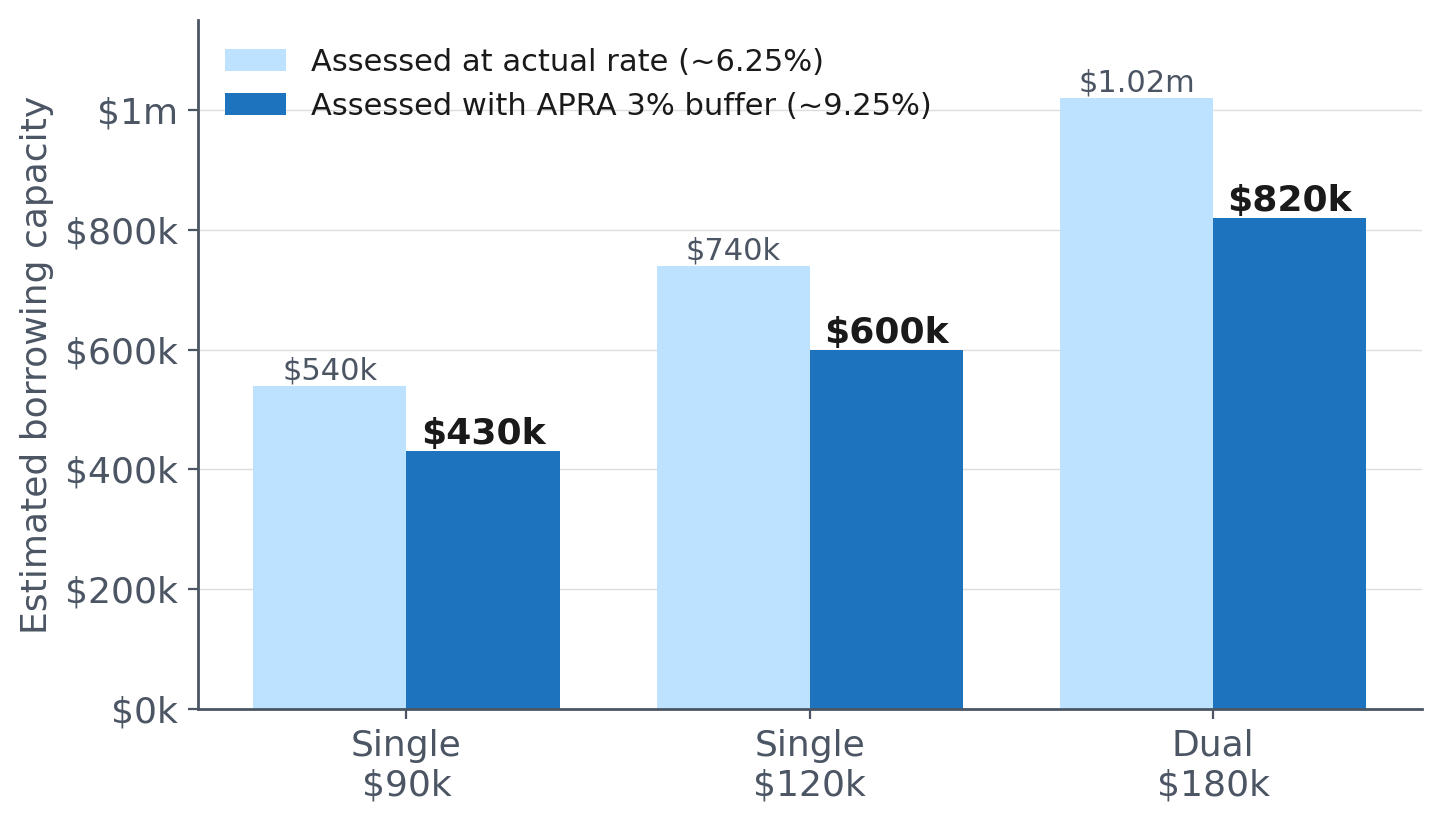
Source: APRA macroprudential settings, 2026. Modelled illustration.
From income to approved loan
It helps to see borrowing capacity as a figure that is built down, not up. A lender starts from what your income could theoretically support, then subtracts living expenses, existing debts, and the buffer effect. What is left is your real number.
How a $120,000 household's approved loan is built down
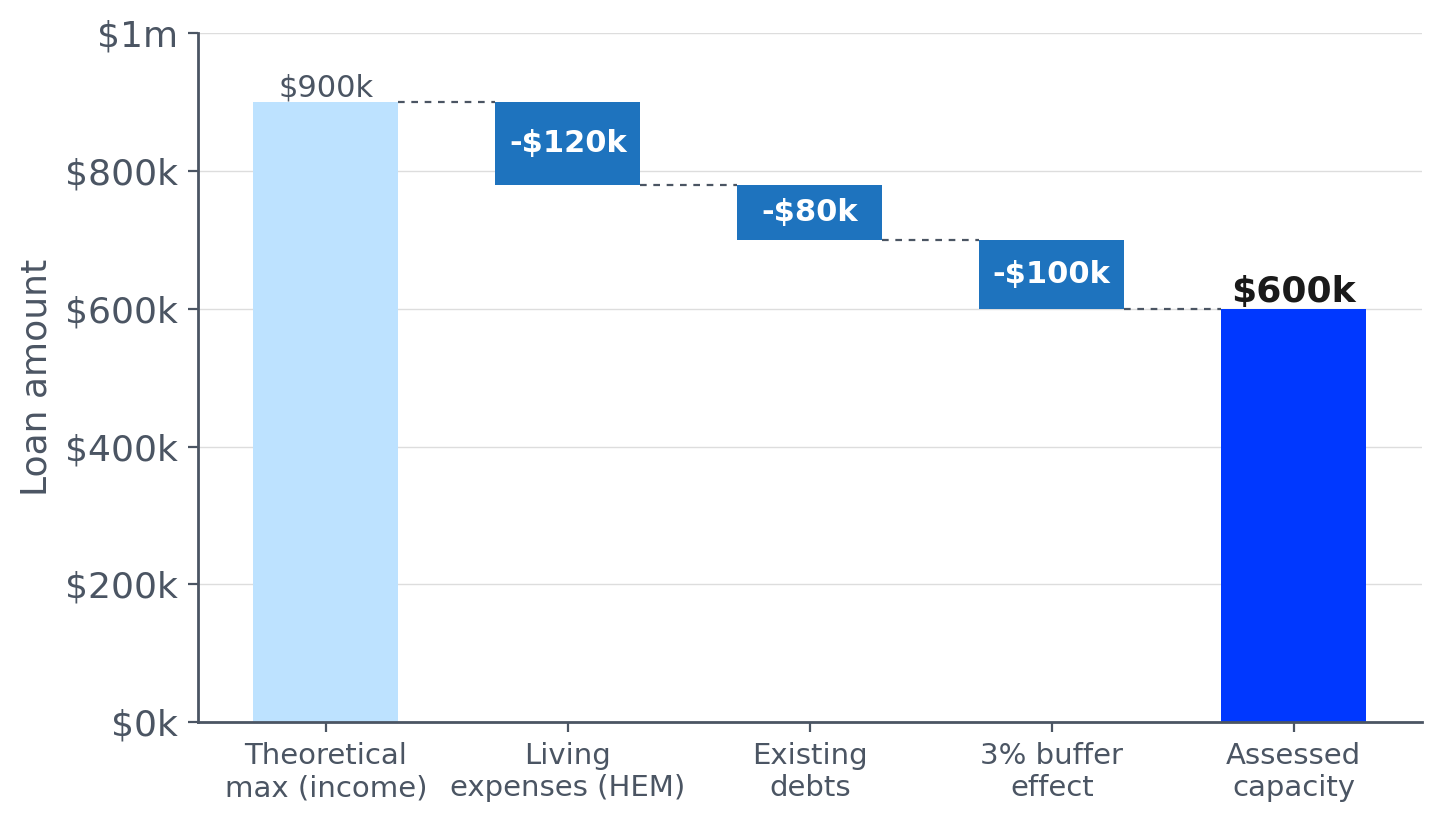
Source: MoneySmart home loans, 2026. Modelled illustration.
How debt-to-income limits cap your loan
From February 2026, APRA limited banks to writing no more than 20% of new loans to borrowers with a debt-to-income ratio of six or higher. A DTI of six means total debt equal to six times your gross income. For many applicants this now acts as a second ceiling, sitting alongside the buffer rather than replacing it.
FOR EXAMPLE
On a $120,000 income, a six times DTI cap puts a practical ceiling near $720,000. In most cases the buffer bites first, landing the real approved figure closer to $600,000 once living costs and a modest debt load are counted.
10 Ways to Increase Your Borrowing Capacity Before You Apply
This is where preparation pays. The actions below are ordered roughly by how much they tend to move the needle. None of them require a higher salary, and most can be done in a single afternoon.
Reduce existing debts. Closing a car or personal loan removes a fixed repayment and frees serviceability straight away. In practice, paying out a small loan often lifts borrowing power by more than the balance you cleared.
Lower your credit card limits. Lenders assess the full limit, not the balance, usually at around 3.8% a month. A $20,000 limit can cost tens of thousands in borrowing power even when you owe nothing on it.
Clear buy now pay later accounts. These are read as recurring commitments and can signal tight cash flow. Closing them is quick and shows clearly on your file.
Increase verifiable income. A documented pay rise, a second income, or consistent overtime all help. The key word is verifiable, because only income a lender can evidence is counted.
Improve your debt-to-income ratio. Lower total debt or higher income both pull your DTI down and away from the six times cap that now constrains larger loans.
Trim discretionary spending. Lenders review three to six months of statements. A tidier spending record lowers the living expense figure used against you.
Build genuine savings. Regular, retained savings show discipline and often satisfy a lender's genuine savings requirement, which sits separate from your deposit.
Tidy your credit profile. Check your report, correct any errors, and avoid late payments in the months before applying.
Avoid new credit before applying. Every application leaves an enquiry and can dent your score at the worst possible time. Apply for your mortgage after other credit moves, not during them.
Work with an experienced mortgage broker. Servicing models vary widely between lenders, and the right match can mean a materially larger approval for the same financial position.
The first two on that list deserve a closer look, because they catch people out the most. Clearing an existing debt and cutting a credit card limit tend to deliver the biggest single gains, and neither asks you to earn more.
A loan repayment is subtracted from your income in full before a lender works out what is left to service a mortgage. Pay out a $15,000 car loan running at around $400 a month and that entire figure flows back into your serviceability. A pay rise of similar value rarely does as much, because income is taxed and often shaded down before it is counted.
Credit card limits work on a quieter logic. Lenders assess the whole limit, not your balance, usually at about 3.8 per cent a month, so a $20,000 limit reads as roughly $760 of monthly commitment even when the card sits at zero. Trimming or closing it removes a repayment you were never actually making.
Which actions lift borrowing power the most
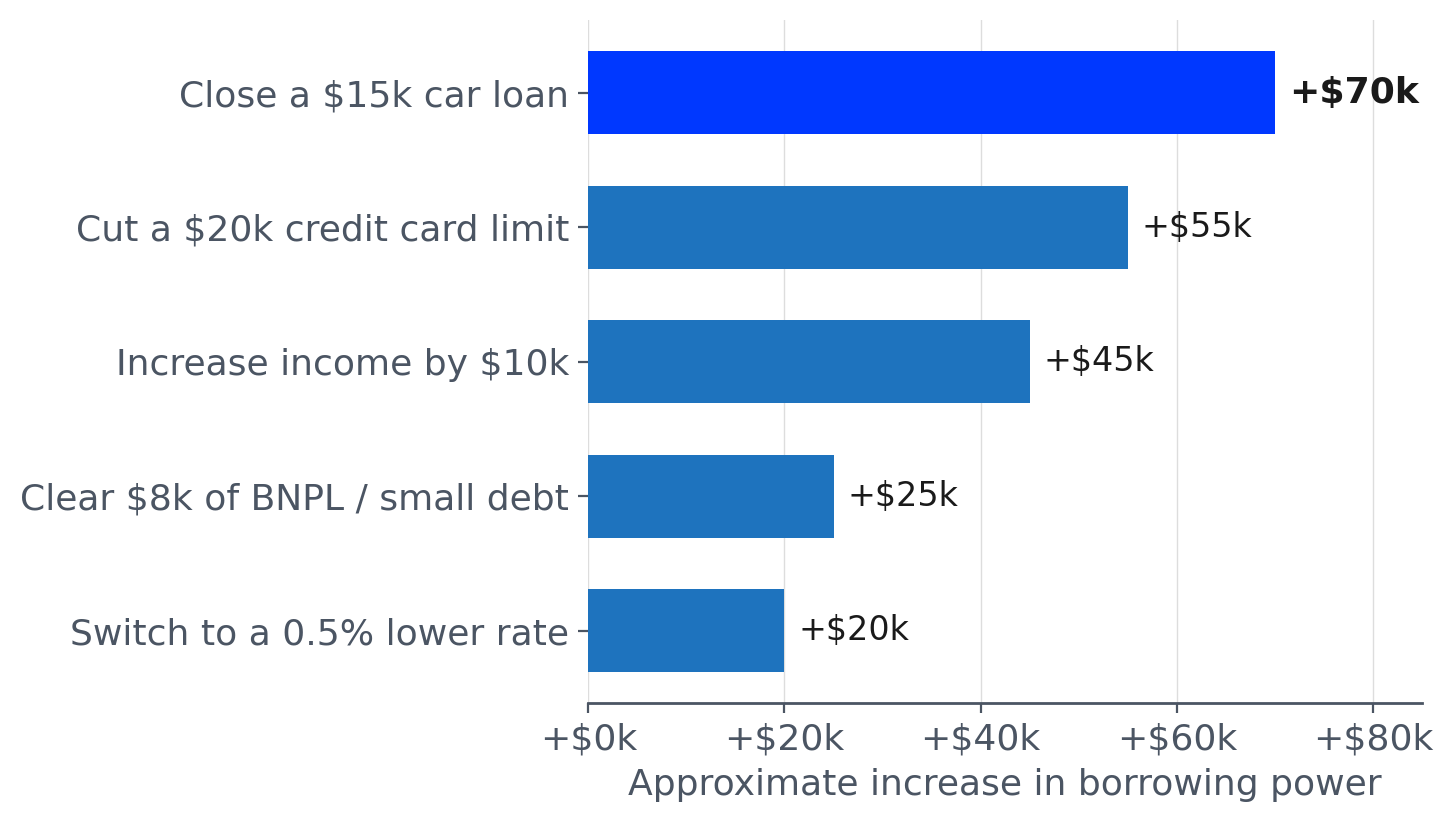
Source: MoneySmart mortgage calculator, 2026. Modelled illustration.
Rate matters, and that’s not only for repayments. Because every loan is assessed at your rate plus the buffer, which means a sharper rate quietly lifts the ceiling on what you can borrow.
The effect is larger for bigger loans, which is why lender selection is part of the strategy, not an afterthought.
How a lower rate lifts your borrowing ceiling
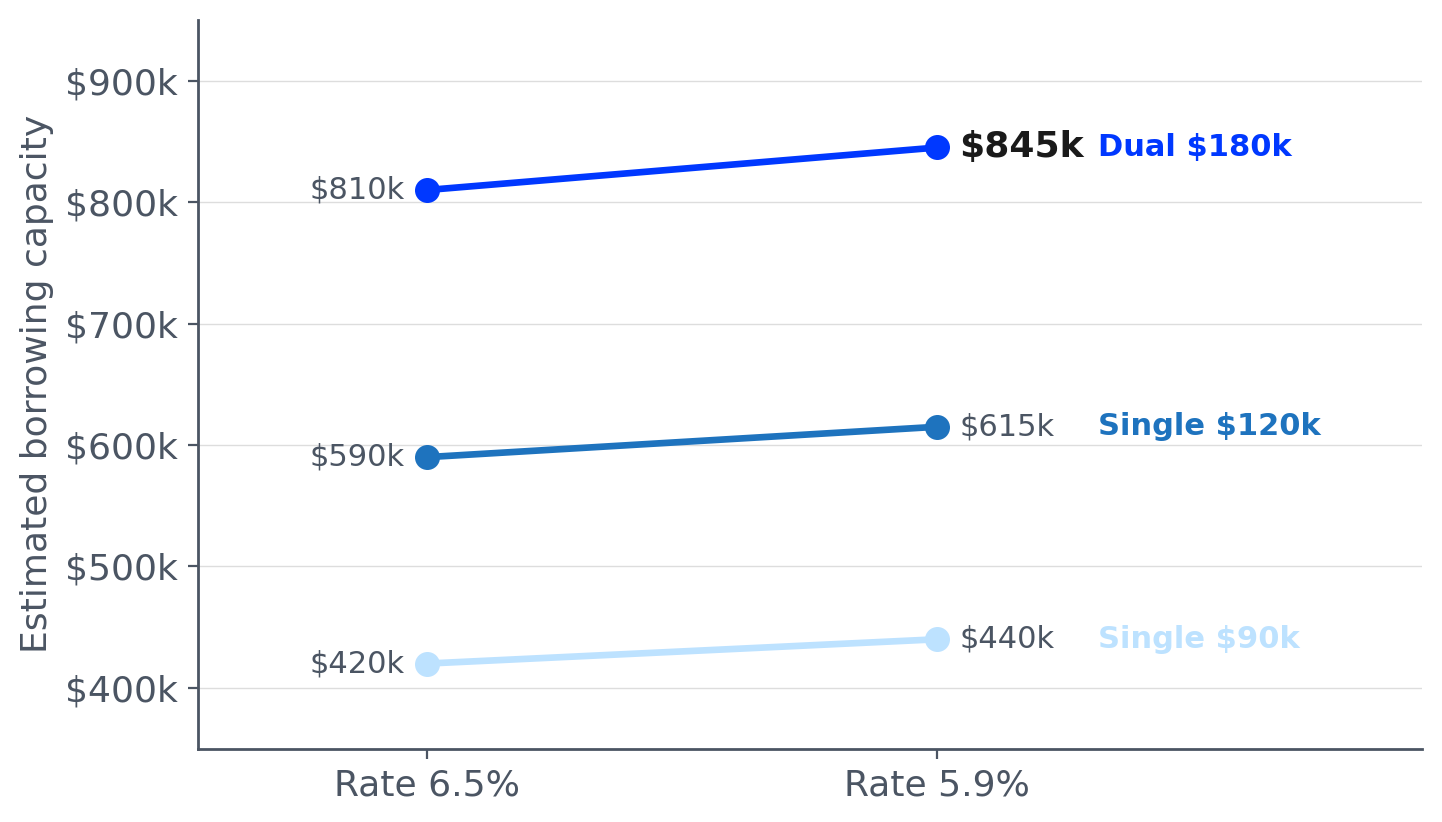
Source: RBA cash rate statistics, 2026. Modelled illustration.
Common Reasons Home Loan Applications Get Rejected
Most declines trace back to a short list: high existing debt, a thin or blemished credit history, unstable or unverifiable income, too small a deposit, and living expenses that outpace what was declared. Each one is fixable with time.
The pattern brokers see most often is not low income. It is good income carrying too much short-term debt. Investors planning their next investment property purchase meet the same math, only repeated at each stage as borrowing capacity tightens.
Final Thoughts
Knowing how to get approved for a home loan comes down to one shift in thinking. Stop asking what you earn and start asking what a lender can count. The buffer, your debts, your credit limits, and your spending all sit between your salary and your approval, and each one is something you can move.
Borrowers who treat the months before an application as preparation, not paperwork, consistently land larger approvals than those who apply cold. The system is strict, but it is also predictable. Work the levers that matter, get your file in order, and the approval tends to follow. If you want to know your real number before you apply, the next step is a conversation rather than a guess.
Frequently Asked Questions
Recommended Reading
Two pages selected based on what readers of this article are most likely to need next.
Recommended Video
While many investors spend time researching growth areas and property types, this discussion highlights a different reality, your ability to continue investing is often determined not by what you buy, but by how your loans are structured and how your borrowing power is managed over time.