

The Overlooked Risk Inside Expanding Property Portfolios
Why Income Stability Quietly Determines Whether Investors Can Keep Moving
For many property investors, portfolio performance is usually measured by visible indicators. Rising valuations, growing equity, and the addition of new properties create the impression that momentum is building. When property values increase, it often feels like confirmation that the strategy is working.
However, portfolio strength is not determined by price movements alone.
Behind the visible growth of many portfolios sits a quieter variable that often determines whether expansion can continue: the stability of income across the assets themselves. In 2026, lenders are less concerned with how much a property is worth in isolation and far more focused on how consistently that property supports the financial obligations attached to it.
A portfolio may appear stronger on paper every year while simultaneously becoming harder to expand. This usually occurs when income becomes uneven, unpredictable, or misaligned with lender expectations.
Income volatility rarely creates immediate alarm. Instead, it slowly reduces flexibility.
Why instability is often overlooked
Income volatility is rarely discussed with the same urgency as capital growth or loan structure. Many investors consider fluctuations in rental income to be part of normal ownership. A short vacancy period, a delayed lease renewal, or a modest rent increase that falls behind the market may appear insignificant in isolation.
The difficulty is that lenders do not evaluate portfolios based on isolated events.
They assess patterns of stability. Their models are designed to determine whether income is durable enough to support debt obligations under conservative scenarios. When small inconsistencies appear across multiple assets, those patterns begin to influence how lenders assess risk.
A portfolio that feels comfortable to the investor may appear less reliable through the lens of lending models. This is why volatility can become a structural issue long before it feels like a financial problem.
The subtle ways volatility enters a portfolio
Income volatility rarely arrives in dramatic forms. Most portfolios experience it through quieter, cumulative shifts.
One common source is rental misalignment. Properties that remain tenanted but sit below market rent gradually weaken the income base supporting the portfolio. Over time, the gap between potential and actual income can become material.
Another source is timing disruption. Lease transitions, short vacancies, or tenant turnover can introduce irregularity into otherwise stable cash flow patterns. When this occurs across several properties, income consistency becomes harder to demonstrate.
Maintenance volatility also plays a role. When repairs are reactive rather than planned, unexpected costs distort the financial rhythm of the portfolio. Investors often absorb these fluctuations personally, but lenders observe the broader pattern of unpredictability.
This is where structured oversight becomes valuable. Effective Property Management ensures that rent remains aligned with market conditions, vacancies are minimised, and tenancy performance stays consistent. When income reliability is actively managed rather than passively observed, the financial foundation of the portfolio becomes significantly stronger.
Why lenders care more than investors expect
Many investors evaluate success through asset growth. If a property appreciates and tenants are paying rent, the investment appears healthy. However, lenders interpret portfolio performance through a different lens.
Their primary concern is not the current value of the assets but the reliability of the income supporting the associated debt. Income is typically shaded, interest rates are stress-tested above current levels, and liabilities are assessed collectively across the entire portfolio. Even modest instability can influence the outcome of these calculations.
This is why two portfolios with similar asset values can behave very differently when an investor attempts to expand. The difference often lies in income durability rather than property price.
When equity exists but progress slows
One of the most confusing experiences for investors occurs when property values rise yet borrowing flexibility becomes tighter. Equity appears available, but accessing it becomes more complicated than expected.
In many cases, the issue is not the value of the property itself. Instead, it is the relationship between that value, the income supporting it, and the financing structure attached to the asset.
An investor may hold several appreciating properties, yet the portfolio’s income profile may not comfortably support additional lending under stress-tested conditions. From the investor’s perspective, the portfolio feels successful. From the lender’s perspective, the margin of safety may appear narrower.
This disconnect is explored further in Does Property Value Always Equal Portfolio Progress?, where we examine why property appreciation does not always translate into borrowing flexibility.
The structural moment many investors underestimate
Income stability becomes particularly important once investors move beyond a single property. With only one asset, serviceability assessments remain relatively simple. Personal income carries most of the weight, and rental income plays a supplementary role.
Once a second property enters the portfolio, the equation changes.
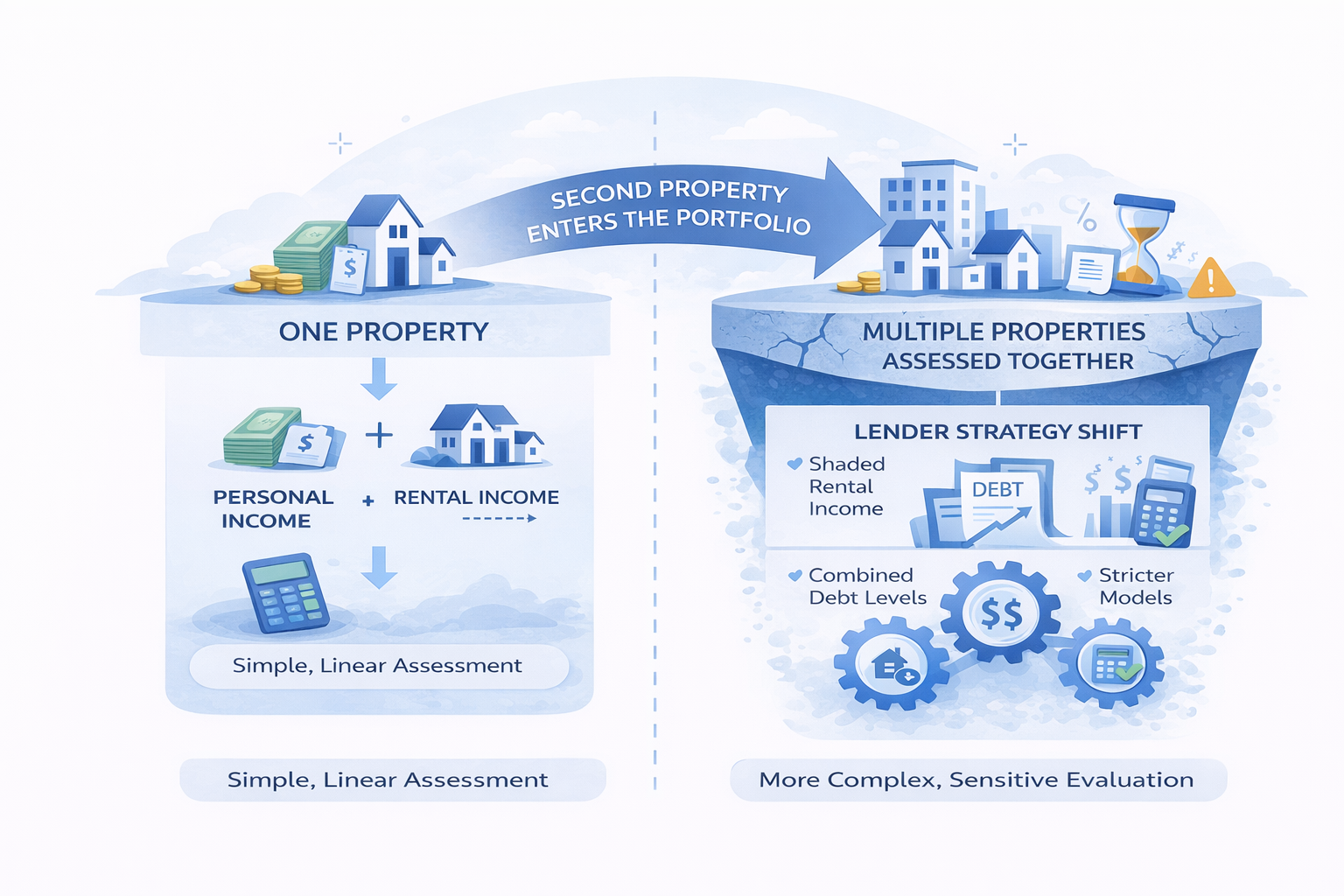
Lenders begin assessing the entire structure rather than a single asset. Rental income from multiple properties is shaded, debt exposure compounds, and serviceability becomes more sensitive to variability. This shift often catches investors by surprise because the financial modelling no longer scales in a linear way.
The structural significance of this transition is explored in Why the Second Property Often Determines the Future of Your Portfolio, where we examine how early portfolio decisions influence long-term borrowing flexibility.
Designing portfolios for income durability
Investors who maintain long-term momentum tend to approach property ownership differently. Rather than focusing exclusively on future valuations, they also consider how each asset contributes to the reliability of the portfolio’s income base.
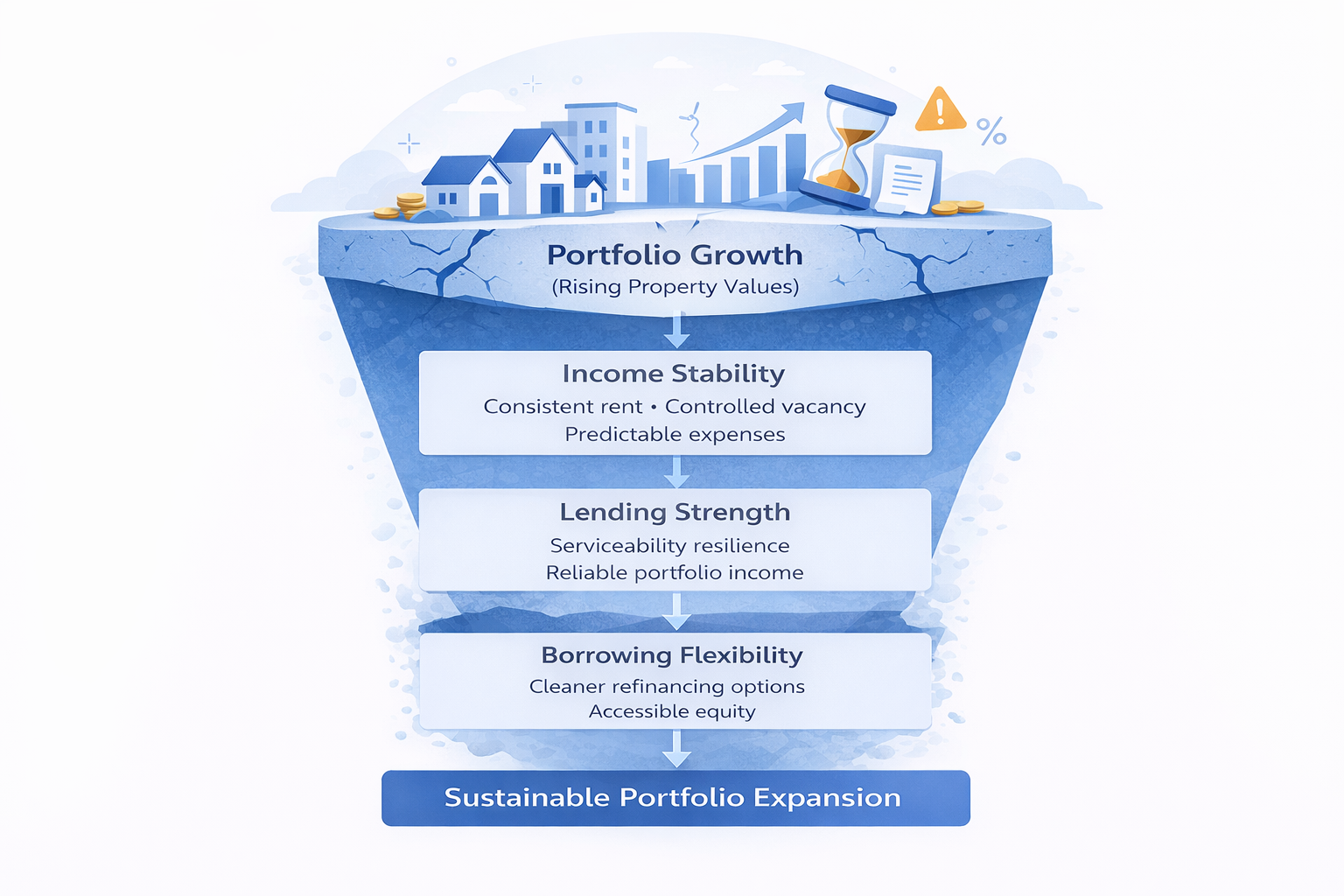
Stable rental performance strengthens serviceability, predictable expenses improve financial clarity, and well-structured loans preserve refinancing flexibility. Together, these elements create a portfolio that lenders view as durable rather than fragile.
This does not mean volatility disappears entirely. Markets shift, tenants change, and properties require ongoing care. What matters is whether the portfolio’s structure can absorb those disruptions without restricting future opportunities.
For this reason, income durability becomes one of the clearest indicators of structural strength within a growing portfolio.
When progress begins to slow
When investors feel that expansion has become more difficult, the instinct is often to attribute the change to external factors. Interest rates may have increased, lending policy may have tightened, or borrowing limits may appear less generous than in previous years.
While these factors certainly influence the environment, they rarely explain the full picture.
More often, the underlying cause lies within the portfolio itself. Income may have drifted below market levels. Loan structures may have become less flexible. Expenses may have become more unpredictable. None of these changes create immediate disruption, but collectively they can reduce borrowing efficiency.
Understanding this dynamic often requires stepping back and reviewing how the portfolio functions as a system rather than evaluating each property individually.
Investors who want a clearer view of this interaction often benefit from speaking with specialists who work with portfolio structure daily. You can Meet Our Team at FPW to see how our advisers approach portfolio design, finance structuring, and long-term investment planning.
Strengthening the income foundation of a portfolio
Improving income durability does not always require major restructuring. In many cases, progress begins with small but strategic adjustments.
Rental alignment may improve the income profile of existing assets. Refinancing may reduce structural friction between loans. Adjusting tenant selection criteria can improve tenancy stability and reduce turnover.
For investors considering additional acquisitions, working with a Buyer Advocacy specialist can also ensure that future purchases complement the income characteristics of the existing portfolio rather than introducing additional volatility.
When each asset strengthens the reliability of the income base, the portfolio becomes easier to scale because lenders see greater stability behind the debt.
Looking beneath the surface of portfolio growth
One of the most useful questions investors can ask is not simply whether their portfolio is growing, but whether it is stable enough to keep growing.
A portfolio may continue increasing in value while its income foundation gradually weakens. When this occurs, expansion becomes slower, refinancing becomes more complex, and new acquisitions require greater caution.
By contrast, portfolios that maintain strong income durability tend to retain borrowing flexibility even as market conditions evolve.
This is why income stability should be viewed as a strategic metric rather than an operational detail. It is often the quiet factor that determines whether property ownership continues translating into opportunity.
A different way to measure portfolio performance
Capital growth will always remain an important driver of long-term wealth in property. Equity accumulation allows investors to build financial leverage and benefit from rising markets over time.
However, growth alone does not determine whether a portfolio can continue expanding.
In the current lending environment, sustainable momentum depends on the reliability of the income supporting that growth. When income remains stable and predictable, lenders gain confidence that additional borrowing can be supported.
For investors who want their portfolios to keep evolving, the most important question may no longer be how much their properties are worth.
It may be how stable the income behind those properties truly is.