

Why the Second Property Often Determines the Future of Your Portfolio
For many investors, the first property represents entry into the market and the psychological shift from intention to action. It establishes exposure to capital growth, introduces rental income into the financial profile, and builds confidence in navigating lending and settlement processes. The experience is significant and often memorable.
However, from a structural perspective, the first property rarely determines long-term portfolio outcomes. It is the second acquisition that begins shaping the financial architecture of an investor’s position. Once a second asset is introduced, lending assessment changes, risk compounds differently, and the interaction between income streams becomes materially more complex. In 2026, where serviceability buffers remain elevated and lenders place increased scrutiny on income durability, the second property frequently determines whether progression accelerates or gradually compresses.
This inflection point is closely aligned with what we explored in Why Property Portfolios Stall and How Strategic Sequencing Drives Growth. Portfolio stagnation rarely occurs because investors stop buying; it often occurs because early acquisitions were not sequenced with long-term serviceability and lender positioning in mind. The second property is typically where that sequencing either reinforces momentum or quietly introduces structural friction that slows future expansion.
Why the first property does not reveal structural limitations
When an investor holds a single property, financial modelling is comparatively straightforward. Lenders assess personal income, apply rental income shading, and evaluate one set of liabilities under stress-tested interest rate assumptions. Risk exposure is concentrated but uncomplicated. If the property performs reasonably well and values rise, equity builds and borrowing confidence often increases alongside it.
Because of this simplicity, the first acquisition rarely exposes structural weaknesses. Serviceability may feel comfortable, cash flow may appear manageable, and refinancing options may seem readily available. Many investors assume that acquiring a second property will follow the same pattern, scaled proportionally.
What is often overlooked is that lending mathematics does not scale linearly. Once a second asset is introduced, liabilities compound under assessment models, and borrowing capacity becomes more sensitive to variability.
The lending shift that occurs after property number two
The transition from one property to two marks the point at which lenders begin evaluating a portfolio rather than an isolated asset. Assessment rates are applied across multiple debts simultaneously, rental income from both properties is subject to lender-specific shading, and total debt exposure increases the impact of serviceability buffers.
Equity alone no longer determines expansion potential. Usable equity becomes dependent on income strength, expense stability, and debt-to-income thresholds. Investors often discover that although property values may have appreciated, their borrowing flexibility has narrowed due to compounded repayment obligations under stress-tested conditions.
This shift does not prevent growth, but it demands deliberate structuring. Without it, serviceability compression can emerge despite strong asset performance.
Compounded exposure and portfolio sensitivity
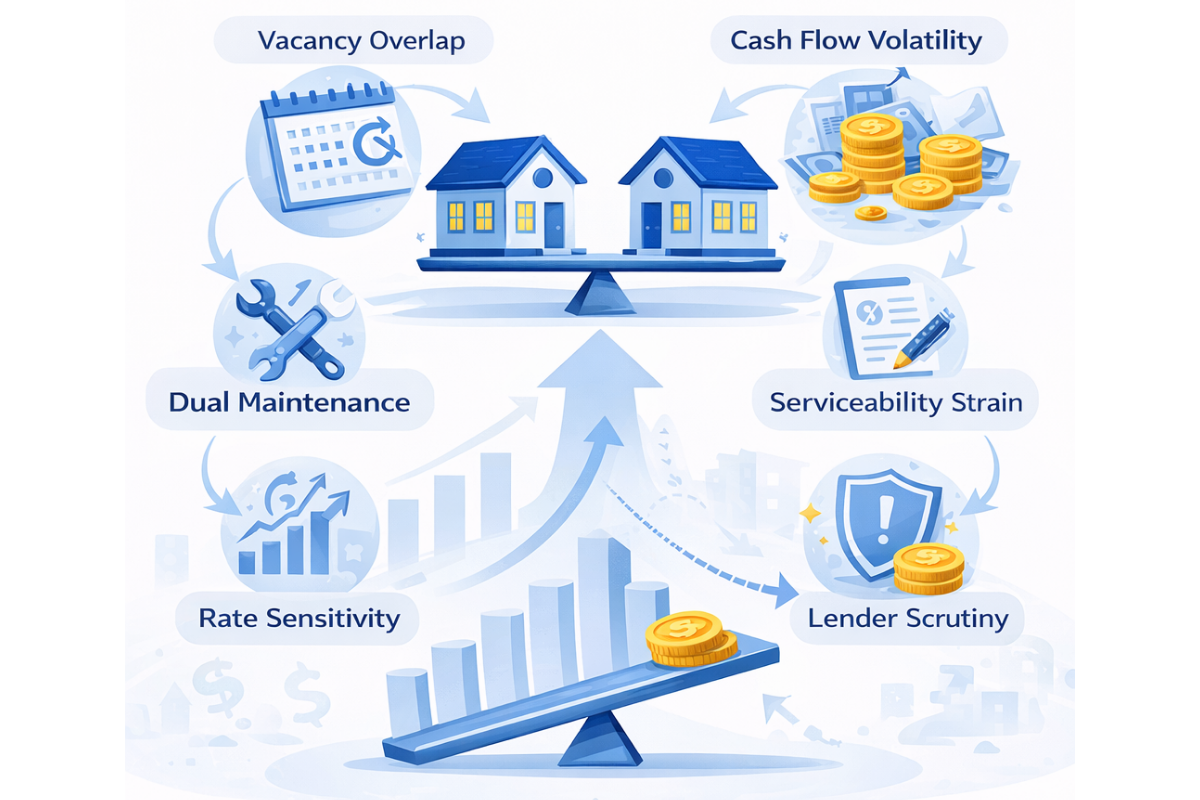
A second property increases exposure not only to opportunity but also to variability. Two rental streams introduce the possibility of overlapping vacancy periods, simultaneous maintenance requirements, and greater sensitivity to interest rate movements. While diversification across locations or asset types can strengthen resilience, diversification without sequencing can introduce instability.
Cash flow volatility across multiple assets affects serviceability calculations and lender confidence. Even minor inconsistencies in rental income, when duplicated across properties, can reduce usable borrowing capacity more than anticipated. The portfolio becomes dynamic, and that dynamism requires structure.
In a higher-rate environment, the margin for structural inefficiency narrows. The second acquisition must therefore be assessed not only for growth potential, but for its impact on income durability and risk balance.
Structural decisions that shape long-term scalability
The most significant portfolio constraints frequently originate at the second acquisition rather than the first. Decisions made at this stage regarding lender selection, loan structure, equity release methods, and security arrangements can influence flexibility for years.
For example, cross-collateralising properties may appear efficient initially but can restrict refinancing options or complicate future asset sales. Selecting a lender without considering long-term sequencing may limit borrowing pathways when attempting to expand again. Similarly, acquiring an asset with weak income characteristics may reduce serviceability headroom even if its capital growth prospects are attractive.
These decisions rarely cause immediate disruption. Instead, they create structural rigidity that becomes apparent only when investors attempt to scale. By that stage, unwinding constraints can require time, cost, and restructuring.
This dynamic is not limited to acquisition strategy alone. As discussed in The Real Cost of Poor Property Management in 2026, management quality directly influences rental stability, serviceability strength, and lender perception over time. Even a well-structured second acquisition can lose momentum if income drifts, vacancy extends, or compliance oversight weakens. Structural scalability depends not only on how a property is financed, but on how consistently it performs once integrated into the portfolio.
Sequencing as a strategic discipline in 2026
In the current lending environment, sequencing is no longer an advanced concept reserved for sophisticated or multi-property investors. It becomes materially relevant at the second acquisition. The order in which assets are purchased, the lenders selected, the way equity is released, and the buffers maintained between transactions all influence whether borrowing capacity remains expandable or gradually compresses. What may seem like a simple purchase decision can materially shape the structural flexibility of the portfolio for years to come.
Sequencing determines how debt accumulates across lenders, how serviceability is assessed under stress-tested conditions, and how easily capital can be redeployed into future opportunities. A carefully structured second acquisition can preserve optionality by maintaining borrowing headroom and avoiding unnecessary lender entanglement. Equity can be accessed more cleanly, refinancing pathways remain available, and lender choice stays broad. This competitive flexibility becomes increasingly valuable as portfolio size grows and lending criteria evolve.
Conversely, a poorly sequenced purchase can narrow progression even if the underlying assets perform well in terms of capital growth. Borrowing capacity may tighten due to cumulative assessment rates, loan structuring decisions may limit refinancing freedom, and cross-collateralisation may complicate future asset sales. On paper, the portfolio may appear larger and more diversified, yet structurally it may be less adaptable.
Sustainable progression is therefore less about how frequently properties are added and more about how deliberately each acquisition is positioned within the broader design. In 2026, sequencing is not simply a tactical consideration; it is a strategic discipline that determines whether growth compounds efficiently or encounters avoidable friction.
Investors who are uncertain about how sequencing may affect their borrowing flexibility often benefit from experienced guidance at this stage. Our team works closely with clients to model lender scenarios, structure debt deliberately, and position each acquisition within a broader portfolio roadmap. Meet our team to understand how strategic sequencing is applied in practice, rather than treated as theory.
Structuring the second acquisition as a foundation for scale
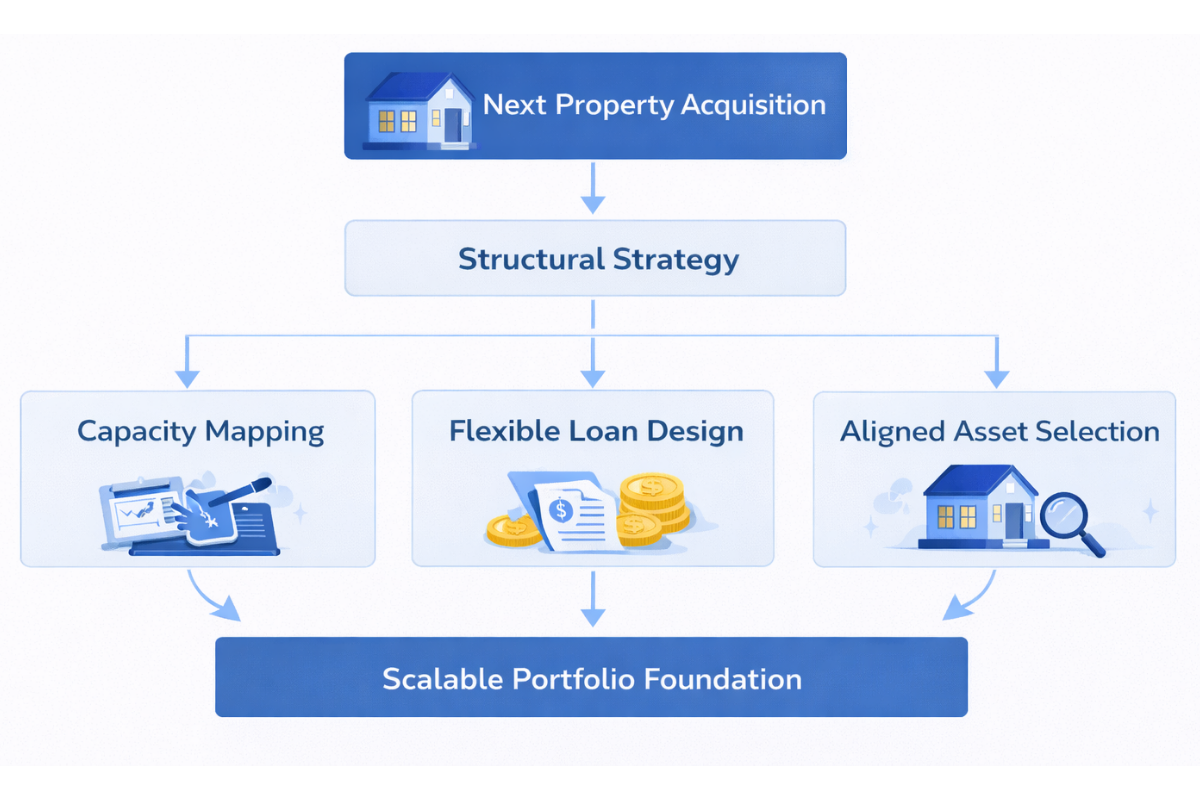
At FPW, the second property is approached as a structural inflection point rather than a routine transaction. By this stage, the focus shifts from entry into the market to the architecture of future growth. Borrowing capacity is mapped not only for immediate approval but with forward planning in mind. Scenario modelling is conducted to assess resilience under interest rate changes, rental variability, and shifts in personal income.
Loan structures are selected to preserve flexibility, minimise unnecessary security linkage, and maintain refinancing optionality. Lender choice is evaluated in the context of long-term sequencing rather than short-term convenience. Asset selection is aligned with both growth fundamentals and serviceability preservation to ensure that performance enhances, rather than constrains, borrowing power.
This integrated approach ensures that property performance, finance design, and portfolio strategy operate cohesively. The objective is not simply to secure approval for another purchase. It is to strengthen the foundation upon which future acquisitions will depend.
A deliberate pause before expanding
For investors who currently hold one property and are considering the next, the more important exercise is not simply identifying what to purchase, but assessing how that acquisition will influence structural flexibility over the next five to ten years. Expansion should not be driven purely by available equity or market momentum. It should be informed by how the additional asset integrates into the broader financial framework and whether it strengthens or compresses long-term scalability.
At this stage, the questions become more strategic than transactional. Will the second property preserve borrowing headroom once lender stress testing is applied across multiple debts? Will equity be accessible in a clean and efficient manner when future opportunities arise? Will the combined portfolio remain resilient if interest rates shift again or if rental income experiences short-term variability?
These considerations may not appear urgent at the point of purchase, yet they often determine whether the portfolio retains flexibility or encounters avoidable ceilings. A deliberate pause allows structural risks to be identified before they compound. The second acquisition has the potential to meaningfully accelerate progression, but only when it is designed with scale, sequencing, and resilience in mind rather than simply momentum.
What This Means for You
The first property establishes participation in the market. The second begins defining the portfolio’s architecture. From this point onward, structure, sequencing, and finance design exert increasing influence over long-term outcomes.
In 2026, where lending assessment remains disciplined and serviceability sensitivity is elevated, expansion without structural clarity can quietly limit progression. Deliberate design, by contrast, preserves flexibility, strengthens resilience, and supports scalable growth.
For investors seeking sustainable wealth creation rather than isolated acquisitions, the second property deserves measured planning. When structured intentionally, it becomes the platform for expansion. When approached casually, it can introduce constraints that shape the portfolio for years.
If you would like clarity on how your next purchase may influence borrowing capacity, risk exposure, and long-term flexibility, a structured strategy conversation can provide direction before expansion begins.