

Property Investing in Australia: The Wealth Strategy Most Australians Never Learn
Most Australians know that property investing in Australia builds wealth. What most never learn is the specific strategy that separates investors who compound that wealth across a growing portfolio from those who own one property for twenty years and wonder why the outcome feels underwhelming.
It is not market timing nor a suburb selection issue. It is a deliberate approach to sequencing, equity, and serviceability that most investors only discover after the first acquisition.
The Strategy Most Investors Never Learn
The strategy is not complicated. But it requires thinking about the first property differently than most buyers are taught to.
Most investors evaluate a property based on what it costs to hold and what it might be worth in five years. Experienced investors evaluate it on a third variable that most people never consider: what it does to their ability to buy the next one.
How Property Investing Creates Wealth in Australia
Property wealth compounds through three forces operating simultaneously. The first is capital growth, with Australian median prices historically growing at approximately 6 to 7% per year over the long run.
The second is leverage. A buyer who contributes $120,000 to control a $600,000 asset generates returns on five times their invested capital.
The third is debt reduction, where rental income progressively pays down the mortgage while the asset grows in value.
Why Most Investors Stall After One Property
The most common question among Australian property investors is not how to find a good property. It is why they cannot seem to buy the second one.
A property with a low rental yield increases holding costs and reduces the income counted toward serviceability on future loans. A property purchased with high debt relative to its value leaves little accessible equity for the next move.
For Example
An investor purchases a $780,000 inner city apartment yielding 2.8% gross. The lender counts 75% of that rental income toward serviceability, contributing approximately $400 per week to the borrowing calculation.
Two years later the investor applies for a second loan. Their debt-to-income ratio is near the lender ceiling and the apartment has grown only modestly. The first purchase was not wrong. It was simply not structured with the second purchase in mind.
Equity: The Engine Behind Portfolio Growth
Equity is the difference between what a property is worth and what is owed against it. For most investors, it sits idle for years without being accessed or deployed.
For experienced investors, equity is the primary funding mechanism for subsequent acquisitions. It allows portfolios to grow without requiring fresh cash savings at every stage.
How Equity Compounds Across a Sequenced Portfolio
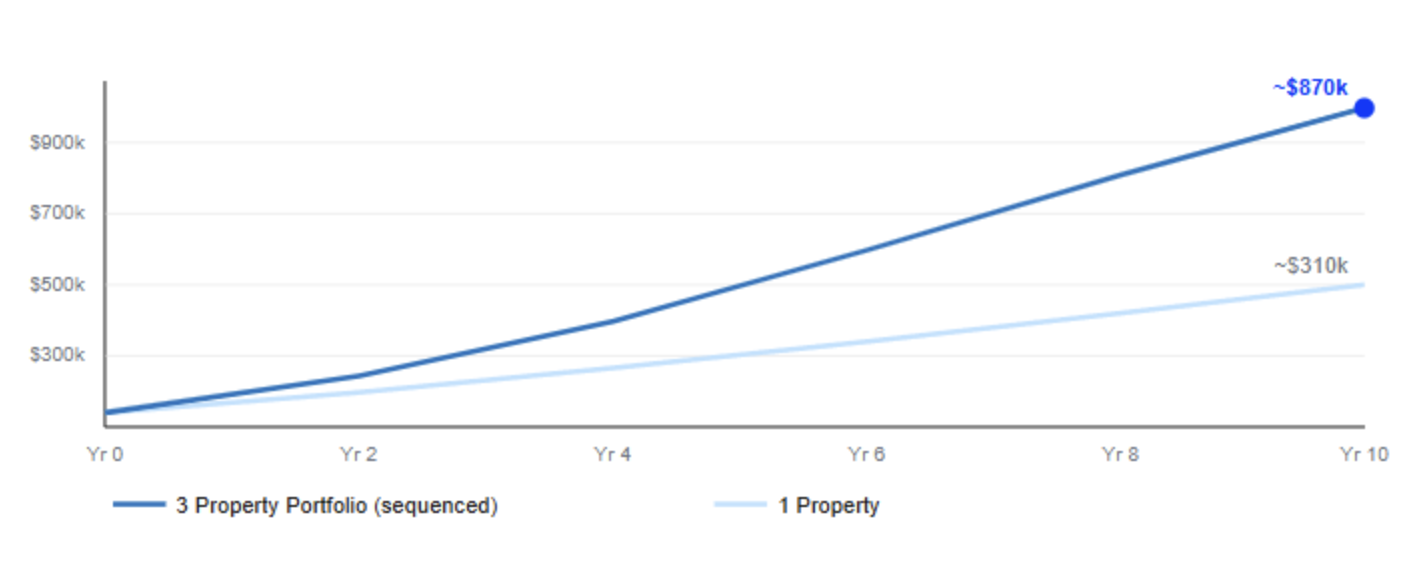
A sequenced three property portfolio compounds equity nearly three times faster than a single property held over the same decade, assuming consistent long run growth and deliberate equity redeployment at each stage.
Source: FPW Group modelled scenario; CoreLogic capital growth assumptions at 6% p.a., 2025 to 2026. Modelled only. Not a forecast.
How Lending Conditions Affect the Wealth Strategy in 2026
APRA's 3% serviceability buffer means lenders assess new loans at approximately 9.3 to 9.8% above the current variable rate. Borrowing power across most income profiles has contracted by 20 to 30% compared to the 2021 peak.
For investors building portfolios, this has one primary practical implication. Rental yield now directly determines whether the next acquisition is possible.
When lenders assess serviceability, only 75 to 80% of rental income is counted. A portfolio yielding 5.1% on average generates meaningfully more usable income toward a third loan application than the same portfolio yielding 3.0%.
What Experienced Investors Do Differently
Experienced investors evaluate every acquisition across three variables simultaneously: expected capital growth trajectory, rental yield relative to serviceability requirements, and the impact on remaining borrowing capacity for the next purchase.
Most beginner investors evaluate only the first variable. They discover the other two only when they try to buy again and find the door has quietly closed.
Portfolio Scalers vs One Property Investors: Three Key Differences
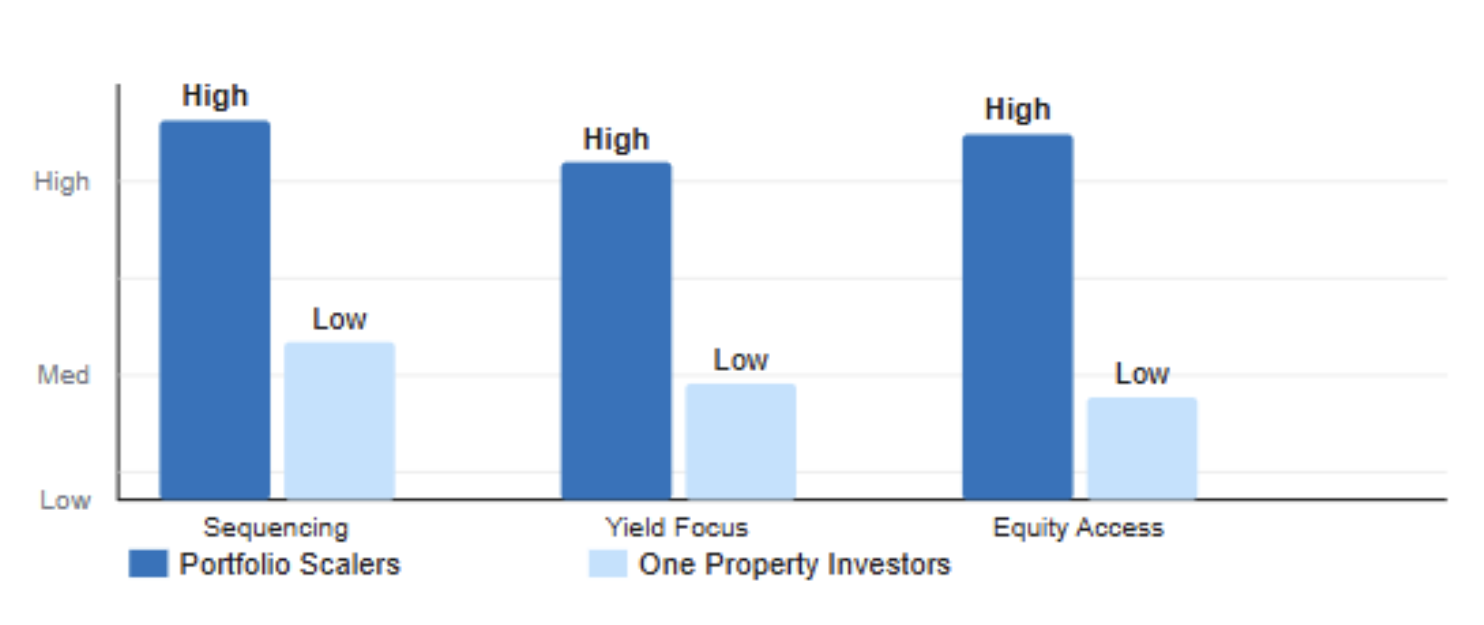
Investors who build portfolios consistently score high across deliberate sequencing, yield conscious selection, and planned equity access. Investors who stall at one property score low across all three.
Source: FPW Group investor behaviour analysis; REBAA industry data, 2025 to 2026.
Final Thoughts: Long Term Property Investing in Australia
The wealth strategy most Australians never learn is not a secret. It is simply the habit of thinking about each acquisition in terms of what it enables next, not just what it delivers on its own.
In 2026, that thinking matters more than ever. Borrowing power is tighter, yield profiles have more consequence, and the cost of an unsequenced first purchase is measured in years of delayed portfolio growth rather than months.