

Why Your Property Portfolio Might Stop at Two Properties
When early momentum creates the wrong expectation
For many investors, the first property marks a turning point. What once felt complex becomes more familiar, and the process of ownership settles into something manageable. Rental income begins to offset repayments, and over time, small gains in value reinforce the belief that the strategy is working as intended.
In markets like Brisbane and across south-east Queensland, where property values have seen sustained growth, this experience can be even more pronounced. Investors often look at their first purchase and see clear evidence of progress. The numbers appear stable, the property is performing, and confidence begins to build around the idea of repeating the process.
This early momentum is often where the foundation of future constraints is set. As explored in The Biggest Property Investing Mistake People Make After Their First Property, many investors begin focusing on the next opportunity without fully understanding how their current structure will perform under more complex lending conditions.
This is where a subtle assumption starts to take hold. If the first purchase worked, the next one should follow a similar path. Expansion begins to feel like a matter of timing rather than structure. What is less visible at this stage is that the financial conditions supporting the first property are rarely tested in a meaningful way. The system feels stable because it has not yet been placed under pressure.
Why the second property introduces a different set of rules
The move from one property to two is not simply an expansion. It changes how lenders assess the entire financial position. What was previously a straightforward borrowing scenario becomes a broader evaluation of how income, debt, and obligations function together.
At this stage, assessments become more layered. Income is no longer taken at face value. Rental earnings are adjusted to account for potential vacancies or variability, and repayment capacity is tested against higher interest rate buffers. In the current environment, these assumptions are playing a much larger role in how borrowing capacity is determined.
Liabilities also begin to carry more weight collectively. Each loan contributes to the overall risk profile, and the interaction between multiple properties becomes part of the assessment. The outcome is a financial model that behaves differently from what investors experienced with their first purchase.
This is often the point where a structured finance strategy becomes increasingly important, particularly when future borrowing capacity depends on how the portfolio is set up today.
What once felt predictable can begin to produce less certain outcomes, not because the opportunity has changed, but because the underlying structure is now being assessed in a different way.
Why this shift often goes unnoticed at first
One of the reasons this constraint catches investors off guard is that it does not present itself immediately. From a day-to-day perspective, the portfolio may still feel comfortable. Tenants are in place, repayments are being met, and there may even be a sense that equity is building as the market moves.
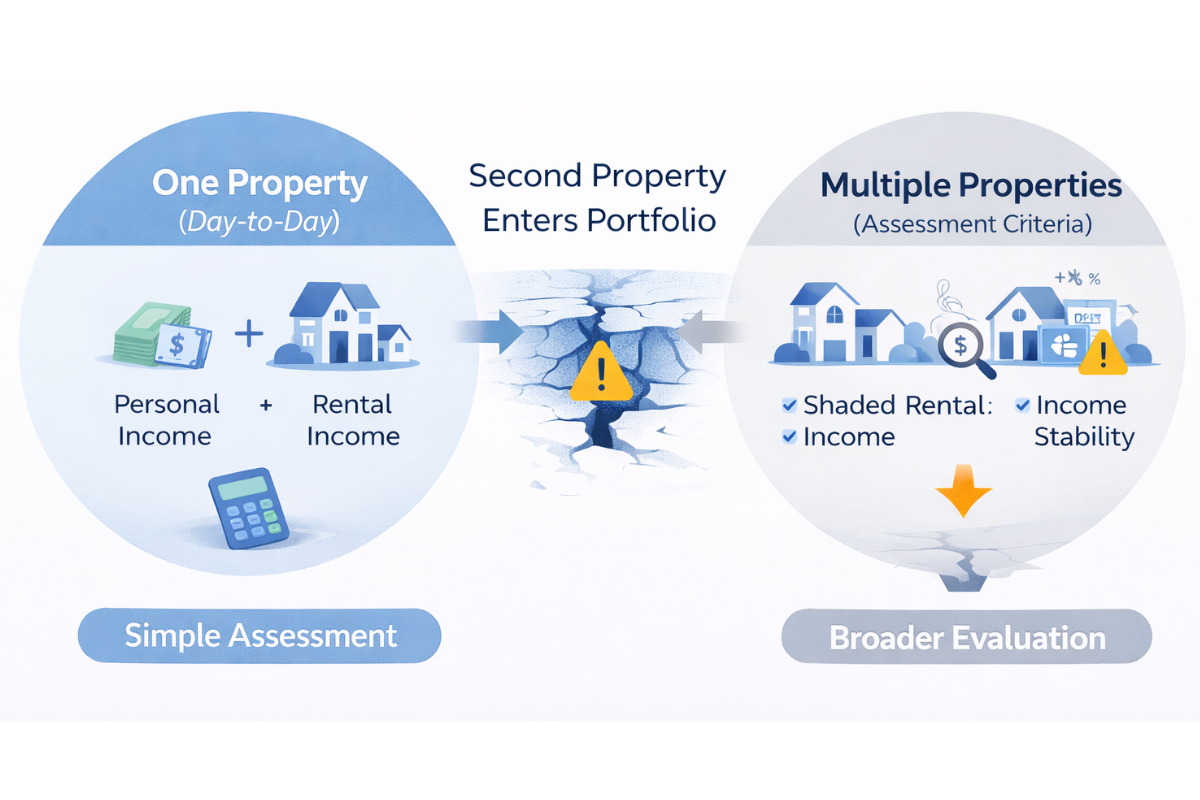
However, lenders are not measuring comfort in the same way. Their focus is on consistency and resilience under less favourable conditions. This distinction becomes more significant in the current lending landscape, where serviceability buffers remain firm and borrowing capacity is being assessed with greater caution.
As a result, there can be a growing gap between how an investor experiences their portfolio and how a lender evaluates it. The portfolio may appear stable on the surface, yet the underlying structure may not support further expansion as easily as expected. This disconnect is often only revealed when the next purchase is attempted.
The constraint that sits beneath most stalled portfolios
When progress begins to slow, many investors instinctively look toward external factors. They reassess the location, question whether they have chosen the right property, or wait for a better entry point into the market. While these considerations are valid, they rarely explain why borrowing capacity has tightened.
The more common limitation lies within the financial structure itself. Lending decisions are not based on income alone. They reflect how income is earned, how consistent it is, how it interacts with existing debt, and how the overall position performs when subjected to conservative assumptions.
This is often where subtle issues begin to compound. In The Overlooked Risk Inside Expanding Property Portfolios, we break down how small variations in income, timing, and cash flow can gradually shape how a portfolio is viewed by lenders, even when it appears stable from the outside.
This is where many portfolios encounter friction. As outlined in our analysis of borrowing capacity, two investors with similar earnings and comparable assets can find themselves in very different positions when assessed by lenders. The difference is not always visible from the outside, but it becomes clear when the financial structure is tested.
How small inconsistencies begin to have a larger impact
As portfolios grow, minor variations that once seemed insignificant can begin to carry more weight. Slight differences in rental performance, timing gaps between tenancies, or increases in ownership costs can introduce subtle irregularities into the overall income profile.
Individually, these changes may not appear concerning. However, when they occur across multiple properties, they begin to influence how the portfolio is perceived within lending models. This is where patterns of income stability become more important than isolated figures.
This dynamic is closely linked to the patterns explored in our discussion on the risks within expanding portfolios, where income consistency plays a central role in maintaining borrowing flexibility. As more properties are added, the margin for variability narrows, and the importance of maintaining a stable financial foundation becomes more pronounced.
Why experienced investors approach expansion differently
Investors who continue to build beyond two properties tend to recognise that growth is not simply about acquisition. They approach each decision with an understanding of how it will affect the broader financial position over time.
This includes considering how income is generated and maintained, how loans are structured to preserve flexibility, and how future lenders are likely to interpret the portfolio. Stability becomes a deliberate focus rather than an assumed outcome.
Consistent rental performance plays a key role in this process. Well-managed properties are more likely to maintain alignment with market conditions, reduce periods of vacancy, and provide predictable income streams. This is where structured Property Management becomes a meaningful component of long-term strategy, ensuring that the income supporting the portfolio remains reliable rather than variable.
By approaching the portfolio as an interconnected system, experienced investors are able to maintain momentum even as lending conditions evolve.
How portfolios quietly reach a ceiling
For many investors, the slowdown does not occur as a single event. It develops gradually as borrowing conditions tighten and flexibility begins to narrow. The next purchase becomes more complex, approvals take longer, and the outcome becomes less certain than it was in the early stages.
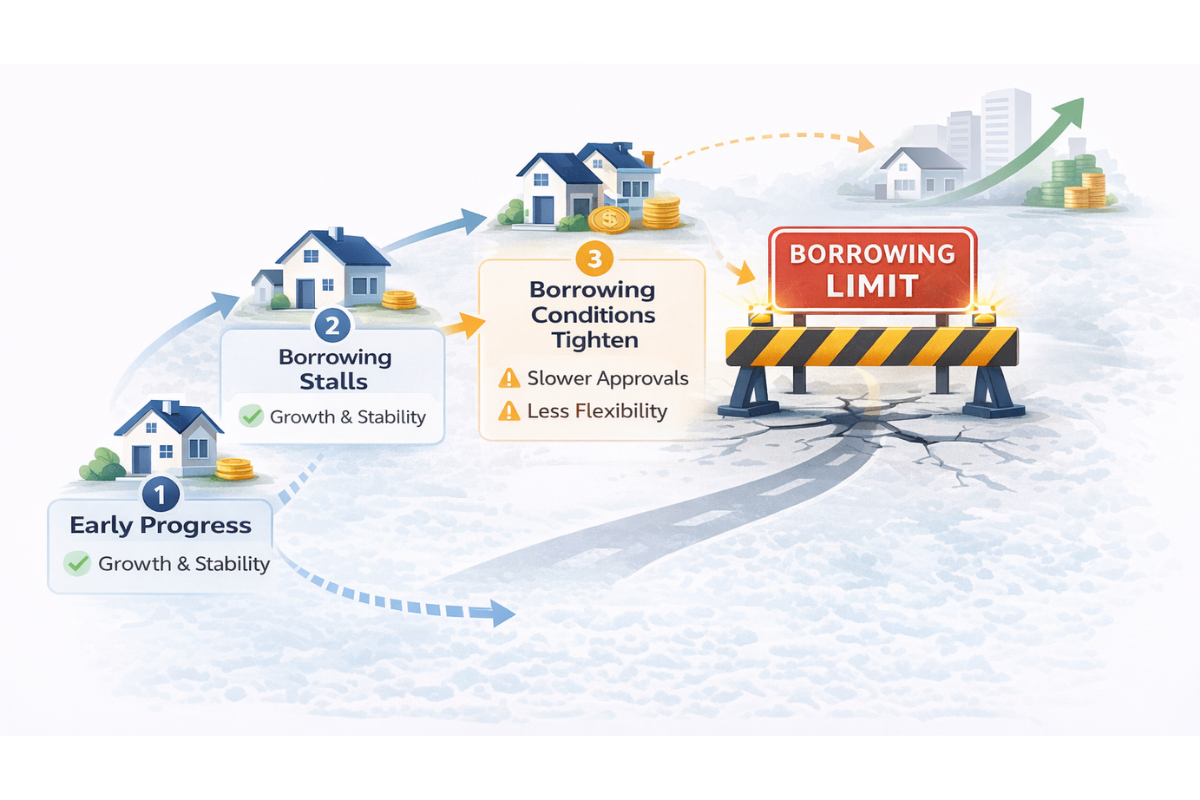
This can be a difficult shift to interpret. From the outside, the portfolio may still appear successful. Properties are performing, values may be rising, and the overall position seems intact. Yet the ability to take the next step becomes constrained.
In many cases, this is the point where investors begin to realise that growth is not determined solely by what they own, but by how well their structure supports what they intend to do next.
Rethinking what drives long-term portfolio growth
Property investing is often framed as a series of successful purchases, with each acquisition representing progress. While this perspective captures part of the journey, it does not fully reflect what allows investors to continue expanding over time.
Sustainable growth depends on how effectively the portfolio functions as a whole. Assets, income, and debt must work together in a way that supports ongoing borrowing capacity. When these elements are aligned, expansion tends to remain achievable. When they are not, progress can slow even in a rising market.
For investors aiming to move beyond two properties, the focus gradually shifts from identifying opportunities to understanding structure. The question becomes less about what to buy next and more about whether the current position is built to support the next stage.
If you are planning your next move
Many investors only encounter these constraints when they attempt to secure their next property. By that point, the outcome is often determined by decisions that were made earlier in the journey.
A more effective approach is to understand how your current portfolio would be assessed before taking the next step. This provides clarity around what may be influencing your borrowing capacity and where adjustments may be needed.
If you want a clearer view of how your position is likely to be interpreted by lenders, and how it may affect your ability to expand, you can speak with our team.