

The Biggest Property Investing Mistake People Make After Their First Property
Why the second purchase often reveals the structural limits of a portfolio
The momentum investors feel after their first purchase
Buying a first investment property often changes how people see the market. Before that step, property investing can feel complex and uncertain. There are questions about timing, finance, and whether the decision will prove correct in the long run. Once the purchase is complete and the property settles into routine ownership, many of those concerns begin to fade.
Over time, the process becomes familiar. Rental income starts flowing, repayments become part of the monthly financial rhythm, and investors begin to see the early signs of capital growth. In strong markets like Brisbane and parts of south-east Queensland, where values have risen significantly over the past few years, those gains can reinforce the impression that the strategy is already working.
This early experience often creates a sense of momentum. If the first property appears manageable and the value continues to rise, the natural conclusion is that the next step should simply involve repeating the process. Many investors begin searching for the second opportunity with the expectation that scaling their portfolio will follow a similar pattern.
What is less obvious at this stage is that the financial environment surrounding the first property is rarely the same environment that governs portfolio expansion.
Why the first property rarely tests the structure of a portfolio
At the beginning of an investor’s journey, the financial structure behind the purchase is usually straightforward. Personal income forms the backbone of the serviceability calculation, and the overall debt position remains relatively simple. Lenders typically evaluate the borrower’s ability to meet repayments based primarily on their salary, existing commitments, and a single property loan.
Because of this simplicity, the first property rarely places meaningful pressure on the broader financial structure. Rental income provides additional support, but the overall lending assessment still depends largely on the borrower’s personal financial position. From the investor’s perspective, the system appears stable and predictable.
This environment can create a misleading sense of scalability. If the first purchase was approved comfortably and the repayments feel manageable, it is easy to assume that the next acquisition will follow the same logic.
Yet as we explored in our analysis of what actually determines borrowing capacity, lenders rarely base their decisions on income alone. Factors such as income durability, existing debt exposure, and how a portfolio performs under conservative stress testing can significantly influence the outcome of lending assessments.
In reality, the first property often sits within a financial framework that has not yet been meaningfully tested. The structure only begins to reveal its limitations once additional assets enter the portfolio and lenders begin examining the full financial picture rather than a single transaction.
The mistake that quietly slows many portfolios
The most common mistake investors make after their first purchase is focusing almost entirely on the next property opportunity. Attention shifts to suburb selection, expected capital growth, and the timing of the next acquisition. These are important considerations, but they are rarely the variables that ultimately determine whether expansion will remain possible.
The deeper constraint often lies within the financial structure supporting the portfolio.
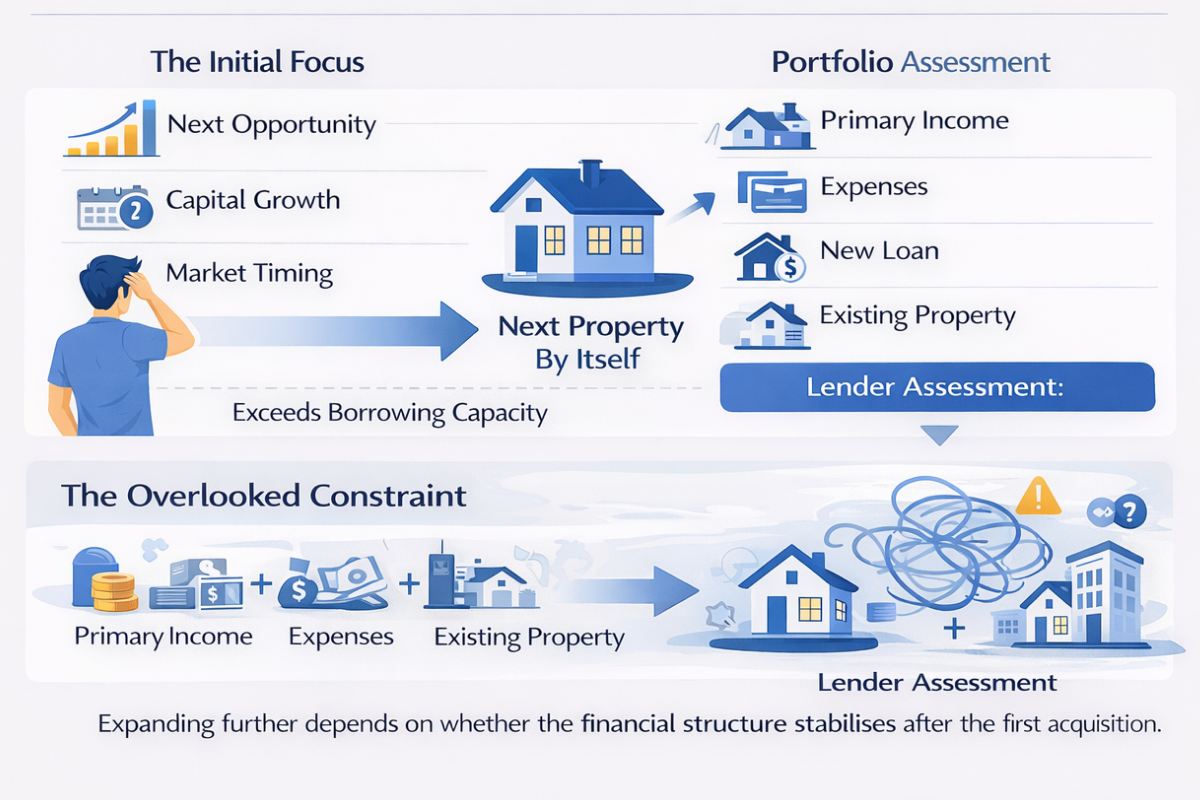
When investors approach the second purchase with the same mindset as the first, they sometimes overlook how the new loan, the existing property, and their personal finances will interact within the lender’s assessment model. Each additional asset introduces new variables. Debt levels increase, income sources diversify, and serviceability calculations begin incorporating a broader set of assumptions.
This shift often occurs quietly. What initially appears to be a straightforward expansion can introduce structural pressure that only becomes visible once lenders evaluate the entire portfolio together.
In fact, many investors encounter this dynamic when small financial inconsistencies begin to accumulate across multiple properties. As highlighted in our discussion on The overlooked risks inside expanding portfolios, factors such as uneven rental income, vacancy patterns, or fluctuating expenses can gradually influence how lenders assess the stability of a growing portfolio.
These issues rarely appear dramatic in isolation. Their impact tends to emerge when lenders begin viewing the portfolio as a system rather than a collection of individual properties.
When lending assessments begin to change
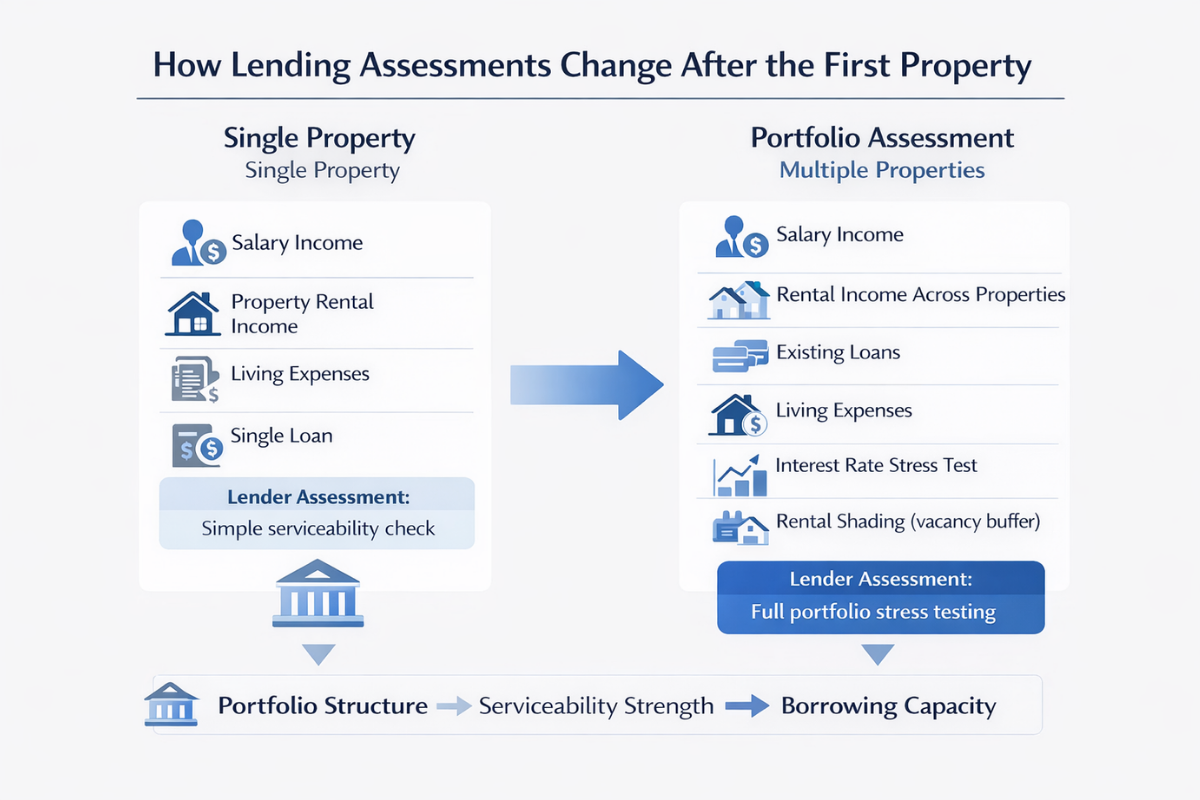
Once an investor moves beyond a single property, lending assessments start to evolve. Australian lenders do not simply evaluate the new purchase in isolation. Instead, they examine how the entire portfolio performs when subjected to their serviceability models.
These models are intentionally conservative. Rental income is typically reduced within the calculation to account for potential vacancy or variability. Interest rates are assessed above current market levels to ensure that repayments remain manageable if borrowing costs rise. Existing liabilities are also considered collectively rather than individually.
In the current lending environment, where serviceability buffers remain relatively strict, these calculations can produce outcomes that surprise investors. A portfolio that appears comfortable from a cash flow perspective may still be assessed more cautiously by lenders once multiple loans and income streams are involved.
The result is that borrowing capacity often becomes less predictable after the first property. The financial structure behind the portfolio begins to matter just as much as the assets themselves.
Why the second property often becomes the real turning point
For many investors, the second acquisition represents the moment when portfolio dynamics begin to shift in a meaningful way. With two properties in place, lenders start examining the relationship between assets rather than evaluating each one independently.
Debt exposure increases, rental income from multiple properties is incorporated into the serviceability model, and the lender’s assessment begins to reflect the interaction between the borrower’s income, the performance of the properties, and the overall financial structure.
In Australia’s current lending environment, where borrowing capacity is already influenced by higher assessment rates and stricter servicing models, this transition can feel like a sudden change. Investors who expected expansion to follow a similar pattern to their first purchase may discover that the financial modelling behaves differently than anticipated.
This is also where the gap between property value and portfolio progress becomes clearer. As discussed in our article on Does Property Value Always Equal Portfolio Progress, an asset can appreciate significantly while contributing relatively little toward borrowing capacity if the surrounding financial structure does not support additional lending.
For this reason, the second property often reveals something important about the portfolio itself. It highlights whether the existing financial framework was designed to support long term expansion or simply accommodate the first acquisition.
How experienced investors approach expansion differently
Investors who successfully build larger portfolios tend to approach the early stages of expansion with a broader perspective. Rather than focusing exclusively on the next property, they consider how each acquisition will interact with the financial structure already in place.
Income reliability becomes an important consideration, particularly when multiple rental streams begin contributing to the serviceability calculation. Loan structuring decisions are made with refinancing flexibility in mind, and lender selection is approached strategically rather than transactionally. Consistent rental performance also becomes increasingly important at this stage, which is why experienced investors often place greater emphasis on professional Property Management to ensure income stability, minimise vacancy periods, and maintain the financial consistency lenders expect when assessing a growing portfolio.
This perspective allows experienced investors to treat each purchase as part of a larger system rather than an isolated opportunity. The objective is not simply to acquire additional assets, but to ensure that the portfolio remains financially adaptable as it grows.
Over time, this approach can make a significant difference. Portfolios that are designed with structural flexibility in mind tend to retain borrowing capacity more effectively as lending conditions evolve.
Rethinking how portfolio growth actually works
Property investing is often presented as a sequence of successful acquisitions. Each purchase appears to represent progress, and rising property values reinforce the perception that the strategy is working as intended.
However, long-term expansion rarely depends on the number of properties alone. What ultimately determines whether a portfolio can continue growing is how effectively the assets, loans, and income streams function together within the lending framework that governs borrowing decisions.
Properties that contribute stable income, integrate well within loan structures, and support serviceability calculations tend to strengthen portfolio momentum over time. Assets that do not may still appreciate in value, yet contribute less toward future borrowing flexibility.
When investors begin evaluating their portfolios through this lens, the focus gradually shifts. The question becomes less about identifying the next property and more about understanding how the existing structure supports the next stage of growth.