

Rental Crisis Australia: Is the Country Becoming a Nation of Permanent Renters?
There is a generation of Australians who grew up watching their parents buy a home. It was not always grand. But it was theirs, and the assumption passed down was simple: you work, you save, you buy.
That assumption is breaking down.
Australia's rental crisis has pushed rents up over 40 per cent in five years. Rental vacancy rates are at historic lows, and the average household now spends a third of its income just to keep a roof over its head. For a growing number of Australians, the question has quietly shifted from "when will I buy?" to "will I ever?"
This is not just a story about struggling renters. It is about what happens to a property market and an economy when renting stops being a stepping stone and starts being the destination. The Reserve Bank of Australia, Cotality, formerly known as CoreLogic, and AHURI have all documented what is building beneath the surface. The data points in one direction.
Did Government Housing Policy Help Create the Rental Crisis in Australia?
Picture a nurse in her mid-thirties. Ten years in the public system, four years in the same Brisbane apartment, never missed a payment. Last year, her landlord raised the rent by $200 a week, and she stayed because finding something closer to the hospital was near impossible.
She is not unusual. She is increasingly the rule.
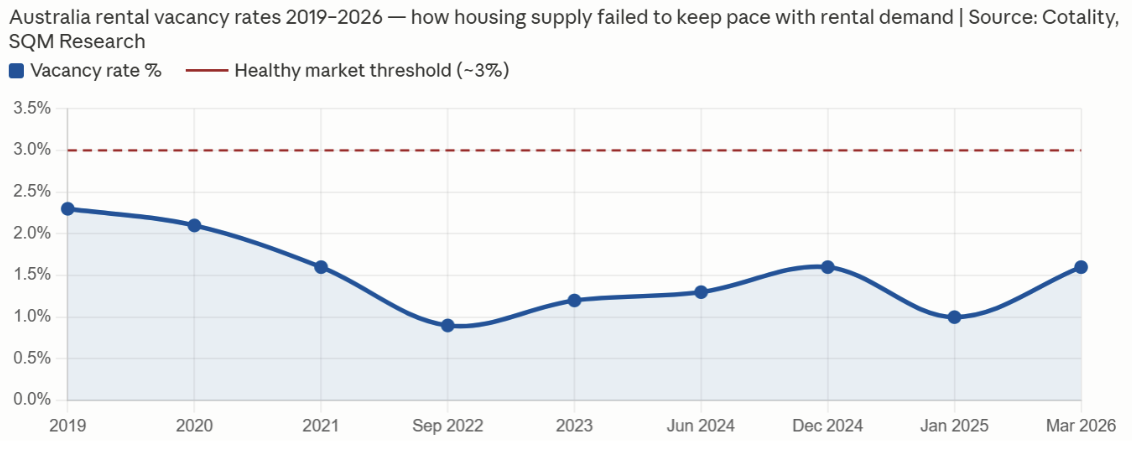
Australia's rental vacancy rate hit 0.9 per cent in September 2022, the lowest since 2006, and has barely recovered since. A healthy rental market sits around 3 per cent. The country has not been there in years.
The tax settings that rewarded the wrong outcomes
Negative gearing has allowed Australian property investors to offset rental losses against their taxable income since the 1980s. Combined with the 50 per cent capital gains tax discount introduced in 1999, it built a system that rewards holding property as a wealth asset, not a housing one. More investors piled into established dwellings rather than new builds, prices rose, and renters competed for stock that was not growing fast enough to meet demand.
The debate over negative gearing remains politically toxic. What is harder to argue with is that government housing policy in Australia has done little to incentivise the housing supply the market desperately needs.
Zoning, infrastructure, and immigration
Large portions of Sydney and Melbourne are locked into low density residential zoning that physically prevents construction where demand is highest. Planning approvals move slowly and infrastructure lags behind population growth. AHURI research found a shortage of 173,000 affordable dwellings in the private rental sector, with 71 per cent of low to moderate income households paying more than 30 per cent of their income on rent.
Migration has compounded the problem at speed. In the first half of 2025, a record 279,460 net permanent and long-term arrivals landed in Australia, up 64 per cent compared to the same period in 2019. Every arrival needs somewhere to live on day one, and when housing supply cannot keep pace, the rental market absorbs the pressure immediately.
The Australian Local Government Association has warned that communities cannot continue absorbing the costs of growth without additional infrastructure support. The 2026 federal budget committed $2 billion toward housing infrastructure, including $500 million for regional Australia to fund critical infrastructure and build up to 65,000 new homes. Whether that reverses decades of underbuilding is another question entirely.
Why Investors Are Watching Long-Term Rental Demand in Australia Closely
Consider two investors who bought investment properties in Brisbane in 2019. One sold in 2022 and moved on. The other held, and today has a vacancy rate below one per cent, a tenant who has renewed twice, and an income stream that has grown significantly.
They are not panicking. They are watching a structural shift that most market commentaries have been slow to name clearly.
First-home buyers are becoming permanent renters, and investors are taking note
Between the 2016 and 2021 Census, single person households rose by 17.1 per cent, driven in part by relationship breakdowns and the dissolution of share houses during COVID lockdowns. Smaller households mean more dwellings needed per capital, and more pressure on a market already running dry.
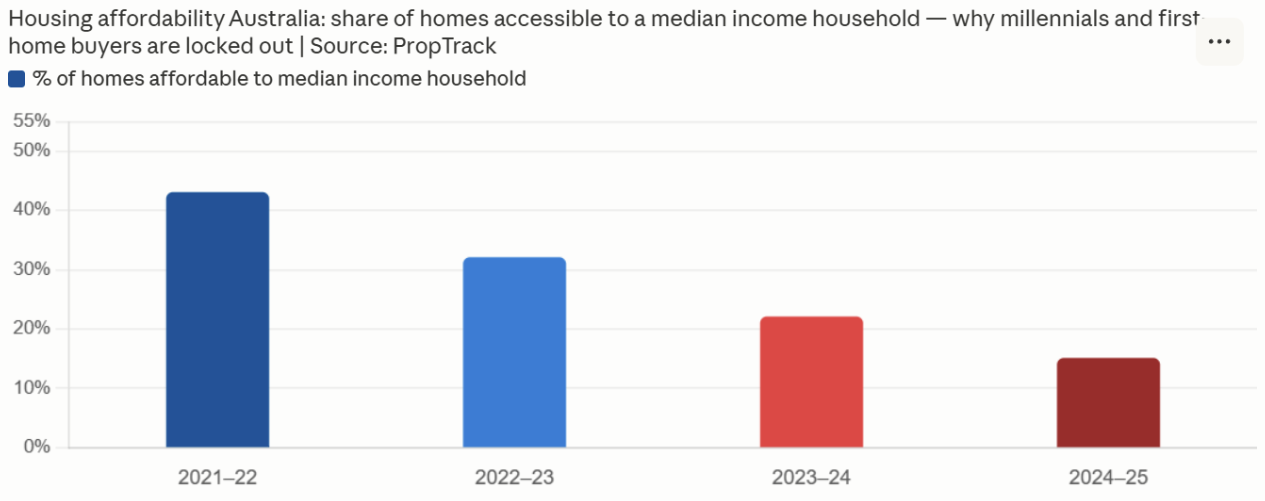
In three years, the share of homes affordable to a median income household collapsed from 43 per cent to just 15 per cent. For first-home buyers in the Australian property market, the path into home ownership has not just narrowed. For many, it has effectively closed.
The tenant pool is not just growing. It is ageing, stabilising, and staying longer. Cotality's Rental Review for Q1 2026 confirmed that every capital city recorded a rental vacancy rate below 2.0 per cent in the March quarter, with the national rate sitting at half the average recorded for the five years to March 2021. When tenants stay longer and vacancy rates are structurally low, the economics of holding an investment property shift: fewer vacant periods, less turnover, more predictable income.
Build-to-rent and what institutional money already knows
Build-to-rent is the trend institutional money has already started following. Largely absent from the Australian property market a decade ago, purpose built residential developments leased long term have been attracting growing interest from superannuation funds and offshore capital. Australia's tax settings have historically made build-to-rent less competitive, but that is slowly changing as governments recognise it as one of the few levers capable of adding meaningful rental stock at scale.
Renting vs Buying in Australia: Is the Country Becoming a Permanent Renter Economy?
In Germany, half the population rents indefinitely. Not as a consolation prize, not as a waiting room, but as a settled, legally protected way of life. Australia is not Germany, but it is worth asking how close it is getting.
For most of the twentieth century, home ownership in Australia was the unquestioned default. That assumption is cracking, and millennials and Gen Z are where it is cracking loudest. Long term renting is increasingly seen not as failure but as a rational response to a market that has structurally priced a generation out.
Why young Australians cannot buy — and what it means for permanent renters
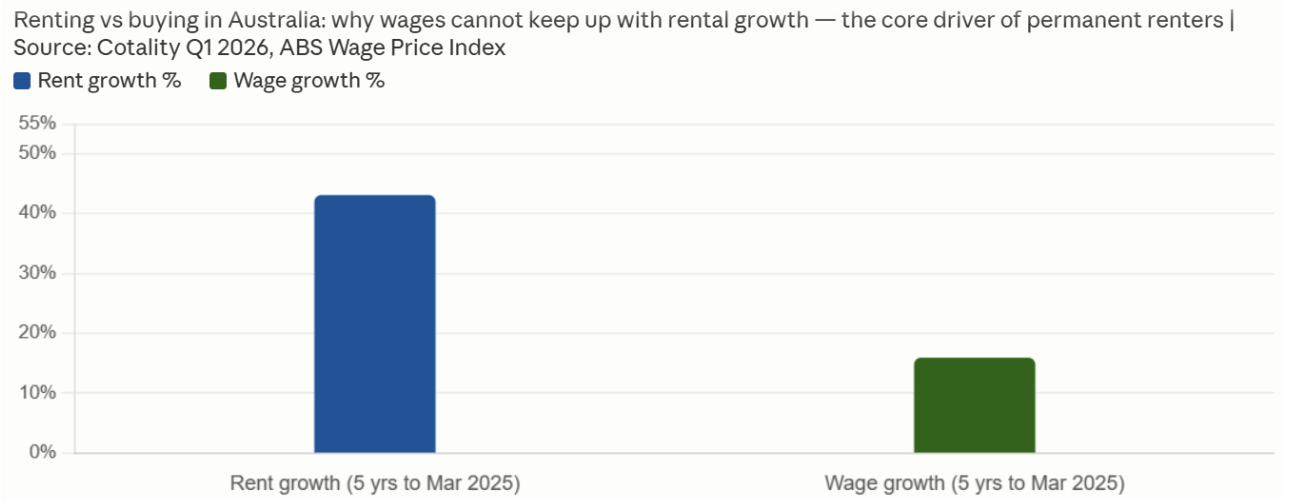
Rents grew nearly three times faster than wages over the same five-year period. Cotality's Q1 2026 Rental Review found that households are now committing a record 33.1 per cent of gross median household income to rent, with five years of sustained growth adding an estimated $202 per week to the typical rent commitment.
AHURI research found that low income working households are either enduring affordability stress, commuting burdens, or both in order to access employment opportunities. Saving a deposit while carrying that rent burden, close enough to work to make it viable, is not a medium-term challenge. It is a near impossibility.
Homelessness in Australia currently sits at around 123,000 nationally, with significant increases evident since 2016, and the rental crisis is directly responsible for over a third of all incidents. The rental market is still largely designed around the assumption that tenancy is temporary. That gap between how people are living and how the system accommodates them is where the real policy failure sits.
What Comes After the Rental Crisis in Australia?
Picture a 67-year-old woman living alone in a rented flat in Adelaide. She has worked her entire adult life, raised two children on a single income, and never quite earned enough to save a deposit. By the time those children were grown, the Australian property market had moved too far ahead of her.
She is not in crisis. Not yet. But she spends nearly half her aged pension on rent, has no asset to fall back on, and every lease renewal brings quiet dread about what the next twelve months will cost.
She is not a worst-case scenario. She is a preview.
The family home has historically been Australia's primary vehicle for building and transferring wealth across generations. It sits outside the pension assets test, it appreciates, and it removes rent from the equation precisely when income drops. For households that never make it into home ownership in Australia, none of that applies.
A 28-year-old whose parents own in Sydney has access to guarantor arrangements and gifted deposits that a 28-year-old whose parents have rented their whole lives simply does not. The divide between those who own and those who do not is becoming less about choices made and more about the family you were born into.
The Senate inquiry into the worsening rental crisis in Australia documented 640,000 households under severe rental stress and a 750,000 shortfall of homes for low-income earners. That is not a fringe constituency. That is a voting bloc in formation.
As the renter cohort grows older and more organised, the political appetite for rent regulation, stronger tenant protections, and changes to negative gearing and the capital gains tax discount will grow with it. For investors in the Australian property market, the same structural shift driving long term rental demand is also the force that will eventually drive political response. Both sides of that ledger deserve attention.
Australia has not made a decision to become a nation of permanent renters. But it is drifting in that direction, driven by government housing policy settings not designed for this outcome, a construction sector that cannot build fast enough, and an Australian property market that has made home ownership genuinely unattainable for a growing share of the population.
For investors looking to act on these conditions rather than just observe them, FPW’s wealth creation through property investment service outlines how to build a long-term strategy aligned with Australia’s evolving rental crisis and housing affordability pressures.
Whether this trajectory continues will depend on policy and market responses that are still being formed. What is clear is that the window for adjustment is narrowing.