

The Window Most Investors Miss in Changing Markets
Markets do not move in straight lines. They shift in phases, often quietly at first, before the broader sentiment catches up. These transition periods rarely feel like opportunity. In fact, they often feel uncertain, constrained, or even slightly uncomfortable to navigate.
Within these shifts, there is typically a narrow window where conditions begin to change, but behaviour has not yet adjusted. This is where positioning matters most. It is not a moment driven by confidence or momentum, but by imbalance between perception and reality.
Most investors recognise a “good market” only after it becomes clear. By that point, confidence has returned, competition has increased, and the advantage has largely compressed. The real question is not whether opportunities exist, but whether you are positioned to act before they become obvious to everyone else.
What this window actually looks like
This window does not resemble the type of market conditions most investors are waiting for. There is no clear signal, no widespread optimism, and no strong narrative reinforcing that “now is the time.”
Instead, it often appears during periods of mixed signals. Interest rates may be rising or stabilising at higher levels. Lending conditions may be tightening. Media coverage may lean cautious or uncertain. From the outside, it can feel like a time to pause rather than act.
However, beneath that surface, a different dynamic begins to form. Buyer urgency reduces, competition thins, and transaction volumes soften slightly. Sellers who remain active tend to become more flexible, and negotiation conditions begin to improve.
This creates a subtle but important shift. The opportunity is not driven by rapid growth or market acceleration, but by reduced pressure and improved access to deals. It is a window defined by less competition, not more opportunity in the traditional sense.
Why most investors miss it
The challenge is not access to information. It is how that information is interpreted.
Many investors wait for clarity before making decisions. They look for signals such as stabilising rates, consistent price growth, or renewed confidence in the market. These signals feel safe, but they are inherently delayed.
By the time conditions feel comfortable, the market has already adjusted. Competition increases, speed becomes more important, and the same opportunities require stronger positions. What was once accessible becomes more difficult to secure.
This is also where structural limitations begin to surface. Investors may assume they are ready to act, only to find that their borrowing capacity no longer supports the same level of flexibility. This dynamic is explored more deeply in Why Your Property Portfolio Might Stop at Two Properties, where the limitation is not the market itself, but how the portfolio is structured to support further growth.
There is also a behavioural element. Many investors carry forward assumptions from their first purchase, expecting the process to remain consistent. In reality, as outlined in The Biggest Property Investing Mistake People Make After Their First Property, the conditions that supported the initial purchase are rarely tested until expansion is attempted. By that stage, the window has often shifted.
The role of borrowing capacity in this window
In the current environment, this window is shaped less by property fundamentals and more by finance conditions.
As interest rates rise or remain elevated, lenders adjust how they assess borrowing capacity. Higher serviceability buffers are applied, income is treated more conservatively, and existing debt carries greater weight. This means borrowing capacity can decline even when income remains stable.
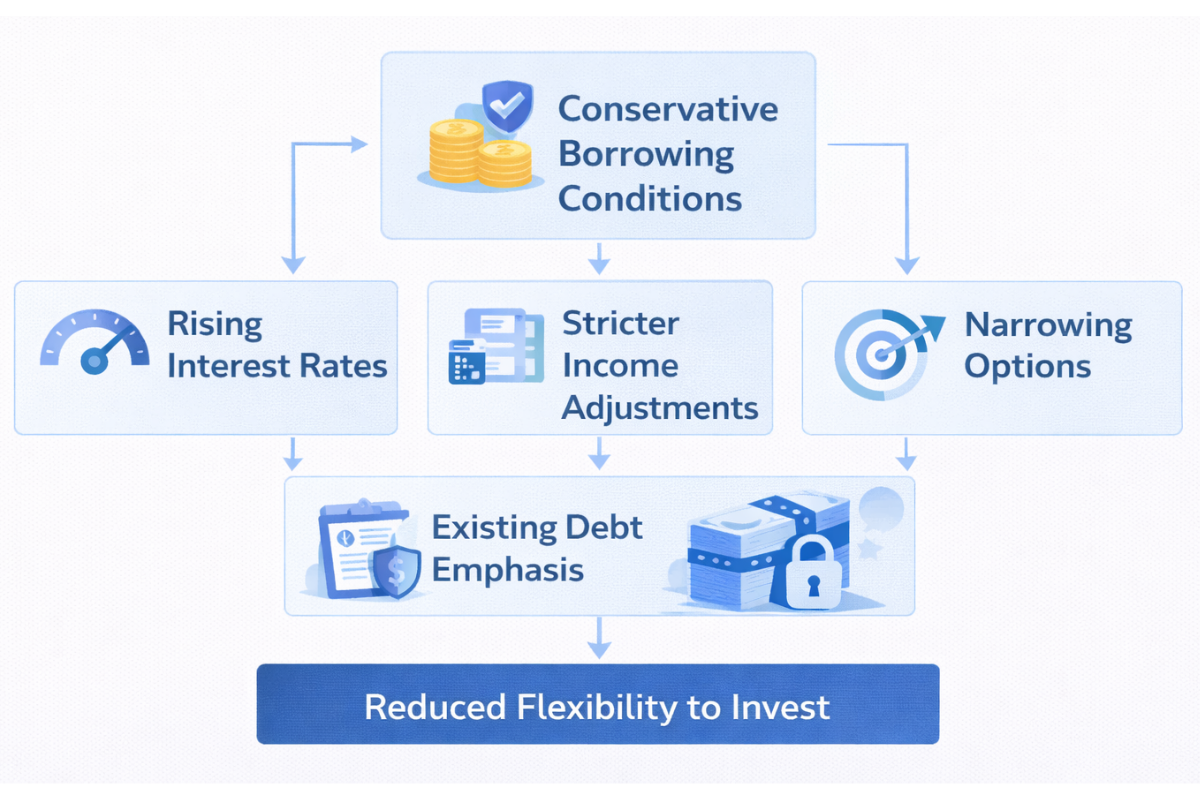
Over time, this reduces flexibility. An investor who could comfortably purchase within a certain range may find that range narrowing. Options become more limited, approvals more sensitive, and the margin for error smaller.
This is where the disconnect becomes clear. The opportunity may still exist, and in some cases may even improve due to reduced competition. However, the ability to act on that opportunity becomes constrained.
Maintaining this flexibility requires a more deliberate approach to Finance, where borrowing capacity, structure, and long-term positioning are actively managed rather than assumed to remain constant.
What prepared investors do differently
Investors who move effectively through these windows approach the market with a different level of awareness. Their focus is not limited to identifying the right property. It extends to ensuring their structure allows them to act when conditions shift.
They maintain a clear understanding of their borrowing capacity and review it regularly as market conditions evolve. They avoid unnecessary liabilities that reduce flexibility and ensure their lending structure supports future purchases, not just the current one.
They also understand that performance at the asset level matters more during these periods. Strong rental consistency, low vacancy, and stable cash flow contribute directly to how lenders assess the portfolio. This is where quality Property Management becomes a structural advantage, not just an operational consideration.
Most importantly, they do not wait for perfect clarity. They recognise that the most favourable conditions often sit just before confidence returns, not after it.
Where this leaves you
The key question is not whether opportunities exist, but whether you are positioned to act when they arise. Waiting for confirmation may feel measured, but it often reduces flexibility and delays timing.
In changing markets, the window is rarely obvious. It appears during uncertainty and closes as confidence and competition return. By the time conditions feel comfortable, the advantage has largely passed.
Understanding where you stand requires looking beyond surface signals and assessing whether your structure and borrowing capacity support action.
Opportunities are not only created by growth, but by positioning and the ability to act early. The window most investors miss is not hidden. It is simply uncomfortable, and often overlooked for that reason.