

Australia’s 2026 Budget Changes: What Property Buyers Need to Know
Treasurer Jim Chalmers handed down the 2026 federal budget this week, creating a major restructuring to two policies that have quietly powered Australian property portfolios for generations. If you are waiting to see how it plays out before acting, that patience may cost you more than you think.
What is actually changing and when
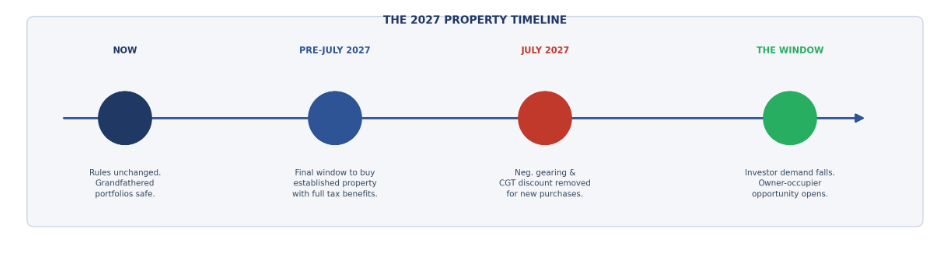
Starting July 2027, negative gearing on established properties is gone for new purchases. If you buy an existing home as an investment after that date, the ability to offset rental losses against your other income disappears entirely.
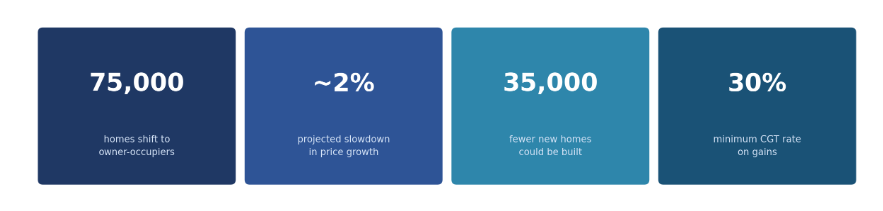
The 50 per cent capital gains tax discount goes with it, replaced by an inflation-linked system with a minimum 30 per cent tax rate on gains. Where the old system rewarded you simply for holding, the new one taxes the real return far more directly.
The critical detail getting lost in most of the commentary is this: if you already own investment property, your arrangements are grandfathered. The rules change for future purchases, not the portfolio sitting in your name today. That distinction matters enormously when thinking about your next move.
Why the government is moving now
For decades, Australian tax settings made it more profitable to buy an existing home as an investment vehicle than to build a new one. The result showed up in auction rooms consistently: investors bidding on established stock with a structural cost advantage built into their numbers, prices running ahead of wages, and first-home buyers consistently outcompeted not because they lacked effort but because the after-tax calculations favoured the other side of the room.
The government is betting that removing those incentives for established properties will cool demand and redirect investor capital toward new construction, where negative gearing still applies. Treasury expects roughly 75,000 homes to shift from investor to owner-occupier ownership over the next decade and projects near-term price growth to slow by around two per cent.
Whether those projections hold depends on a long list of variables. The direction of intent, however, is clear.
The winners and the right move for each of them
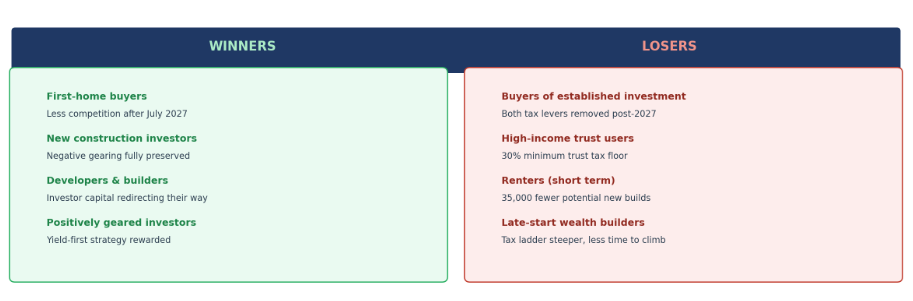
The structural shift this budget creates for owner-occupier buyers is straightforward as a market dynamic: when investor demand for established property falls after July 2027, the auction rooms that have consistently outpriced first-home buyers start to change character. Fewer bidders running tax-advantaged numbers means less competition. Softer price growth means deposits have a better chance of keeping pace. The window between those two effects opening and any supply response rebuilding prices is the timing opportunity this budget creates.
The practical call for buyers in that position is not to move immediately. The market shift the budget is designed to produce has not happened yet. July 2027 is when the rules actually change, and the advantage window opens after investor demand starts cooling, not before. The move worth positioning for is the one you make when that window is open, with a deposit that has had time to grow and prices that have not yet rebounded from new supply.
Investors who move into new construction also come out ahead. The government has deliberately preserved negative gearing for newly built homes, build-to-rent developments, and specific housing programs. Off-the-plan apartments, house-and-land packages, and new townhouse developments are the clearer play going forward.
The losers and what it means in practice
Under the current rules, buying an established investment property produces two structural tax advantages at opposite ends of the holding period. The rental loss is deductible at your marginal rate while you hold it, and the gain at sale attracts only half the normal tax when you exit. Under the new rules for any purchase made after July 2027, both of those advantages are gone.
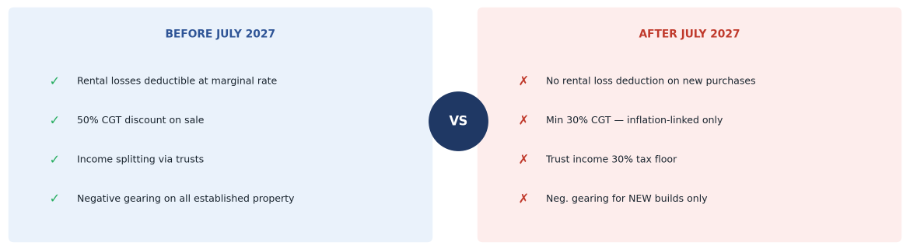
The after-tax return on established residential investment looks materially different as a result. Not necessarily unworkable, but different enough that any planned purchase needs to be modelled from scratch before committing. If the existing strategy relied on those deductions and that discount to make the numbers work, the numbers need to be run again before July 2027.
High-income households using discretionary trusts face a direct hit from the new minimum 30 per cent trust tax. The income-splitting arrangements that many wealthier families have relied on to reduce their effective tax rate are squarely in the crosshairs. That conversation with your accountant should happen before the end of this financial year, not after the rules take effect.
The group that tends to get forgotten in the early commentary is renters. Treasury acknowledges the tax changes could result in around 35,000 fewer homes being built. If investors step back from the established market faster than new construction fills the gap, rental supply tightens before affordability improves. The estimated median rent increase is around two dollars a week. Modest on paper, but the direction matters in a market that was already under pressure before this budget landed.
Where the money goes instead
The capital that was flowing into established residential property does not evaporate. It redirects. Understanding where it goes is where the real opportunity sits in the new environment.
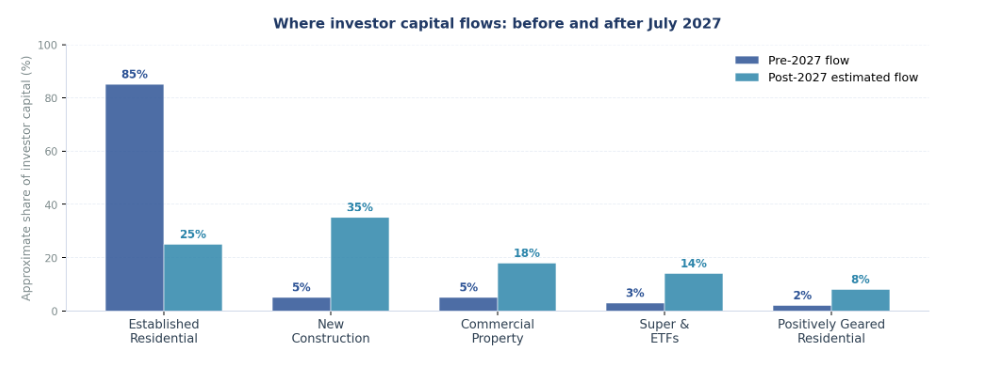
The shift is away from capital growth plus tax arbitrage and toward cash flow and fundamentals. It is a structurally different market, one that rewards investors who understand yield and quietly punishes those whose strategy depended on the deduction and the discount to make the numbers work.
What this means depending on where you sit
Your position in 2026 determines almost everything about how you should respond.

In your 20s or 30s and trying to buy: the structural conditions are moving in your favour but they have not moved yet. Keep building your deposit, avoid overpaying for property that may soften once investor demand retreats, and stay ready to act when the window opens after July 2027.
Already own investment property and are in your 40s or 50s: you are mostly protected through grandfathering, and there is no need to rethink your existing holdings. The clearer signal is that expanding further into established residential is a diminishing-returns strategy going forward. The conversation to have with your adviser this year is whether your next move is a new build, a commercial asset, a super contribution, or an ETF position rather than another established house.
Still building wealth at 40 or 50, perhaps after a career disruption or a later start: this budget makes things genuinely harder. Property investing has been the catch-up vehicle for a generation of late starters, and the weakened tax advantages make that ladder steeper at exactly the moment when there is less time to climb it. If established property is part of your strategy, acting before July 2027 is meaningfully better than acting after.
The retirement question not getting enough attention
Watch what financial advisers are actually doing in client sessions right now. Twelve months ago, most of those conversations were focused almost entirely on the next residential purchase. They are now covering super contributions, ETF income strategies, private credit, and commercial property exposure. That shift in professional practice is a reliable signal of where the structural change is landing hardest.
The government is sending a clear message that future retirement planning cannot lean on tax-favoured housing wealth the way it has for the past two decades. For anyone sitting between 45 and 60, that is a practical problem with a closing window for response, not an abstract concern. The conversation is worth having sooner rather than later, while the choices are still open.
The bigger picture
This budget may mark the start of a slow structural shift in how Australians think about property. From housing as a primary wealth engine toward housing as shelter first and investment second.
Whether it fully materialises depends on factors still in play. How much new supply actually gets built, where interest rates move, how migration tracks over the next three years. These are all live questions.
What is already settled is that the rules have changed. The investors who come out ahead from here are the ones who accept that quickly, run honest numbers on the new environment, and stop trying to play the old game. The window between now and July 2027 is not a time to watch. It is a time to act.
This article is general information only and does not constitute financial or investment advice. Please consult a qualified financial adviser before making investment decisions.