

Home Loan Borrowing Capacity: 10 Ways to Increase It
Most borrowers discover their home loan borrowing capacity is lower than expected after they have already found a property they want. That sequence is the problem. Lenders do not just assess income. They assess the entire structure of your finances, which includes every credit limit, every liability, every spending pattern over the past three to six months.
The gap between what you think you can borrow and what a lender will approve is rarely about income. It is almost always about debt exposure, credit facilities, and how your spending profile looks to an automated assessment engine.
These are fixable problems. But only if you address them before you apply.
Why Small Financial Changes Have a Large Impact on Borrowing Capacity
This is the part most borrowers miss. Lenders do not calculate what you can afford based on your income alone. They run a serviceability assessment that models your capacity to repay the loan if interest rates were 3 percentage points higher than your actual product rate. That buffer, set by APRA, is applied to every active credit facility you hold, not just the new loan you are applying for.
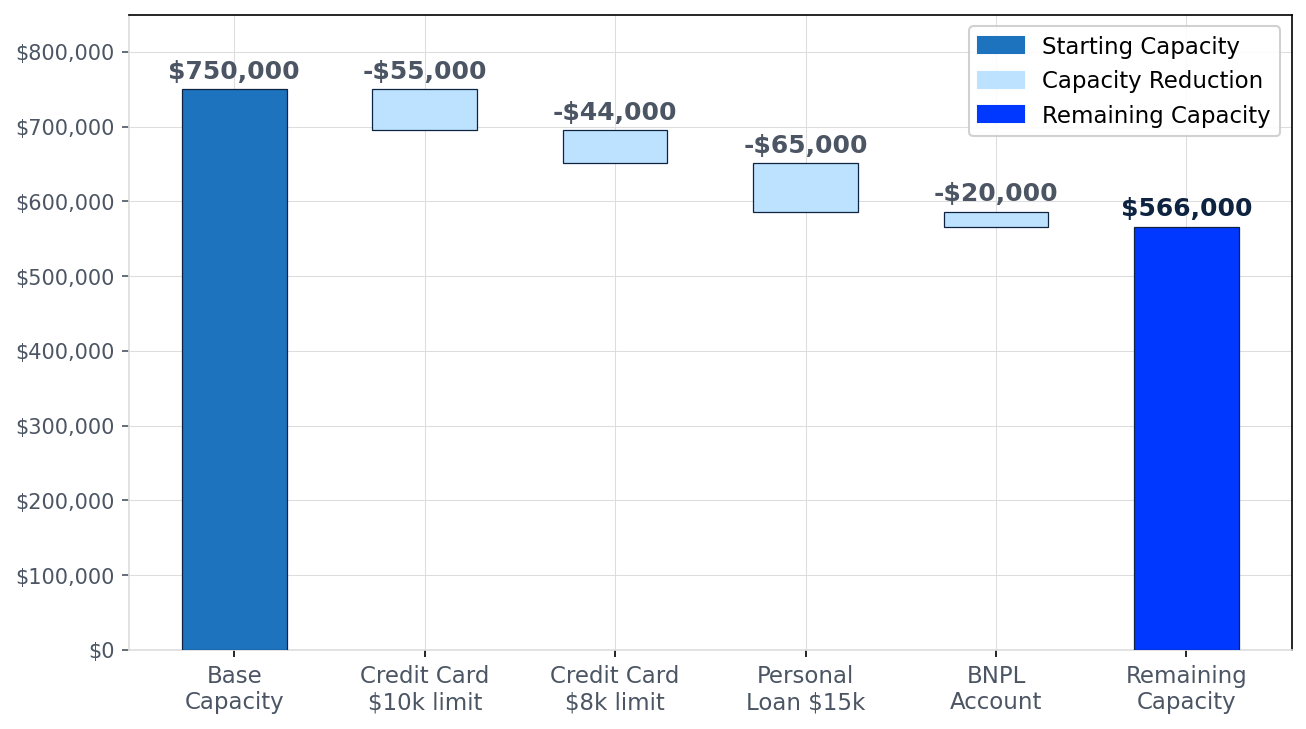
A single $10,000 credit card limit reduces assessed borrowing capacity by approximately $45,000 to $55,000, depending on the lender. That is not a typo. Lenders assume a minimum monthly repayment obligation on the full credit limit, even if you carry no balance.
How Existing Credit Facilities Drain Your Borrowing Capacity
Source: APRA Prudential Practice Guide — Residential Mortgage Lending
Action 1: Reduce Credit Card Limits Before Applying
Most borrowers know their credit card balance does not matter much. Fewer know their credit limit matters a great deal. Lenders do not assess the balance you carry. They assess your total limit as a theoretical liability because at any point, you could draw that limit down.
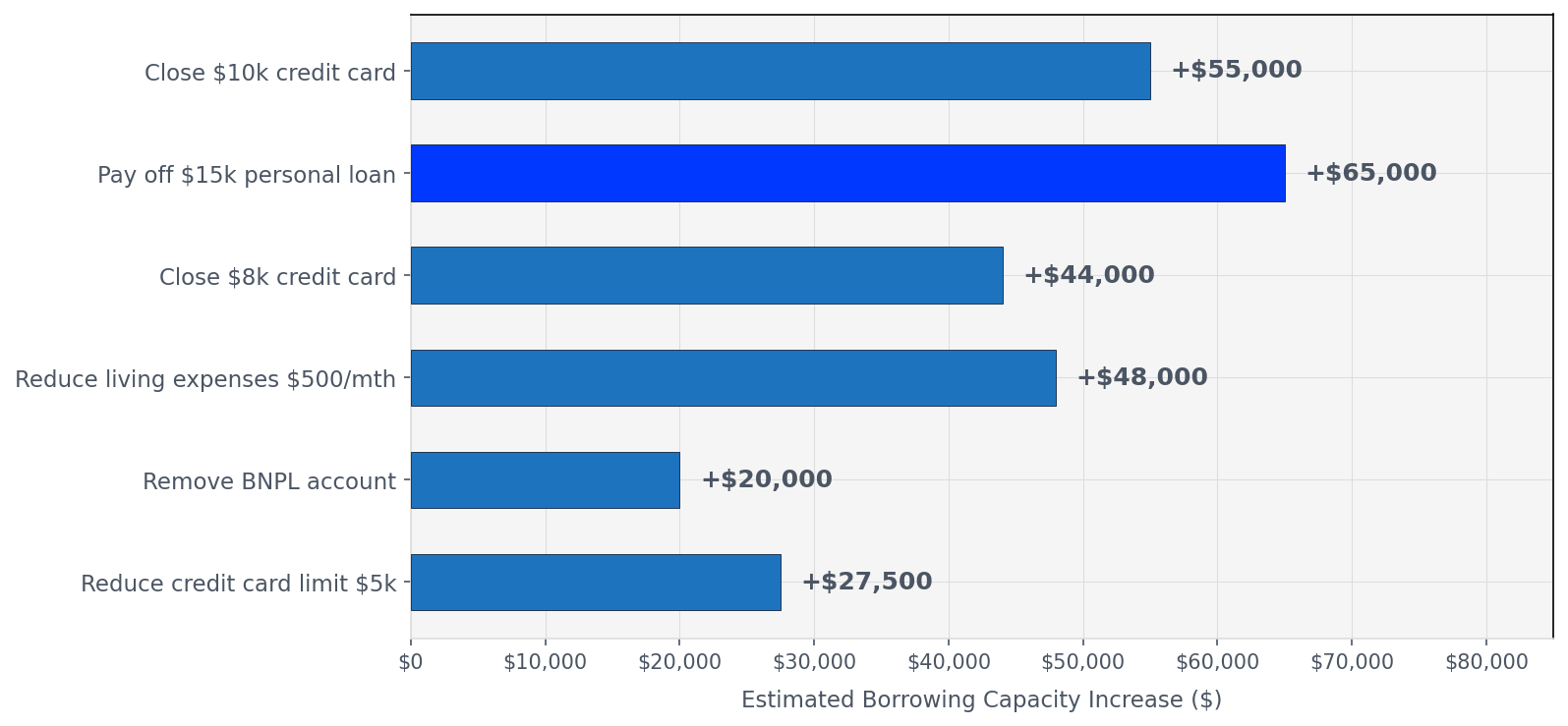
Reducing a $15,000 credit card to $3,000 can increase your assessed borrowing capacity by $55,000 or more depending on the lender. Closing it entirely produces an even larger improvement. The process takes a phone call and a few business days to reflect in your credit file.
Action 2: Pay Down Existing Debts Strategically
The order in which you pay down debt matters. Fully closing a personal loan has more impact on borrowing capacity than halving the balance. This is because lenders assess the monthly repayment commitment, not the outstanding balance in isolation. Eliminating a debt removes that repayment entirely from the serviceability calculation.
Prioritise debts by repayment size, not by interest rate. If a $12,000 personal loan costs $350 per month in repayments, retiring that debt removes $350 per month from your assessed liabilities, which can translate to $50,000 to $70,000 more in approved borrowing capacity.
FOR EXAMPLE
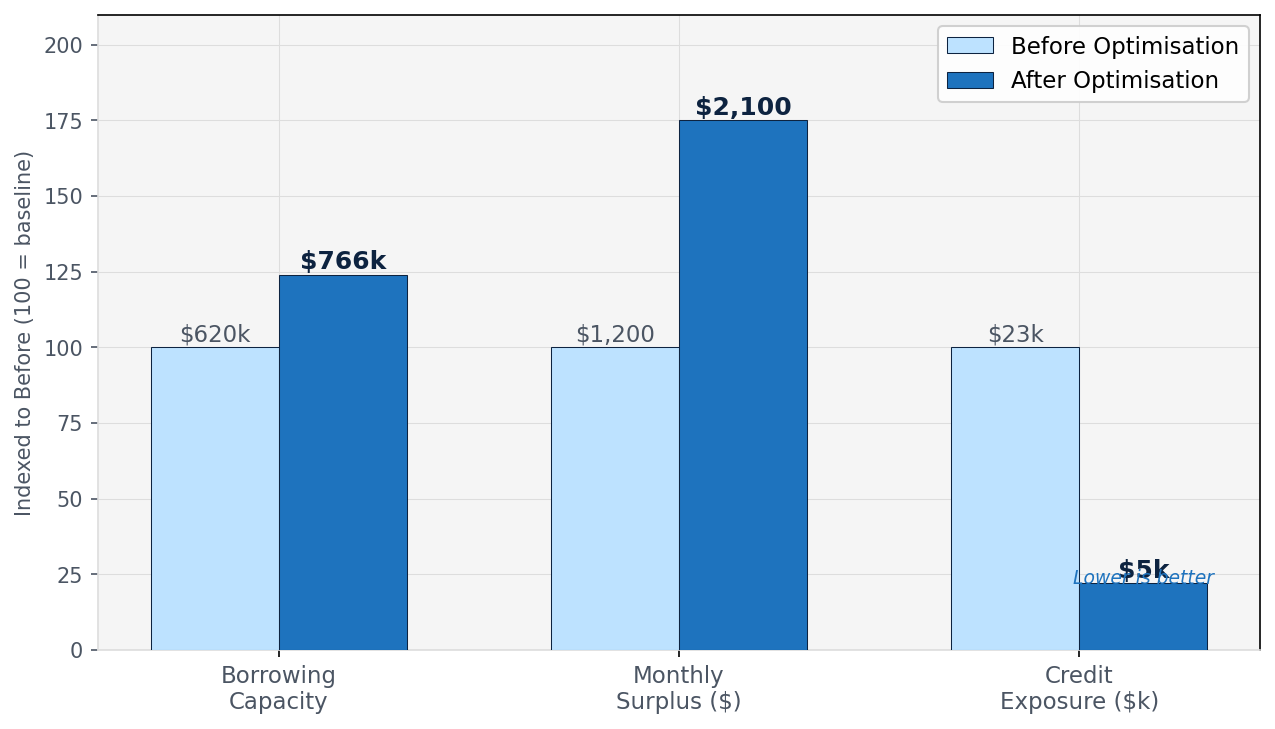
A borrower earning $120,000 with two credit cards totalling $18,000 in limits and a $15,000 personal loan applies for a home loan. Before changes, assessed borrowing capacity is $580,000. After closing both credit cards and repaying the personal loan, assessed capacity rises to approximately $766,000. The same income. A completely different outcome.
Action 3: Remove Buy Now Pay Later Accounts
BNPL platforms are treated as credit facilities by most lenders. Even an inactive Afterpay or Zip account with a $2,000 limit can reduce assessed borrowing capacity by $15,000 to $25,000. The fix is straightforward: close any BNPL account you will not actively need before applying.
This includes accounts you signed up for years ago and have barely used. If it is registered in your name, most lenders factor it in.
Estimated Borrowing Capacity Increase by Action
Source: APRA Serviceability Guidelines 2024 / FPW Group Analysis
Action 4: Document Income Consistently
How lenders assess income is more nuanced than most borrowers expect. Base salary is straightforward. But overtime, commission, rental income, and business income are often assessed at 80% to 100% of value depending on the lender and the consistency of the income stream.
If you have received a pay rise recently, make sure it appears on at least two consecutive payslips before you apply. A verbal confirmation from your employer does not carry the same weight as two matching payslips. Similarly, if you have secondary income from a side business or freelance work, that income typically needs two years of tax returns to be fully assessable.
Action 5: Reduce Visible Living Expenses in the Lead-Up
Lenders examine your actual bank statements, usually covering three to six months prior to your application. Patterns they look for include recurring discretionary spending, gambling transactions, subscription services, and irregular large outflows. None of these are necessarily disqualifying, but the aggregate picture they create affects how your expenses are assessed.
Serviceability is calculated using the higher of your declared living expenses or a benchmark figure (the Household Expenditure Measure). If your stated expenses are already above the benchmark, reducing them genuinely helps your assessment.
Action 6: Avoid New Credit Applications Before Applying
Every credit enquiry appears on your credit file. Multiple enquiries in a short window signal financial stress to lenders, even if each individual application was for something minor. Car financing, a new credit card, a phone plan with a credit check — these all count.
In the 90 days before applying for a home loan, avoid any new credit application that triggers a hard enquiry. This includes "checking your borrowing capacity" through comparison websites that perform full credit checks rather than soft searches.
Action 7: Use Equity More Effectively
If you own an existing property, usable equity can reduce the loan-to-value ratio (LVR) on a new purchase, which directly improves how lenders assess the application. A lower LVR reduces risk in the lender's model, which can influence the rate offered and the likelihood of approval at the requested amount.
The common mistake is assuming equity access is automatic. Lenders assess the combined LVR across your portfolio. If your existing property is highly leveraged, drawing equity may not significantly change your borrowing position. This is worth mapping through a broker before assuming equity solves the problem.
Action 8: Consider Refinancing Before Applying
If your existing home loan carries a high interest rate, refinancing to a lower rate before seeking a new loan can meaningfully improve your serviceability position. Lenders assess the repayments on your existing debt as part of the serviceability calculation. A lower rate on that debt creates more assessed surplus monthly income.
This approach has a timing implication. Refinancing triggers a credit enquiry and starts a new loan history. In some cases, allowing the new loan to season for three to six months before the next application produces better outcomes than applying immediately after refinancing.
Action 9: Time Your Application Around Employment Stability
Starting a new job in the months before applying can reduce your assessed income even if your salary is higher. Most lenders require three to six months in a current role for PAYG employees, and longer for contractors or newly self-employed borrowers. If you are planning a career change, consider whether to apply before or after the transition.
Probationary employment is assessed differently across lenders. Some exclude income during a probation period entirely. Knowing which lenders treat probation more favourably (and which penalise it) is where a broker adds immediate value.
Action 10: Get Documentation Ready Early
Most application delays are documentation delays. Having your last two payslips, three months of bank statements, tax returns for the past two years, and a full list of liabilities prepared before starting the process reduces lag time and prevents additional credit enquiries from being run while paperwork catches up.
If you are self-employed or have multiple income sources, prepare more. A document delay in a rising market can cost you a property. Preparation is not administrative — it is strategic.
The 90-Day Pre-Application Borrowing Capacity Timeline
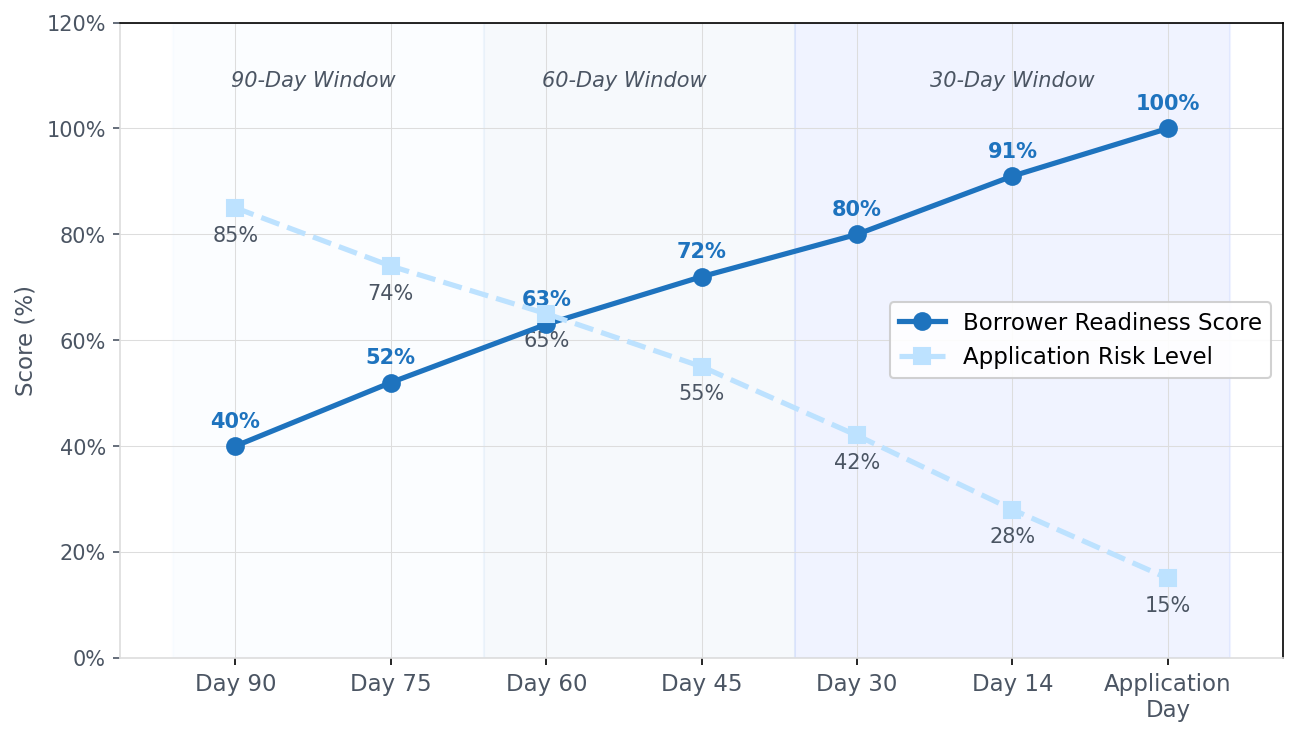
Most borrowers wait until they have found a property before thinking about finance. That is the wrong sequence. A structured 90-day preparation window gives you enough time to reduce credit exposure, stabilise documentation, and arrive at an assessment with the strongest possible financial profile.
The 90-Day Readiness Timeline
Source: APRA Lending Standards Review 2024 / MoneySmart Home Loan Guides
90 Days Before: Close and Reduce
Request credit limit reductions on all cards not needed for the application period
Close BNPL accounts and personal lines of credit not actively in use
Begin repaying personal loans and aim for full closure, not just balance reduction
Stop any non-essential credit applications immediately
60 Days Before: Stabilise
Maintain consistent monthly spending patterns and avoid large irregular purchases
Ensure all income streams are documented with at least two consecutive payslips
Check your credit file for errors using a free credit report from Equifax or illion
If considering refinancing, initiate that process now, not during the application window
30 Days Before: Prepare
Assemble full documentation: payslips, tax returns, bank statements, liability list
Run a soft borrowing capacity assessment with a broker and not a comparison site
Confirm your deposit structure and confirm stamp duty in your target state
Do not apply for any new credit facilities at all during this window
What Preparation Actually Produces: Before vs After Optimisation
The combined effect of the steps outlined above is not marginal. A borrower who enters an application with two credit cards, a personal loan, and three months of inconsistent spending will receive a meaningfully different assessment result than the same borrower three months later — with reduced credit exposure, documented income, and a clean statement period.
Borrower Profile: Before and After a 90-Day Optimisation Window
Source: FPW Group Broker Data 2024-25 / CoreLogic Finance Analysis
These are not theoretical gains. They reflect the actual impact of removing assessable liabilities. The income did not change. The financial structure did.
Common Mistakes That Reduce Borrowing Capacity
Beyond the proactive steps above, several common behaviours actively work against borrowers in ways that are not always obvious.
Applying to multiple lenders simultaneously. Each application triggers a hard enquiry. Multiple enquiries in a short period signal risk, even if each application would be approved individually.
Consolidating debt into the home loan application. Adding personal debt to a home loan application increases the assessed loan size and often worsens the LVR. This can also attract lender mortgage insurance costs that exceed the interest savings.
Declaring lower living expenses than your statements support. Lenders cross-reference declared expenses against actual bank statements. If the numbers diverge significantly, the assessment defaults to the higher figure, and the inconsistency may trigger additional scrutiny.
Assuming pre-approval equals full approval. Conditional pre-approval is based on declared information. The formal assessment at application can produce a different result if financial circumstances have changed, if the property valuation comes in lower, or if documentation does not match declared figures.
Final Thoughts
Home loan borrowing capacity is not a fixed number. It is a snapshot of your assessed financial position now you apply. That means it is adjustable, and it is most effectively adjusted in advance.
The investors and owner-occupiers who arrive at a home loan application having spent 90 days preparing their finances consistently receive higher approval figures, faster processing times, and more lender options than those who apply without preparation. The difference is not income. It is structure.
If you are working toward a property purchase and want to understand what your borrowing capacity looks like right now, the right first step is a conversation with a qualified mortgage broker before you start inspecting properties.
Frequently Asked Questions
Recommended Reading
Two pages selected based on what readers of this article are most likely to need next.
Recommended Video
As rates rise, many people immediately assume it is no longer a good time to invest. But in reality, the opportunity has not disappeared—it has simply shifted. This episode explains why higher interest rates do not automatically remove your ability to invest, but they do change your borrowing power, your cash flow, and the price point that makes sense for you.