

Can You Buy an Investment Property With Less Than $100k in Australia?
The short answer is: sometimes. But the more useful question is what $100k actually covers because the deposit is rarely the only thing standing between an investor and settlement.
In 2026, tighter lending conditions, elevated property prices in most capital cities, and a 3% APRA serviceability buffer have reshaped what realistic entry looks like. This article breaks down the true cost of an investment property deposit in Australia, where $100k still works, and where it no longer stretches far enough.
What Does $100k Actually Cover?
Most investors entering a property search with $100k available assume that figure represents their deposit. In practice, it represents their entire upfront cash requirement and that distinction matters enormously.
A minimum deposit for investment property in Australia typically sits at 10% of the purchase price, though lenders will often accept 5% if Lenders Mortgage Insurance (LMI) is paid. On top of the deposit, investors need to account for stamp duty, conveyancing and legal fees, building and pest inspections, and a cash buffer post settlement.
Investors planning an acquisition should also understand the home loan pre approval process before beginning their search.
What Does $100k Actually Need to Cover?
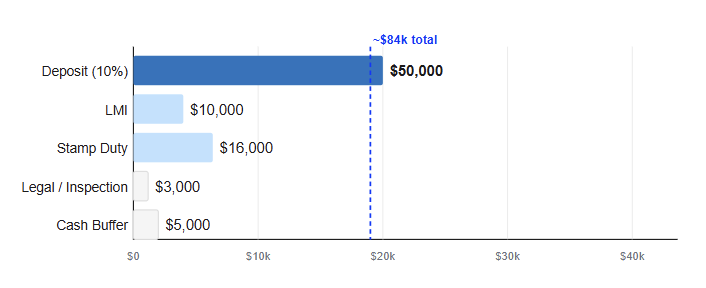
On a $500,000 regional property at 10% LVR, the deposit accounts for roughly 60% of total upfront cash required and not the full amount.
Source: State revenue office calculators; lender LMI schedules, 2025 to 2026.
The True Cost of Buying an Investment Property in Australia
Investment property costs in Australia are consistently underestimated at the research stage and only fully understood at the settlement statement.
Stamp duty is the single biggest variable. It differs by state, by purchase price, and by whether the investor qualifies for any concessions. Most do not because investment properties are excluded from first home buyer schemes.
For Example
A $500,000 investment property in Queensland attracts approximately $15,525 in stamp duty. The same property in Victoria incurs roughly $21,970. That $6,000 to $7,000 difference is not trivial when working within a tight cash budget. It is often the difference between a workable deposit structure and a funding shortfall at settlement.
Low Deposit Investment Property: What Lenders Actually Require
Holding $100k does not automatically mean a lender will approve the loan. In 2026, APRA's serviceability buffer requires lenders to assess repayments at 3% above the actual lending rate. On an investment property loan at 6.5%, that means the assessment rate is 9.5%. Borrowing capacity shrinks accordingly.
This is the variable most first time investors underestimate. Not the deposit, but the income required to service the debt at assessment rate.
Lenders also scrutinise rental income differently for investment properties. Typically, only 70 to 80% of projected rental income is counted toward serviceability. A property expected to return $450 per week is assessed as $315 to $360 per week for servicing purposes.
Where $100k Can Still Work in Australia
The honest answer is that $100k as a total upfront budget works best in regional markets where entry prices sit below $500,000. Parts of regional Queensland, South Australia, and Western Australia still offer investment grade property at price points where a 10% deposit plus costs lands within budget.
Regional Entry Points Where $100k Still Works
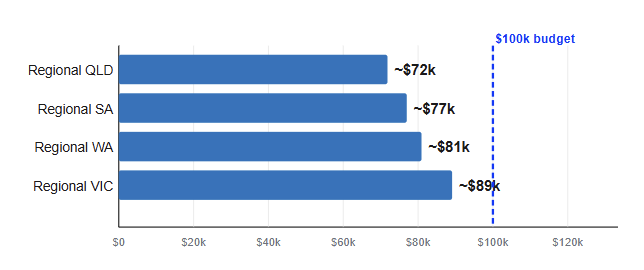
Regional Queensland and South Australia remain the most accessible entry points for investors working within a $100k total budget at a 10% LVR.
Source: CoreLogic regional median data; state stamp duty calculators, 2025 to 2026.
What Investors Often Get Wrong About Borrowing Power
In practice, borrowing capacity is the binding constraint more often than the deposit. An investor with $100k saved but a high existing debt to income ratio may find that lenders cap their maximum loan well below what the deposit would suggest is possible.
The investors who enter the market effectively in 2026 are those who have modelled their borrowing position before selecting a price point and not after.
Final Thoughts: Is a Sub $100k Entry Realistic in 2026?
Yes, but with precision. The investors making it work are entering regional markets at the right price point, with pre-approval in place, and with a clear understanding of what $100k actually needs to cover from deposit to settlement. Those approaching the question without that groundwork are the ones who discover the gap too late.
The minimum deposit for an investment property in Australia is only part of the equation. The complete picture including LMI, stamp duty, legal costs, and cash buffer is what determines whether $100k is enough.
Frequently Asked Questions
Recommended Reading
Two pages selected based on what readers of this article are most likely to need next.