

What Actually Determines Your Property Borrowing Capacity
The Finance Variables That Quietly Shape Borrowing Power
When investors think about how much property they can buy, the first assumption is usually simple: income determines borrowing capacity.
The logic appears straightforward. A higher salary should lead to a larger loan approval, which in turn allows an investor to purchase more property. Many buyers enter the market believing this relationship is largely linear.
In practice, lending decisions rarely operate that way. Borrowing capacity is influenced by a far broader set of variables than most investors initially expect.
Income certainly matters, but lenders also evaluate how stable that income is, how existing debts interact with it, and how the entire financial position performs under conservative stress scenarios.
For property investors in particular, borrowing power becomes less about a single number and more about how an entire financial structure behaves. Two investors earning similar incomes can receive very different loan approvals depending on how their finances, assets, and liabilities are arranged.
Understanding this distinction is often what separates investors who continue expanding from those who unexpectedly reach a borrowing ceiling.
Why borrowing capacity is more complex than most investors expect
Banks do not evaluate loan applications using one universal formula. Each lender applies its own serviceability models, policy settings, and internal risk buffers when assessing borrowing power.
These models are designed to test whether a borrower could continue servicing their debt even if economic conditions changed. Interest rates are typically assessed above current market levels, rental income is reduced to account for vacancy risk, and living expenses are benchmarked against household profiles.
Because of this layered assessment, borrowing capacity behaves more like a financial framework than a fixed number.
Small changes in income composition, loan structure, or portfolio design can alter the outcome considerably. A borrower who appears comfortably positioned today may find the assessment shifting once additional properties, new liabilities, or lending policy changes enter the equation.
For this reason, investors who approach lending strategically often begin with financial structure rather than property selection. Through Finance, borrowers can map how lenders interpret their financial position and design loan structures that preserve borrowing flexibility as their portfolio grows.
The income factor lenders care about most
While income remains central to any lending decision, lenders rarely focus on the raw figure alone. What they prioritise instead is the reliability and durability of that income.
Stable, predictable earnings provide lenders with confidence that repayments will remain manageable even if conditions change. Salary income, long term employment, and consistent rental payments tend to strengthen this perception of reliability.
Income that fluctuates frequently can produce a different outcome. Bonuses, contract income, or rental payments that vary significantly may lead lenders to apply more conservative assumptions when calculating serviceability.
This is one reason rental stability becomes increasingly important as portfolios expand. When properties are managed effectively, rents remain aligned with market conditions, vacancies are minimised, and tenant performance becomes more predictable.
Strong oversight through Property Management helps ensure that the income supporting a portfolio remains stable rather than irregular, which in turn strengthens the financial profile lenders rely on when assessing borrowing capacity.
Why property value alone does not determine borrowing power
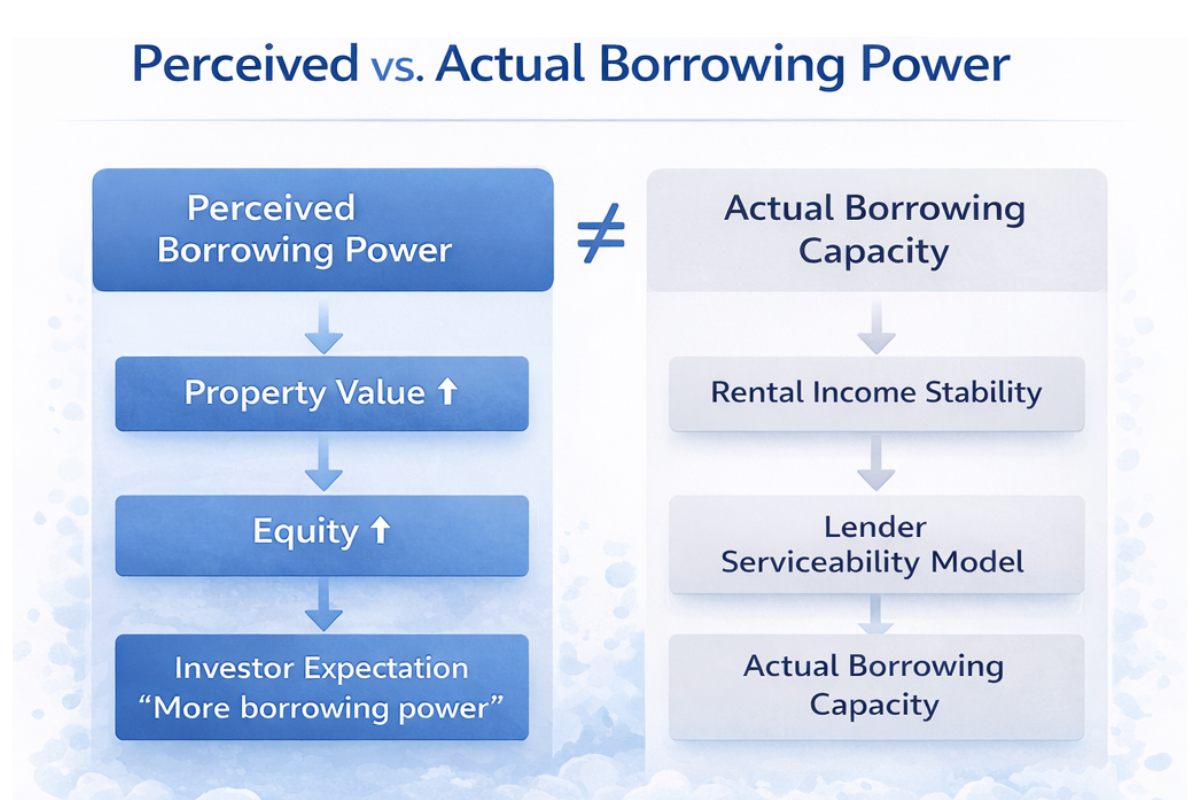
Many investors assume rising property values automatically create new borrowing opportunities. When an asset appreciates significantly, it often feels like the portfolio should naturally support further expansion.
While capital growth can increase equity, lenders do not base lending decisions solely on the value of the asset itself. Their primary concern is whether the income supporting that asset can comfortably service the associated debt.
A property may increase substantially in price while contributing relatively little to borrowing capacity if its rental income remains modest or inconsistent.
This distinction between asset value and financial functionality is explored in Does Property Value Always Equal Portfolio Progress?, where we examine why appreciation does not always translate into greater borrowing flexibility.
Understanding this relationship becomes particularly important for investors who expect rising property values alone to unlock their next purchase.
The structural shift that occurs as portfolios grow
Borrowing capacity often behaves very differently once investors move beyond a single property.
With only one asset, serviceability assessments remain relatively straightforward. Personal income carries most of the weight in the calculation, while rental income plays a supporting role.
The introduction of a second property changes this equation. Lenders begin evaluating the entire financial structure rather than a single asset in isolation.
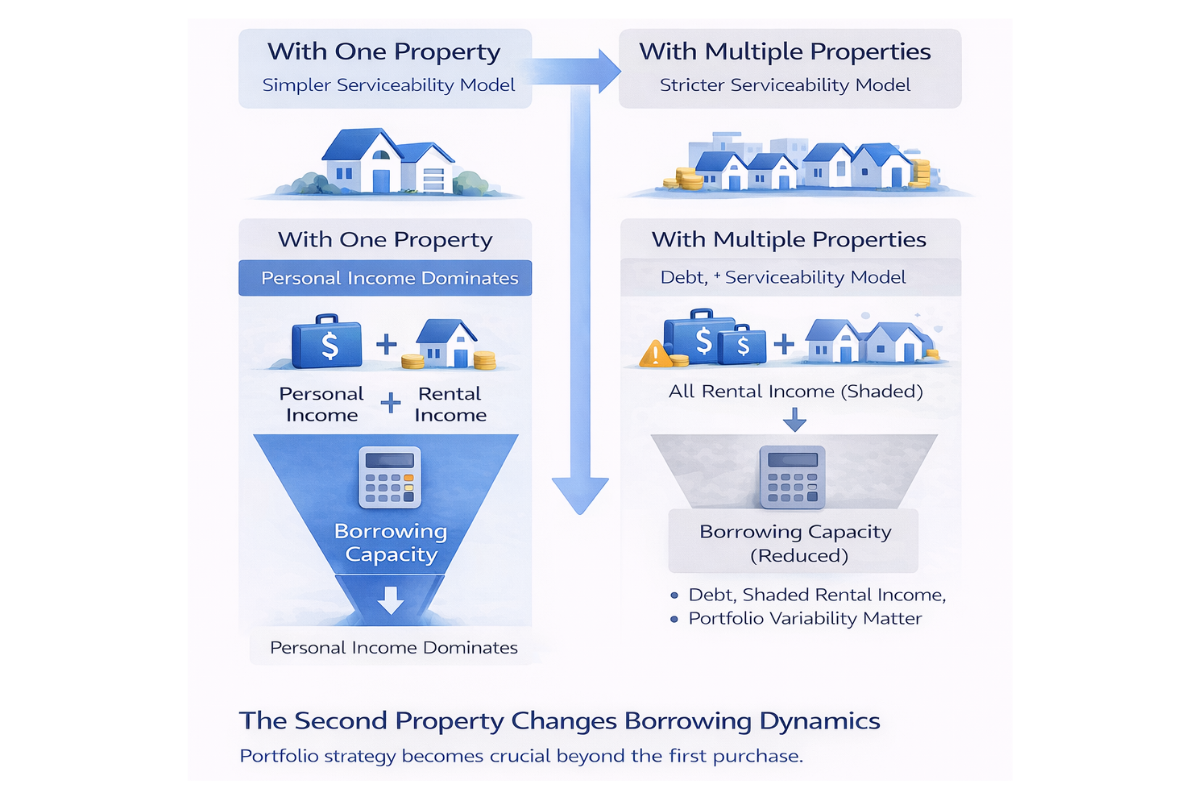
Debt exposure compounds, rental income from multiple properties is shaded, and serviceability modelling becomes more sensitive to variability across the portfolio. Small shifts that once felt insignificant can begin influencing borrowing calculations more meaningfully.
This transition is explored further in Why the Second Property Often Determines the Future of Your Portfolio, where we examine how early financing decisions can shape long term expansion potential.
For many investors, the second property marks the point where portfolio strategy becomes just as important as property selection itself.
How income volatility can quietly limit expansion
Income instability rarely appears dramatic when it first emerges. More often, it develops gradually through small changes that accumulate across a portfolio.
Rent falling slightly below market levels, short vacancy periods, or reactive maintenance costs can introduce subtle irregularities into the financial rhythm of a property.
Individually, these events may seem insignificant. When they occur across several assets, however, the overall income profile supporting the portfolio can begin to appear less predictable.
Because lenders evaluate patterns of stability rather than isolated events, these cumulative changes can influence how borrowing capacity is assessed.
This interaction between income reliability and portfolio scalability is explored in The Overlooked Risk Inside Expanding Property Portfolios, where we examine how volatility can quietly affect long term expansion.
Recognising these patterns early allows investors to strengthen the structural resilience of their portfolios before borrowing flexibility begins to narrow.
Why sophisticated investors approach borrowing capacity strategically
Investors who maintain long term momentum tend to look at borrowing capacity from a different perspective.
Rather than asking how much they can borrow today, they consider how each financial decision influences their ability to borrow tomorrow.
They examine how income durability supports serviceability calculations, how loan structures preserve refinancing flexibility, and how additional acquisitions will interact with existing liabilities.
This broader perspective transforms borrowing capacity from a simple borrowing limit into a strategic variable within the portfolio.
When finance strategy, income stability, and asset performance work together, borrowing flexibility often becomes far more resilient.
A more useful way to measure borrowing power
Borrowing capacity is often presented as a single number on a page. In reality, it reflects how lenders interpret the stability and structure behind a borrower’s financial position.
Income durability, debt exposure, loan design, and portfolio composition all interact to determine the final outcome. When these elements are aligned, investors often discover that borrowing flexibility extends further than they initially expected.
When they are not aligned, expansion can become more difficult even while property values continue rising.
For investors who want their portfolios to keep evolving, the most important question may not be how much they can borrow today. It may be how well their financial structure supports what they intend to do next.