
Credit Card Limits: Should You Reduce Them Before Applying for a Home Loan?
Most people getting ready for a home loan focus on paying down their credit card balance. It feels responsible, and it looks tidy on a statement. The problem is that lenders are not looking at your balance. They are looking at your credit card limits.
To a bank, an unused limit is money you could draw tomorrow. So a card with a zero balance can still drag down your borrowing capacity, sometimes by tens of thousands of dollars. That is why reducing or closing cards before you apply is one of the most effective moves available to a buyer.
This article explains how lenders treat credit card limits, how much they can cost you, and when reducing them is worth it.
Why Credit Card Limits Matter When Applying for a Home Loan
When a lender works out how much you can borrow, they add up every commitment that competes with a mortgage repayment. Credit cards are one of the first things they look at, and they treat them more harshly than most people expect.
The key point is that lenders assess the limit, not the balance. It does not matter that your card sits at zero. What matters is that you could spend up to the limit at any time, and the bank assumes you might.
This is part of responsible lending. Regulators expect banks to check you can manage your debts even in a worse case, which is the same thinking behind the serviceability buffer applied to your loan rate. An open limit is treated as a real liability.
How Lenders Assess Your Credit Card Limits
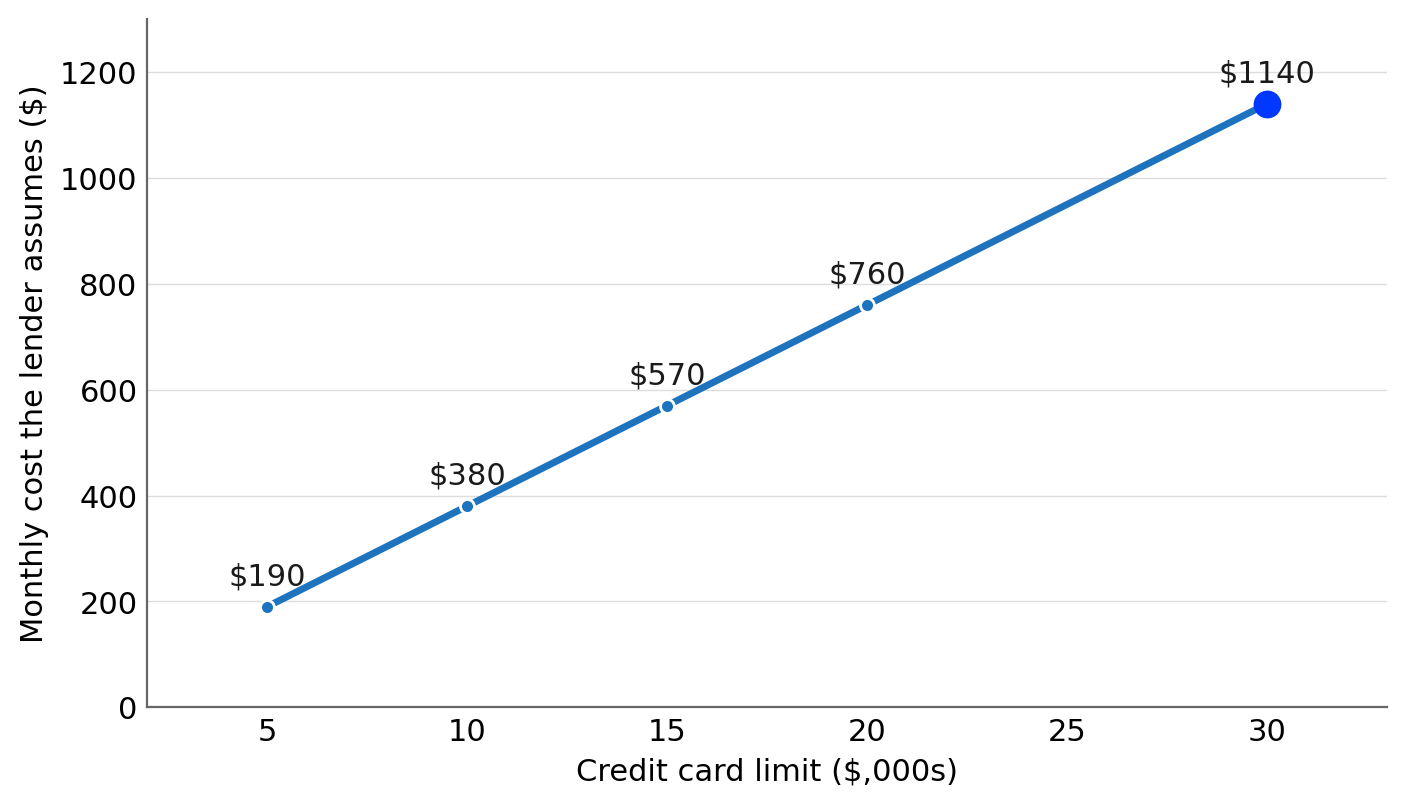
Most lenders convert your limit into an assumed monthly repayment. The common range is around 3% to 3.8% of the total limit per month, regardless of what you owe. A MoneySmart guide to credit cards explains the consumer side of this, but the serviceability impact is where it bites.
So, a $10,000 limit is treated as roughly $300 to $380 a month in commitments. That figure is subtracted from the income available to service your loan, before the loan is even calculated.
Multiple cards make it worse. Each limit is counted in full, so three modest cards can quietly remove a large chunk of your borrowing power even if you never carry a balance on any of them.
The monthly cost a lender assumes for each limit
Source: FPW analysis based on common lender serviceability policies, 2026
How Much a Credit Card Limit Can Reduce Borrowing Capacity
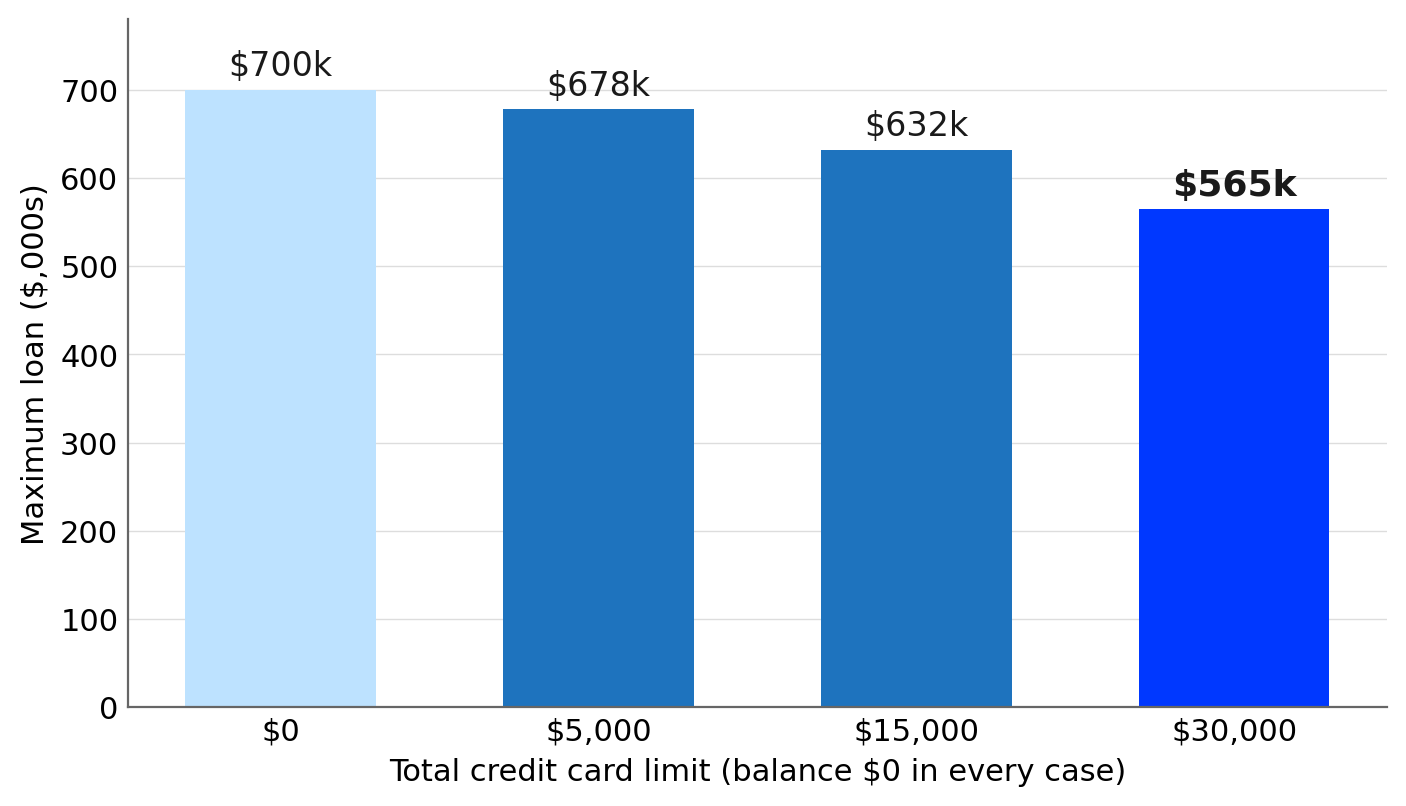
The numbers add up faster than most people realise. As a rule of thumb, every $10,000 of limit reduces borrowing power by somewhere around $40,000 to $60,000. It also pushes up your debt to income ratio, which lenders watch closely.
FOR EXAMPLE
Two borrowers, same income, same expenses, both with a $0 balance. The first holds a $5,000 limit. The second holds a $15,000 limit. On the higher limit, the second borrower is assessed with roughly $570 a month in card commitments instead of $190. That single difference can lower their borrowing capacity by close to $50,000.
Borrowing capacity falls as the total limit rises
Source: FPW analysis based on common lender serviceability policies, 2026
Should You Reduce Your Credit Card Limits Before Applying?
For many buyers, yes. If you are close to the edge of what you need to borrow, lowering or removing card limits is one of the quickest ways to recover capacity. It costs nothing and works almost immediately.
It will not help everyone. If your borrowing power is already comfortably above your target, trimming a small limit may make little difference. And if you rely on the card for cash flow or genuine emergencies, the trade-off may not be worth it.
Reducing a limit versus closing the card
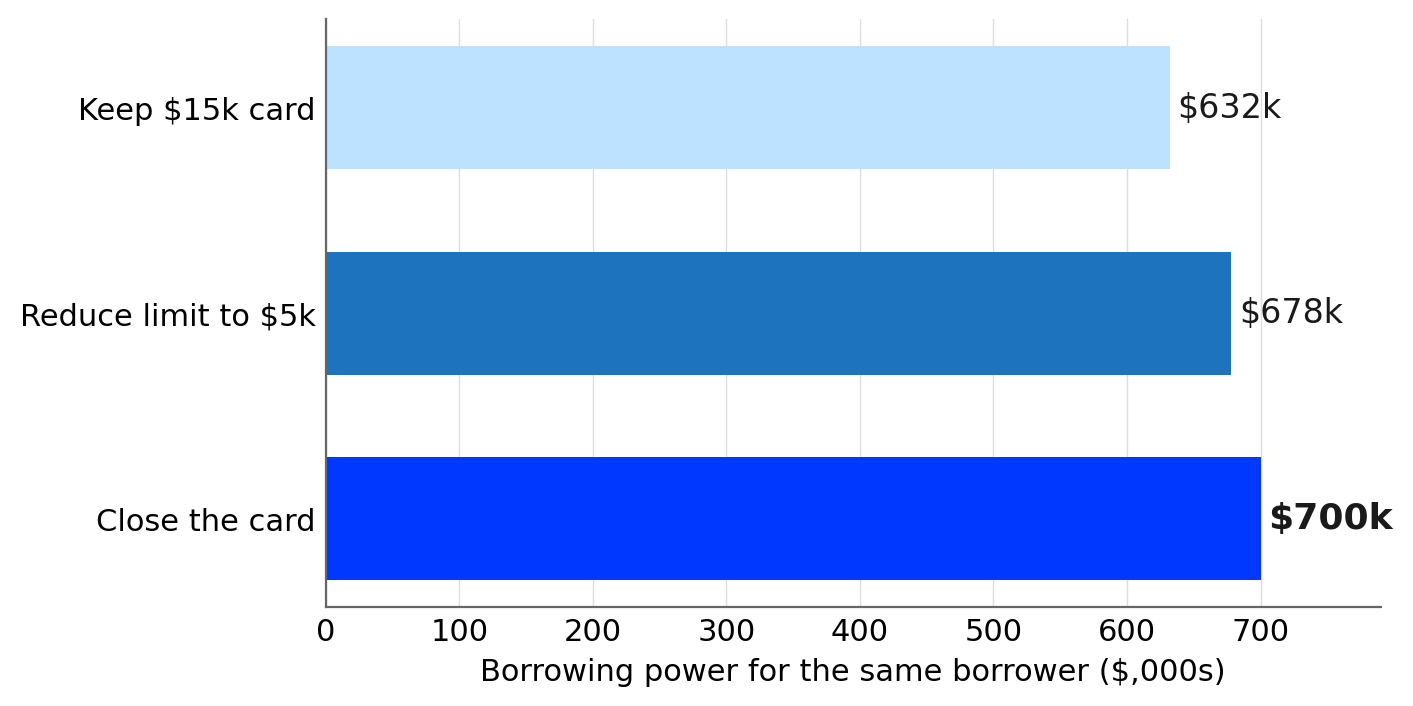
Reducing the limit lowers the assessed monthly commitment. Closing the card removes it from the assessment entirely, which gives the biggest lift. The right choice depends on whether you still need the card at all.
Reduce, close, or keep: the effect on the same borrower
Source: FPW analysis based on common lender serviceability policies, 2026
Other Ways to Improve Borrowing Capacity Before Applying
Credit cards are rarely the only liability holding you back. The broader work to increase borrowing capacity usually combines several small moves.
Clear small personal and car loans, which are counted at their actual repayment.
Reduce or close Buy Now Pay Later accounts, which lenders increasingly treat as commitments.
Review your everyday spending, since lenders compare it against a benchmark and use the higher figure.
Avoid applying for any new credit in the months before your home loan.
It also helps to know your numbers before you apply. A debt to income calculator gives you a sense of where you stand, so there are no surprises when a lender assesses you.
How several cards stack up against your borrowing power
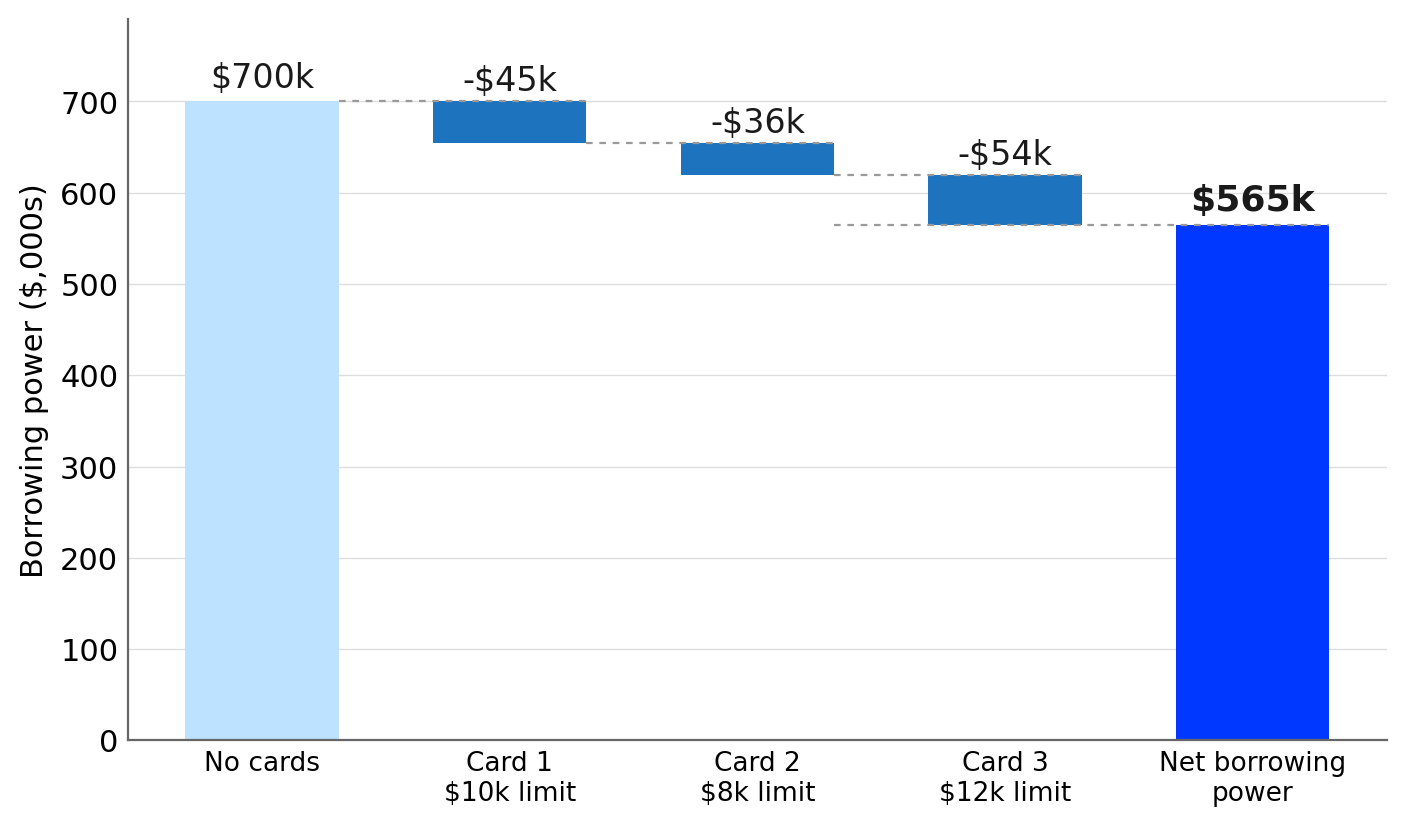
Source: FPW analysis based on common lender serviceability policies, 2026
Common Mistakes Borrowers Make with Credit Cards
A few habits quietly work against buyers in the lead up to a home loan.
The first is keeping unused cards open. A card you forgot about still carries a limit, and that limit still counts. The second is applying for new credit just before a mortgage, which adds liabilities and can put a fresh enquiry on your file at the worst possible time.
The third is assuming every lender treats cards the same way. They do not. Some are stricter than others, which is one more reason the choice of lender matters as much as the choice to reduce a limit.
Final Thoughts
Credit card limits are one of the most underestimated influences on borrowing power. Because lenders assess the limit rather than the balance, an unused card can quietly cost you tens of thousands of dollars in borrowing capacity. Reducing or closing cards you do not need is a simple, low-cost way to recover some of that ground.
Just be deliberate about it. Keep the cards that genuinely serve you, trim the ones that do not, and do it early enough to show up cleanly on your file.
Most importantly, line this up with the right lender. The same card can be treated very differently from one bank to the next and getting that match right is where the real gains are.
Frequently Asked Questions
Recommended Reading
Two pages selected based on what readers of this article are most likely to need next.
Recommended Video
What Actually Stops you from Buying your Second and Third Property
While many investors spend time researching growth areas and property types, this discussion highlights a different reality—your ability to continue investing is often determined not by what you buy, but by how your loans are structured and how your borrowing power is managed over time.