

Investment Property Loan: How Much Can You Borrow for a Property in Australia?
Your investment property borrowing capacity is the number that decides which properties you can realistically buy, and it rarely matches what a basic online calculator suggests. Lenders do not simply look at your salary. They run your income, debts, living costs and rental projections through a conservative serviceability model that assumes rates higher than the ones you pay.
That gap matters. A property that looks affordable on paper can sit just outside what a bank will approve once its buffers are applied. Understanding how the borrowing capacity formula works before you make an offer is the difference between a confident purchase and a declined application.
This guide breaks down how much you can borrow for an investment property loan in 2026, what lifts the number, and what quietly drags it down.
How Lenders Calculate Investment Property Borrowing Capacity
Borrowing capacity is what a lender believes you can repay, not what you feel you can afford. The calculation starts with your assessable income, subtracts your living expenses and existing commitments, then tests the result against a higher interest rate than the one on offer.
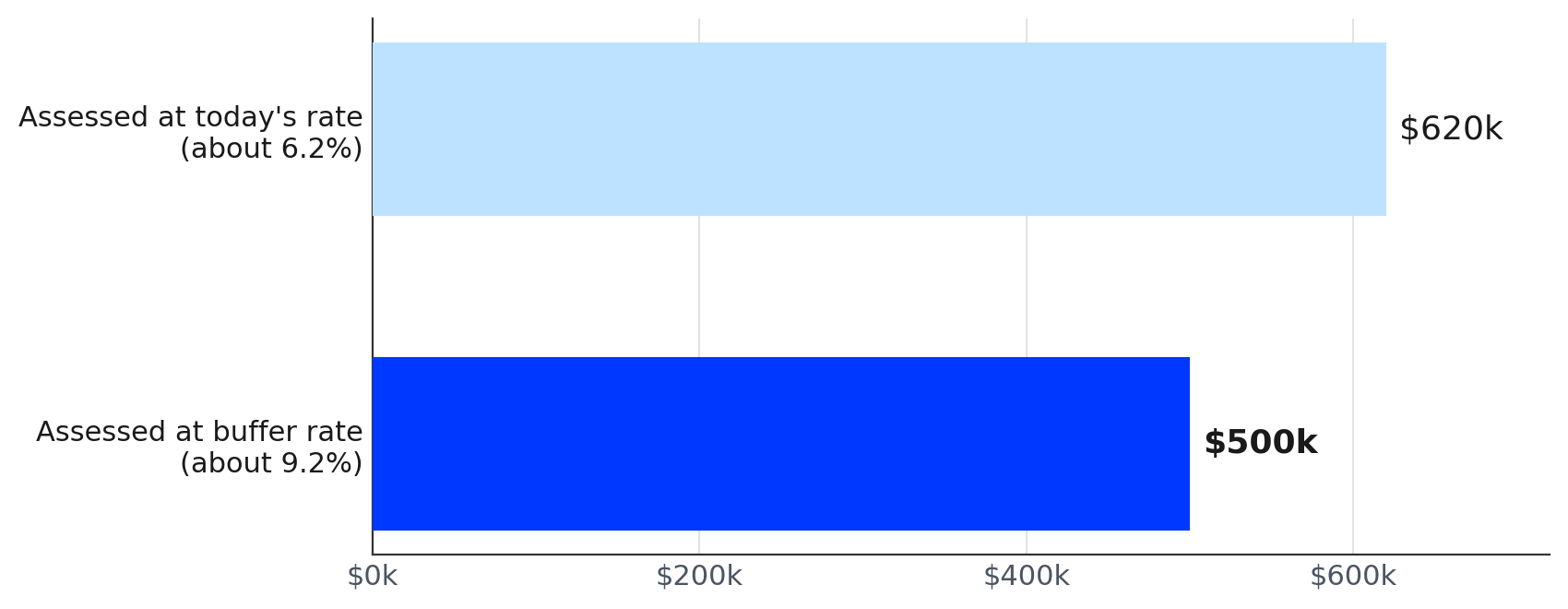
That higher rate is set by regulation. The Australian Prudential Regulation Authority requires lenders to assess repayments at your product rate plus three percentage points. With the RBA cash rate held at 4.35% and investor rates near 6.2%, most applications are tested at roughly 9.2%.
Income is not counted at face value either. Salary is usually accepted in full, while bonuses, overtime and rental income are discounted. Living costs are measured against a benchmark, so understating your spending rarely helps.
How the Serviceability Buffer Lowers Borrowing Capacity
Source: APRA, 2026
How Rental Income Affects Your Borrowing Capacity
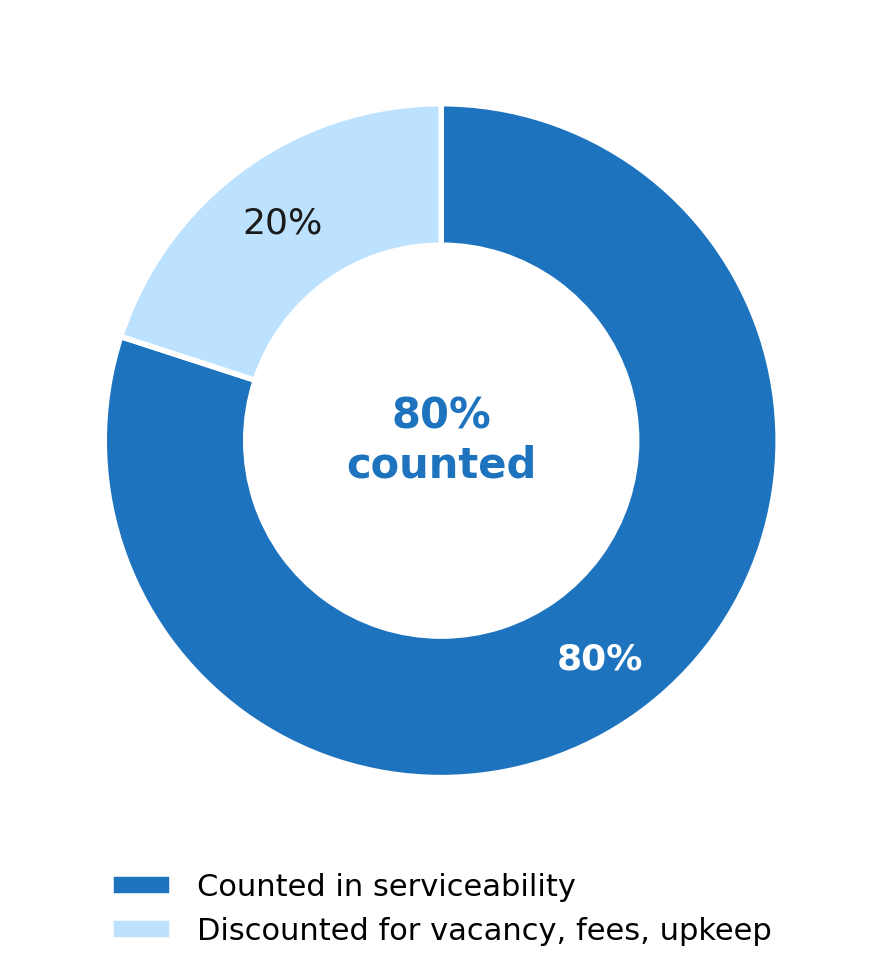
Rental income helps your application, but lenders never count all of it. They apply a discount known as shading, which sets aside part of the rent to cover vacancy, management fees and maintenance.
Most lenders count between 70 and 80% of gross rent. On a property earning $700 a week, that turns roughly $36,400 of annual rent into about $29,120 of assessable income at an 80% rate.
How Lenders Count Gross Rent in Serviceability
Source: Lender serviceability practice; MoneySmart, 2026
FOR EXAMPLE
An investor expects a $700 a week rental to add $400,000 to their capacity. After 80% shading and the assessment buffer, the usable lift is closer to $300,000. The rent did help. It simply did not stretch as far as the headline figure implied.
Shading also compounds. Each new property adds rent, but also adds shaded income and a fully assessed debt. Tight conditions in the rental market can support rents, yet lenders still model vacancy into every calculation.
Borrowing Capacity Scenarios for Different Investors
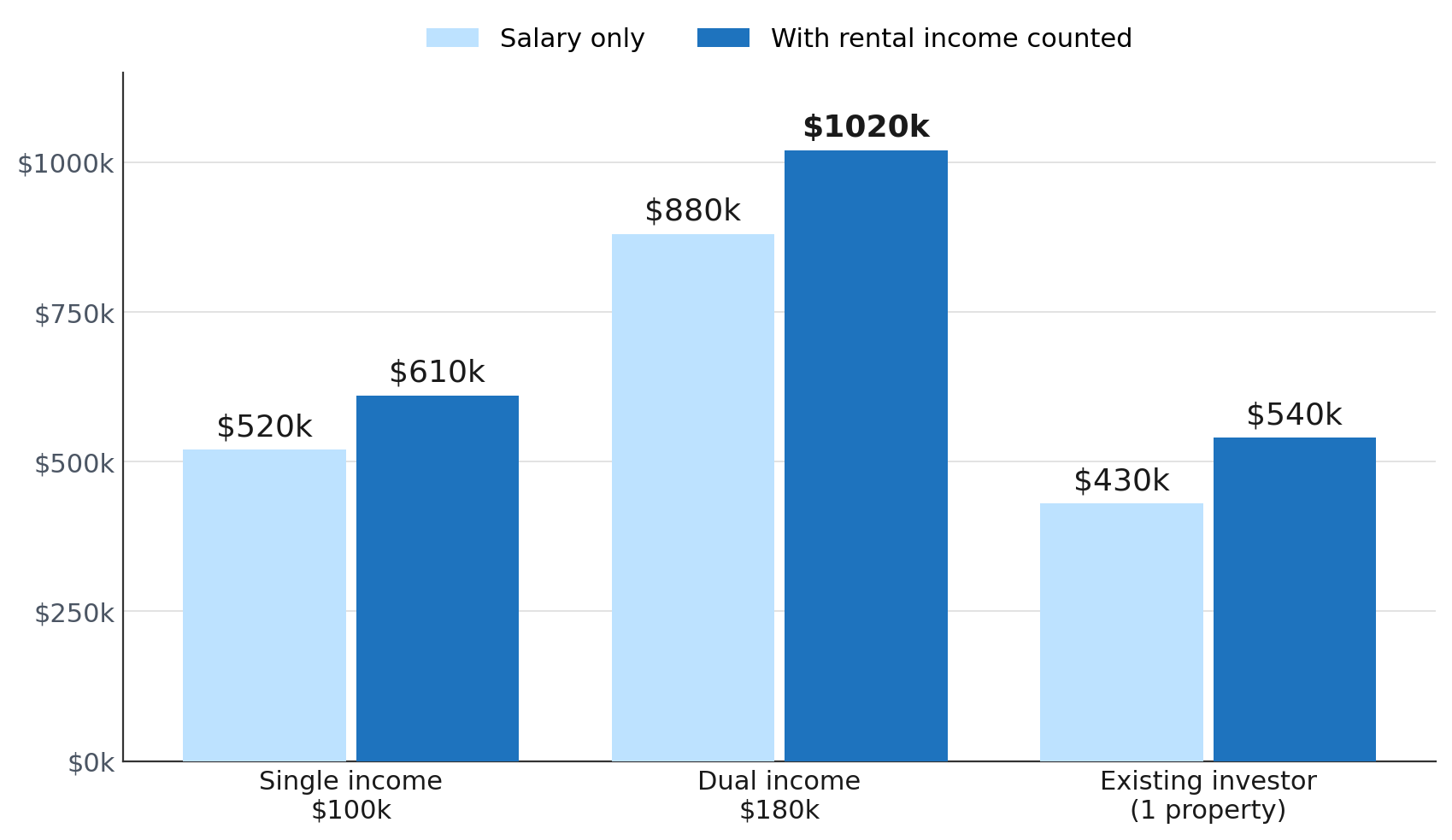
Two applicants with the same income can receive very different limits. The variables that move the number most are household income, existing debt and how rental income is treated.
Indicative Investment Borrowing Capacity by Investor Profile
Source: Modelled by FPW Group using current APRA settings, 2026
A single applicant on $100,000 might access around $520,000 on salary alone, lifting toward $610,000 once rental income is counted. A dual income household on $180,000 combined reaches materially higher.
An investor who already holds one mortgaged property looks different again. Their existing repayments are assessed in full, so residual capacity falls even when new rent is added.
How to Increase Your Investment Property Borrowing Capacity
Borrowing capacity is not fixed. Several levers can move it before you apply, and most cost nothing beyond a little planning.
Reducing unsecured debt is usually the fastest. A $20,000 credit card limit is assessed as a commitment even when the balance is zero, so trimming or closing unused limits can free up real capacity.
Why Lender Choice Decides So Much
Lenders apply different shading rates, expense benchmarks and debt-to-income tolerances. From February 2026, APRA limits banks to writing no more than 20% of new loans at a debt-to-income ratio above six. That makes lender selection more important, not less.
A broker who runs your profile across multiple lenders can find the policy mix that supports your next investment property purchase. The same applicant can be approved for very different amounts depending on whose calculator runs the numbers.
Common Mistakes That Reduce Your Borrowing Power
Some of the most common borrowing mistakes are also the easiest to avoid. They tend to surface at assessment, when it is too late to fix quickly.
High credit limits, undisclosed buy now pay later accounts and messy expense records all drag the number down. Applying to the wrong lender for your income type can cost tens of thousands in approved capacity for no good reason.
Final Thoughts
Your investment property borrowing capacity is shaped less by what you earn and more by how a lender models your risk. The three point buffer, rental shading and debt-to-income limits all sit between your income and your approval.
The investors who scale do not guess at these numbers. They understand the assessment before they shop, reduce the commitments that count against them, and choose lenders whose policies match their situation.
Borrowing power can be improved. It needs to be understood first, then managed with intent rather than discovered at the worst possible moment.
Frequently Asked Questions
Recommended Reading
Two pages selected based on what readers of this article are most likely to need next.
Recommended Video
While many investors spend time researching growth areas and property types, this discussion highlights a different reality—your ability to continue investing is often determined not by what you buy, but by how your loans are structured and how your borrowing power is managed over time.