

Can You Lose Grandfathered Negative Gearing in Australia?
Most coverage of the negative gearing grandfathering rules carries the same reassuring message: if you owned your investment property before the 2026 budget cut-off, you are protected. That is broadly true but incomplete.
Grandfathering protects the property while you hold it in its current ownership. The moment that ownership changes, the protection can change with it.
That distinction rarely matters until a life event forces it. A partner dies. A marriage ends. A spouse gets added to the title for asset protection. Each of these can quietly reset the tax position on part or all a property that everyone assumed was safe. Understanding where the 2026 Budget changes bite is now part of sensible property investment strategy, not just a tax footnote.
What Grandfathering Actually Protects
The reform itself is straightforward. From 1 July 2027, negative gearing on established residential property is limited to homes bought before the budget cut-off, with new builds carved out separately. Properties held at 7:30pm AEST on 12 May 2026, including those already under contract, keep the current rules and can be negatively geared against your salary until you sell.
The detail that trips people up is what grandfathering is attached to. It is not a personal entitlement that follows you around. It attaches to a specific property, held by a specific owner, from a specific date. On a jointly owned property, each co-owner is assessed by their own acquisition date, even though they share one title. Two names on the original pre-Budget contract means two grandfathered owners. A name added later is a different story.
The Two Dates That Decide Your Position
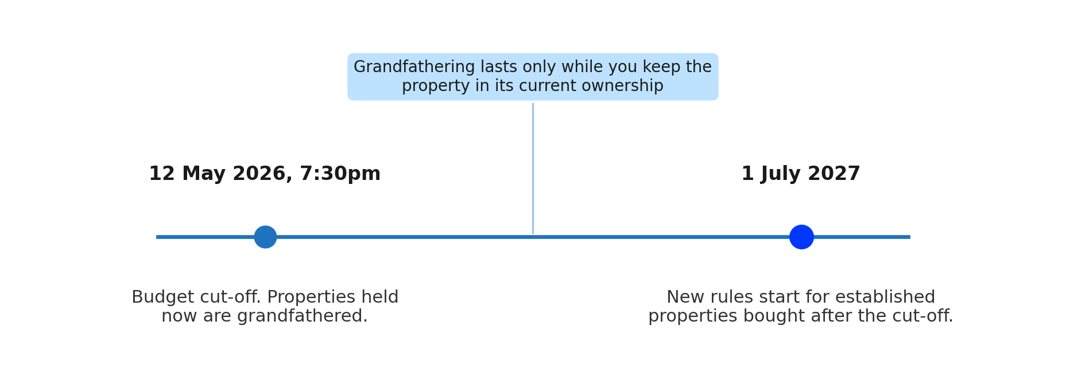
Source: Australian Taxation Office, 2026
What Happens to Grandfathered Negative Gearing When a Co-Owner Dies
This is the scenario doing the rounds, and it is worth getting right because the alarming version is probably overstated. When a property is held as joint tenants, the share of a deceased owner passes to the survivor automatically by survivorship.
The question is whether the survivor receives that share with the deceased owner’s pre-Budget grandfathered status, or as a fresh acquisition under the new rules.
The stronger reading is that grandfathering travels with the property. No market sale has taken place, title has moved through death rather than purchase, and inherited property generally retains the deceased’s acquisition date for tax purposes. On that view, the survivor keeps the grandfathered treatment on the whole property.
The catch is that the legislation has not been drafted in full, and the announced framework may include anti-avoidance rules to stop estates being used to refresh grandfathering. Until that detail lands, this case should be treated as likely protected but not guaranteed (and planned for conservatively) rather than assumed away.
FOR EXAMPLE
A couple bought an investment property together in 2019, both names on the contract. Both are grandfathered. One partner dies in 2028, and their half passes to the survivor by survivorship. On the strongest current interpretation, the survivor keeps grandfathering across the full property, because the share was inherited, not purchased. But the surviving partner should confirm this with their adviser once the legislation is settled, rather than rely on the assumption, because the cash-flow difference over a long hold is significant.
How Divorce and Separation Change the Picture
Relationship breakdown is murkier still. When a property moves between partners as part of a separation, capital gains tax rollover relief can apply, so the transfer happens without an immediate CGT event and the receiving partner inherits the original cost base and acquisition date.
What the announced framework does not yet spell out is whether that rollover also carries grandfathering across for negative gearing. The CGT side has a clear mechanism. The negative gearing side is silent. So, a partner who keeps the property after a settlement could find their grandfathered status either preserved or treated as a fresh acquisition, depending on how the final rules read.
Which Ownership Transfers Reset Grandfathering, and Which Do Not
Death and divorce are the dramatic cases, but the more common ones are the routine bits of paperwork families do without thinking about tax. The table below sets out how the main events are likely to be treated, with the usual caveat that the unsettled cases are flagged as uncertain.
How Common Ownership Events Affect Grandfathering
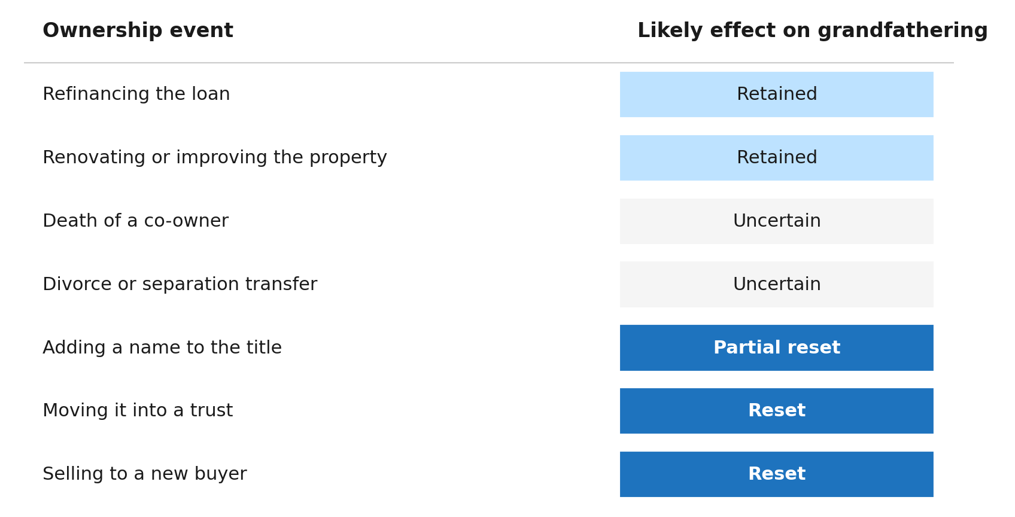
Source: FPW Group analysis of the 2026 Budget framework
Two points are worth drawing out. Adding a spouse or partner to the title does not wipe your own grandfathering, but the share you transfer to them is generally treated as their new, post-budget acquisition. And refinancing, which many owners worry about, does not change ownership at all, so it leaves grandfathering intact.
What a Reset Actually Costs in the First Year
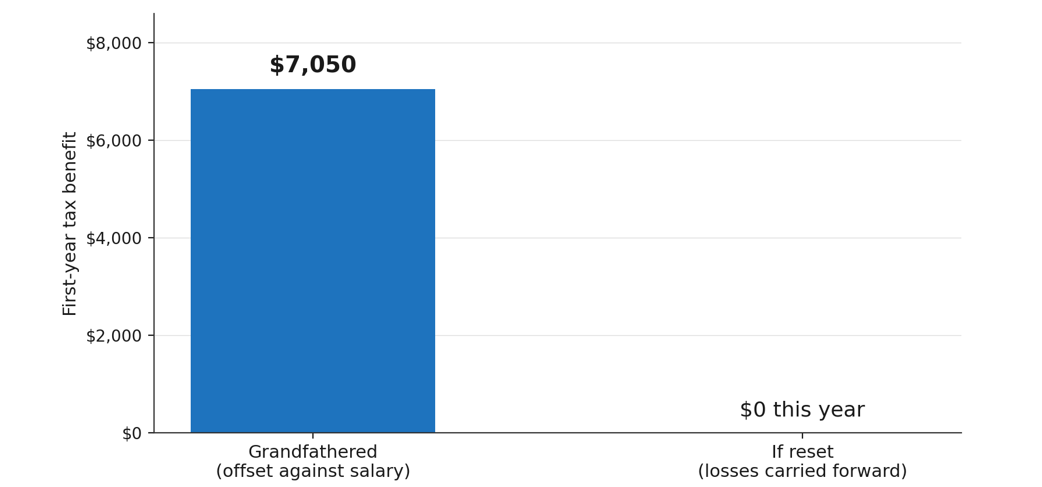
Source: FPW Group worked example
What Grandfathered Owners Should Do Now
None of this calls for panic. It calls for a review while you still have choices, rather than after an event has removed them.
Start by confirming your own position. Keep the original purchase contract and settlement records for any grandfathered property, because the acquisition date is what proves your status. If a property is jointly held, know who is grandfathered and from when.
Then look at the structures you may have been planning to change. Adding a partner to a title, shifting a property into a trust, or restructuring for asset protection all carry a tax cost now that they did not before the Budget. None of them are off the table, but they should be priced in with eyes open.
Finally, fold the property into your estate planning rather than treating the two as separate. Who inherits which asset, in what structure, now has tax consequences that compound over a long hold.
Final Thoughts
The grandfathering rules are more conditional than the headlines suggest. They protect a property in its current ownership, and the protection can move, shrink, or reset when that ownership changes. The death and divorce cases are not settled in the draft framework, and the safest assumption is that they may be, until the legislation says otherwise.
For most owners, the right response is simple. Document your acquisition dates, understand which planned changes carry a tax cost, and make ownership and estate decisions deliberately rather than letting a life event make them by default. The tax break is real. Whether you keep it depends on choices you can still control.
Frequently Asked Questions
Recommended Reading
Two pages selected based on what readers of this article are most likely to need next.
Recommended Video
Most investors think they understand the distinction, but few have ever seen the numbers modelled properly over a 25-year window. Using conservative growth, rent, and tax assumptions, this video shows how the same property can create completely different outcomes depending solely on ownership structure.