

Biggest Mistakes First-Time Property Investors Make (And How to Avoid Them)
Most first-time investors do not fail because property is a bad investment. They fail because they make avoidable decisions before they understand what drives long-term growth. The difference between a portfolio that builds real wealth and one that stagnates for a decade often comes down to a handful of choices made early.
This guide covers the mistakes that come up most consistently in first-time investor portfolios across Brisbane, Adelaide, Perth, and beyond. Understanding them before you commit is the single best form of property investment preparation available.
Why First-Time Property Investors Often Make Costly Mistakes
The information available to first-time investors has never been better. Property data platforms, market reports, and online calculators are widely accessible. Yet the mistake rate among first-time buyers has not fallen in proportion. The problem is not access to information. It is knowing which information matters and how to use it before committing to a purchase.
According to the Australian Bureau of Statistics, first-home buyer investment loans grew at 21.4 per cent in 2024, with more Australians entering the investor market than at any point in the past five years. Many of these buyers are doing so without a clear strategy, and the consequences tend to show up not immediately, but two to three years into ownership.
Top 5 First-Time Investor Mistakes: Financial Impact vs How Often They Occur
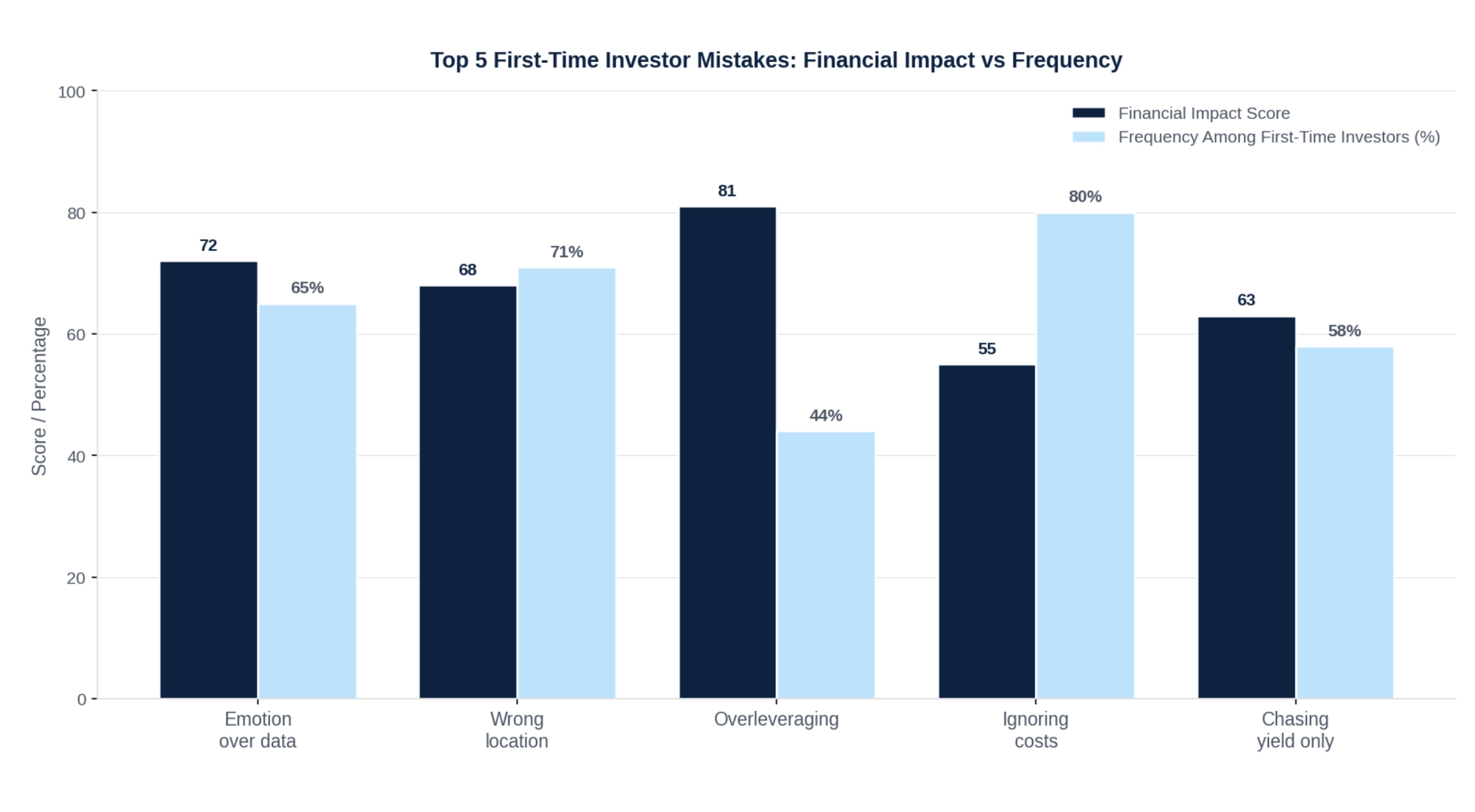
Source: FPW Group analysis drawing on CoreLogic (corelogic.com.au) investor data 2022 to 2025, PropTrack (proptrack.com.au) first-home buyer reports, and ABS (abs.gov.au) housing finance statistics. Impact scores are weighted composites based on long-term capital underperformance and cash flow disruption.
Buying Based on Emotion Instead of Data
A property that feels right and a property that performs well are rarely the same thing. First-time investors frequently buy in suburbs they know, near family, or in areas they find personally appealing. That is understandable as a homebuyer. As an investor, it is a liability.
The question to ask before any purchase is not 'Do I like this property?' It is 'What does the data say about employment growth, population trends, infrastructure pipeline, and rental vacancy in this suburb?” Those four factors drive long-term value more reliably than any aesthetic quality.
For example
An investor purchases a well-presented apartment in a lifestyle suburb based on personal familiarity. Five years later, the property has grown 6 per cent in total while a comparable entry price in an Adelaide northern suburb with AUKUS-driven employment growth delivered 47 per cent. The difference was not luck. It was a decision made before settlement.
Where First-Time Investors Focus vs What Actually Drives Long-Term Returns
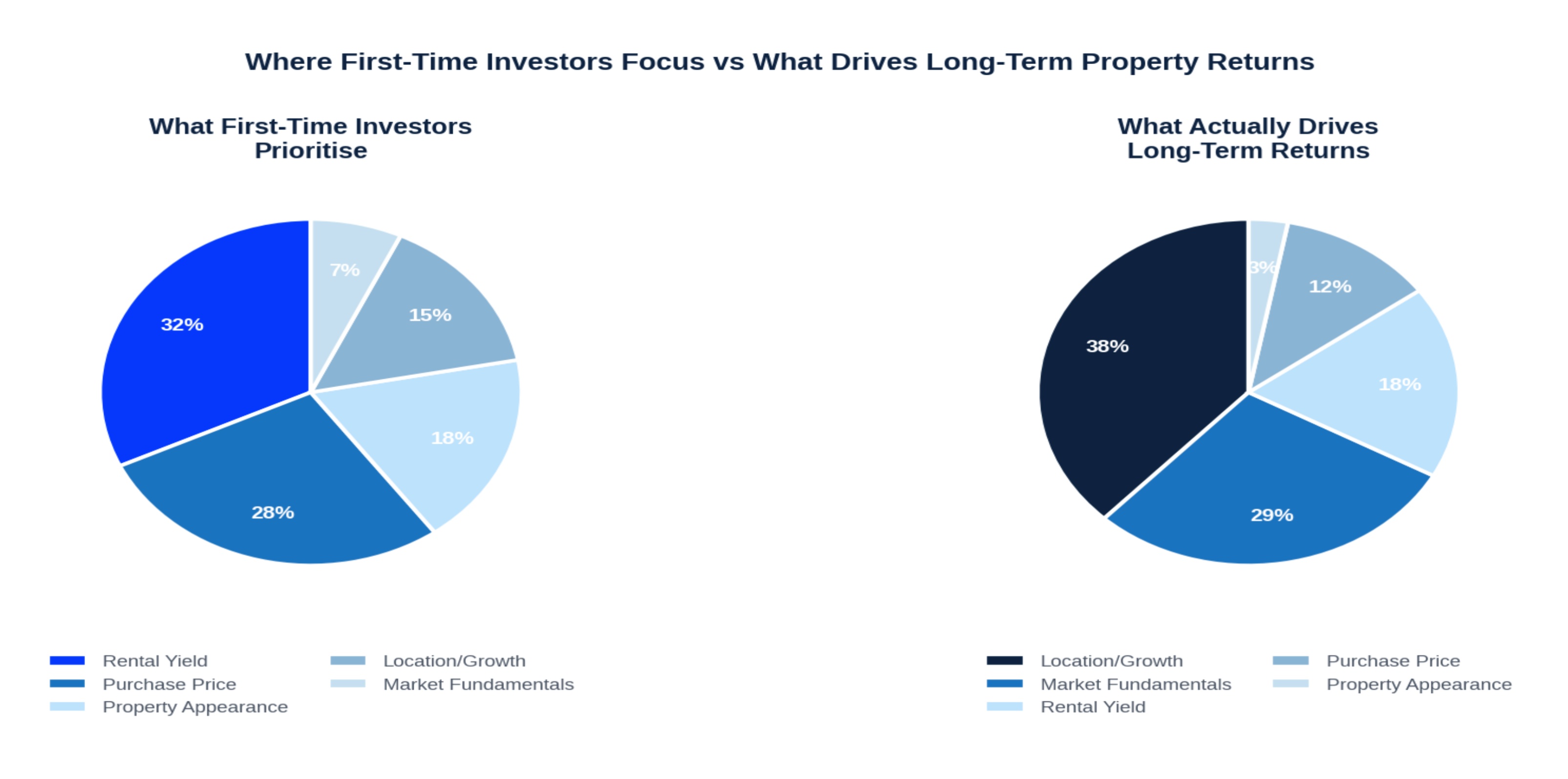
Source: FPW Group investor analysis, CoreLogic (corelogic.com.au) 10-year suburb performance data, PropTrack (proptrack.com.au) buyer behaviour research 2023 to 2025.
Overlooking Strategy Before the First Purchase
A purchase without a strategy is just an expense with a mortgage attached. Before any acquisition, investors need a clear answer to three questions: Is this property for capital growth, rental yield, or both? How does it fit within a broader property investment strategy? And how will this purchase affect my ability to buy again?
The third question is the one most investors skip. A first property that locks up all available equity and pushes the debt-to-income ratio to its limit is not a platform for portfolio growth. It is a ceiling. Strategy means thinking about purchase two before you settle on purchase one.
Ignoring Ongoing Costs and the Real Cash Flow Picture
Purchase price is the number most investors focus on. Ongoing costs are the number that determines whether the investment is sustainable. Rates, insurance, property management fees, maintenance, vacancy gaps, and property management costs can collectively add 2 to 3 per cent of the property value per year to your holding costs.
A property generating $28,000 per year in rent on a $700,000 purchase looks attractive on paper. Once management fees, rates, insurance, maintenance, and a modest vacancy allowance are factored in, the actual net yield often sits closer to 2.8 to 3.2 per cent. That is a very different cash flow position than the gross yield suggests.
Chasing High Rental Yield Without Checking Capital Growth Fundamentals
High yield and strong capital growth rarely exist in the same property at the same time. Regional towns and outer fringe suburbs frequently offer gross yields of 6 to 8 per cent. They also frequently offer capital growth of 1 to 2 per cent per year over the long term.
The result is a property that pays for itself month to month but does not build wealth at any meaningful rate. Understanding the difference between rental yield versus capital growth before selecting a target market is one of the most important decisions a first-time investor makes.
For example
An investor purchases a regional Queensland property at a 7.2 per cent gross yield in 2018. By 2024, the property has grown 14 per cent in total value. A comparable investment in a Brisbane middle-ring suburb at 4.1 per cent yield over the same period delivered 52 per cent capital growth. The yield investor received income. The growth investor built equity.
Choosing the Wrong Location and What It Costs Over Time
Location determines roughly 80 per cent of a property's long-term performance according to CoreLogic suburb analysis. Infrastructure pipeline, employment anchors, population growth projections, and school catchment data are all stronger predictors of capital growth than the condition or size of the dwelling.
First-time investors often choose location based on price, familiarity, or proximity to where they live. These are not investment criteria. They are personal preferences. The markets delivering the strongest investor outcomes in 2026 including Adelaide northern suburbs, Perth outer ring, and select Brisbane infrastructure corridors share one thing: their growth is being driven by structural demand, not sentiment.
Overleveraging and How It Limits Your Next Purchase
Buying at maximum borrowing capacity feels like ambition. In practice, it is often the single decision that stops a one-property investor from ever becoming a two-property investor. APRA's debt-to-income framework means lenders assess not just your income but your total debt exposure relative to what you earn. Maximising debt on purchase one leaves very little room for purchase two.
The investors who build portfolios consistently understand their borrowing capacity formula before they buy, not after. They buy below their ceiling on purpose, preserve serviceability, and position themselves to move again when the market or their income creates the next window.
How One Poor Purchase Affects Your Future Portfolio
The compounding effect of a poor first purchase is rarely discussed. Most articles focus on the immediate financial loss. The bigger cost is what that underperforming property prevents you from doing over the following five to ten years.
Equity that does not grow cannot be used to fund a second acquisition. A property that delivers below-market returns ties up borrowing capacity without building the net worth needed to support further purchases. For investors who are building toward a retirement income target, the time cost of one poor decision can be measured in years, not just dollars.
$500k Purchase in 2016: Strategic vs Emotion-Led Decision (Value to 2026)
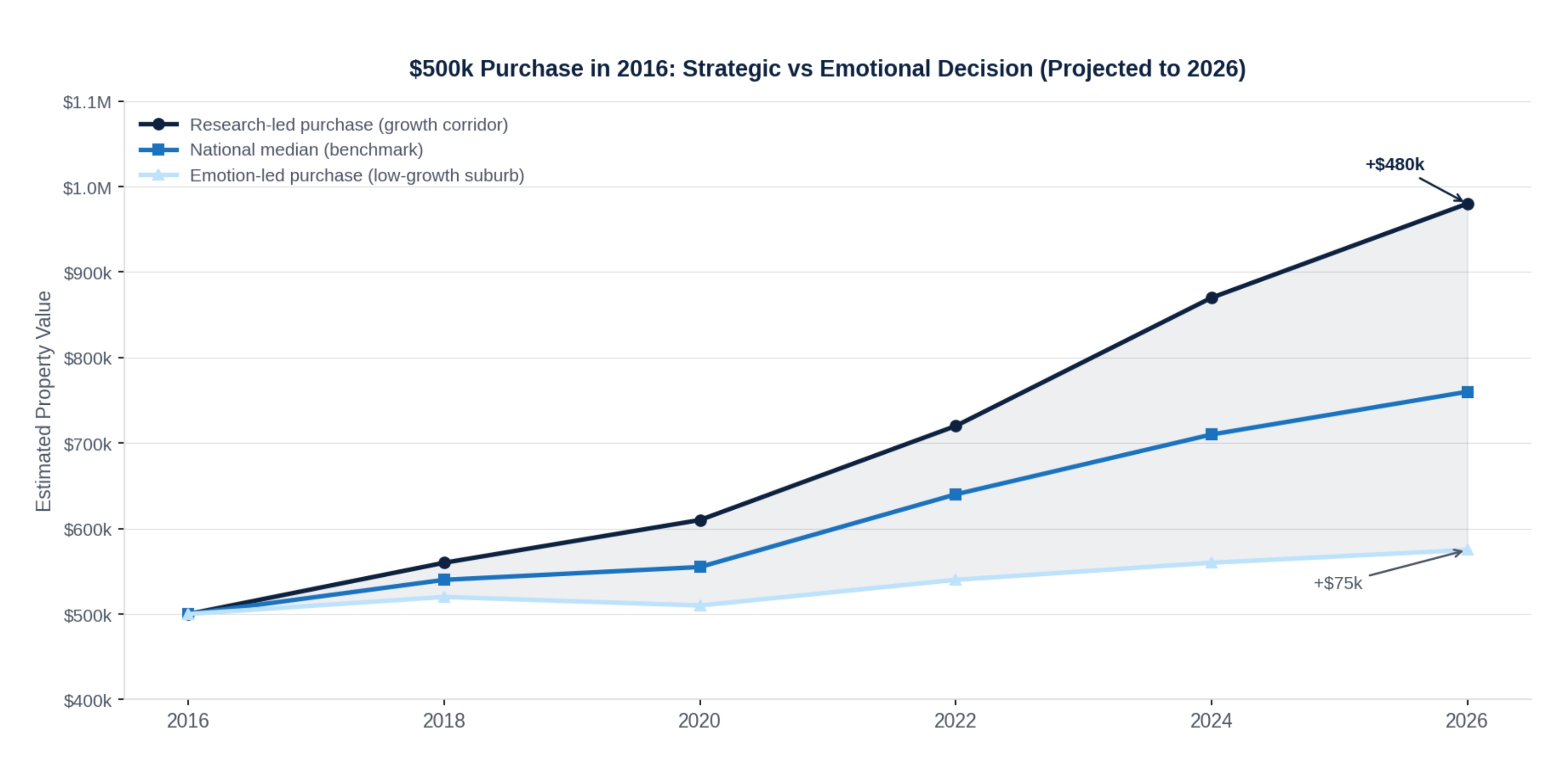
Source: FPW Group analysis based on CoreLogic (corelogic.com.au) 10-year suburb median value data. Strategic example: Adelaide northern suburb growth corridor (AUKUS employment driver). Emotional example: lifestyle suburb with low employment anchor. National median benchmark from ABS (abs.gov.au) housing finance series.
Is Property Investment Worth It in Australia?
Yes, with the right strategy. The RBA cash rate cut to 3.85 per cent in February 2026 has improved serviceability conditions. Adelaide, Perth, and Brisbane are all delivering investor returns that outperform the national median. The underlying drivers of demand, population growth, housing undersupply, and constrained construction pipelines per HIA data, remain firmly in place.
The question is not whether property works as an investment in Australia. It does. The question is whether the specific choices you make at entry level will compound into the outcome you are working toward, or become the reason you stay stuck at one property.
Final Thoughts
Most of the mistakes covered in this article are not complicated to avoid. They are common because they are easy to make when you are emotionally invested in a purchase and under pressure to act. The investors who build genuine long-term wealth from property are not smarter than everyone else. They are simply more systematic about separating what feels right from what the data supports.
If you are weighing up your first purchase or reviewing a strategy that has not delivered what you expected, understanding how to increase your borrowing capacity and which markets align with your goals is the place to start.
Frequently Asked Questions
Recommended Reading
Two pages selected based on what readers of this article are most likely to need next.
Watch: 7 Property Challenges Investors Miss
These are not dramatic mistakes or rare worst-case scenarios. They’re the pressure points that often show up after purchase—when the property is already settled, the loan is in place, and the reality of ownership starts to unfold.