

Buyer's Agent for Investment Property: How to Choose
Most investors spend months comparing properties. They research suburbs, track vacancy rates, and run yield calculations on spreadsheets, then spend about twenty minutes choosing who helps them buy.
That mismatch is where most property investment mistakes start, not at auction and not at settlement, but in the choice of who is doing the research on your behalf. A buyer's agent for investment property is not just someone who finds listings. The right one shapes your location strategy and negotiates without a conflict of interest pulling their decisions sideways.
The wrong one can quietly cost you more than their fee, and you will not see it until years after settlement, when comparable properties nearby have grown while yours has barely moved.
What Is a Buyer's Agent for Investment Property?
A buyer's agent works exclusively for the buyer. They are paid by you, not the vendor, and their job is to source, evaluate and negotiate the purchase on your behalf.
But there is a distinction most investors miss. A residential buyer's agent helps people find a home they connect with emotionally, while an investment buyer's agent is doing something structurally different. They are assessing investment-grade suburbs, and filtering out properties that photograph well but underperform across a seven-to-ten-year hold.
That is the gap a specialist fills, and it is why hiring the wrong type of buyer's agent is a real and underappreciated risk. Buying general investment property guidance without a specialist lens is part of the broader work of property investment in Australia, and this is the stage where strategy either holds up or quietly falls apart.
Why the Choice of Buyer's Agent Has Long-Term Consequences
The suburb matters far more than most investors want to believe. Two properties at the same price point, purchased in the same city and the same year, can produce genuinely divergent outcomes if the underlying suburb dynamics differ.
The difference between 4.5 percent and 8 percent average annual growth does not sound dramatic until you model it. It has almost nothing to do with luck, and comes down to the quality of the suburb selection methodology behind the purchase decision.
Modelled 5-Year Capital Growth: Specialist Selection vs Average Pick
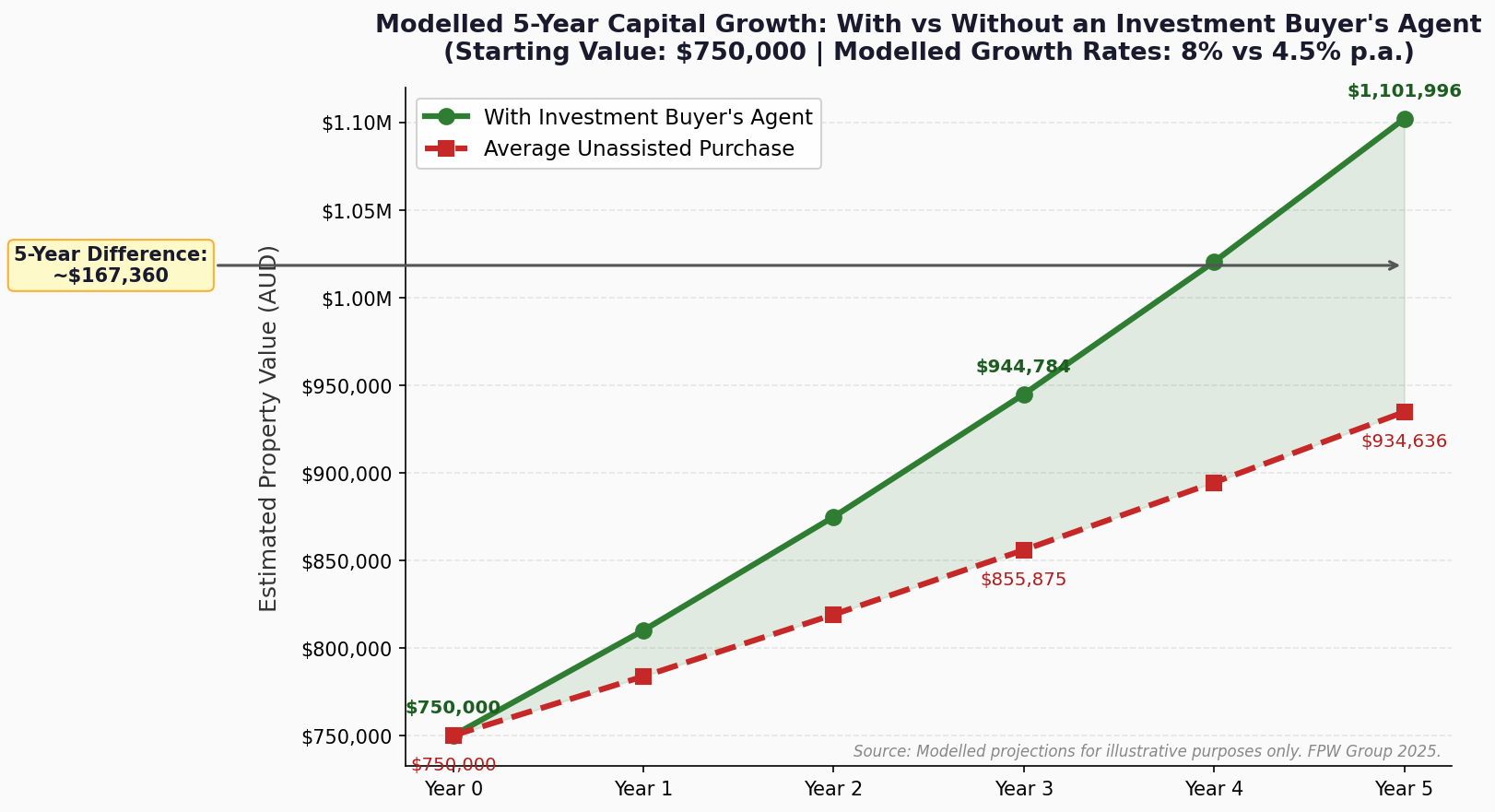
Source: Modelled projection for illustrative purposes only, referencing CoreLogic and ABS historical growth data (corelogic.com.au). Actual results will vary.
That is where skilled investment buyer's agents earn their fee. Not from access to off-market listings, but from the systematic, repeatable process of narrowing thousands of suburbs down to the ones that genuinely suit your goals.
How to Choose the Right Buyer's Agent for Investment Property
Verify Their Licence and Professional Memberships
Every buyer's agent in Australia must hold a current real estate licence in the state where they operate. Beyond the licence, membership with REBAA or PIPA adds a further layer of professional accountability.
FOR EXAMPLE
You can verify any licence directly through your state's fair trading office or consumer affairs body. A polished website is not a substitute for a valid, active licence, so do not skip this step.
Look for Investment-Specific Experience
Ask how many investment properties they have helped clients purchase in the last twelve months, and in which markets. An agent who primarily works with owner-occupiers applies a different evaluation lens, and emotional liveability criteria can quietly erode capital growth outcomes when applied to a portfolio asset.
Understand Their Property Selection Process
This is where you separate serious operators from polished marketers. Ask directly how they select investment suburbs, and expect an answer built on population growth metrics, infrastructure pipeline data and vacancy rate trends, not a general claim about experience.
Vague answers about years in the industry or a strong local network are not a methodology. If they cannot articulate their process clearly, that is meaningful information on its own.
Clarify Whether They Are Truly Independent
This is the question most investors do not think to ask until it is too late. Some buyer's agents receive referral payments from developers for directing clients toward new builds or off-the-plan apartments, which creates a conflict of interest that can skew recommendations toward stock that serves the agent's income rather than your goals.
Signs to Investigate vs Signs of a Genuine Operator
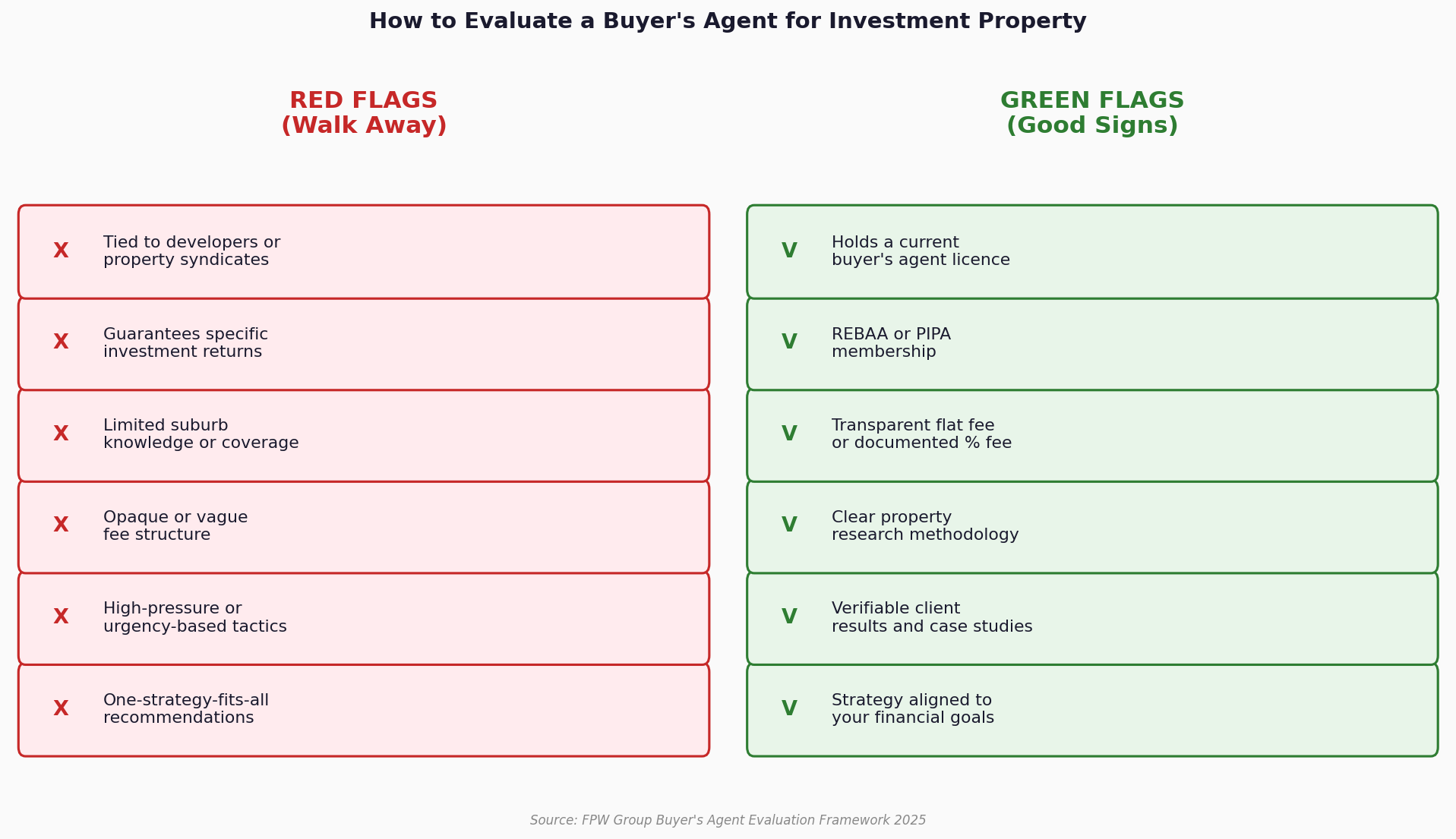
Source: REBAA Professional Standards and PIPA Code of Conduct (rebaa.com.au)
Questions to Ask a Buyer's Agent Before You Hire
Before you sign any engagement agreement, work through these directly:
How do you select investment locations, and why do those locations suit my specific strategy?
Do you receive any payments from developers, vendors or third parties?
What is your fee structure, and what does it include?
Can you share recent client results or case studies with verifiable outcomes?
How do you source off-market opportunities, and what proportion of recent purchases came from off-market stock?
Are you currently licensed in the state where I intend to buy?
Understanding Buyer's Agent Fees in Australia
Buyer's agent fees in Australia fall into three broad structures, and each has different implications for how the agent's incentives align with yours as an investor.
Buyer's Agent Fee Structures on a $750,000 Property
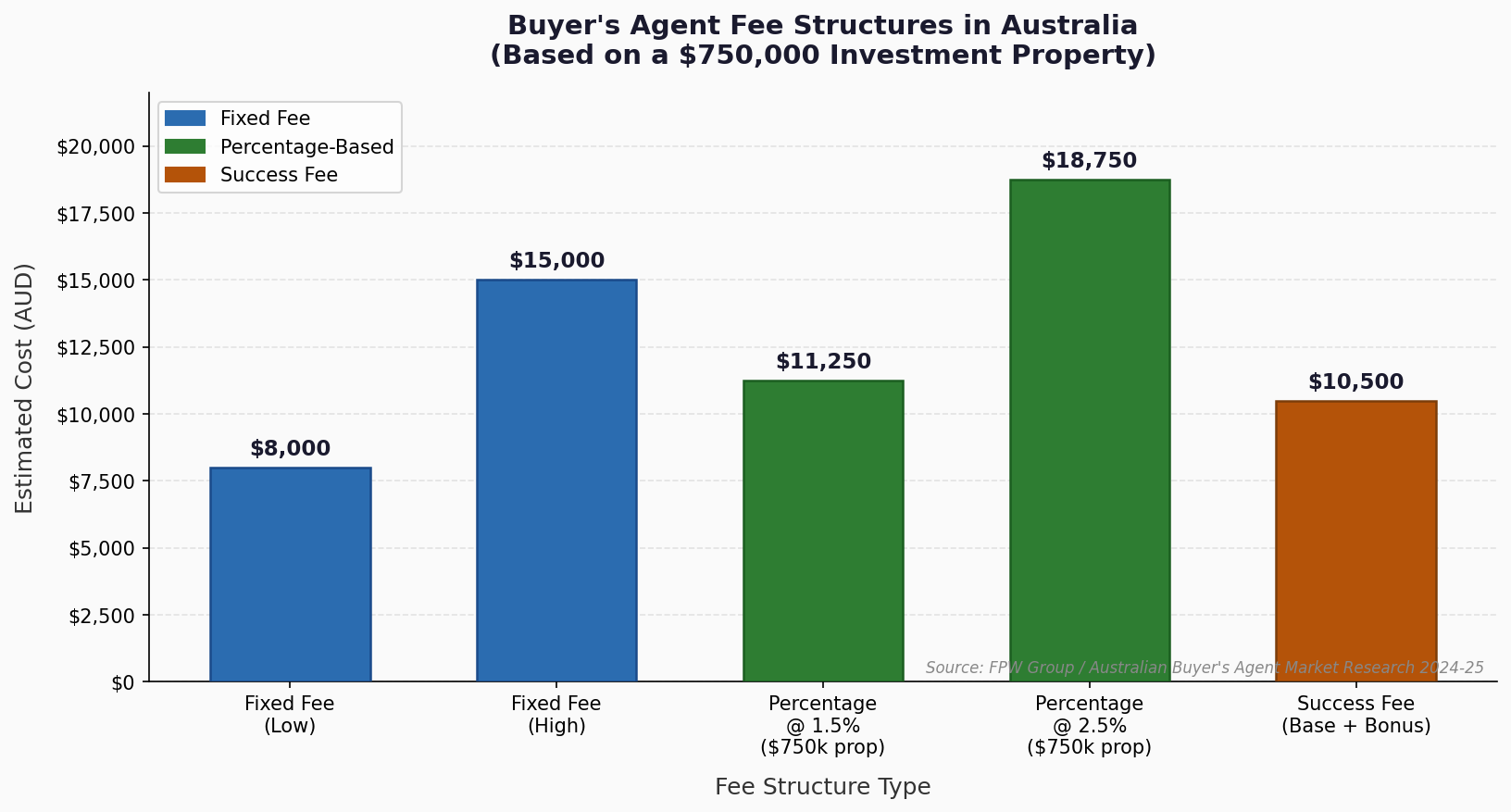
Source: REBAA industry data and Australian buyer's agent market research, 2024 to 2025 (rebaa.com.au)
Fixed fees usually run between $8,000 and $15,000 and do not change with purchase price, which removes the incentive to recommend higher-value properties. Percentage-based fees typically sit between 1.5 and 2.5 percent, which is transparent and common but means higher prices generate higher fees for the agent.
Success fees combine a lower base retainer, often $3,000 to $8,000, with a completion payment at settlement. There is no universally superior model. What matters most is full transparency before you engage, with every component disclosed and documented in writing.
Red Flags That Should Stop You From Signing
A few patterns appear consistently across buyer's agents who underdeliver or carry conflicts that were not disclosed upfront.
They push new-build or off-the-plan stock without connecting it clearly to your investment strategy.
They cannot explain in concrete terms why a particular suburb suits your goals.
They create urgency without a substantiated, data-backed rationale.
They apply the same strategy to every client regardless of borrowing position or timeline.
Their fee structure contains variable or undisclosed components.
Markets like Brisbane, Adelaide and Perth have attracted a significant influx of buyer's agent operators over the past three years, and not all of it is focused on genuine investor outcomes. Increased market activity attracts strong operators and opportunistic ones alike, and knowing how to tell the difference is the job.
Who Actually Benefits Most from Using a Buyer's Agent?
Most investors can navigate their own research when buying locally in familiar markets. The value of a specialist investment buyer's agent compounds significantly in specific situations.
You are buying interstate and lack direct access to the market, local inspection capability or established selling agent relationships. You are a first-time investor who has not yet built a systematic due diligence process, where the risk of an early mistake is often underestimated because the consequences are delayed.
You have strong borrowing capacity but limited time to do the research properly, which is exactly where shortcuts happen and where shortcuts in suburb selection get expensive. Or you are building a multi-property portfolio and need a consistent, scalable selection framework you can replicate across several purchases over several years.
Final Thoughts on Choosing a Buyer's Agent for Investment Property
The quality of the research, the discipline of the suburb selection and the rigour of due diligence behind a purchase matter more than most investors realise until they see the comparison a few years later. Choosing a buyer's agent deserves the same scrutiny as choosing the property itself.
Frequently Asked Questions
References and Citations
REBAA, Real Estate Buyers Agents Association of Australia: rebaa.com.au
PIPA, Property Investment Professionals of Australia: pipa.asn.au
CoreLogic Home Value Index, 2024: corelogic.com.au
APRA, Lending Standards and Serviceability: apra.gov.au
Recommended Reading
Two pages selected based on what readers of this article are most likely to need next.
Recommended Video
These are not dramatic mistakes or rare worst-case scenarios. They’re the pressure points that often show up after purchase, when the property is already settled, the loan is in place, and the reality of ownership starts to unfold. From growing cashflow pressure and tenant risk to interest rate changes, rising ownership costs, overpaying at the start, and making structural decisions too late, this episode explains why even good properties can start to feel heavy when these issues aren’t understood early.