

The CGT Mistake That Could Cost You $100,000
If you already own an investment property, the question that matters most from the 2026 CGT reform is not what changed. It is what happens to the gain you have already built up.
Australia's 50% CGT discount has been replaced with cost base indexation and a 30% minimum tax on capital gains, effective 1 July 2027. The legislation received Royal Assent on 26 June 2026, so this is confirmed law. For the full breakdown of the reform itself, including the negative gearing changes bundled into the same package, see our article on Australia's CGT Discount Has Been Replaced: What Property Investors Need to Know.
This article focuses specifically on one question: will your existing investment property keep the old rules, and what could accidentally forfeit that protection.
The CGT Reform in Brief
Australia's capital gains tax discount has been replaced, not merely reduced. From 1 July 2027, individuals, trusts, and partnerships no longer exclude 50% of a nominal capital gain from tax. Instead, the cost base of an eligible asset is adjusted for inflation, and a 30% minimum tax applies to the resulting real gain.
The reform passed both houses of Parliament and received Royal Assent on 26 June 2026. It is not a proposal. Negative gearing was also restricted in the same package, limited to new residential dwellings for properties bought after 7:30pm AEST on 12 May 2026, Budget night. This article assumes you already have the broader picture. If you want that first, read Australia's CGT Discount Has Been Replaced: What Property Investors Need to Know.
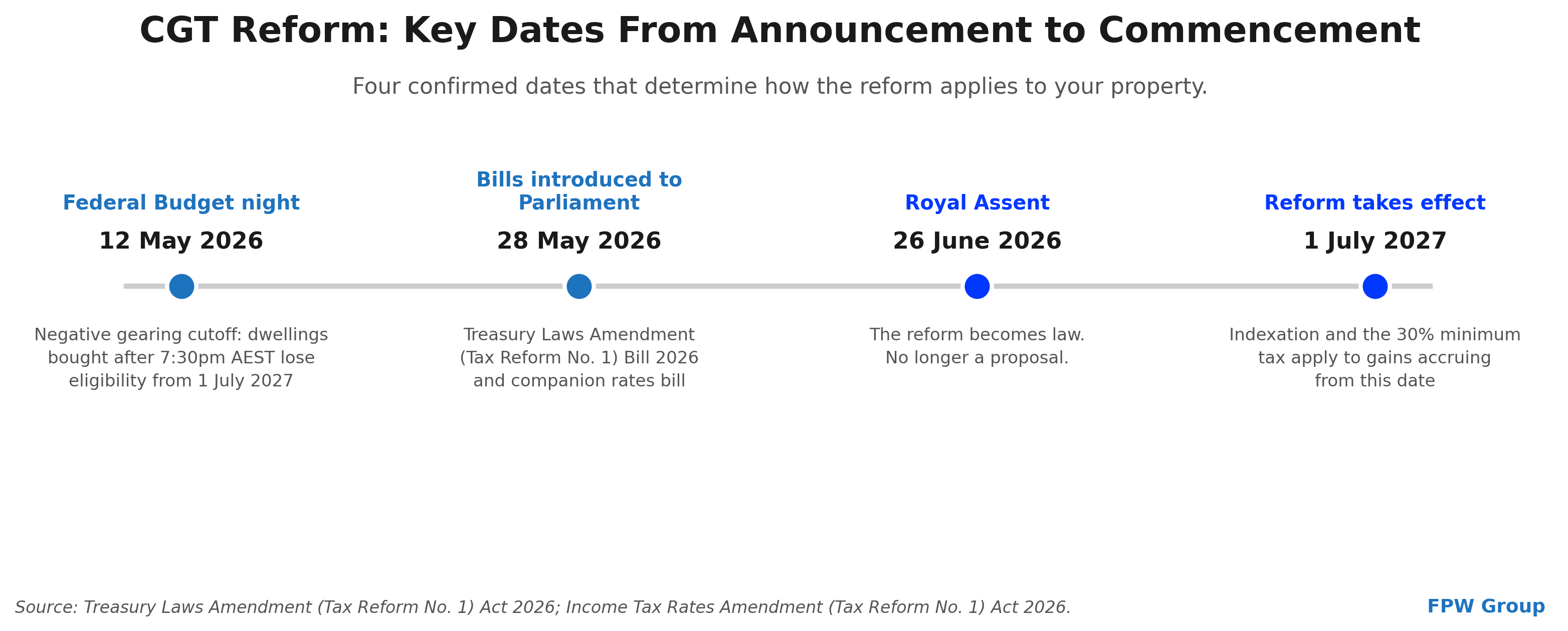
Source: Treasury Laws Amendment (Tax Reform No. 1) Act 2026; Income Tax Rates Amendment (Tax Reform No. 1) Act 2026.
Will Existing Investment Properties Keep the Old CGT Rules?
What Does CGT Grandfathering Actually Mean?
Grandfathering in tax law means assets already held under an existing framework are protected from a change that comes later. The principle is that investors who made decisions based on the rules in place at the time should not have those decisions undermined by rules that did not exist when they bought.
Under this reform, grandfathering works through what is known as the deemed-sale rule. Any gain that had already accrued on your property up to 1 July 2027 keeps the 50% discount. That portion is not lost, it is deferred until you sell. Only the growth in value that occurs after 1 July 2027 is assessed under the new indexation and minimum tax rules.
This is genuinely different from full grandfathering, where an entire asset would sit outside the new rules indefinitely based purely on its purchase date. Under this reform, every property that straddles 1 July 2027 is effectively split into two components at the point of sale: the pre-reform gain, taxed the old way, and the post-reform gain, taxed the new way.
The negative gearing grandfathering rules for properties affected by death, divorce, or ownership transfers work on a related principle and are worth understanding if your property is likely to change hands within the family.
What Are the Conditions That Could Remove the Protection?
There are three conditions worth understanding before you make any structural decision about a property you already hold.
First, if you sell before 1 July 2027, the sale is assessed entirely under the current rules as they stand today, meaning the full 50% discount applies to the whole gain. There is no need to rush a sale purely to lock this in, since the deemed-sale mechanism already protects the pre-2027 portion regardless of when you eventually sell.
Second, grandfathering applies to the property as held in its current ownership structure. Changing that structure, transferring it to a company, a family trust, or a new SMSF, can trigger a disposal and reacquisition for CGT purposes in its own right, which resets the cost base and can affect how much of the gain is treated as pre-reform versus post-reform.
Third, owners of new residential dwellings and affordable housing are treated differently again. They can choose to retain the existing 50% discount instead of moving to the indexation model, which is a separate decision from the grandfathering question that applies to established properties.
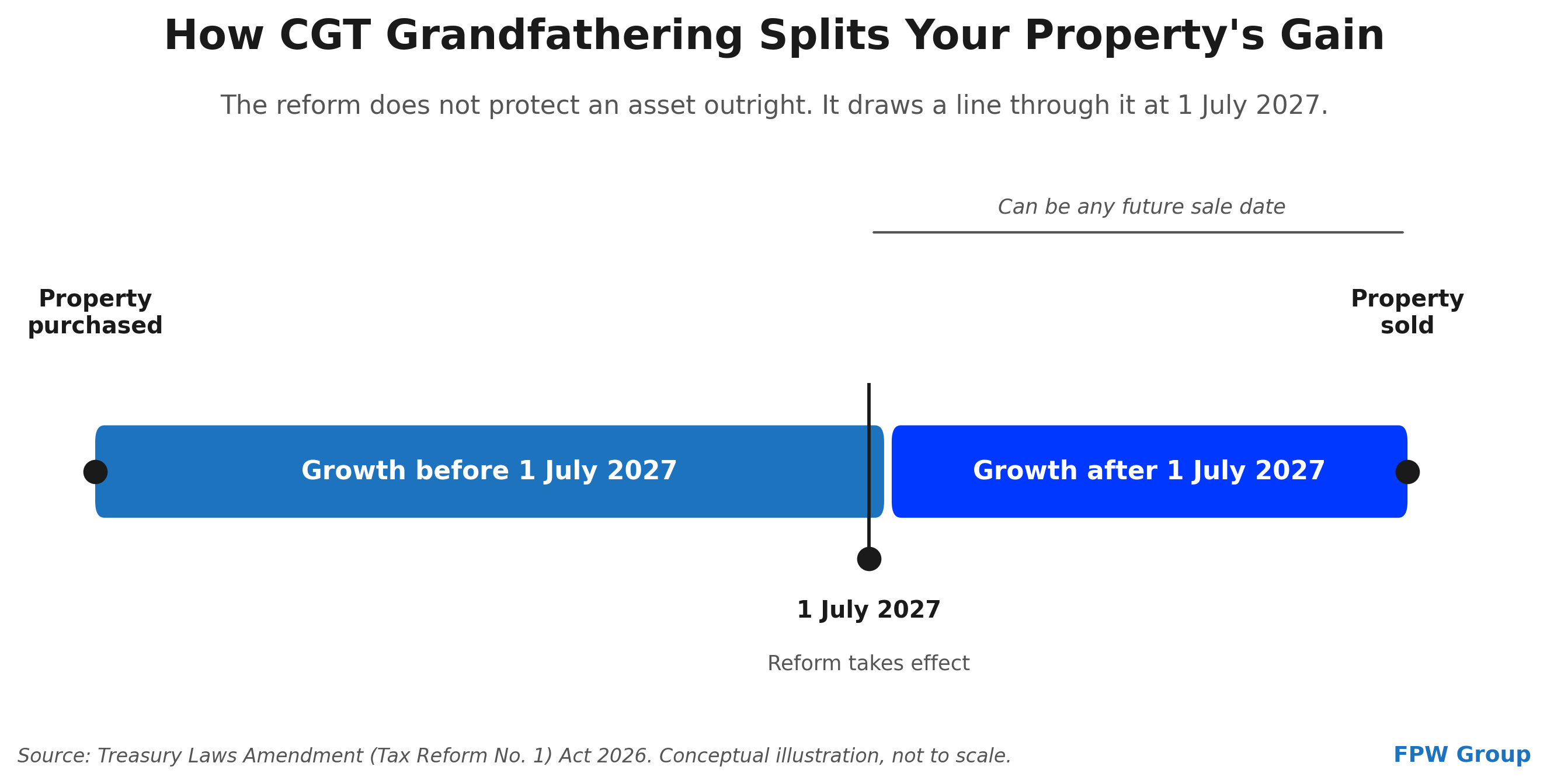
Source: Treasury Laws Amendment (Tax Reform No. 1) Act 2026. Conceptual illustration, not to scale.
FOR EXAMPLE
Say you bought an investment property in 2016 for $500,000. By 1 July 2027 its value has grown to roughly $650,000, a $150,000 gain that accrued entirely under the old rules. That portion keeps the 50% discount permanently, whenever you eventually sell.
From 1 July 2027 onward, any further growth is treated differently. If you hold the property until 2032 and sell for $900,000, the additional $250,000 of growth is indexed for inflation, and the resulting real gain is taxed at your marginal rate, with a floor of 30% if your marginal rate would otherwise be lower. Investors already on a marginal rate of 30% or above generally see little practical difference from the minimum tax, since their own rate already meets or exceeds the floor.
The exact split depends on a formal valuation or a specified indexation formula at 1 July 2027, and the exact tax payable depends on your marginal rate and the inflation assumption used. This example is illustrative only. A tax adviser can model your specific position.
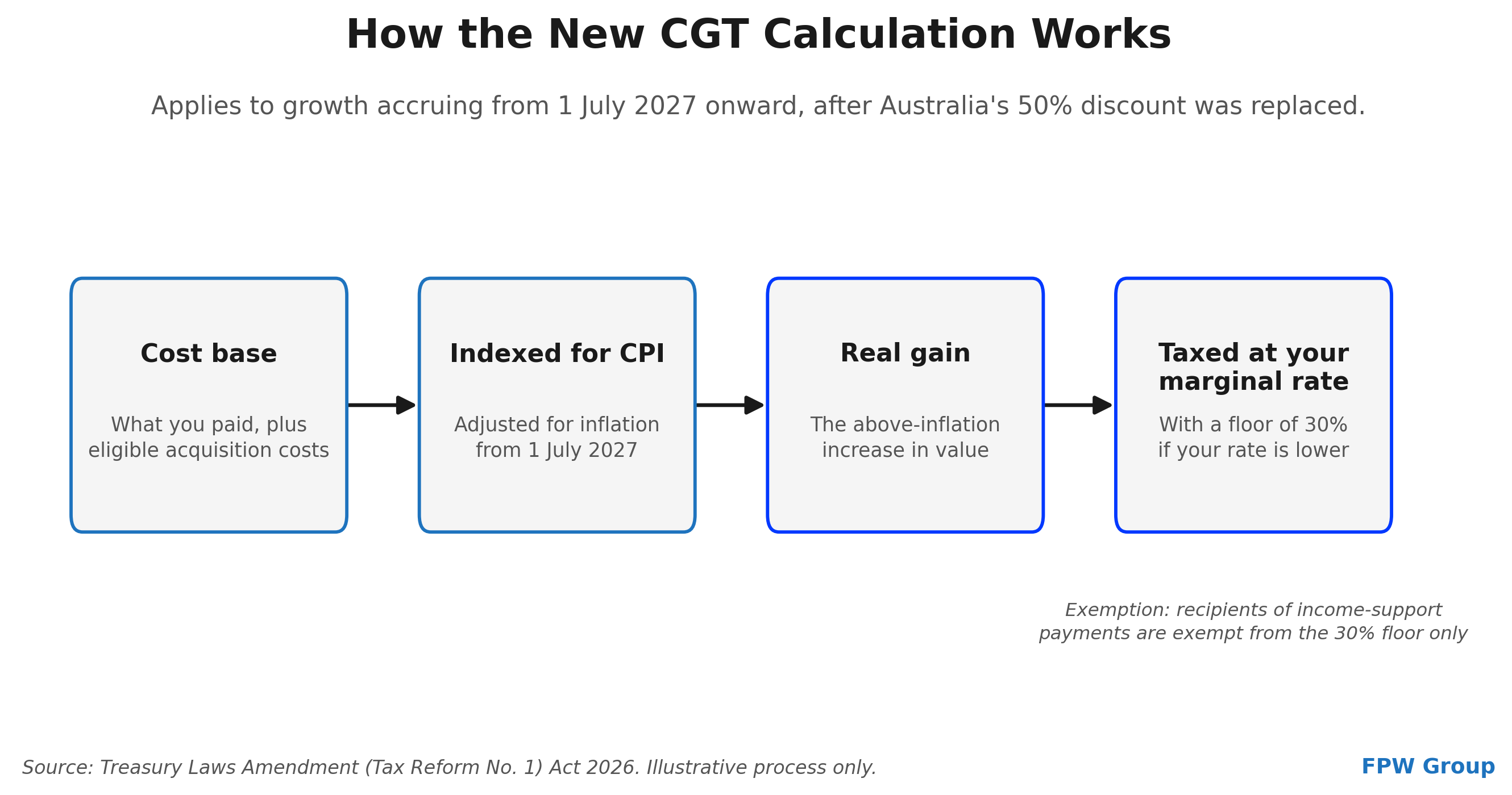
Source: Treasury Laws Amendment (Tax Reform No. 1) Act 2026. Illustrative process only.
How the Deemed-Sale Split Works for Long-Term Holdings
The longer you have held a property before 1 July 2027, the larger the portion of your eventual gain that sits under the old, more generous rules. In effect, the CGT change taxes existing investments based on length of ownership across two separate periods rather than as a single block.
An investor who bought in 2010 and sells in 2035 will have roughly 17 years of growth protected under the 50% discount and around 8 years of growth assessed under the new indexation and minimum tax model. An investor who bought in 2024 and sells on the same date has a much smaller protected portion.
This has a practical implication for how you think about future growth versus past growth. The gain you have already made is largely settled. The gain you have not yet made, from this point forward, is the part now subject to the new rules, and it is the part worth factoring into any decision about whether to hold, add to, or restructure your portfolio.
Should You Change Your Selling Strategy Because of Grandfathering?
Why Selling Solely to Lock In the Old Rules Can Be Risky
Selling a property before 1 July 2027 purely to secure the full 50% discount is only sound reasoning for a narrow group of investors: those who intended to sell in the next year or two regardless, whose portfolio strategy already supports the timing, and who have a clear plan for the released capital.
For everyone else, the deemed-sale rule already protects the pre-reform portion of the gain without needing to sell early. Transaction costs, agent commissions, legal fees, and stamp duty on any reinvestment commonly reach $40,000 to $60,000 on a property in the $800,000 to $1,000,000 range. Add the opportunity cost of future capital growth, and a sale driven purely by grandfathering timing is a poor financial outcome in most scenarios.
Questions to Ask Before Selling
Four questions cut through the noise:
Does this property still serve my long-term portfolio strategy and financial goals?
What is my net position after transaction costs, any CGT payable now, and the cost of reinvesting into a replacement asset?
What would I do with the released capital that delivers a better outcome than holding?
Have I spoken with both a property investment specialist and a qualified tax professional about my specific position?
These questions apply regardless of the CGT rules. That is the point. The reform is not a new reason to sell, it is a new factor to run through a decision you were already making.
Investors who fall into common property investment mistakes such as reactive selling in response to a policy change tend to underperform those working from a clear strategic framework, and understanding when to sell an investment property on its own merits matters more than reacting to a tax headline.
FOR EXAMPLE
Two investors each own an identical property bought in 2021 for $600,000, now worth $950,000, a gain of $350,000.
Investor A panics after the reform passes and sells in late 2026 to lock in the 50% discount, paying roughly $70,000 in CGT at a 40% marginal rate plus around $30,000 in transaction costs, then sits out of the market.
Investor B holds. Their gain up to 1 July 2027 is already protected under the deemed-sale rule regardless of when they sell. Five years later, the same property is worth $1.2 million. Investor A spent $100,000 exiting a position that needed no change to stay protected.
How Property Investors Can Prepare
Keep Accurate Records to Understand Your Future Tax Position
The cost base of an investment property directly determines the taxable gain, under both the old rules and the new ones. A higher, well-documented cost base means a lower gain and a lower tax bill regardless of which regime applies to a given portion of growth. Investors with incomplete records cannot claim all eligible costs, which means paying more tax than the law requires.
Every investor should maintain a cost base file for each property covering the original purchase price and acquisition costs including stamp duty and legal fees, all capital improvements made during ownership, borrowing costs eligible for inclusion, and selling costs when the time comes.
A well-kept file matters even more under the new regime, since a formal valuation or documented cost base as at 1 July 2027 is what determines the split between the protected and unprotected portions of your eventual gain.
Review Your Portfolio Strategy Before Making Changes
The CGT reform is one input into your overall investment strategy, not the whole strategy. Before restructuring, selling, or making new acquisitions in response to it, review your complete financial position: your current borrowing capacity and existing debt levels, the equity position in each property you hold, your income and cash flow from existing investments, and your short and long-term goals.
If the new rules meaningfully change the after-tax return on acquisitions you are considering, that is relevant information to build into your modelling. The response should be a considered strategy review, not a reactive decision made in the weeks after the legislation passed.
Working with a buyer’s agent who understands both the CGT framework and the property market is often the most effective way to separate the tax question from the actual investment decision.
Final Thoughts
The CGT reform is now law, not a proposal, and it meaningfully changes the after-tax return on growth that occurs from 1 July 2027 onward. For investors who already hold property, the deemed-sale mechanism provides genuine protection for the gain that has already accrued, whenever that property is eventually sold.
The investors most likely to be worse off from this reform are not the ones who hold and wait. They are the ones who make a reactive decision, selling a property that did not need to be sold, or restructuring an ownership arrangement without understanding the CGT consequences.
Make sure to document your cost base, confirm your position with a tax professional, and make any new acquisition decisions with the actual new rules, not an earlier proposal, factored in from the outset.
Frequently Asked Questions
Recommended Reading
Two pages selected based on what readers of this article are most likely to need next.
Recommended Video
As of April 2026, Treasury is actively modelling potential changes ahead of the May Budget. This isn’t speculation—it’s confirmed. In this video, we unpack exactly what’s being proposed, who stands to benefit, who could be impacted, and what it could mean for investors, renters, and first home buyers across Australia.