

Financing Investment Property: The Financing Mistake That Can Make Buying Your Next Property Harder
Financing investment property is not just about getting approved for a loan. It is about how much borrowing power remains afterwards, for the property that comes after this one.
Most investors focus on the deposit and the advertised rate. Lenders look further at borrowing capacity and how every existing debt reduces what you can borrow next. Get the financing wrong on this purchase and you may not be able to buy again for years, regardless of how the asset itself performs.
This guide explains how lenders assess investment property finance, the mistake that quietly limits future purchases, and how to structure lending so today's purchase supports tomorrow's, rather than blocking it.
Why Financing Investment Property Is About More Than Getting Approved
Every seller has finance sorted before listing. Every buyer, by contrast, usually discovers their true borrowing position only after applying.
That gap matters more for investors than owner occupiers. A single poorly structured loan can consume the borrowing capacity a second or third property would otherwise use. Lenders are not really assessing whether you can afford this property. They are assessing whether you can service it alongside every other debt you already carry, at a rate well above what you currently pay.
How Lenders Assess Investment Property Finance
Three factors dominate almost every assessment: existing debt, the debt-to-income ratio, and the serviceability buffer.
The borrowing capacity a lender calculates rarely matches what a borrower expects, because it is tested at a rate most investors will never actually pay.
Under APRA's rules, lenders must assess new loans at the actual rate plus a 3-percentage point buffer, regardless of where the cash rate sits at the time.
Chart 1: How the Serviceability Buffer Cuts Borrowing Capacity
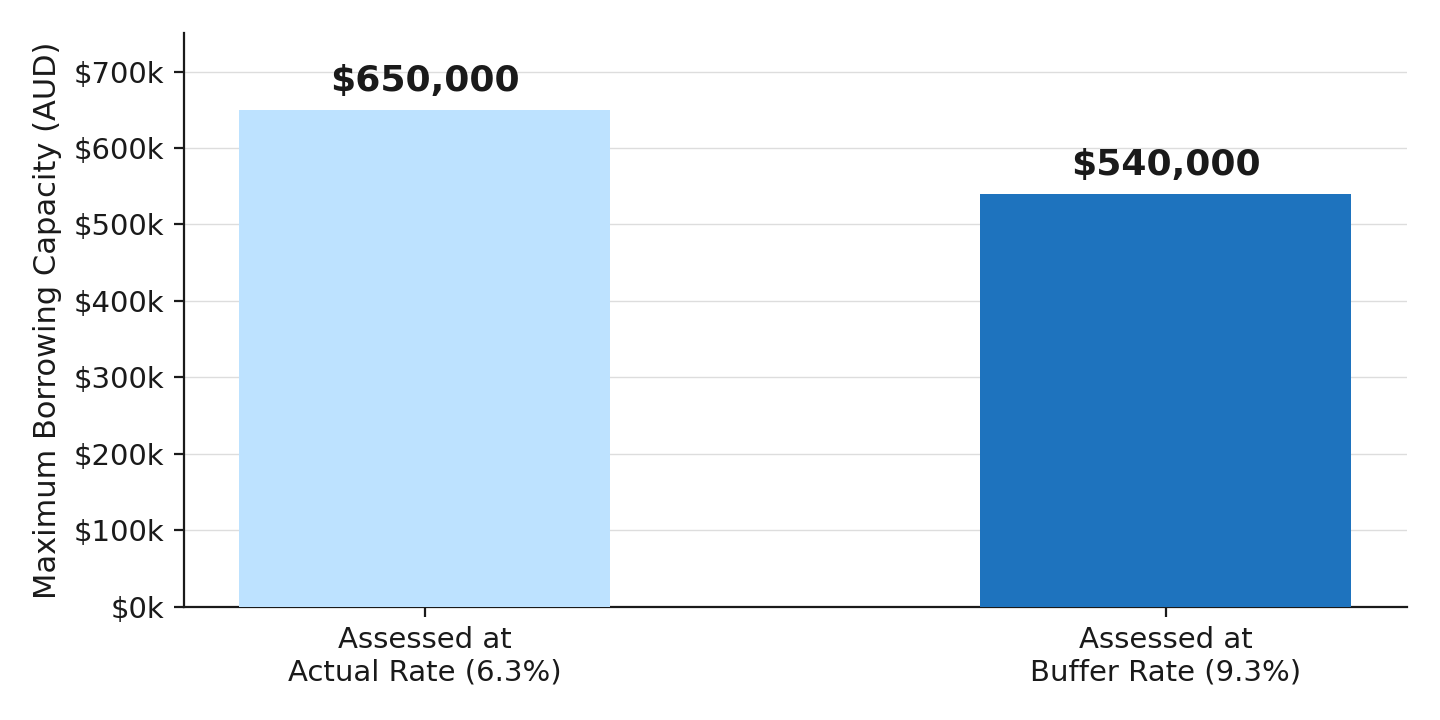
Illustrative modelling based on a single investor income scenario. Actual borrowing capacity varies by lender, income, and existing debt.
Source: APRA, 2026
With the RBA cash rate at 4.35 percent after three increases this year, a typical investment loan priced around 6.3 percent is tested closer to 9.3 percent. That single rule shapes borrowing capacity more than the headline interest rate does.
The Financing Mistake That Limits Future Property Purchases
The most common mistake is straightforward: borrowing the maximum a lender will approve on the very first purchase.
This maximises leverage today but leaves almost nothing in reserve. Once the debt-to-income ratio and serviceability buffer are already stretched, a second application often fails, even if rental income and equity have both grown in the meantime.
FOR EXAMPLE
An investor who borrows to the maximum approved limit on a $700,000 purchase may find their next application declined two years later, even with $80,000 in equity gained, because existing repayments already consume most of their assessed serviceability.
Poor structure compounds the problem. Interest only terms, cross collateralised security, or loans with no offset account can all quietly narrow the path to the next purchase, long before the borrower notices.
Financing Strategies That Protect Your Borrowing Capacity
Borrowing below the maximum approved limit preserves capacity for the next purchase, even when it feels conservative now.
Structuring loans separately, rather than cross collateralising security, keeps each property's equity available on its own terms. Using interest rate buffers to model a worst-case scenario before applying shows how much genuine room remains.
Chart 2: RBA Cash Rate Path Through 2026
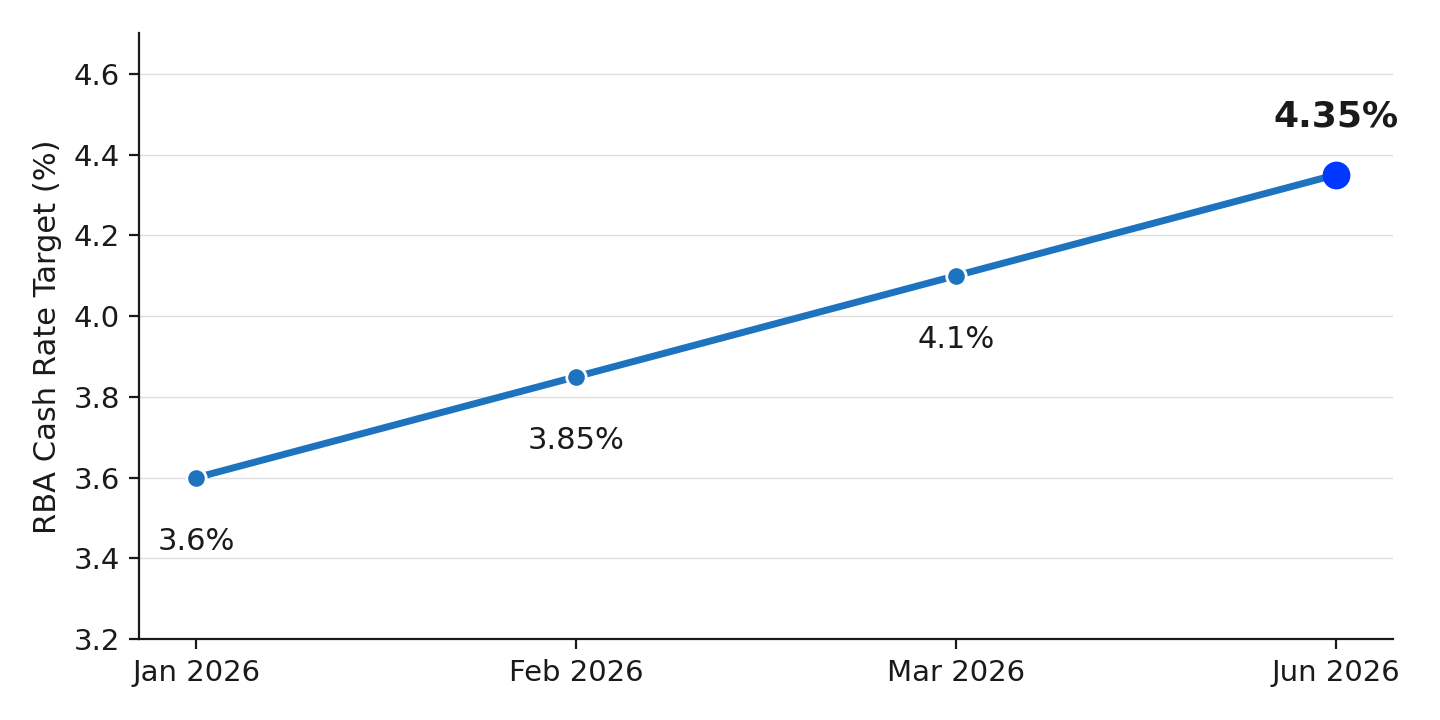
Source: Reserve Bank of Australia, 2026
Reviewing serviceability annually, not only when applying for new finance, catches capacity erosion early, well before it becomes a blocked purchase.
Final Thoughts
Financing investment property well means thinking one purchase ahead, not only one approval ahead. The mistake that costs investors the most is rarely the property itself. It is the loan structure left behind it.
Protecting borrowing capacity today is what makes a second or third purchase possible tomorrow. A mortgage broker who understands portfolio lending, not only single property approval, is often the difference between a portfolio that grows and one that stalls after the first purchase.
Frequently Asked Questions
Recommended Reading
Two pages selected based on what readers of this article are most likely to need next.
Recommended Video
As rates rise, many people immediately assume it is no longer a good time to invest. But in reality, the opportunity has not disappeared—it has simply shifted. This episode explains why higher interest rates do not automatically remove your ability to invest, but they do change your borrowing power, your cash flow, and the price point that makes sense for you.