

How Interest Rate Buffers Reduce Borrowing Power
Your income has not changed. Your debts have not changed. But your borrowing capacity is lower than you expected.
In most cases, the reason is the interest rate buffer. Banks do not assess your ability to repay at the rate you actually pay. They test it at a higher rate, and that one adjustment can reduce what they will lend you by hundreds of thousands of dollars.
This article explains how the buffer works, why it exists, and what property investors can do to work around it.
What Is an Interest Rate Buffer?
An interest rate buffer is the extra percentage that lenders add to your actual loan rate before they decide how much you can borrow. If your home loan rate is 6.5%, the bank does not test whether you can afford repayments at 6.5%. They test at 9.5% or higher.
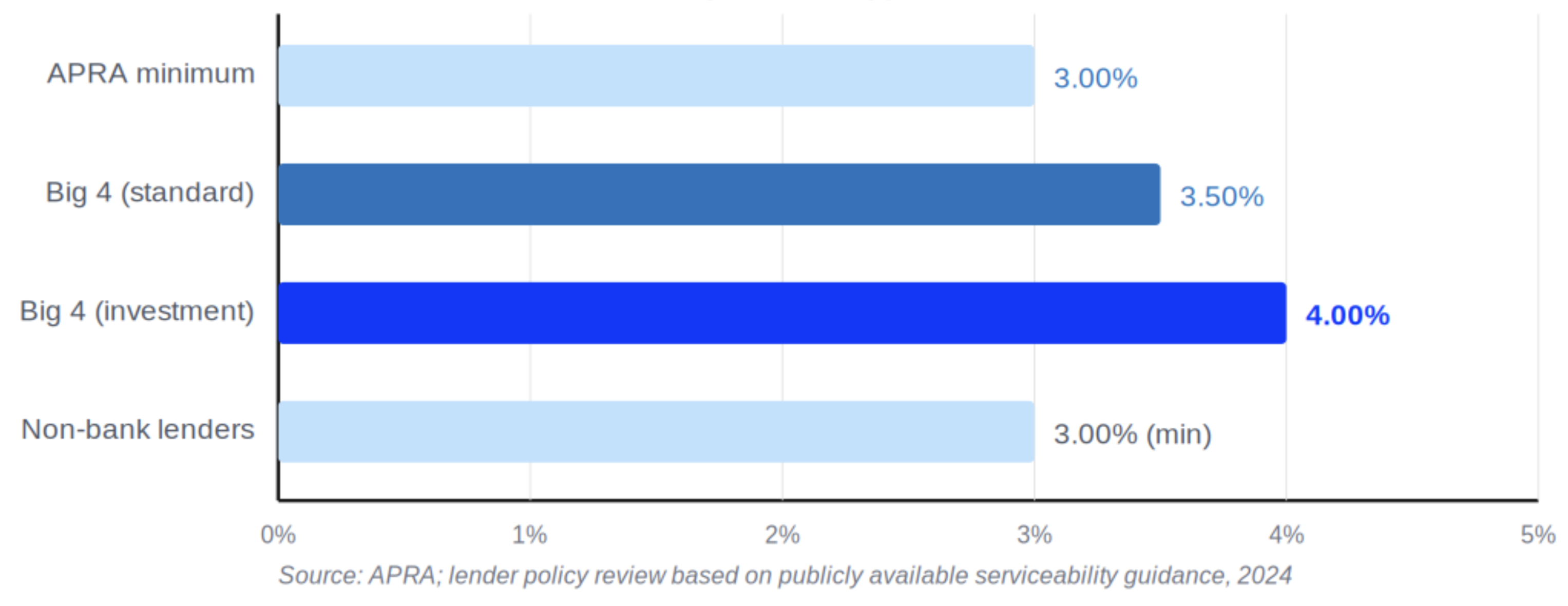
The minimum buffer is 3%, as required by the Australian Prudential Regulation Authority (APRA). Most lenders apply 3.5% to 4% in practice.
Why Do Banks Use Interest Rate Buffers?
The buffer exists to protect borrowers from rate rises. A loan that looks affordable today at 6.5% may not be at 8% in two years. The buffer ensures lenders only approve loans that borrowers could still service if rates moved significantly higher.
APRA increased the minimum buffer from 2.5% to 3% in October 2021, as rates were near historic lows and lending volumes were surging. The change was designed to cool the market and reduce the risk of borrowers becoming overextended.
How Interest Rate Buffers Reduce Borrowing Power
Higher test rates mean higher assessed repayments. Higher assessed repayments mean the bank approves a smaller loan. That is the direct mechanism.
The borrowing capacity formula works by calculating the maximum loan where your assessed repayments stay within your disposable income. When the test rate rises, the repayments rise, and the loan ceiling falls.
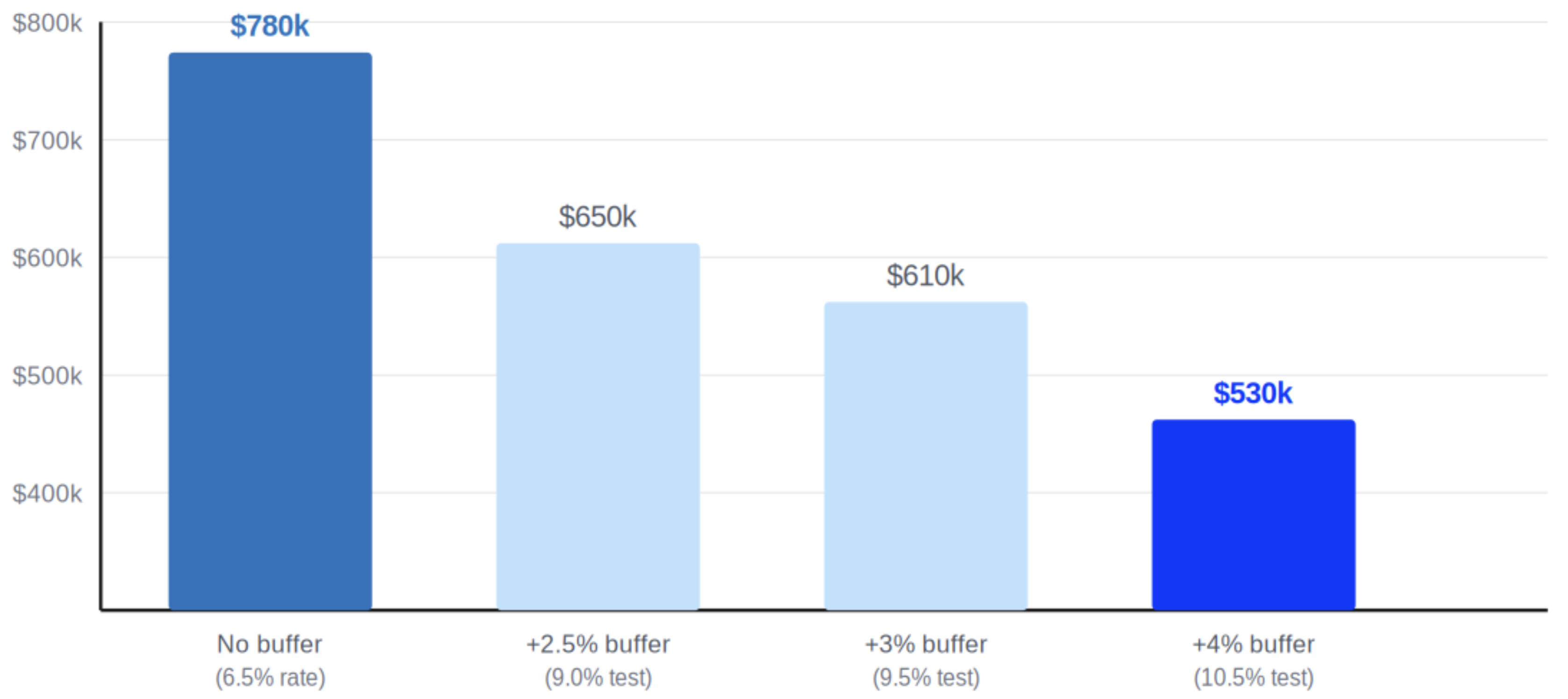
The effect is not small. A 1% increase in the test rate on a $700,000 loan increases monthly repayments by roughly $400. That translates to a reduction in borrowing power of approximately $65,000 to $80,000, depending on loan term and income.
How the Buffer Rate Reduces Maximum Borrowing Power
Source: APRA, Increased Serviceability Buffer for New Mortgage Lending, 2021
Example: How a 3% Buffer Changes the Numbers
The numbers below are illustrative but based on realistic Australian income and expense assumptions.
Borrower: Dual-income couple, combined income $180,000, standard living expenses, no existing debts.
Actual loan rate: 6.50%
APRA test rate (3% buffer): 9.50%
At 6.50%: Maximum borrowing power approximately $780,000
At 9.50%: Maximum borrowing power approximately $610,000
The buffer alone removes $170,000 from what this couple can borrow. Their income did not change. Their debts did not change. Only the test rate changed.
Why Different Lenders Give Different Borrowing Power Results
APRA sets the minimum buffer at 3%. What most borrowers do not realise is that lenders can and do apply higher buffers at their own discretion.
Some lenders apply 3.5% for investment loans. Others apply 4% across all loan types. Some adjust based on the borrower's debt-to-income ratio. The result is that the same borrower can get significantly different results from different banks.
This is explored in detail in our article on why different banks give different borrowing capacity results.
Buffer Rate by Lender Type: Where the Market Sits
Interest Rate Buffers and Property Investors
For investors, the buffer creates a compounding problem. Each property added to a portfolio comes with its own loan, and each loan is stress-tested at the buffered rate. Existing investment loan repayments are also assessed at the higher rate when calculating capacity for the next purchase.
Many investors now face a position where borrowing power does not keep pace with property prices, even when rental income is growing and debts are being serviced without difficulty. The buffer is often a central reason why.
Understanding how your existing loan structure affects your next rental property purchase is an important part of portfolio planning. The buffer applies to what you already owe as much as what you are about to borrow.
How to Improve Borrowing Power Despite Rate Buffers
You cannot change the buffer itself. But you can change the inputs the lender uses to calculate what you can afford. The most effective strategies are covered in our guide to how to increase borrowing capacity, but the key levers are:
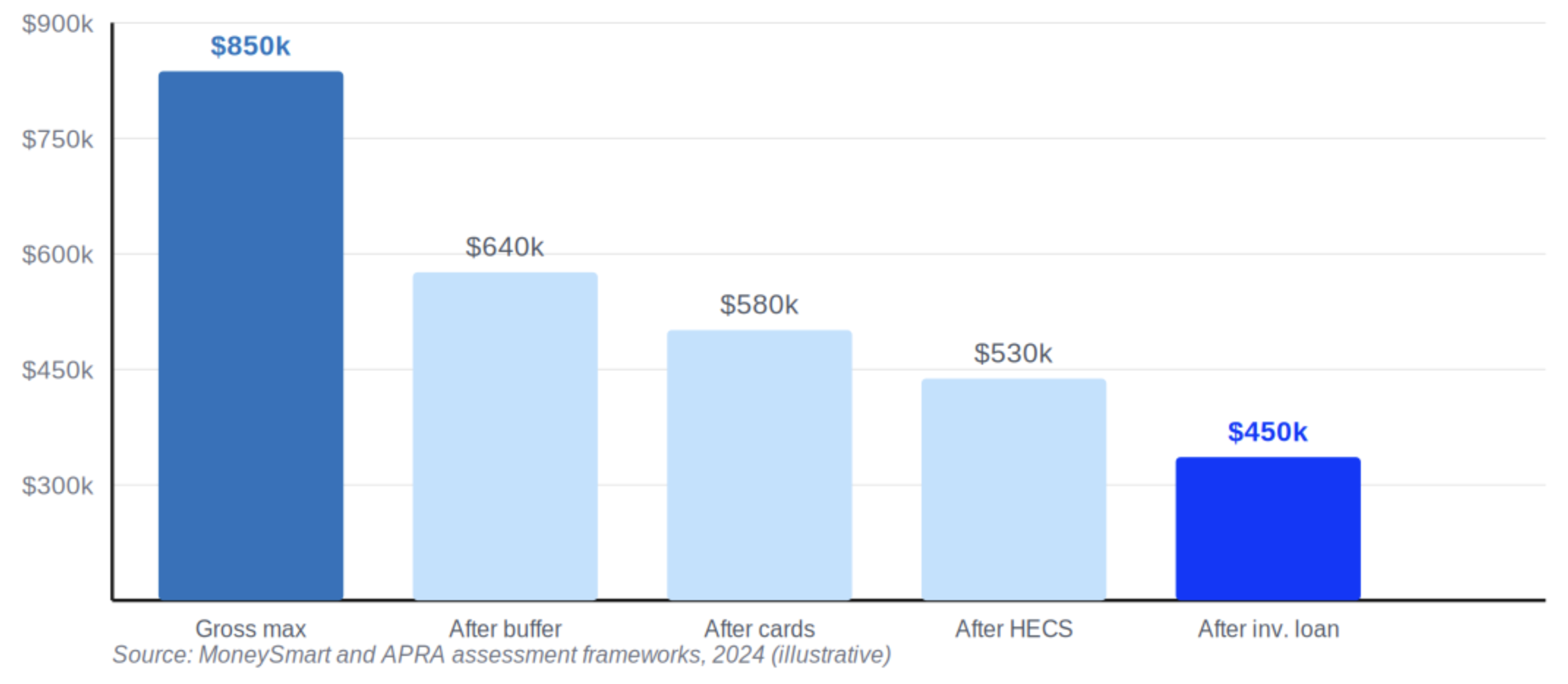
Cancel unused credit cards. Lenders assess the full limit as a liability, not just your balance. A $20,000 limit you never use still reduces what they will approve.
Pay down personal loans before applying. Every existing loan commitment reduces the disposable income available for the new loan's stress-tested repayments.
Document your actual expenses. If your real living costs are below the benchmark lenders use, providing evidence can reduce the expense figure the bank applies.
Test multiple lenders. Because buffers vary, so does your approved amount. A broker can compare your position across lenders before any formal applications are made.
Strategies That Can Recover Borrowing Power
Source: APRA buffer policy and typical lender assessment methodology (illustrative)
Other Factors That Reduce Borrowing Capacity
The buffer is significant, but it is not the only constraint. Your debt-to-income ratio is increasingly used by lenders to cap how much they will approve regardless of serviceability. At a DTI of 6 or above, many lenders will decline or reduce the loan even if the buffer test is passed.
Other factors that reduce what lenders will approve include:
Existing investment loans assessed at the buffered rate, not the actual rate.
Credit card limits, assessed in full regardless of balance.
Buy-now-pay-later accounts, which some lenders now treat as regular debt commitments.
HECS debt, which reduces monthly disposable income and therefore serviceability.
You can use the debt-to-income ratio calculator to see how your current debt position affects your borrowing ceiling before speaking to a lender.
Combined Impact: Buffer and Debt Factors on Borrowing Power
Should You Rely on a Borrowing Power Calculator?
Online borrowing power calculators are a useful starting point. They give you a rough range based on simplified assumptions, typically one standard buffer rate and a default expense benchmark.
What they cannot do is account for how a specific lender will treat your income type, your existing investment loans, or your particular expense profile. The gap between a calculator result and an actual approval can be significant.
Use calculators as a sense check. Use a broker assessment when you are planning a purchase.
Final Thoughts
Interest rate buffers are not going away. APRA introduced them to reduce systemic risk, and they work as intended. For borrowers, that means working with them rather than around them.
The practical response is to understand how the buffer applies to your specific position, identify which lenders apply the minimum buffer, and reduce the other factors that compound its effect. For property investors, managing serviceability across a growing portfolio requires the same strategic attention as the properties themselves.
If your borrowing power for investment property is lower than you expected, the buffer is usually part of the answer. The full picture includes your DTI, existing debts, and which lender's model best suits your income profile.
Frequently Asked Questions
Recommended Reading
Two pages selected based on what readers of this article are most likely to need next.
Watch: RBA rate hikes… but this is what actually matters for property investors
As rates rise, many people immediately assume it is no longer a good time to invest. But in reality, the opportunity has not disappeared—it has simply shifted. This episode explains why higher interest rates do not automatically remove your ability to invest, but they do change your borrowing power, your cash flow, and the price point that makes sense for you.