

Housing Shortage Australia: Property Prices in 2026
Australia is not building enough homes. That is not a new observation, but in 2026 the numbers behind it are harder to ignore than ever. Construction is running well below target, migration keeps adding new households, and rents are rising across most capital cities.
This article explains what is driving the shortage, which markets it affects most, and what it actually means for investors who are trying to decide where to put capital right now. The goal is not to alarm. It is to help you read the data correctly and make better decisions because of it.
Australia's Housing Shortage Is Becoming a Long-Term Structural Problem
A structural shortage is different from a temporary imbalance. Temporary imbalances correct when developers respond to price signals and new supply enters the market. Structural shortages are embedded in the economics of building, the mechanics of planning, and the geography of cities. They resist correction even when governments intervene.
Australia's housing shortage has all three of those properties. In 2023, the federal government set a target of 1.2 million new homes over five years under the National Housing Accord. As of 2026, NHFIC and the Housing Industry Association have both flagged that completions will not reach 60% of that target by 2029. The gap is not narrowing. It is widening.
The supply problem has three separate layers, each with a different cause and a different resolution timeline.
Population Growth Continues to Outpace Housing Supply
Two forces are generating housing demand at a rate existing stock cannot absorb. The first is net overseas migration. After COVID-era restrictions lifted, migration returned strongly and continued to run above pre-pandemic baseline levels. At its peak in 2023, net overseas migration reached approximately 518,000 people, roughly double the long-run average. Even as that figure has moderated, it remains materially elevated in 2026.
The second force is household formation. Australia's average household size has been declining for decades. People live longer, family structures are changing, and single-person households are more common than they were twenty years ago. A population producing smaller average households needs more dwellings than the same population would have needed in 2005.
Construction Constraints Are Limiting New Housing Delivery
The obvious question is: why isn't the industry just building more? The answer is that multiple structural constraints are working against it at the same time, and none of them can be removed quickly.
Construction cost inflation. Material and labour costs rose sharply during 2021 to 2023 and have not returned to pre-pandemic levels. Build costs in major capital cities have increased 30 to 40% over that period. At current land prices, the economics of new apartment and townhouse development at mid-market price points simply do not work for many developers.
Skilled labour shortages. Australia has a persistent shortage of qualified tradespeople. The same workers who build new homes are also building roads, hospitals, and public infrastructure. That competition keeps costs high and timelines long.
Planning delays. Approval timelines have extended across most major capitals. Each delay represents deferred supply entering a market that needs it now, not in three years.
For Example
A mid-density apartment project in Brisbane that received planning approval in late 2022 is still working through a 28-month approvals and pre-sales process before breaking ground. The developer has flagged that revised construction costs mean the feasibility assessment no longer stacks up at the original sale price targets.
That scenario is not unusual. It is representative of what is happening across the industry in 2026.
The Australian Markets Facing the Greatest Supply Pressure
The housing shortage does not affect every market equally. Some cities and suburbs are under far more pressure than others, depending on population growth rates, geographic constraints, planning rules, and how much new supply has been delivered in recent years.
Tight Rental Markets Are Supporting Higher Rents
When the number of available dwellings falls short of demand, renters compete for a limited pool of stock. That competition pushes vacancy rates down and rents up. Australia's national rental vacancy rate has been below the long-run equilibrium of 3 to 3.5% for an extended period. In inner Sydney, Melbourne, and Brisbane, vacancy rates in 2025 to 2026 have been running at or below 1.5%.
Rental Vacancy Rates vs Market Equilibrium
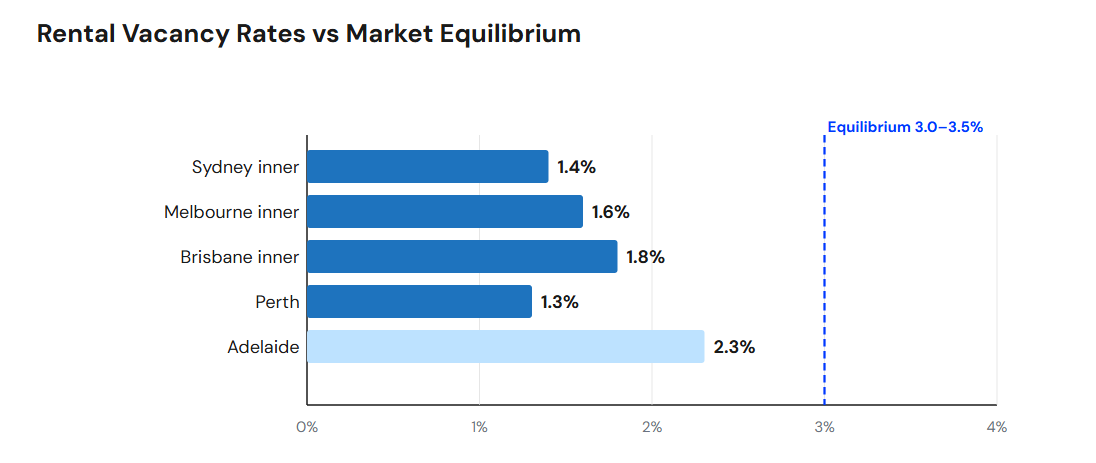
All major capitals are running well below the 3 to 3.5% vacancy rate that defines a balanced rental market. Perth and Sydney inner are the tightest nationally.
Source: Domain vacancy data, CoreLogic rental market analysis, 2025 to 2026. Figures are indicative.
At vacancy rates below 2%, landlords receive multiple applications per listing, asking rents move upward, and existing tenants absorb increases to avoid re-entering a market that is even more constrained than when they last searched.
Why Government Policy Is Unlikely to Solve the Problem Quickly
Government policy has made genuine commitments to addressing the housing shortage. The challenge is that commitment and delivery operate on very different timelines. Planning reform is underway in most states, but faster approvals take years to show up as completed dwellings. Federal housing funding programs are real but extend well beyond 2026. Build-to-rent incentives have improved the economics for some institutional developers but do not address the near-term shortfall that affects everyday buyers and renters.
Policy can improve conditions at the margin and over a long enough horizon it will make a difference. But it cannot resolve a multi-year structural supply deficit in a 12 to 24 month window.
What Investors Often Get Wrong About Housing Shortages
The most common mistake is treating the shortage as a blanket reason to buy. A housing shortage in Australia does not mean every Australian property is a sound investment. It means that specific markets with genuine supply constraints have a structural argument for sustained demand. The distinction is critical.
The second mistake is confusing proximity with exposure. A suburb adjacent to a high-shortage inner-ring market does not automatically share its supply characteristics. Vacancy rates, land constraints, and rezoning potential can vary significantly across suburbs that are only a few kilometres apart.
The third mistake is ignoring the entry price. A structurally tight market that is also expensive to enter may offer strong long-term capital growth but poor initial cash flow. That trade-off needs to be modelled honestly before committing, not assumed away because the macro case is compelling.
Why Housing Shortages Do Not Automatically Create Good Investments
A shortage tells you that demand exceeds supply. It does not tell you what price correctly reflects that imbalance, or whether that price already discounts years of future rental growth and capital appreciation. In well-covered markets like Sydney's inner ring, the shortage has been documented extensively. That coverage means prices in those markets are more likely to already reflect the structural argument than prices in less-discussed markets.
Yield compression is the mechanism that connects a well-known shortage to a less attractive investment. When shortage data becomes widely understood, more investors compete for the same constrained stock. That competition pushes prices up and initial yields down. The macro story strengthens while the acquisition economics weaken.
Shortage Pressure vs Acquisition Economics: How the Major Markets Compare
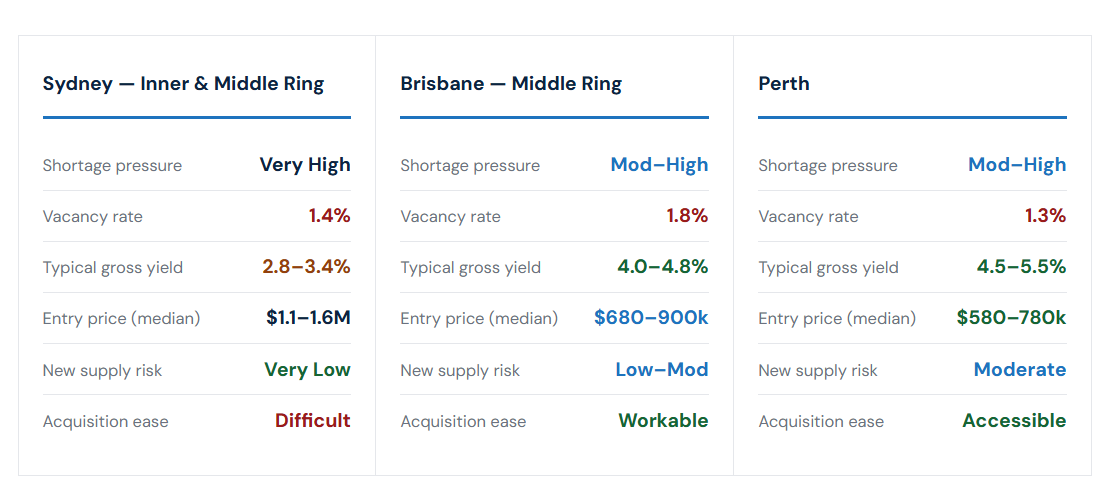
Brisbane and Perth offer stronger acquisition economics for most investor profiles in 2026 — tighter vacancy, higher initial yield, and lower entry price than Sydney — while still carrying meaningful shortage pressure.
Source: CoreLogic, Domain, REIA, 2025 to 2026. Figures are indicative ranges for investment-grade established stock. Individual properties and suburbs vary.
What Australia's Housing Shortage Means for Property Investors in 2026
The housing shortage is structural and it is not resolving quickly. That creates a set of conditions that are genuinely favourable for property investors who approach the market with the right framework.
A common question is whether current shortages support buying now— the answer depends on your financial position and chosen market.
This development is part of broader Australian property investment trends that continue to favour investors who understand supply-demand dynamics.
For property selection, it means prioritising established stock in locations where new supply cannot easily be added. Units and houses in inner and middle-ring suburbs with genuine zoning or geographic constraints have a supply-side advantage that greenfield or outer-ring properties do not.
For market selection, it means weighting toward cities with the highest sustained demand pressure relative to their existing stock. Sydney and Melbourne have the strongest structural case but the leanest initial yields. Brisbane and Perth offer a better balance of shortage exposure and acquisition economics for most investor profiles in 2026.
For rental performance, the shortage supports above-average rent growth in tight markets over a standard hold period. Investors entering now should model conservative initial yields but realistic rent growth assumptions based on current vacancy conditions, not historical averages from a more balanced market.
For long-term capital growth, the structural shortage provides a demand floor that pure sentiment-driven markets do not have. Prices in genuinely constrained markets are supported by the ongoing gap between what households need and what exists. That is a more durable growth driver than speculative demand alone.
Where Investors May Find the Biggest Opportunities in 2026
The biggest opportunities in a shortage environment are not always in the most talked-about markets. They are in the markets where the supply constraint is real, the acquisition economics are still workable, and the shortage story has not yet been fully priced in.
Brisbane's middle ring fits that description in 2026. Vacancy rates are tight, interstate migration continues, and the 2032 Olympics infrastructure program provides a demand tailwind that extends well beyond the typical investment horizon. Entry prices remain materially lower than equivalent positions in Sydney or Melbourne, which means the yield at acquisition is stronger and the borrowing requirement is lower.
Perth presents a similar case with a different driver. Mining sector employment is supporting strong population growth, vacancy rates are among the tightest nationally, and the market has historically been more cyclical than the eastern seaboard. For investors with a medium to long hold horizon, that cyclicality represents an entry window rather than a deterrent.
Within Sydney and Melbourne, the opportunity is more selective. Broad exposure to these cities does not capture the shortage premium. Middle-ring suburbs with genuine supply constraints, strong rental demand, and proximity to employment hubs offer the structural case without the extreme yield compression of the inner ring. The selection work is harder, but the structural tailwind is equally strong.
2026 Market Opportunity Assessment
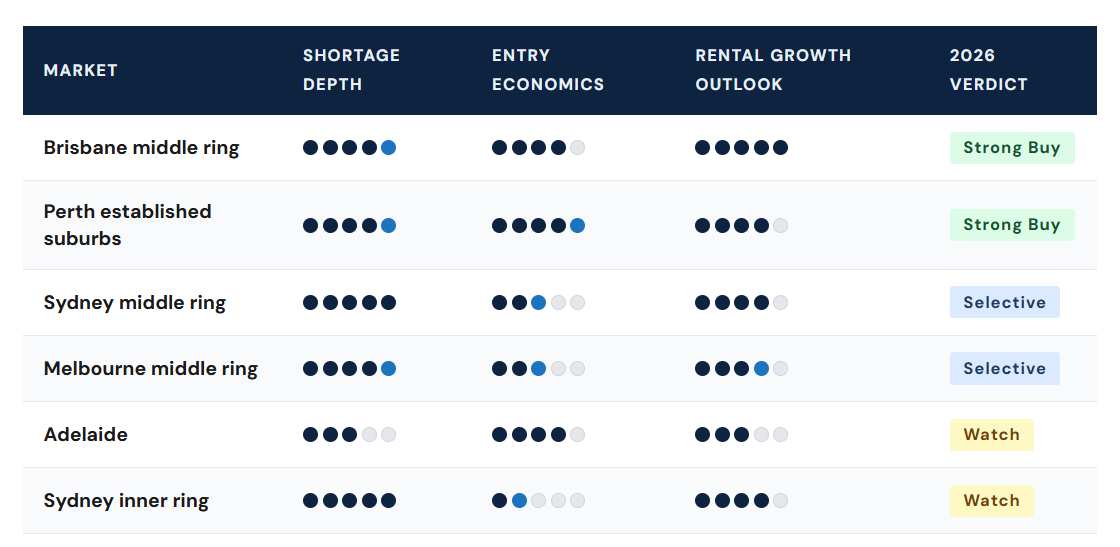
Dots indicate relative strength out of five for each dimension. Brisbane middle ring and Perth score highest on the combination of shortage depth and acquisition economics — the two factors most relevant for investors entering in 2026.
Source: FPW Group modelled assessment. Based on CoreLogic, Domain, REIA data, 2025 to 2026. Ratings are indicative and reflect broad market conditions, not individual property analysis.
Frequently Asked Questions
This article is general information only and does not constitute financial or investment advice. Market data, supply estimates, and vacancy figures are based on publicly available sources including ABS, CoreLogic, NHFIC, and state government housing data as at 2025 to 2026. Individual market conditions vary. Speak with a qualified financial adviser before making investment decisions.
Recommended Reading
Two pages selected based on what readers of this article are most likely to need next.
Watch: How Australia Dodged a Recession
A short breakdown of the housing crisis shaping the rest of this decade.