

Is Now a Good Time to Buy Property in Australia? What the 2026 Market Actually Tells Us
It is the question sitting behind every property conversation in Australia right now.
Prices in most capital cities remain elevated. Interest rates have moved off their peak but serviceability buffers are still being applied at historically tight levels. Rents continue rising. And yet the dominant emotion among prospective buyers is hesitation.
Whether now is a good time to buy investment property in Australia depends less on what the market is doing and more on what your personal financial position allows. This article sets aside the forecasts and focuses on the variables that actually determine whether buying now or waiting is the right decision for your situation.
Why Timing the Market Is the Wrong Question
Most Australians who are trying to decide whether to buy property now are asking a market question when they should be asking a personal finance question. The two are related but they are not the same thing.
Property market forecasts are notoriously unreliable. Economists who predicted a 20% price fall during the 2022 rate cycle watched prices correct modestly and then resume growth in most capital cities. The same commentators who called for a crash in 2020 were wrong in the other direction. The reality is that nobody consistently predicts property price movements with enough accuracy to build a reliable waiting strategy around.
What Interest Rates Are Actually Doing to Affordability
The APRA serviceability buffer requires lenders to assess mortgage repayments at 3% above the actual lending rate. With variable investment loans currently sitting around 6.3 to 6.8%, the assessment rate applied to new borrowers is closer to 9.3 to 9.8%. That is a substantial ceiling on what most households can borrow.
For a borrower earning $120,000 per year with no existing debt, the maximum loan at current assessment rates is roughly $580,000 to $620,000. In 2021, the same borrower on the same income could borrow approximately $800,000. Understanding the borrowing capacity formula lenders use explains exactly how that gap has opened up — and what it would take to close it.
For Example
A couple with a combined income of $180,000 and a $120,000 deposit are assessing a $750,000 purchase. At a 6.5% variable rate, their monthly repayment on a $630,000 loan is approximately $3,990. At the assessment rate of 9.5%, the same loan is stress tested at $5,300 per month.
The lender wants to see that the couple can comfortably meet the higher figure. Many households in this position find their maximum borrowing is lower than their purchase target, which shifts them toward regional markets or a longer saving period.
How Borrowing Power Has Shifted Since 2021
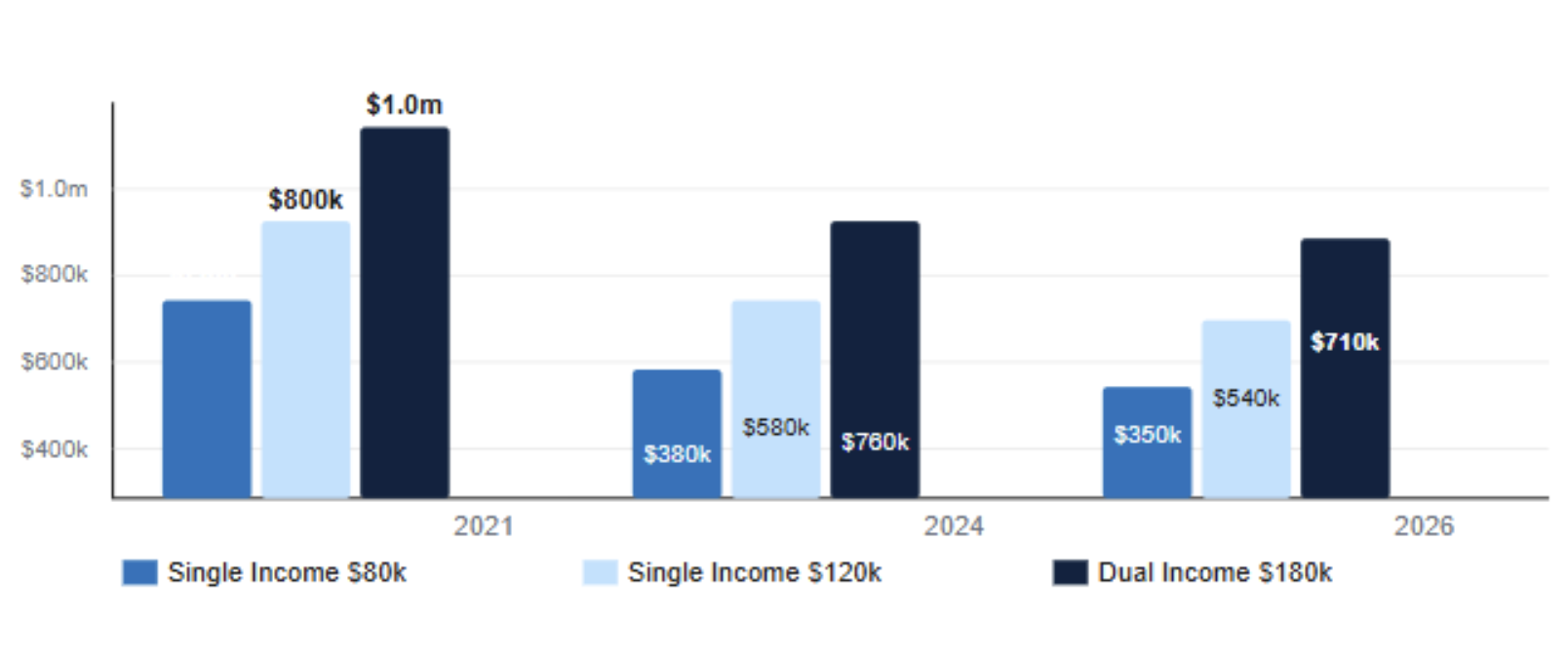
Borrowing capacity has contracted materially across all income levels since 2021. A dual income household earning $180,000 combined can borrow roughly $290,000 less today than at the peak of the low-rate cycle.
Source: FPW Group modelled borrowing capacity scenarios; APRA serviceability buffer policy; major lender assessment rate schedules, 2021 to 2026.
The Real Cost of Waiting
Waiting is not a neutral position. Every month spent watching the market is a month paying rent, a month not building equity, and a month during which property prices may move in either direction.
What investors often discover is that the cost of waiting is not dramatic in any single month but compounds quietly over time. Australian median property prices have grown at approximately 6 to 7% per year over the long run. A buyer waiting two years for conditions to improve on a $650,000 target may find that the same property now costs $730,000 to $740,000 while their saved deposit has grown by considerably less.
Rising rents add a second layer to this calculation. A buyer paying $650 per week in rent while waiting for prices to fall is spending approximately $33,800 per year on accommodation with no equity accumulation. Over two years, that is nearly $68,000 in rent with nothing to show for it on a balance sheet.
When Buying Now Makes Sense
Buying now makes sense when the personal financial conditions are right regardless of what the broader market is doing. The conditions that support a purchase decision in 2026 are stable employment with a reliable income trajectory, a deposit of at least 10% plus costs, repayments that sit comfortably below 30 to 35% of gross household income, and a genuine ability to hold the property for seven or more years.
The first step is understanding your borrowing capacity before buying.
Buyers who meet these criteria and continue waiting are primarily carrying opportunity cost risk. Every year of waiting is a year of compounding equity forgone. Securing home loan pre-approval before committing to a search is the clearest way to confirm whether your financial position is ready before the property hunt begins.
Not sure whether your current financial position is strong enough to support a purchase in 2026? A strategy session maps your borrowing capacity, repayment sustainability, and realistic entry options before you commit to a direction.
When Waiting Makes Sense
Waiting makes sense in specific circumstances. If employment is uncertain or recently changed, most lenders require a minimum of two years in the same role or industry before approving a mortgage. Buying under those conditions creates repayment risk that is entirely within the buyer's control to avoid.
Waiting also makes sense if the deposit is materially below the 10% threshold and the gap would require LMI of $15,000 or more. In that scenario, a structured saving plan over 12 to 18 months can meaningfully reduce the total cost of acquisition.
Buy Now vs Wait: Scenario Comparisons
Abstract advice rarely helps buyers make concrete decisions. The following scenarios illustrate how the buy now versus wait calculation plays out across different buyer profiles.
Rent Paid vs Equity Built: A Two-Year Comparison
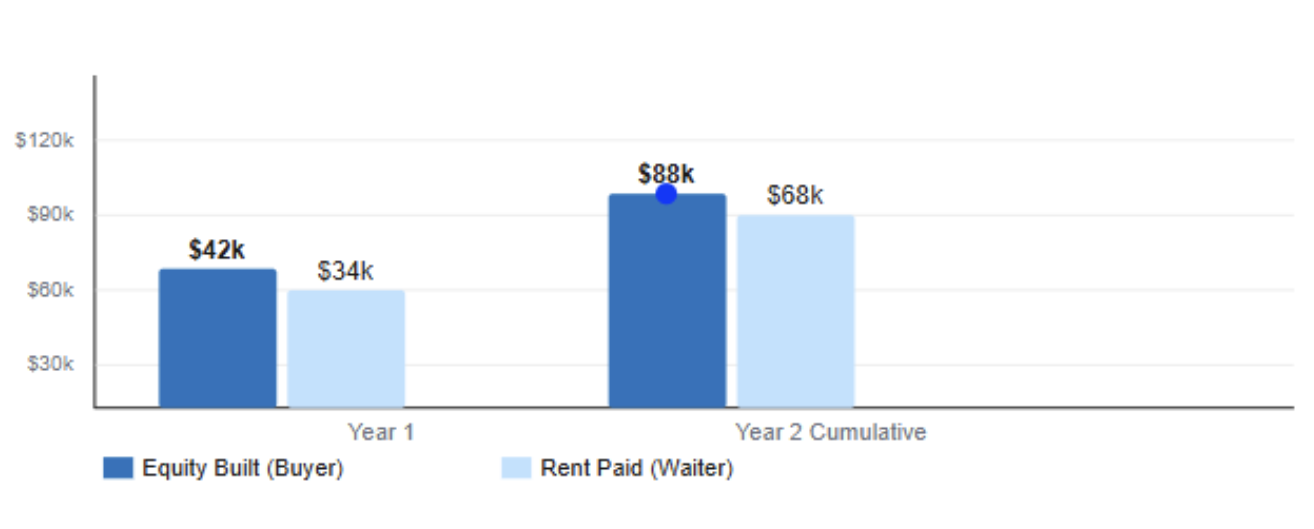
A buyer who purchased a $650,000 property and held for two years accumulates substantially more in equity growth than a renter pays in rent over the same period, assuming average long run capital growth conditions.
Source: FPW Group modelled scenario; CoreLogic long run capital growth assumptions at 6.5% p.a.; ABS rental CPI data, 2025 to 2026. Modelled only. Not a forecast.
What the 2026 Market Looks Like for Investors
For investors specifically, 2026 is a market that rewards careful positioning rather than aggressive acquisition. Borrowing power constraints mean that the first acquisition decision shapes what the second and third acquisitions look like. Buying a low yield property in a capital city that strains serviceability may prevent the investor from acquiring again for three to five years.
Choosing the right investment strategies for today's market is more important than ever.
Regional markets continue to attract investor attention for exactly this reason. Yield profiles in parts of Queensland, South Australia, and Western Australia remain materially higher than inner capital city equivalents, which supports serviceability and allows investors to maintain borrowing capacity for subsequent moves. A clearproperty investment strategybefore entering the market is what separates investors who continue building from those who stall after one acquisition.
Final Thoughts: A Decision Framework for Australian Buyers
The question of whether now is a good time to buy property in Australia does not have a single answer. It has a personal answer. The market provides the conditions. The buyer's financial position determines whether those conditions are workable.
For a complete overview, read our property investment guide for Australian investors.
In 2026, the buyers making sound decisions are those asking whether they can sustain repayments through further rate movements, whether their income is stable enough to service a long hold, and whether their deposit is sufficient to avoid excessive LMI exposure. Those questions matter far more than any short-term price forecast.
Frequently Asked Questions
This article is general information only and does not constitute financial, tax, or investment advice. All figures, scenarios, and modelled examples are illustrative and based on publicly available data as at 2025 to 2026. Individual outcomes vary based on market conditions, lender policy, income, and personal circumstances. Speak with a qualified financial adviser and mortgage broker before making property decisions.
Recommended Reading
Two pages selected based on what readers of this article are most likely to need next.