

How Lenders Assess Borrowing Capacity: Mortgage Stress Testing Explained
Most borrowers treat their borrowing capacity as a fixed sum tied to their salary. It is not. The number a lender approves is the product of mortgage stress testing, a behind the scenes process that assesses your loan at a much higher interest rate than the one you pay.
This article assumes you already understand the basics. If you want the full breakdown, start with our borrowing capacity guide. Here we focus on something narrower and more useful: what moves that number inside a lender's system.
Two forces do most of the work. The assessment rate the bank applies, and the buffer that sits on top of it. Understand those, and the gap between what you expect and what you are approved for stops being a mystery.
Why Borrowing Capacity Is Not a Number You Can Calculate
Borrowing capacity is an output, not a formula you can punch into a calculator and trust. Lenders do not start with a target loan size. They start with your income, strip it back under stress conditions, and measure what is left.
That leftover figure, your assessed surplus, is what sets the loan. It is why two people on the same salary can walk away with very different numbers. If you want the mechanics of how banks calculate borrowing power, that sits in a separate guide. The point here is simpler. The figure is derived, not declared.
What Is Mortgage Stress Testing
Mortgage stress testing is the process lenders use to check whether you could still afford your loan if rates rose sharply. Rather than assessing you at the rate you will pay, they assess you at a higher assessment rate.
Under rules set by the Australian Prudential Regulation Authority, every lender must test your repayments at least 3 percentage points above the loan's actual rate. So, a loan advertised near 6.5 per cent is assessed at around 9.5 per cent.
You are not being approved for the loan in front of you. You are being approved for a tougher version of it that may never exist.
The Buffer Gap: Actual Rate vs Assessment Rate
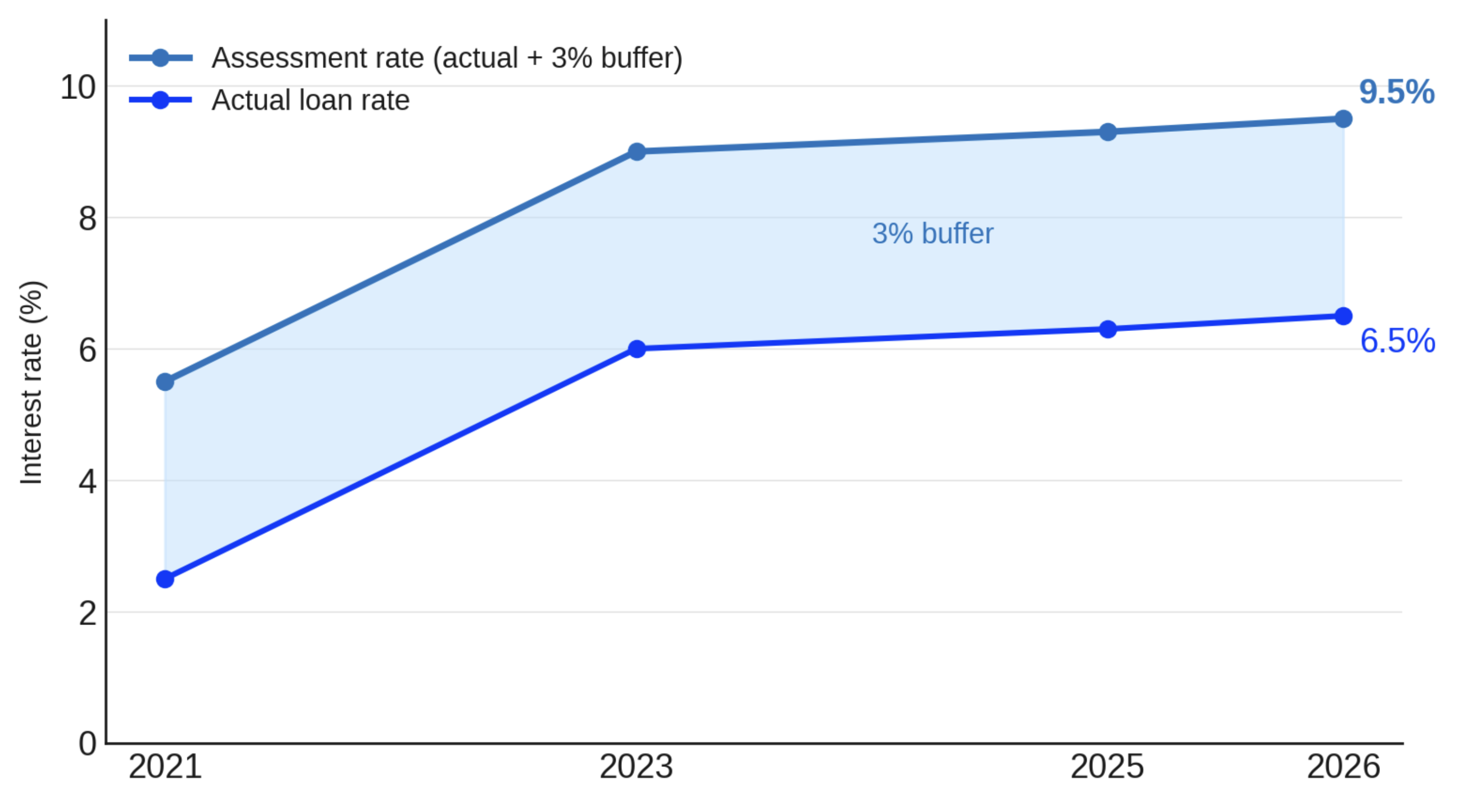
Source: RBA cash rate, 2026
The Interest Rate Buffer System, Explained
The buffer is the single most powerful lever in the system, and most borrowers never see it. It is a fixed margin added to the assessment rate, currently three percentage points.
Public borrowing calculators rarely apply it in full. They show what looks affordable at today's rate, which is why their numbers run well ahead of what a lender will actually approve.
The buffer does not care about your comfort with current repayments. It quietly lowers your ceiling before you have made a single decision.
FOR EXAMPLE
On a $700,000 loan over 30 years, repayments assessed at 9.5 per cent run roughly $1,400 a month higher than at 6.5 per cent. The lender needs to see that you could cover the higher figure, not the real one.
How Serviceability Works Under Stress Conditions
Serviceability is the test of whether your income covers your commitments once everything is stressed. The lender takes your gross income, applies its own living expense benchmark, subtracts existing debts assessed at the buffer rate, and measures the surplus that remains.
That surplus is the fuel for new lending. The smaller it is, the less you can borrow, no matter how affordable the loan feels in real life.
This is the key distinction. Affordability is what you can manage today. Borrowing capacity is what survives a hypothetical future the lender is required to model.
Where Your Income Goes in a Serviceability Assessment
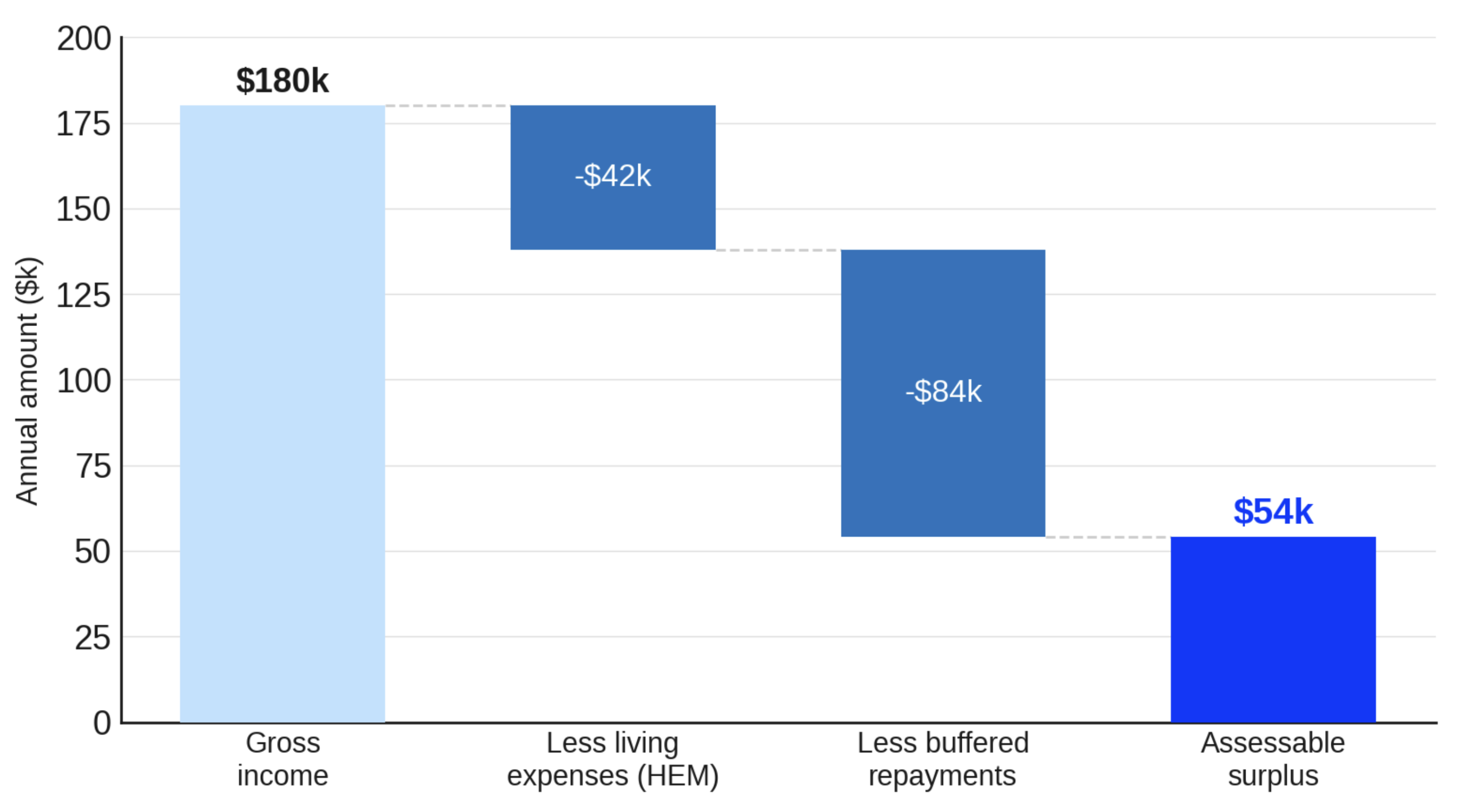
Source: Modelled scenario, APRA serviceability settings, 2026
Why Borrowing Capacity Differs Between Banks
Here is where it gets frustrating. The same application can return different numbers at different banks, sometimes by hundreds of thousands of dollars.
Lenders share the APRA floor, but everything above it is their own policy. How much rental income they count, how they treat overtime or self-employed income, where they set their debt-to-income ratio limit, and how much risk they will accept.
A borrower knocked back at one bank is not necessarily a weak borrower. They may simply have hit one lender's internal rule.
Same Borrower, Different Lenders, Different Capacity
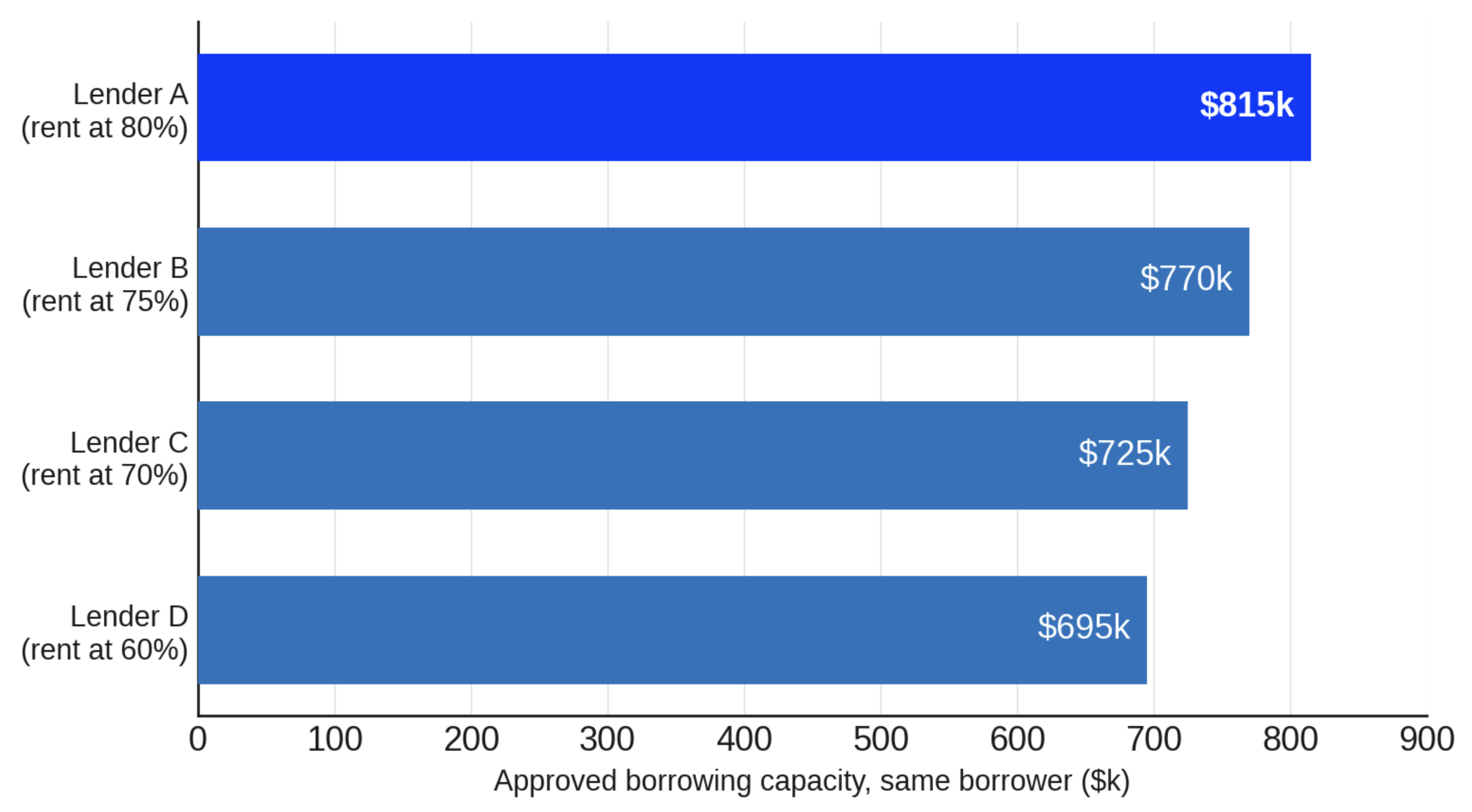
Source: Modelled scenario, indicative lender policy, 2026
How Mortgage Stress Testing Reduces Your Borrowing Capacity
Every dollar of buffer eats into the surplus that funds your loan. Test the same income at 9.5 per cent instead of 6.5 per cent, and the repayments the lender must cover jump, shrinking what is left for new debt.
This is why borrowing capacity fell sharply as rates climbed, even for people whose salaries rose. The income went up. The assessed cost of debt went up faster.
Same Income, Lower Capacity: 2021 vs 2026
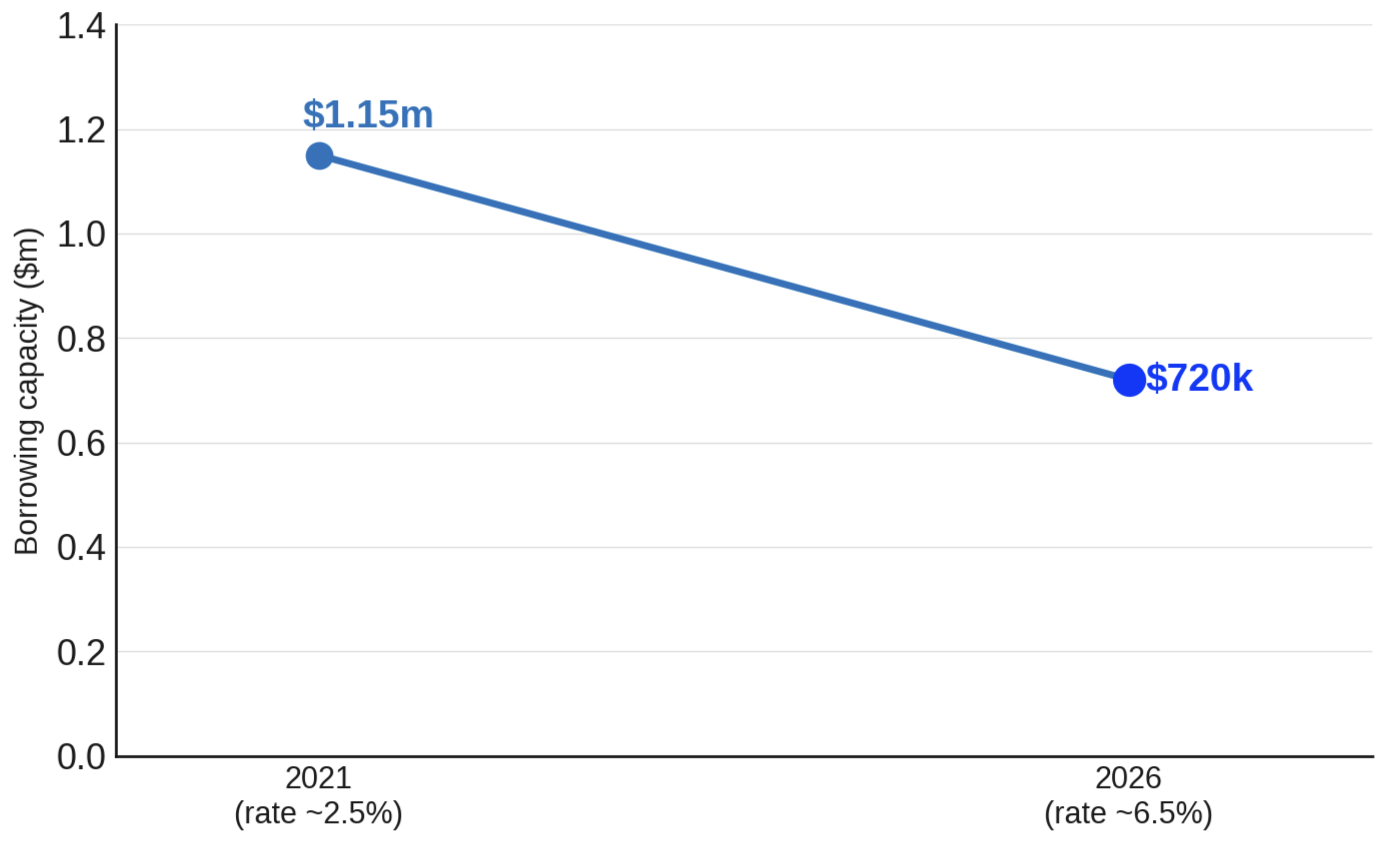
Source: Modelled scenario, APRA buffer and RBA cash rate, 2026
Why Borrowing Capacity Changes Over Time
Borrowing capacity is not stable because the inputs are not stable. Rates move, and the assessment rate moves with them. Policy shifts, as it did when APRA added a debt-to-income limit in 2026. Benchmark living costs are updated as the cost-of-living rises.
None of these depend on you. A borrower who did nothing differently can find their capacity higher or lower simply because the settings around them moved.
What Mortgage Stress Testing Means for Borrowers
For most borrowers, this is where the theory becomes personal. The amount you can borrow is lower than online tools suggest, because those tools rarely apply the full buffer.
Pre-approval is not a locked number either. It reflects your profile and the lender's policy on the day it was issued, both of which can change before you buy.
And the gap is widest exactly when you feel wealthiest, when prices have risen but the assessment rate has held your capacity down.
FOR EXAMPLE
A buyer pre-approved in one quarter may find the figure reduced months later after a policy change or a rate move, despite no change in their own finances.
Stress testing is lender specific, and the right structure can move your number more than most borrowers expect.
How to Improve Your Borrowing Capacity
You cannot change the buffer, but you can change what the buffer is applied to. A few levers consistently help.
Cancel unused credit card limits, since lenders count the full limit as debt. Pay down or consolidate small liabilities. Keep your income stable and well documented. Avoid taking on new commitments in the months before you apply.
These are the basics. For the full set of strategies, see our guide on how to increase borrowing capacity. The detail matters more than most borrowers expect.
Final Thoughts
Borrowing capacity is not a reward for earning well. It is a stress tested outcome, the amount left after a lender models a harder version of your loan than the one you will actually hold.
Mortgage stress testing, the buffer, and each lender's own rules explain almost every surprise borrowers run into. Once you see capacity as resilience under pressure rather than a salary multiple, the system stops feeling arbitrary.
The practical takeaway is steady. Know that your number is conservative by design, that it shifts with rates and policy, and that the lender you choose can change it. Plan around the test, not against it.
Frequently Asked Questions
Recommended Reading
Two pages selected based on what readers of this article are most likely to need next.
Watch: Australia Just Changed Property Investment Rules
This is not just another policy update. It is a structural shift in how the entire market is being shaped. The 2026 Federal Budget introduces changes across negative gearing, updates to capital gains tax CGT, and a growing tax advantages.