

Newcastle vs Geelong: What Does the Data Tell Investors?

A divorce property settlement rarely ends with one decision. The family home might be sold, kept, or refinanced onto a single income, and any investment property gets weighed against the same three choices: sell, keep, or restructure. What often gets missed is what happens next, when one household becomes two people who each need somewhere to live, on incomes that no longer combine the way they did when the original loan was approved.
Settlements are treated as a legal and personal matter, and rightly so. But every settlement also feeds into something bigger: household formation, borrowing capacity, and, multiplied across tens of thousands of cases a year, housing demand across the country.
Comparing the geelong property market with Newcastle comes down to a simple trade-off: Geelong offers a lower entry price and much stronger near-term population growth, while Newcastle offers a slightly higher rental yield and a tighter rental market. Neither market is simply the better buy, and the right one depends on what an investor is optimising for.
This comparison uses the same set of indicators for both markets, checked against data current to September 2026, rather than relying on reputation or a single headline statistic.
That matters because within the broader property investment Australia landscape, regional cities get compared on reputation far more often than on actual data.
Geelong Property Market: What Is Happening Now?
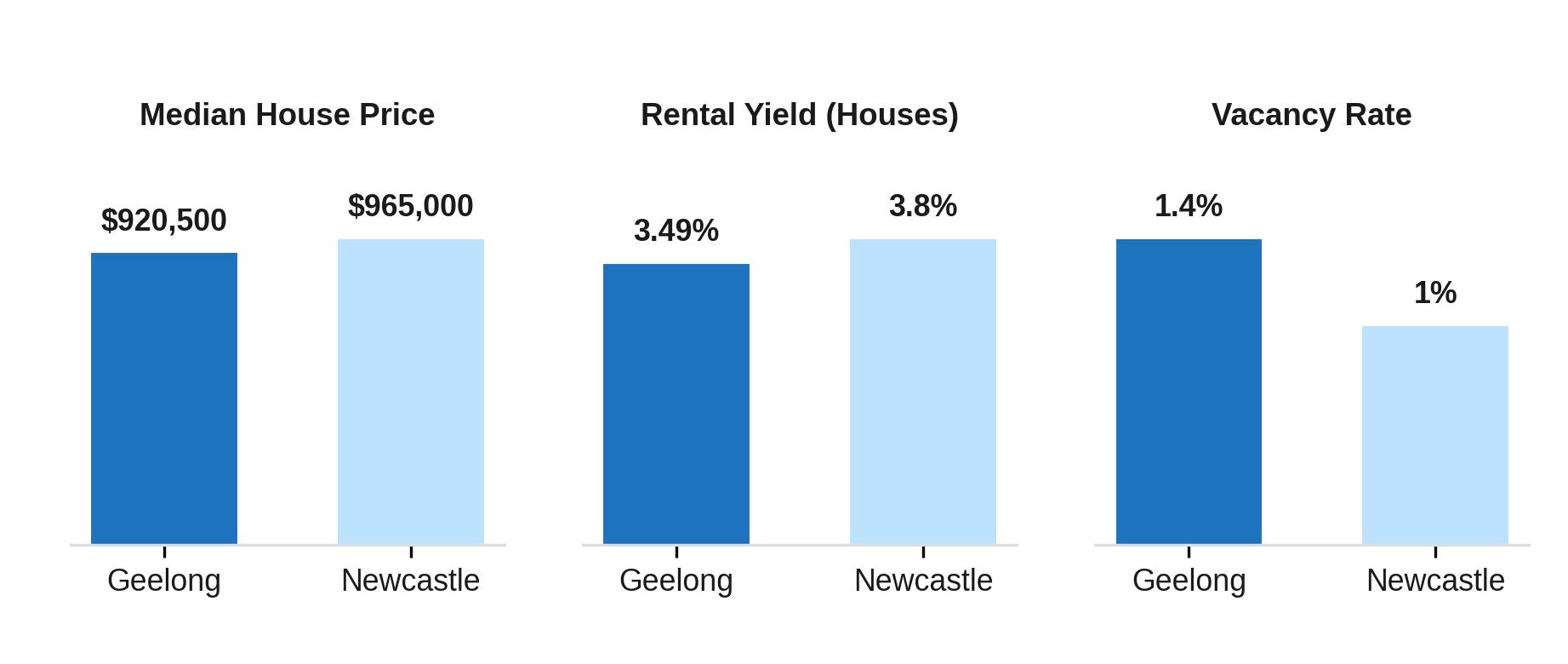
Geelong's median house price currently sits at $920,500, up 5.14 percent over the past year, according to CoreLogic data. Units have moved separately, with a median yield of 4.49 percent against 3.49 percent for houses.
Rental conditions are tight. SQM Research puts Geelong's vacancy rate at around 1.4 percent, with some suburbs sitting closer to 0.5 percent. Median rent runs at $592 a week for houses and $520 for units.
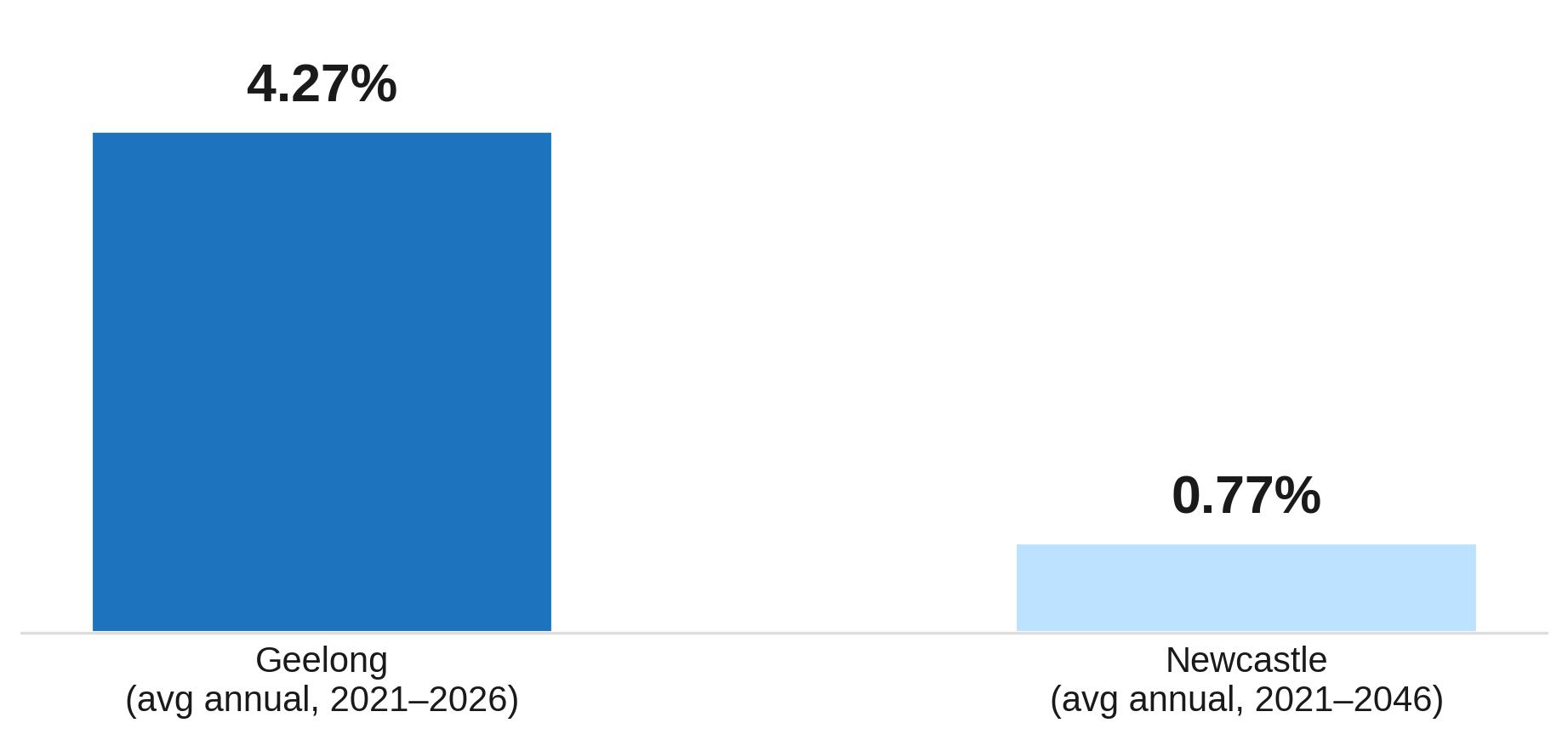
Population is the standout number. The City of Greater Geelong is forecast to grow from 270,786 people in 2021 to 333,751 by 2026, an average annual growth rate of 4.27 percent, according to the council's official population forecast.
That growth is not evenly spread. Suburbs like Highton and Belmont continue to record steady family demand and price stability, while Armstrong Creek remains one of the fastest-growing population corridors in the country, absorbing much of the new supply that keeps the citywide vacancy rate as tight as it is.
Price momentum has been uneven rather than one-directional. Geelong's median house price fell 11.7 percent annually at one point in the recent cycle before recovering, and the market has historically followed Melbourne's cycle with a six to twelve-month lag. KPMG forecasts Melbourne house prices to rise 6.6 percent in 2026, which is typically read as an early signal for Geelong's own next leg of growth.
Newcastle Property Market: What Are Investors Buying Into?
Newcastle's median house price sits closer to $965,000, with annual growth around 5.4 percent, according to InvestorKit research. That puts Newcastle roughly $45,000 above Geelong on a typical house purchase.
Rental yield runs slightly ahead of Geelong at approximately 3.8 percent for houses, supported by a vacancy rate of around 1 percent, one of the tightest in regional New South Wales.
Suburbs such as Mayfield, Wallsend and Jesmond offer the more affordable entry points into that rental demand, sitting close to the John Hunter Hospital and University of Newcastle employment precincts that anchor much of the city's tenant base.
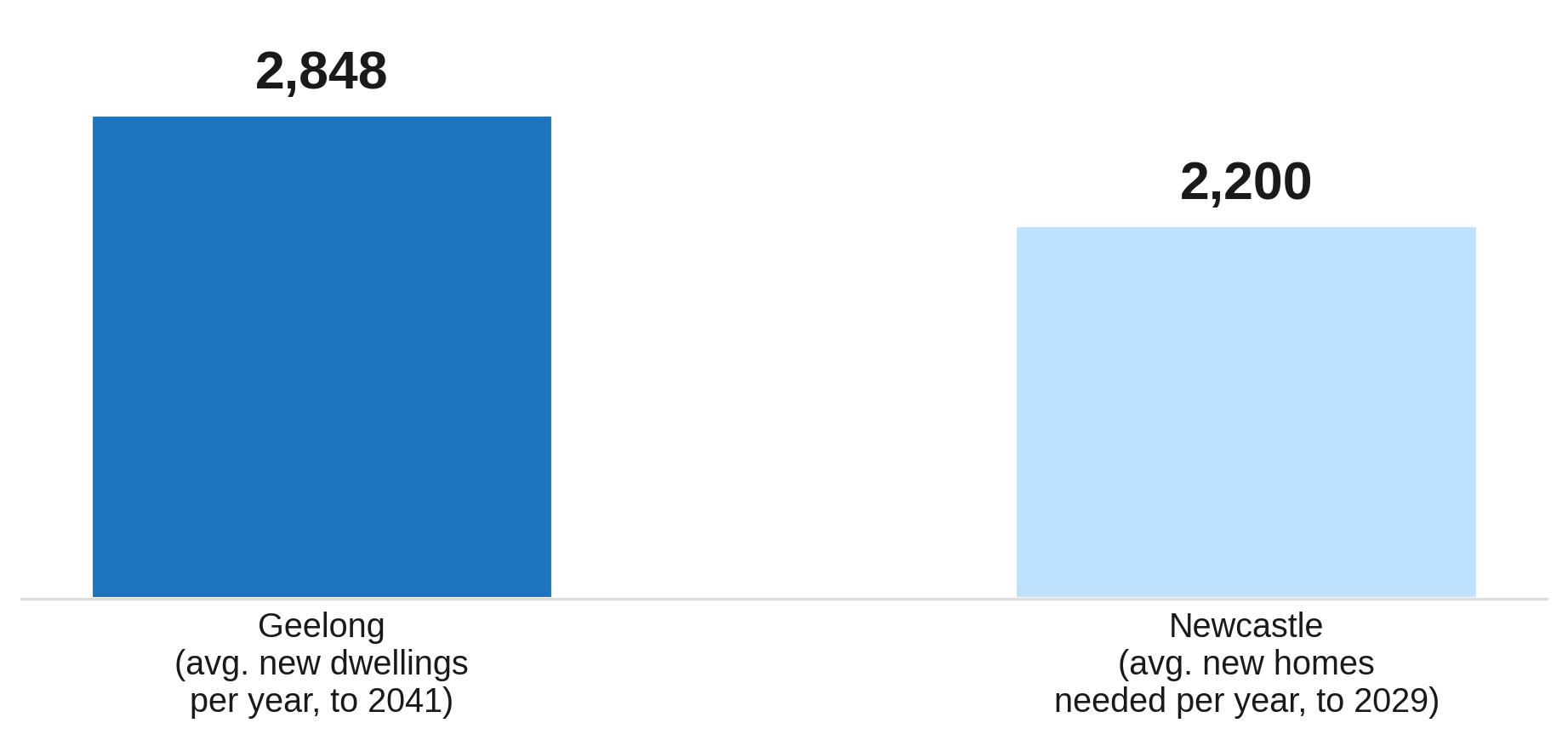
Newcastle's population growth looks more modest on paper. The City of Newcastle's official forecast points to 0.77 percent average annual growth out to 2046. The NSW Government's own housing target, an extra 11,000 homes by 2029, implies a considerably faster near-term pace than that long-run average.
Infrastructure spending backs that acceleration. The 2026 NSW Budget committed $14 million to the Broadmeadow Precinct, a transport-oriented redevelopment expected to house up to 40,000 additional residents over time, alongside transport-oriented development zones the state government has designated around Adamstown, Newcastle Interchange, Hamilton and Kotara stations.
Market Snapshot: Newcastle vs Geelong
Source: CoreLogic data via Your Investment Property Magazine, and SQM Research, 2026
Newcastle vs Geelong: How Do the Numbers Compare?
Placed side by side, the two markets tell a consistent story. Geelong wins on affordability and population momentum. Newcastle wins on yield and rental tightness.
The gap in entry price matters more than it looks on paper, because it changes what a given borrowing capacity can actually buy in each market.
Population Growth Comparison: Geelong vs Newcastle
Source: forecast.id.com.au, City of Greater Geelong and City of Newcastle population forecasts, 2026
Housing supply tells a more balanced story. Geelong's building approvals have fallen by roughly half since 2021 but remain comparatively high against other regions. Newcastle approved almost 1,500 new dwellings in the 2022 to 2023 financial year, the third highest total in New South Wales, yet InvestorKit estimates supply is still constrained at just 0.53 percent of existing stock.
Housing Supply Pipeline: Newcastle vs Geelong
Source: forecast.id.com.au, City of Greater Geelong, and NSW Government housing targets, 2026
Rental Growth and Tenant Demand
Rents have moved at a similar pace in both cities, but for different reasons. Geelong rents rose 4.2 percent over the past year, according to HtAG Analytics, driven by steady population inflow against a shrinking pool of listings.
Newcastle's rental growth has been more uneven across dwelling types. Median unit rents rose an average of 7.6 percent a year over the five years to December 2025, according to housing.id, while house rent growth has slowed closer to 5 percent as affordability limits start to bind after several years of sharp increases.

Which Market Has the Stronger Investment Fundamentals?
Where Geelong Has the Advantage
Geelong's advantage is proximity and momentum. It sits just over an hour from Melbourne, benefits from Deakin University, Barwon Health and the NDIA's national headquarters, and is forecast to add over 60,000 residents by 2026 alone.
Affordability compounds that advantage. A median house price roughly $45,000 below Newcastle's gives Geelong buyers more room to borrow for renovations, a second property, or a buffer against rate rises, without stretching to the top of their capacity on the purchase alone.
Where Newcastle Has the Advantage
Newcastle's advantage is economic diversification. The port, the University of Newcastle, John Hunter Hospital and the Hunter Renewable Energy Zone give it a broader employment base than a market reliant on a single anchor industry.
That diversification matters most in a downturn. A regional economy built around several distinct sectors, logistics, health, education and energy, is less exposed to a single employer or industry cycle than a market where one institution or manufacturer carries an outsized share of local jobs.
Where Each Market Carries More Risk
Each market carries its own risk. Geelong's price has already moved, with growth of 5.14 percent in the past year following a period of correction, and a large share of demand still depends on Melbourne's cycle rather than Geelong's own economic base.
Newcastle's higher entry price leaves less room for error if population growth stays closer to its long-run average than its accelerated target. A government housing target is a policy goal, not a guarantee, and the gap between the two has mattered in other cities before.
Interest rate sensitivity cuts across both markets rather than favouring one. A market priced on continued population acceleration, whether that is Geelong's Melbourne-linked growth or Newcastle's infrastructure-driven target, tends to correct harder than a market priced on more conservative assumptions if rates rise faster than either city's underlying demand.
Newcastle vs Geelong: Which Market Suits Different Investors?
An investor prioritising capital growth has more evidence pointing toward Geelong, given its population trajectory and Melbourne-linked demand.
An investor prioritising rental income has a marginally stronger case in Newcastle, where yield and vacancy both sit slightly ahead of Geelong.
An investor prioritising a lower entry price has a clearer answer in Geelong, where the median house price sits meaningfully below Newcastle's. Either way, the suburb selected inside each market matters as much as the city-level numbers, which is where choosing an investment grade suburb becomes the next real decision.
An investor prioritising long-term growth drivers rather than a single indicator has a genuinely close call. Geelong's population trajectory and Melbourne overflow demand are stronger in the near term, but Newcastle's port, energy transition and transport-oriented redevelopment give it a broader base of drivers that do not all depend on one city's cycle.
The Newcastle vs Geelong Investment Scorecard
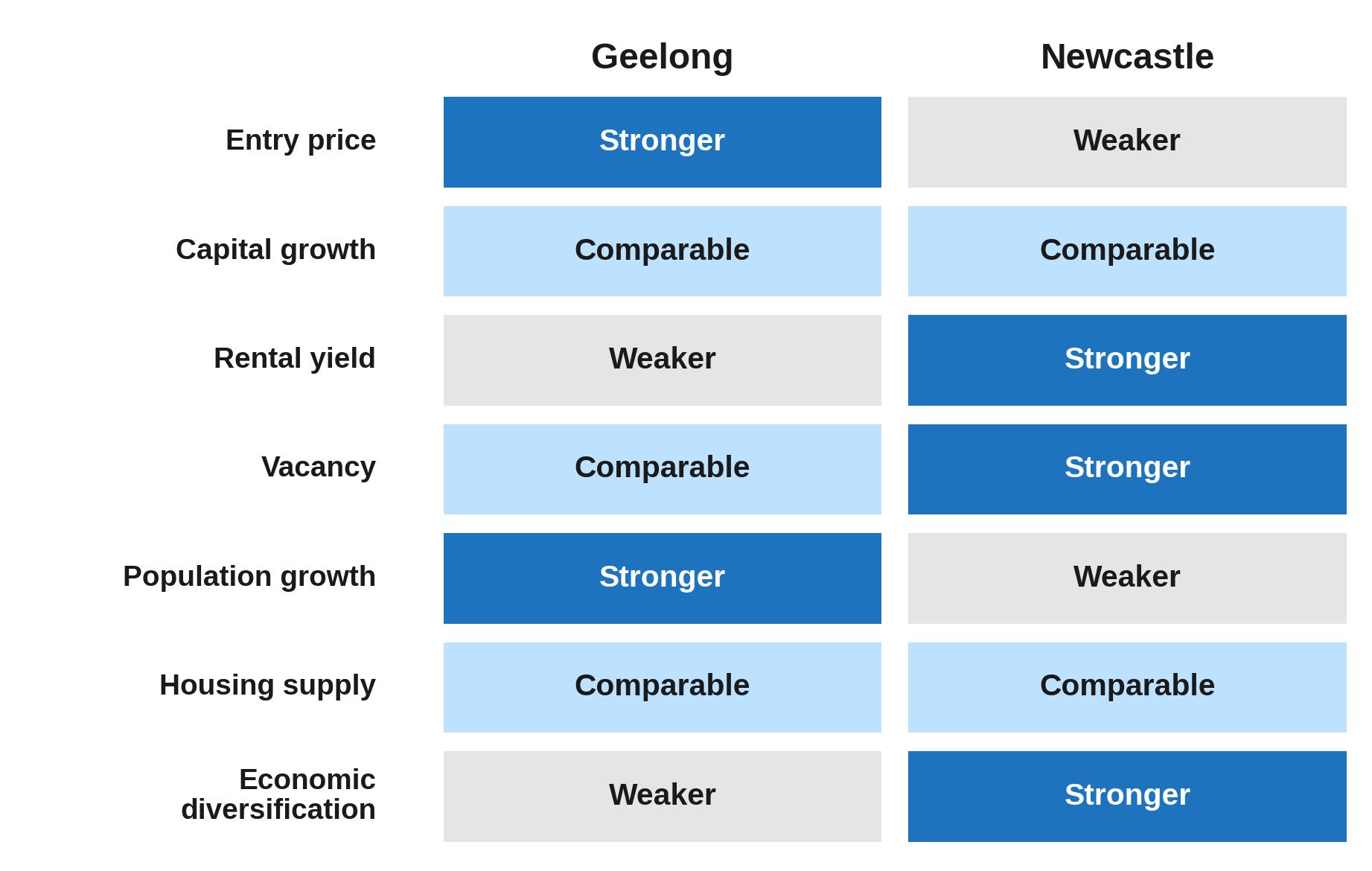
Scoring two markets against each other only works if the method is transparent. Each criterion below is rated Stronger, Comparable, or Weaker based on the data covered above, not a hidden formula.
A Stronger rating means one city clearly leads on that specific measure, based on the figures already discussed. Comparable means the gap is small enough that other factors, such as the specific suburb or property, would likely matter more than the citywide difference. No criterion is weighted more heavily than another, since the right weighting depends entirely on what the individual investor is optimising for.
The Newcastle vs Geelong Investment Scorecard
Source: FPW Group analysis based on CoreLogic, SQM Research, InvestorKit and forecast.id.com.au population data, 2026
What to Check Before Buying in Either Market
A citywide median hides enormous suburb-level variation in both markets. Check the specific suburb's rental demand and vacancy rate, not just the city average, since a 1.4 percent city figure can mask individual suburbs sitting well above or below it.
Examine what is actually approved and under construction nearby, since a strong demand story can be undone by a large incoming supply pipeline. A buyer's agent working across both markets can pressure test a shortlist against this before you commit.
Investigate the infrastructure timeline before paying a premium for proximity to a project that is still years from completion. A rail upgrade or precinct redevelopment can support prices well before it opens, but only if the delivery date is realistic rather than aspirational.
Finally, test the property against your own strategy rather than the market's reputation. A Geelong property bought for growth and a Newcastle property bought for yield are both reasonable decisions if they match what the investor actually needs from the portfolio.
Final Thoughts
Neither Newcastle nor Geelong is the obvious winner, and a genuinely data-led comparison should not force one. Geelong currently offers the stronger affordability and population growth case. Newcastle offers the stronger yield and diversification case.
The right market depends on what the investor is optimising for, not which city has the better headlines. Capital growth, cash flow and entry price rarely all point to the same city at the same time, and chasing all three at once usually means settling for a weaker result on each.
Checking the same indicators before buying in either market, rather than relying on reputation, is what actually separates a considered decision from a coin flip. The scorecard above is a starting point for that comparison, not a substitute for checking the specific suburb and property against it.
Frequently Asked Questions

Recommended Reading
Two pages selected based on what readers of this article are most likely to need next.
Recommended Video
Most investors are still positioned in capital cities — but in 2026, that allocation gap is creating real opportunity cost. In a market where timing, positioning, and yield profiles compound into long-term outcomes, that disconnect matters more than most people realize.