
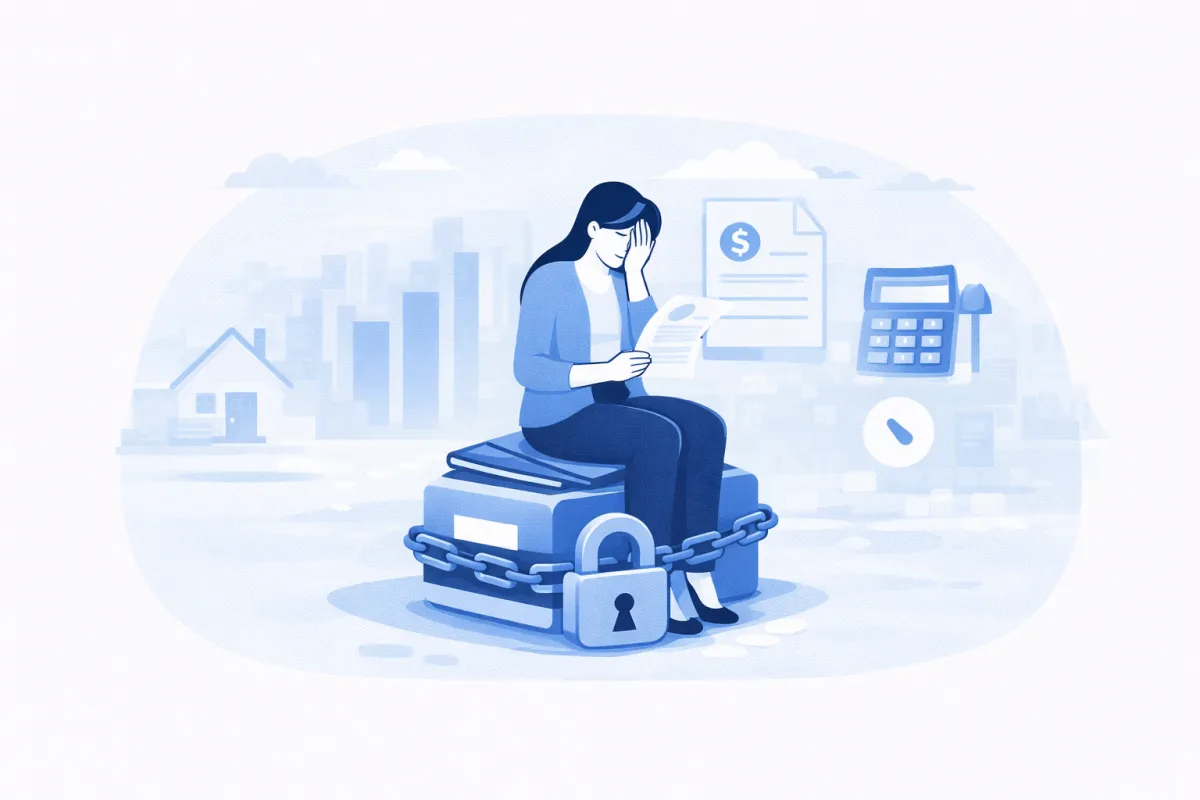
It’s Not the Market Slowing You Down
Markets often get the blame when progress slows.
When conditions feel uncertain, lending tightens, or activity becomes less visible, it is easy to assume that the environment itself is the limiting factor. Many investors step back during these periods, waiting for clearer signals, stronger momentum, or a return to what feels like more stable or “normal” conditions.
At face value, this seems rational. If the market appears slower or less predictable, the natural response is to slow down with it and avoid unnecessary risk.
But in many cases, the market is not what’s preventing forward movement. The real constraint often sits elsewhere, in how well positioned you are to act within the conditions that already exist.
What the market is actually doing
Even in slower or more cautious environments, the market does not stop.
Transactions continue. Properties change hands. Opportunities still emerge, often with less competition and more favourable negotiation conditions. In some cases, these environments can offer better entry points than periods of strong momentum. The difference is not the absence of opportunity. It is the absence of urgency.
When sentiment is mixed, fewer buyers are actively competing. Sellers who remain in the market are often more flexible. Pricing becomes less aggressive, and conditions open up in ways that are not available during high-confidence cycles.
This dynamic is not always obvious, which is why many investors overlook it. As outlined in The Window Most Investors Miss in Changing Markets, the most advantageous conditions often appear before confidence returns, not after it.
From a purely market perspective, the pathway to acquisition still exists.
Why it feels like progress has slowed
If opportunity still exists, why does it feel harder to move? The answer is friction. This friction is rarely driven by property fundamentals, but instead by changes in finance and lending conditions.
As interest rates rise or remain elevated, lenders adjust how they assess borrowing capacity. Serviceability buffers increase, income is treated more conservatively, and existing debt is scrutinised more closely. These changes often occur without any visible shift in an investor’s personal circumstances.
This creates a subtle but important disconnect. The market continues to function, but the ability to participate becomes more constrained, making progress feel slower than it actually is.
An investor who previously operated within a certain price range may find that range narrowing, with approvals becoming more sensitive and lending decisions less forgiving. From the outside, this feels like the market has slowed down, when in reality it is the investor’s capacity to act that has changed.
The real bottleneck
The limitation is not always external, but often structural in nature. Many investors approach each purchase in isolation, focusing on securing the asset without fully considering how that decision impacts future borrowing capacity and overall portfolio flexibility.
Over time, this can lead to inefficient lending structures, increased servicing pressure, and a gradual reduction in borrowing capacity. These constraints are rarely visible after the first acquisition, as early purchases often feel relatively straightforward and accessible.
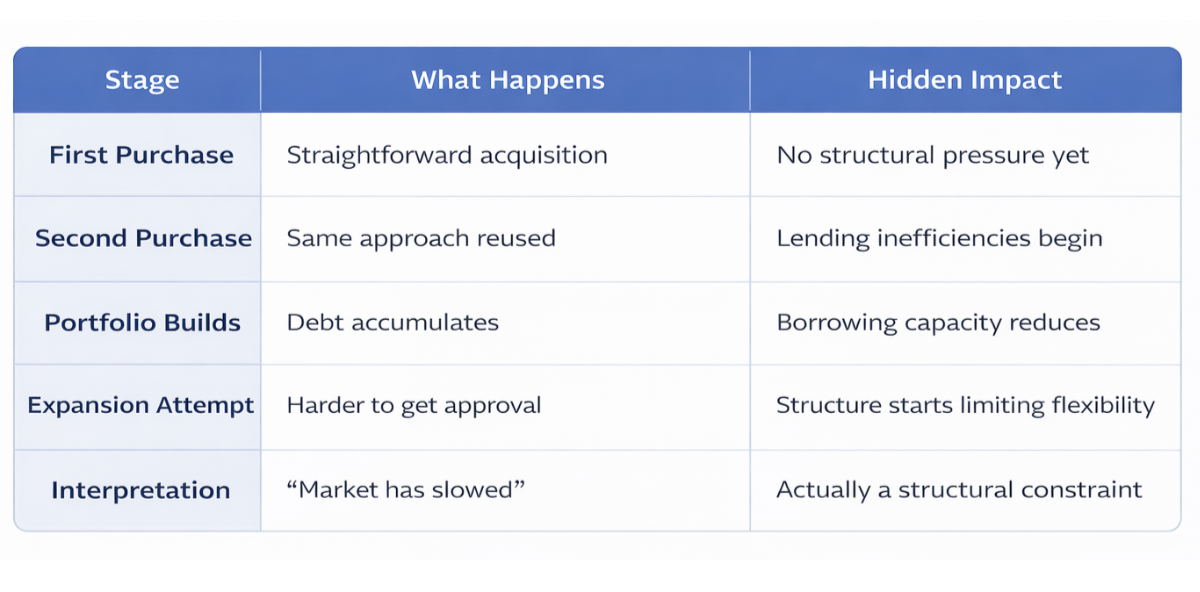
The issue tends to surface later, when expansion is attempted and the same approach no longer produces the same outcome. At that point, it is often assumed that the market has become more difficult, when in reality the structure supporting the portfolio has not been designed for continued growth.
This is explored more deeply in Why Your Property Portfolio Might Stop at Two Properties, where the limitation is not the availability of opportunity, but the way borrowing capacity is managed over time.
By the time the constraint becomes obvious, the bottleneck is already in place.
Where most investors get it wrong
A common response to this friction is to wait, with many investors delaying decisions until conditions feel clearer or more favourable. They look for signals such as stabilising interest rates, consistent price growth, or renewed confidence in the market, as these indicators create a sense of safety and reassurance.
However, these signals are inherently delayed. By the time conditions feel comfortable again, the market has already adjusted, with competition increasing, negotiation power reducing, and speed becoming more important. The same opportunities that were once accessible now require stronger positioning to secure.
At the same time, borrowing capacity does not automatically improve alongside sentiment. In many cases, it remains constrained or recovers more slowly than expected, which further limits the ability to act. There is also a behavioural component, where past experiences shape expectations and influence decision-making in ways that are not always aligned with current conditions.
Many investors carry forward assumptions from their first purchase, expecting the process to remain consistent as they expand. However, as discussed in The Biggest Property Investing Mistake People Make After Their First Property, the conditions that supported the initial purchase are rarely tested until the next step becomes more complex.
By that stage, the environment has changed, and so have the requirements to move forward. Waiting does not resolve these issues. It often reinforces them.
The disconnect between opportunity and readiness
This is where the core issue becomes clear, as opportunity and readiness are not the same thing. The market may present favourable conditions, including reduced competition, improved negotiation, and better access to deals, but the ability to act on those conditions depends entirely on how well an investor is positioned.
Without the right structure in place, these advantages cannot be fully leveraged. As a result, the presence of opportunity alone is not enough, what matters is whether you have the capacity and flexibility to act within it.
If borrowing capacity has reduced, flexibility narrows. If lending is inefficient, options become limited. If the portfolio is not positioned correctly, approvals become harder to secure. This creates a widening gap.
The opportunity may still exist, and in some cases may even improve. But the ability to move within that opportunity becomes increasingly constrained. This is often misinterpreted as a market issue. In reality, it is a positioning issue.
How prepared investors operate
Investors who continue to move effectively through changing conditions approach the market with a different level of awareness.
They maintain a clear understanding of their borrowing capacity and review it regularly as conditions evolve. They structure lending with future acquisitions in mind, not just immediate outcomes. They avoid unnecessary constraints that reduce flexibility and ensure their portfolio is designed to support continued growth. They also understand that uncertainty can create advantage.
Rather than waiting for clarity, they position themselves to act before confidence returns. They recognise that the most favourable conditions often sit just before the broader market becomes comfortable again.
Importantly, they separate external conditions from internal capability.
They do not assume the market is the limiting factor. They assess whether their position allows them to move within it.
Where this leaves you
The key question is not whether the market is slowing down, but whether your current position allows you to move within it. Opportunities do not disappear during uncertain periods; they tend to become less visible, less competitive, and more dependent on preparation.
The investors who benefit are not necessarily those who predict the market correctly, but those who are structured to act when others hesitate. If progress has stalled, it is worth looking beyond surface-level conditions, as the limitation is often not the market itself but the structure behind your ability to move through it.