

Personal Loans: Costs, Approval Criteria, and Impact on Borrowing Capacity
Personal loans are one of the fastest ways to fund a car, consolidate debt, or cover a large expense. They are also one of the quietest ways to shrink your borrowing capacity before you ever apply for a mortgage.
Australians take out roughly 2.5 billion dollars in fixed-term personal loans every month, yet most applicants have no idea how heavily a single loan weighs on a future home loan assessment.
Here is the part that catches people out. Lenders care about the repayment, not the balance. A loan you could clear in three years can still cost you tens of thousands in borrowing power right now. This guide explains what personal loans cost in Australia, how lenders assess them, and exactly how they change what you can borrow for property.
What a personal loan really costs in Australia
A personal loan is a fixed amount borrowed over a set term, usually one to seven years, repaid in equal instalments. The headline rate is only part of the story. What you pay depends on whether the loan is secured, your credit profile, and the fees built into the deal.
Most lenders use risk-based pricing. Two people can apply for the same loan and walk away with very different rates depending on their credit score. Advertised rates start near 5.5 percent, but the average unsecured personal loan in Australia carries an interest rate of about 13.87 percent a year. Secured loans, where an asset such as a car backs the debt, usually price lower because the lender carries less risk.
Then there are fees, which is why the comparison rate exists. It folds establishment and ongoing fees into a single figure so you can see the true cost rather than the marketing rate. The government's MoneySmart guidance explains how these disclosures protect borrowers.
How personal loan rates compare with other debt
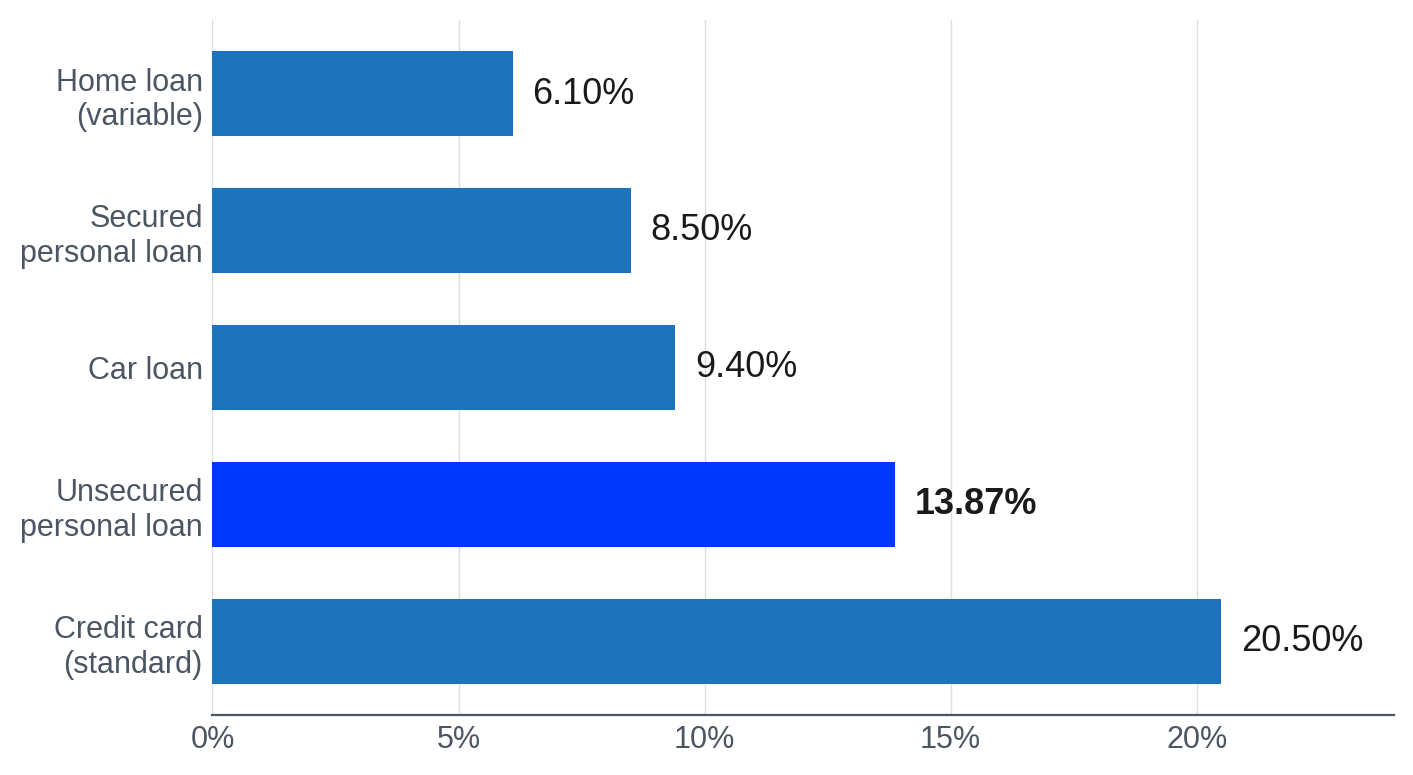
Source: Money.com.au, 2026
How lenders assess your personal loan application
Approval comes down to three things: your income, your existing commitments, and your credit history. Lenders pull a credit report, check your repayment conduct, and weigh your debts against what you earn. A clean record and steady income widen your options and lower your rate.
The wider rate environment matters too. The Reserve Bank lifted the cash rate three times in 2026 before holding it at 4.35 percent in June. Higher rates flow through to assessment rates; the buffered rate lenders use to test whether you can still afford repayments if conditions tighten.
For a personal loan, approval is usually quick. The harder question is what that approval does to your borrowing power later, which is where how banks calculate borrowing power becomes the number that counts.
The rate environment lenders are assessing you in
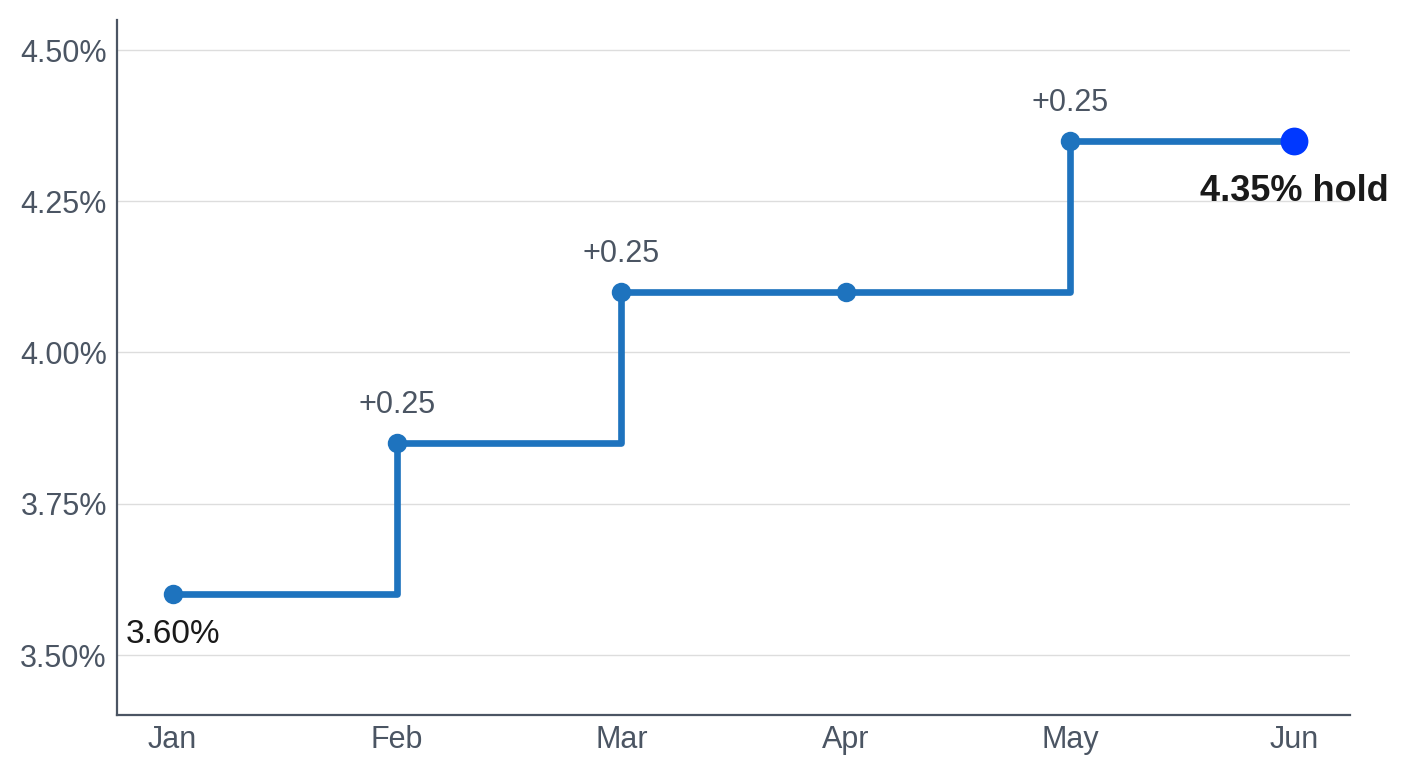
Source: Reserve Bank of Australia, 2026
How personal loans affect your borrowing capacity
This is the part most borrowers underestimate. When a lender works out your home loan limit, they start with your income, subtract your living costs, then subtract every existing debt repayment. What remains is the surplus available to service a mortgage. A personal loan repayment comes straight off the top of that surplus.
It gets sharper. The mortgage itself is assessed at your actual rate plus a 3 percent buffer set by APRA. So every dollar of surplus the personal loan removes is a dollar that would have supported a buffered, and therefore amplified, mortgage amount.
FOR EXAMPLE
A $20,000 unsecured loan at 13.87 percent over three years costs about $682 a month. Assessed against a buffered mortgage rate, that single repayment can reduce borrowing capacity by roughly $81,000. The loan is worth $20,000. The borrowing power it removes is four times larger.
What a 20,000 dollar loan does to your borrowing power
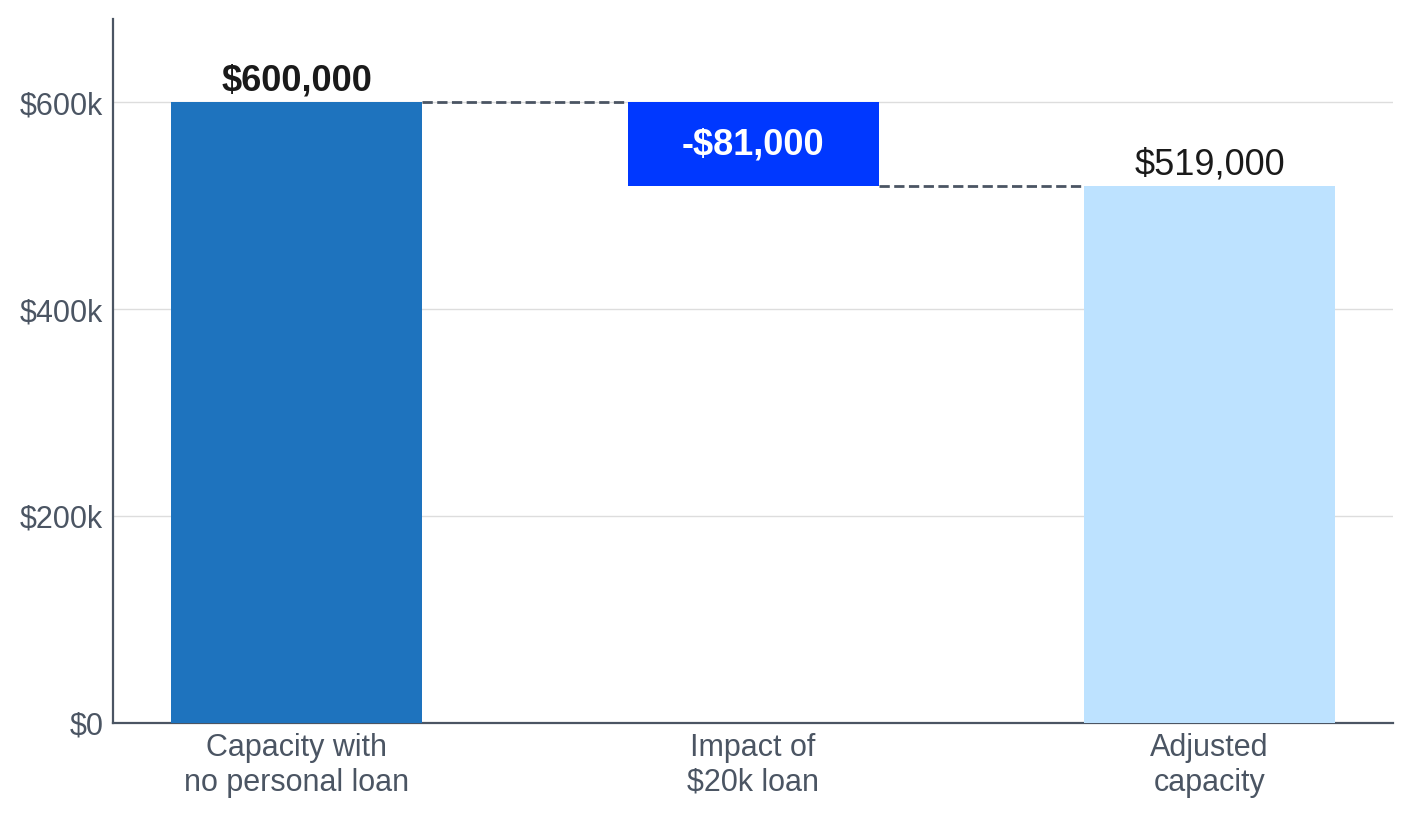
Source: Illustrative, based on APRA serviceability buffer
If you are trying to lift your limit, the fastest lever is often clearing or restructuring existing debt. There are other levers too, covered in how to increase borrowing capacity.
Can you get a home loan with a personal loan?
Yes, in most cases. A personal loan does not automatically block a mortgage. It just lowers the ceiling. Whether you are approved depends on how much room is left once the repayment is counted.
Two thresholds matter. The first is serviceability, the buffered test of whether you can afford repayments. The second is your debt-to-income ratio, the size of your total debt against your income. Lenders generally treat a ratio of six times income or more as risky. From February 2026, APRA limits how much of a lender's new lending can sit at that level, capping high debt-to-income loans at 20 percent of new mortgages.
A personal loan pushes both numbers in the wrong direction. It is rarely fatal on its own. Stacked with a car loan, a credit card, and a HECS balance, it can be.
Should you pay off a personal loan before applying for a mortgage?
Sometimes yes, sometimes it changes nothing. The answer depends on whether the repayment is the binding constraint.
If the personal loan repayment is the reason your serviceability falls short, clearing it can restore a large chunk of borrowing power, often far more than the balance you repay. If you are nowhere near your limit, paying it out early may simply drain the deposit you need.
There is an opportunity cost either way. Cash used to clear a loan is cash not sitting in your deposit. The right move is the one that improves the number a lender uses, not the one that feels tidiest.
How personal loans compare with other debt types
Not all debt damages borrowing power equally. The difference comes down to how each one is assessed.
A credit card is assessed on its limit, not its balance. A 10,000 dollar limit you never touch is still read as a 10,000-dollar liability, which is why an unused card can cost more borrowing power than a personal loan of the same size. Car loans behave like personal loans, since both are fixed repayments. HECS-HELP is gentler, because the repayment is a percentage of income rather than a fixed instalment, though it still trims your surplus.
How different debts cut your borrowing power
Source: Illustrative, based on lender serviceability practice
Final Thoughts
Personal loans are not the enemy of property ownership. Used carefully, they solve real problems. The mistake is treating them as separate from your home loan plans, when lenders read them as part of the same financial picture.
The numbers do the talking. A loan worth $20,000 can quietly remove $80,000 of borrowing power, and the repayment, not the balance, is what drives it. If buying property is on your horizon, map your debts before you take on new ones. Knowing how each commitment affects your borrowing capacity is the difference between a confident application and a declined one.
Frequently Asked Questions
Recommended Reading
Two pages selected based on what readers of this article are most likely to need next.
Recommended Video
While many investors spend time researching growth areas and property types, this discussion highlights a different reality, your ability to continue investing is often determined not by what you buy, but by how your loans are structured and how your borrowing power is managed over time.