

Property Investment Myths in Australia: What the Data Actually Shows
A lot of property investment advice in Australia is not wrong because it is dishonest. It is wrong because it is simplified. It strips out the conditions, the context, and the cycle position that make any piece of advice actually true.
What gets left behind sounds confident. It travels well on social media. And it shapes how a significant number of investors make real decisions with real money.
This article examines the narratives that distort how many Australians think about property. Not what investors did wrong, but what the advice itself gets wrong at a structural level.
Why so much property investment advice in Australia is misleading or oversimplified
Three forces work against nuanced property advice. Media economics rewards bold, shareable claims. Marketing economics rewards confidence over complexity. And the simplified narrative travels faster than the conditional one, every time.
The result is a steady supply of rules that contain some truth, stripped of the circumstances that determine whether that truth applies to you.
Does property always increase in value over time?
The long-run average for Australian residential property is positive. That is accurate. But it is also useless as a planning tool unless you know which market, over which cycle, and relative to your holding period.
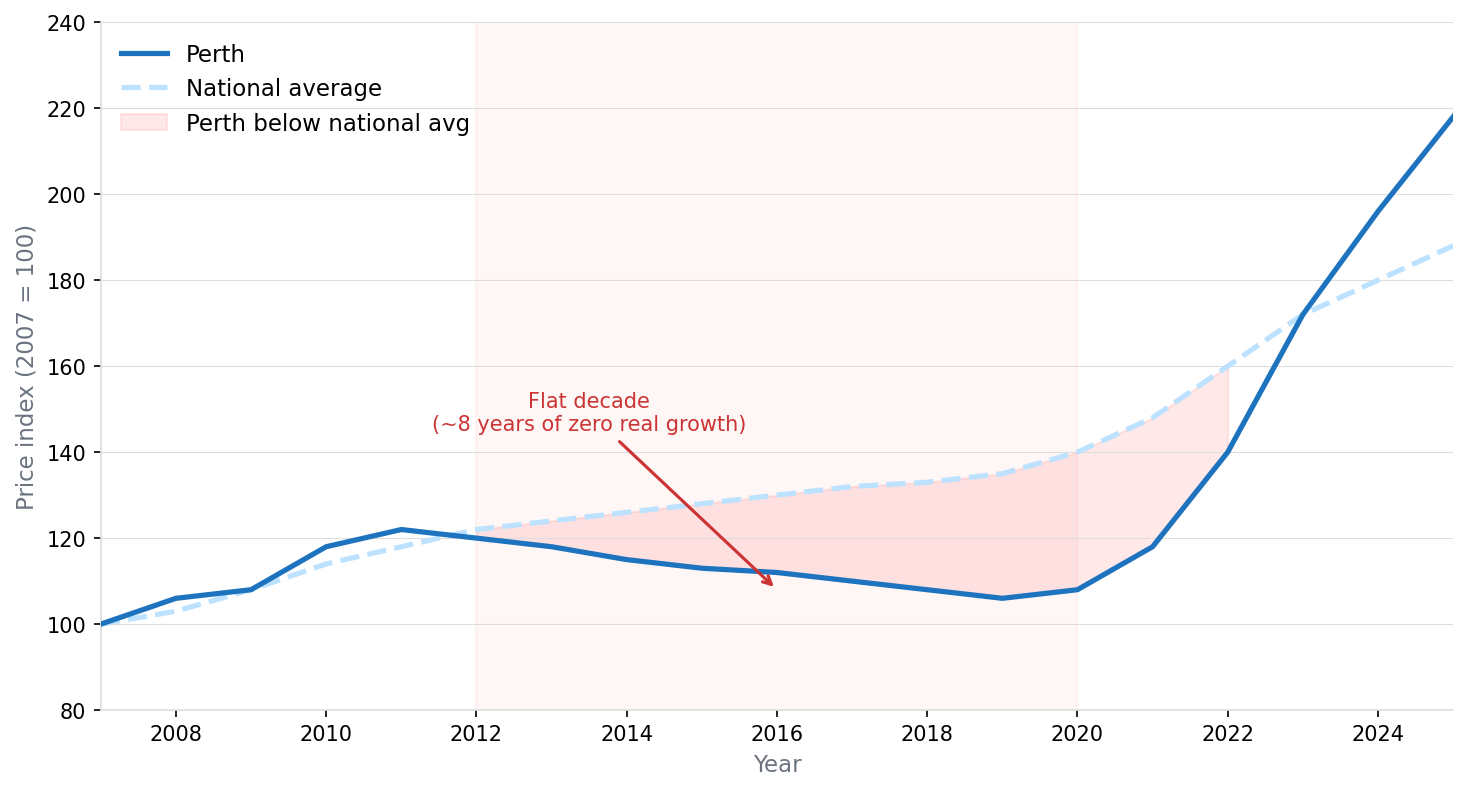
Perth is the clearest counter-example. Values in Perth were broadly flat for the better part of a decade from roughly 2011 to 2020. Investors who entered near the 2007 peak did not see real-value recovery for close to 12 years. The national average looked fine. Perth did not.
Perth vs National Average: Price Index 2007 to 2025
Source: CoreLogic / Cotality Home Value Index, 2025
Linear growth assumptions are particularly dangerous when used to calculate future wealth. A projection that assumes 7% annual compound growth does not account for a flat decade in the middle, or the fact that compounding only helps if you can hold through the cycle.
Is buying in capital cities always the safest property strategy?
The capital city preference rests on two assumptions: that depth of population equals depth of demand, and that liquidity is the primary measure of safety. Both are partially correct. Neither is always correct.
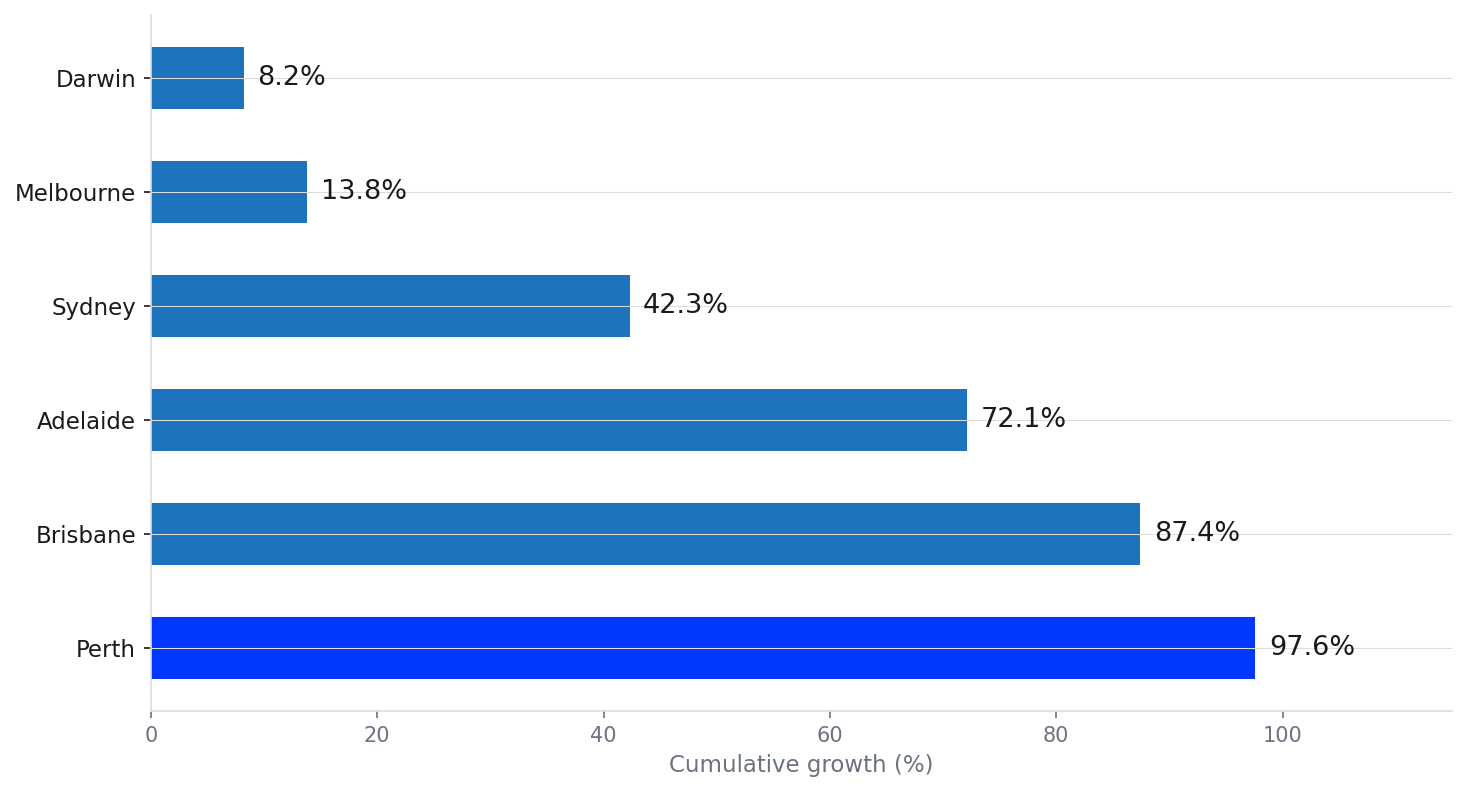
City-level data regularly obscures suburb-level divergence of 15 to 30 percentage points within the same metropolitan area. Two suburbs sharing a postcode boundary can produce completely different investor outcomes across a single cycle.
Cumulative Property Value Growth by City, 2020 to 2025
Source: CoreLogic / Cotality Home Value Index, December 2025
Regional centres also require more nuanced treatment than the binary framing of "capital vs regional" allows. Larger regional cities with diverse employment bases have outperformed several capital city suburbs across recent cycles.
How accurate is the idea that past property performance predicts future growth?
Growth charts are one of the most selectively used tools in property marketing. A 10-year chart from 2013 to 2023 produces a very different narrative about Sydney than a 15-year chart from 2008 to 2023. The data is accurate. The framing is not neutral.
Extrapolation bias, the tendency to assume the recent past will continue, is among the most documented errors in investment decision-making. In property, it shows up when investors use a suburb's last three years of growth to project the next ten.
FOR EXAMPLE
An investor researching Brisbane in mid-2021 would have seen strong recent growth figures. An investor who entered Brisbane in early 2004, near the peak of a cycle, then saw values stagnate for close to seven years. The data for both entry points was technically accurate. The framing was different.
Should property investment strategies be universal for all investors?
Templated strategies, the "buy a house in a growth suburb and hold for 10 years" type, are not wrong in the abstract. The problem is that they ignore the variables that determine whether any strategy is executable for a specific investor.
Your borrowing capacity sets a hard ceiling on which markets are actually accessible. Your income structure determines which lending products apply to you. Your existing debt position, including how lenders assess your debt-to-income ratio, shapes what you can borrow. A strategy designed for a dual-income household with no existing debt is a structurally different proposition for a single-income investor at a different DTI.
Is rental yield more important than capital growth in property investing?
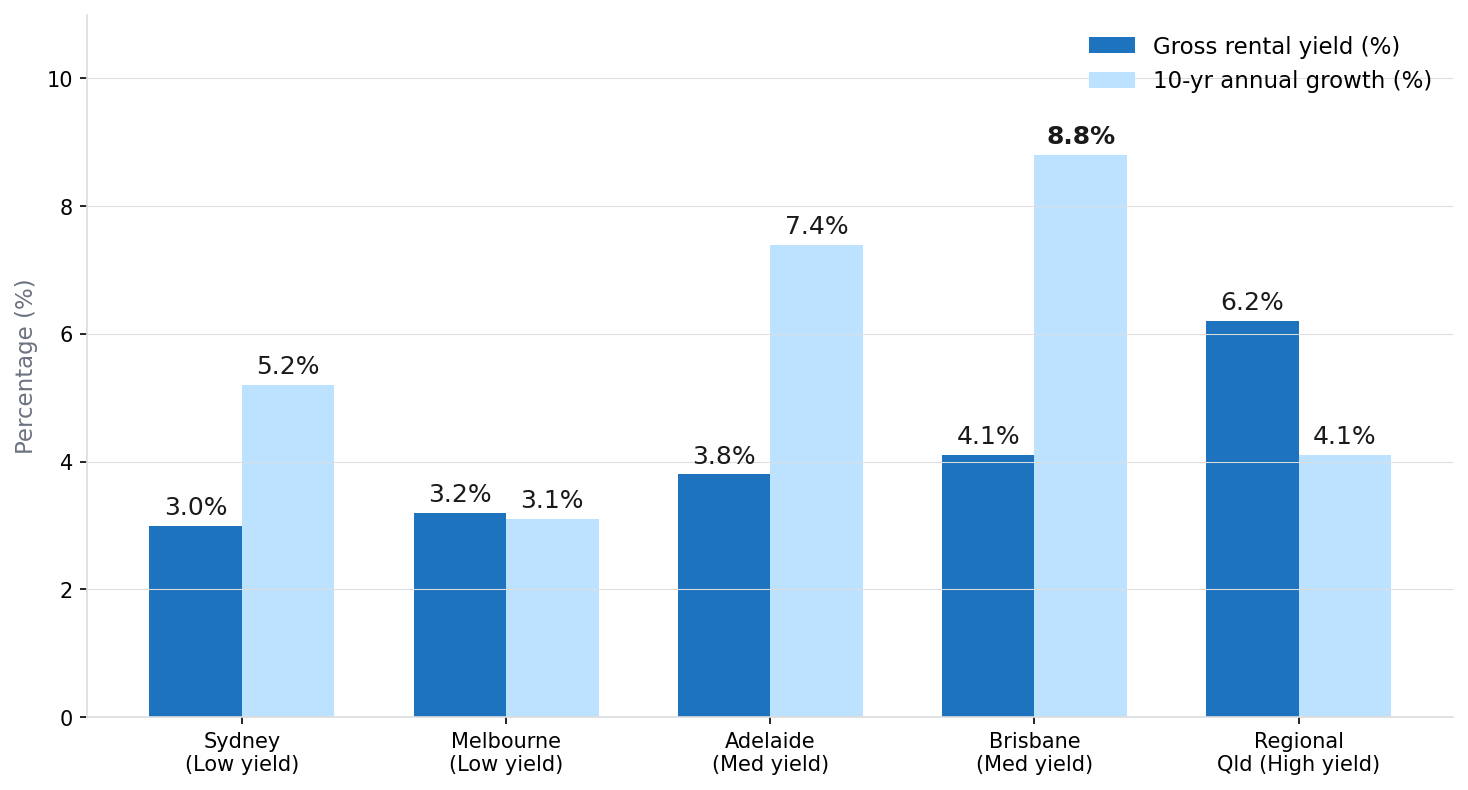
The yield versus growth binary is one of the most persistent oversimplifications in property advice. It frames two interrelated variables as mutually exclusive, which is both analytically wrong and strategically limiting.
Gross Rental Yield vs 10-Year Annual Capital Growth by Market
Source: CoreLogic / Cotality, Domain Research, 2025
Yield affects how long you can hold an asset under financial pressure. Capital growth determines how much equity you build to fund the next acquisition. Optimising for one in isolation produces strategies that work in one market phase and break down in another.
How risky is using leverage or debt to invest in property?
Debt is not inherently good or bad for property investment. The relevant factor is the relationship between the cost of debt, the income the asset generates, and your capacity to hold the position if those variables change.
The narrative that "long-term debt is always good in property" omits the risk of refinancing conditions changing mid-cycle. The rental crisis has temporarily improved yield positions for many investors. That dynamic is not guaranteed to persist.
FOR EXAMPLE
A property purchased with an 80% LVR at a 2.5% rate looked very different when rates moved to 6.5%. The asset did not change. The debt service cost increased by approximately $1,850 per month on a $600,000 loan. Investors who stress-tested at current rates managed it. Those who did not were forced to sell.
Do renovations always increase property value in Australia?
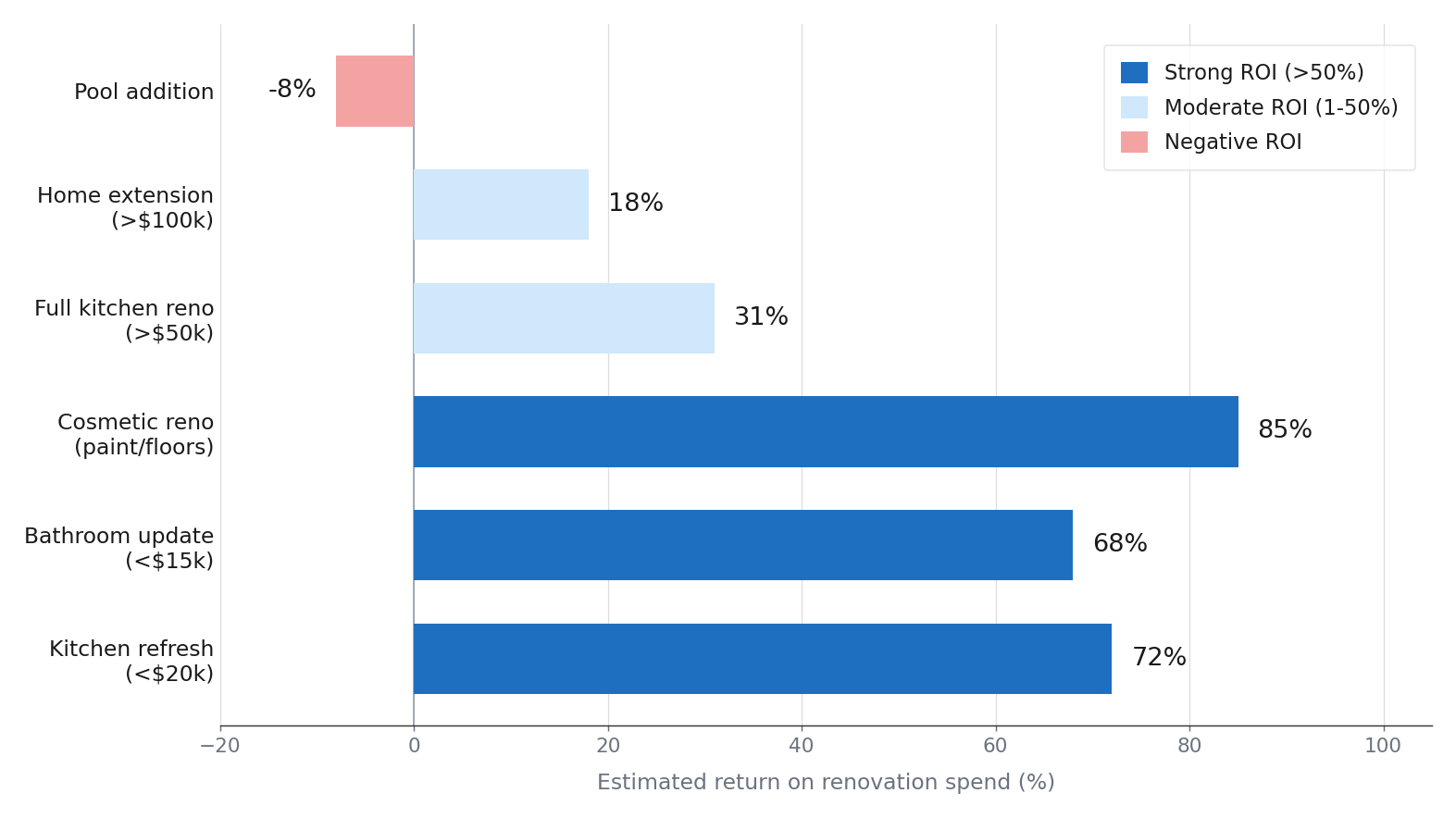
The assumption that renovation produces automatic capital uplift misunderstands how property values are determined. Values are set by comparable sales in the market, not by the cost of the work installed.
Estimated Return on Renovation Spend by Type
Source: HIA Australia, CoreLogic Renovation Insights, 2024-2025
Over capitalisation is the specific risk: spending more on a property than the local market ceiling allows to be recovered. It is most common when investors apply the renovation standard of a higher-price suburb to a property in a lower-price one.
Why "buy now or miss out" property advice is often misleading
Urgency framing is one of the most effective and least reliable communication tools in property commentary. The claim that the market will leave you behind if you wait is true during specific cycle phases and misleading during others.
During the peak of a growth cycle, with rising prices and low stock, urgency has some basis. At a cycle top, with rising listings and slowing price growth, the same urgency framing may push buyers into poor entry positions.
Who benefits from simplified property advice in Australia?
Simplified narratives perform better commercially than conditional ones. A developer selling off-the-plan property benefits from the message that property always goes up. A marketing platform benefits from content that generates clicks, which simple claims do more reliably than nuanced ones.
This is not a conspiracy. It is an incentive structure. The distinction between educational content and transactional content matters. Content designed to inform requires conditions. Content designed to convert does not. The formats are increasingly hard to tell apart.
How to critically evaluate property investment advice before acting on it
Conditional thinking is the most reliable tool for evaluating property claims. Every meaningful statement about property should include the conditions under which it is true. When the conditions are absent, supply them yourself.
A useful evaluation framework applies three questions to any piece of property advice:
In which market cycle is this claim accurate?
Which investor profile does it assume, and does that match yours?
What data or evidence supports it, and is that evidence specific enough to be meaningful?
If the advice collapses under those questions, it is not advice. It is a narrative. The FPW buyers agent team works through exactly these questions with investors before any acquisition decision.
Final Thoughts
"Property always goes up" is true on a long enough timeline, for the right market. "Capital cities are safer" is true under certain conditions of liquidity and depth. "Debt is good in property" is true when the yield and growth cover the cost and the investor can hold through a rate cycle.
The myths are not lies. They are truths with the qualifications removed. Reinstating those qualifications is what separates analysis from noise.
Frequently Asked Questions
Recommended Reading
Two pages selected based on what readers of this article are most likely to need next.
Recommended Video
These are not dramatic mistakes or rare worst-case scenarios. They’re the pressure points that often show up after purchase—when the property is already settled, the loan is in place, and the reality of ownership starts to unfold. From growing cashflow pressure and tenant risk to interest rate changes, rising ownership costs, overpaying at the start, and making structural decisions too late, this episode explains why even good properties can start to feel heavy when these issues aren’t understood early.