

Are Vacancy Rates Below 1% Really the Best? Here's What the Data Reveals
No, a vacancy rate below 1% is not automatically the best signal for property investors. It reduces the risk of an empty property, but it says nothing about entry price, rental yield, or whether a market still has room to grow.
Australia's national vacancy rate sat at 1.2% in May 2026, and several capital cities are running well under 1%. That tightness gets treated as an unambiguous green light in most investor commentary, when in practice it is only one part of a much bigger picture.
This article breaks down what vacancy rates actually measure, when a low reading helps an investment case and when it does not, and how to weigh it against rental yield, capital growth, and the other metrics that determine whether a property is genuinely worth buying.
What Are Vacancy Rates?
A vacancy rate measures the percentage of rental properties sitting empty in a given area at a given time. SQM Research, Australia's most cited source, counts properties advertised for three weeks or more, filtering out normal turnover between tenants.
A suburb with 1,000 rental dwellings and 12 sitting empty has a vacancy rate of 1.2%, roughly where Australia sat nationally in May 2026. Investors watch this number because it is one of the clearest live signals of how much competition exists for rental stock in a specific market.
The figure moves for reasons that have nothing to do with quality. A single large apartment block settling in one quarter can shift a small suburb's reading more than a genuine change in demand.
Are Vacancy Rates Below 1% Always a Good Sign?
A vacancy rate below 1% means tenants are competing hard for limited stock. Landlords fill vacancies faster, negotiate from a stronger position, and typically see steadier rent growth than in a looser market.
That is where the benefit ends, not where the story ends. Below roughly 0.8%, the relationship between vacancy and rent growth starts to break down. Domain's March 2026 Rental Report recorded Sydney vacancy at a record low of 0.8%, yet house rents held flat at $800 a week and unit rents at $750 for two consecutive quarters, the first time that has happened in five years. Canberra's vacancy tightened sharply to the same 0.8% in March, down from 1.5% in December, and rents still did not move.
Sydney and Canberra vacancy figures here come from Domain's Rental Report, which reads slightly tighter than SQM Research's figures elsewhere in this article due to differing methodology. Both agree on the direction: rents stalling despite record tightness.
An extremely tight vacancy rate can also be a warning sign. Domain's Chief Residential Economist Dr Nicola Powell put it plainly: the affordability ceiling has been reached, and vacancy rates are lower than ever, but rent growth is no longer accelerating everywhere. Investors who buy purely on the vacancy signal, a common one of several property investment mistakes first-time investors make, can find themselves holding a property just as tenants run out of room to absorb further rent rises.
FOR EXAMPLE
Sydney's vacancy rate hit a record low of 0.8% in the March 2026 quarter. An investor modelling continued double-digit rent growth off that tightness alone would have been wrong: Domain recorded house rents flat at $800 a week and unit rents flat at $750, both unchanged for two straight quarters, the first time that has happened in five years.
Vacancy Rates vs Rental Yields: Which Matters More?
Vacancy rate and rental yield answer different questions, and conflating them is one of the most common mistakes investors make. Vacancy tells you how likely a property is to sit empty. Yield tells you how much income it produces relative to what you paid for it.
Perth and Adelaide are the clearest illustration. Both sat at 0.7% vacancy in 2026, yet Perth's gross rental yield ran closer to 4.3% against Adelaide's 3.8%, because Perth's entry prices remained lower relative to rent. A market can be extremely tight and still deliver a mediocre yield if the purchase price has already run ahead of what the rent supports.
For investors weighing a purchase against their own borrowing capacity, yield carries more direct weight than vacancy. Vacancy protects the income you have modelled. Yield determines whether that income was worth the price you paid to get it.
Vacancy Rates vs Rental Yields by Capital City
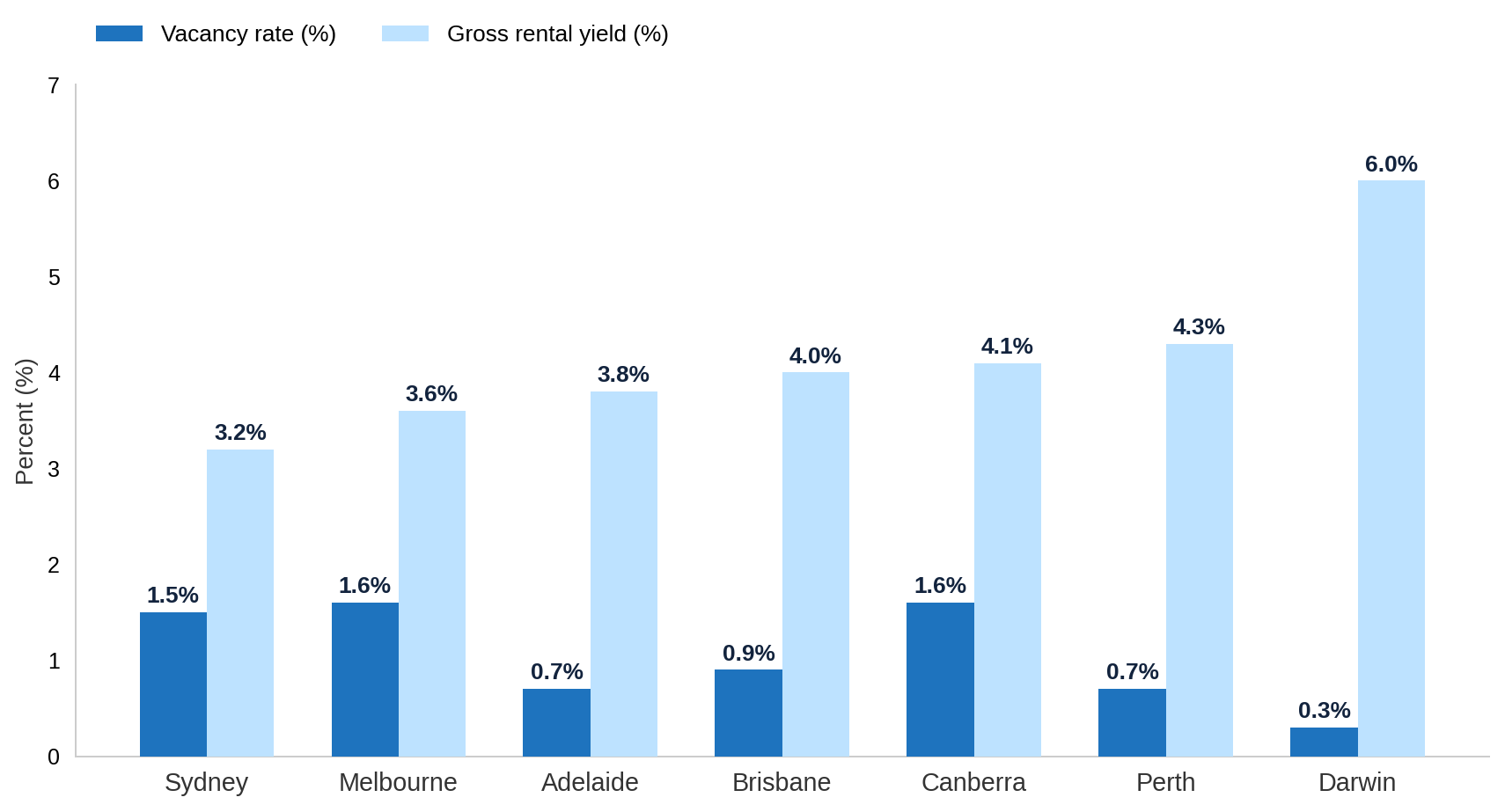
Source: SQM Research, CoreLogic and Domain rental data, 2026. Figures are indicative.
Vacancy Rates and Capital Growth
Vacancy rate and capital growth have moved together across most capitals over the past year. Darwin, Perth, Adelaide, and Brisbane all combined sub-1% vacancy with annual dwelling value growth above 15%, while Melbourne's looser 1.6% vacancy came with growth of just 0.5%, according to Cotality data to early 2026. On the surface, that looks like a clean relationship.
Darwin is the exception that proves it is not a reliable one. The same market that delivered 17.1% growth in 2025 was flat the year before, according to Cotality's Best of the Best 2025 report, a swing no vacancy reading could have predicted in advance. Darwin's rental market is also small relative to the other capitals, which means modest changes in absolute terms can move the percentage sharply and make the reading less stable than it looks.
Sydney and Melbourne, by contrast, carry higher vacancy rates than several smaller capitals but continue to attract the deepest and most diversified buyer demand. Capital growth depends on population growth, employment diversity, infrastructure investment, and the balance between yield and growth in a portfolio, alongside vacancy, not instead of it.
Vacancy Rate vs 12 Month Capital Growth by Capital City
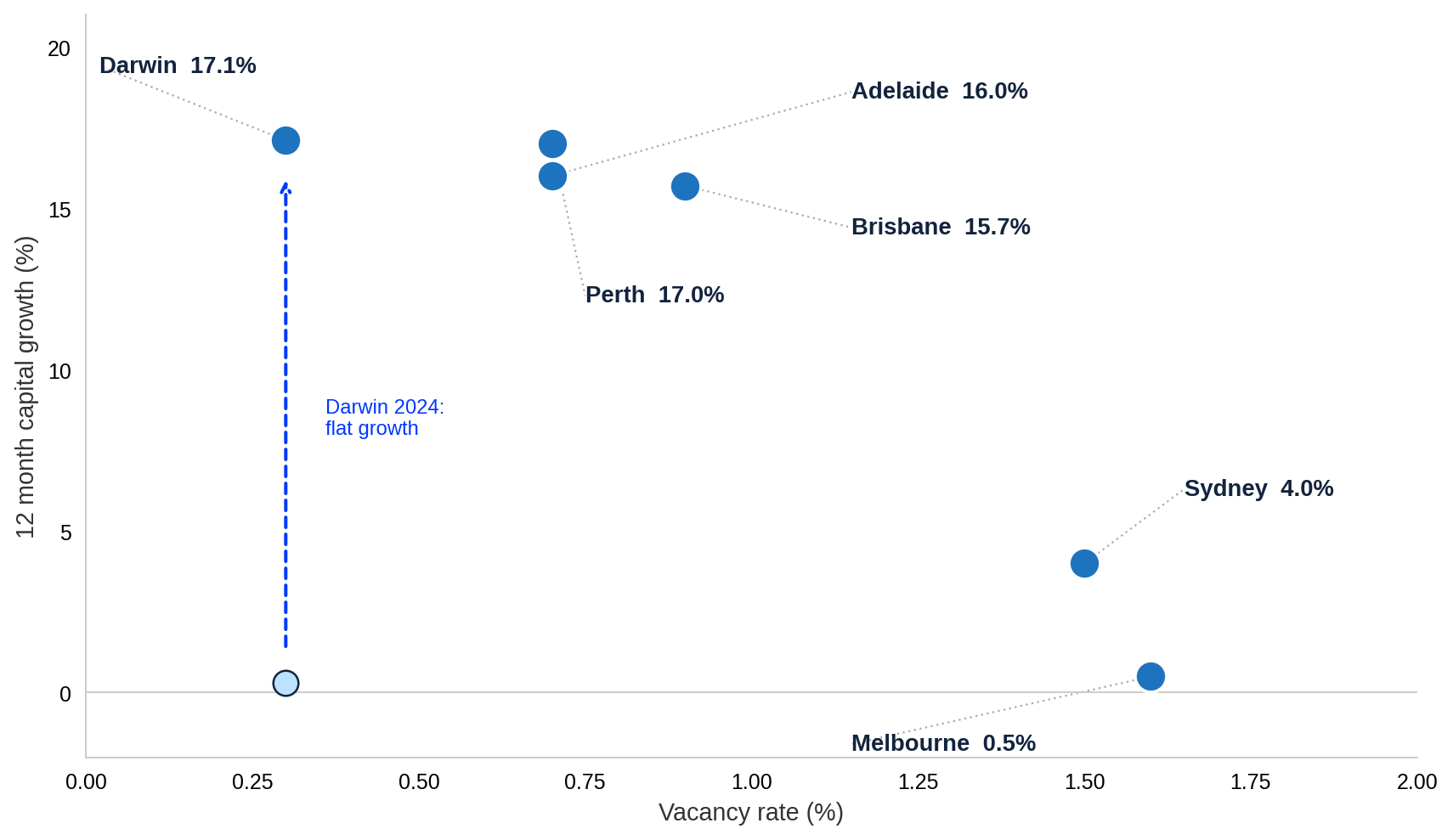
Source: Cotality (CoreLogic) Home Value Index and Best of the Best 2025 report; SQM Research vacancy data. Figures to Q1 2026, indicative.
Vacancy Rates Across Australia
Vacancy conditions vary sharply across Australia's capital cities, and the gap between the tightest and loosest markets has widened through 2026. Darwin, Perth, and Adelaide all sit below 1%, while Sydney, Melbourne, and Canberra remain above the national average despite still running below the long run balanced range of 2.5% to 3.5%.
That spread matters more than the national figure, and reflects a broader housing shortage playing out unevenly across the country, since a national reading blends genuinely undersupplied markets with others that are close to balanced.
Vacancy Rates Across Australia's Capital Cities
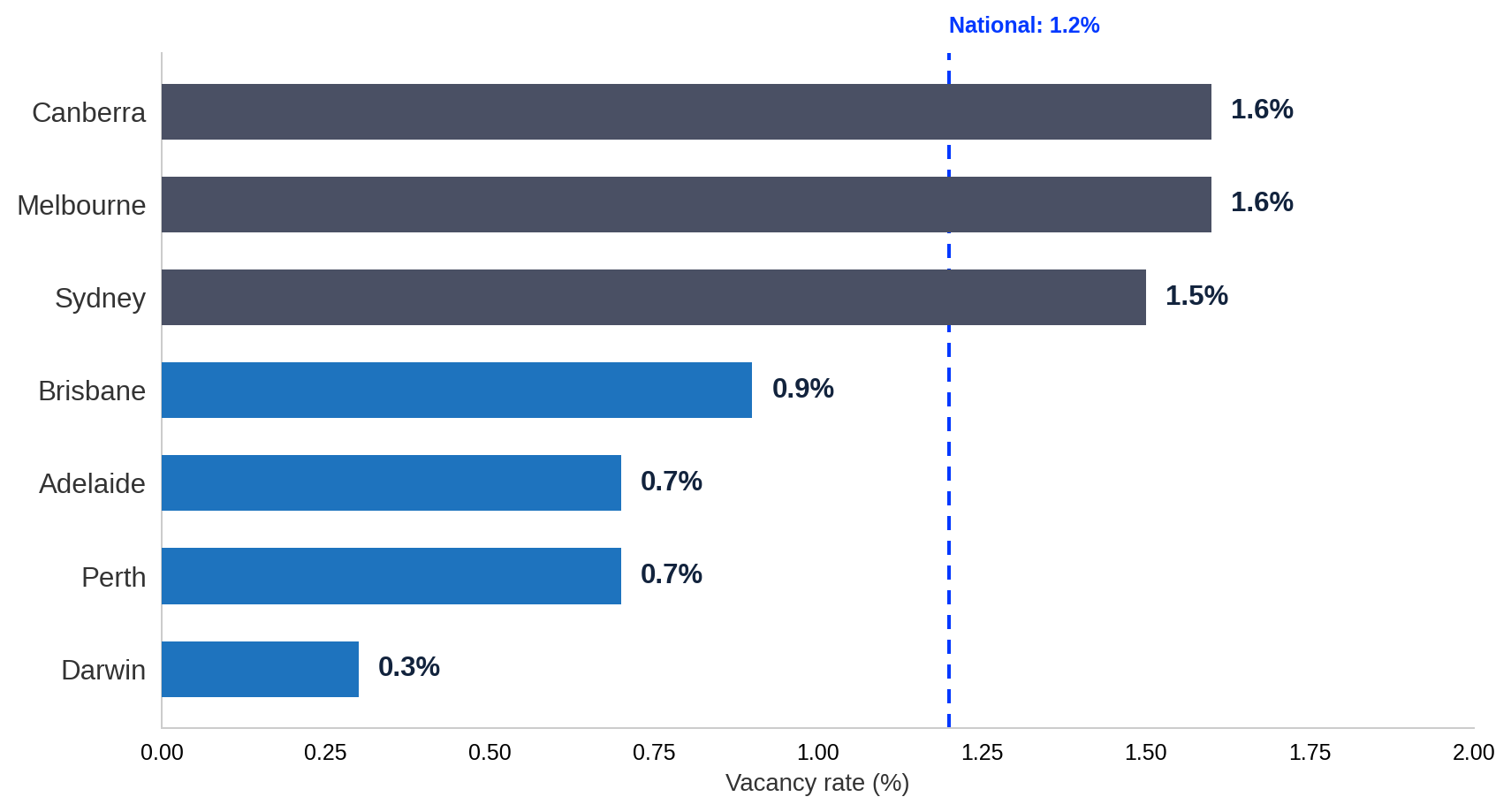
Source: SQM Research, May 2026 monthly vacancy data.
What Is Considered a Healthy Vacancy Rate?
Below 1% is landlord favourable but carries the risks already covered above. Between 1% and 2% is where most experienced investors want to sit, tight enough to protect rental income without signalling a market so constrained that a correction becomes likely. Above 3% is where negotiating power shifts back toward tenants, and rent growth typically slows.
The Vacancy Rate Spectrum: What Each Band Means for Investors
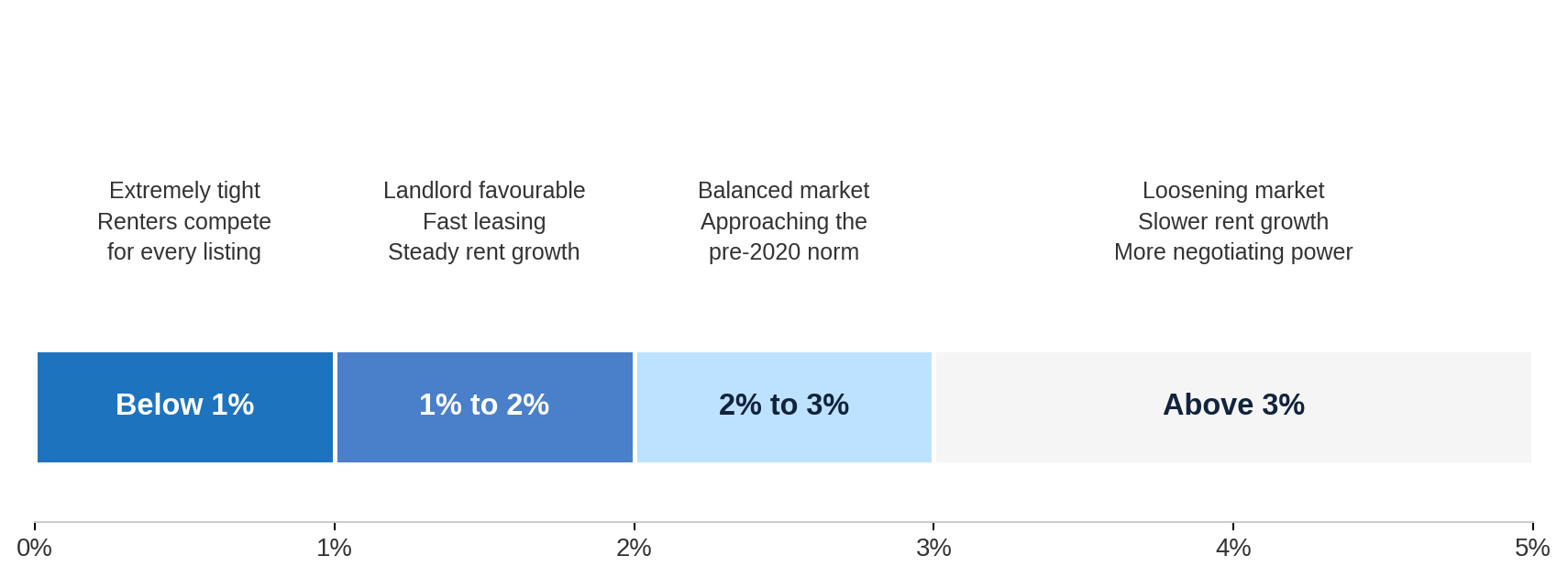
Source: SQM Research, 2026 vacancy benchmarks.
Other Metrics You Should Analyse Alongside Vacancy Rates
Vacancy rate is one input, not a complete investment case. Population growth and employment diversity determine whether current demand is likely to hold. Building approvals and days on market show whether supply is about to catch up with that demand.
Vendor discounting, the gap between initial asking price and final sale price, reveals whether a market is genuinely tight or whether sellers are quietly adjusting expectations. Checking these alongside investment grade suburb criteria gives a far more reliable picture than any single metric on its own.
Final Thoughts
A vacancy rate below 1% is a genuine positive signal, not a false one. It lowers the risk of your property sitting empty and it usually comes with steadier rent growth than a looser market.
What it cannot do is replace the rest of the analysis. Rental yield tells you whether the income justifies the price. Capital growth depends on population, employment, and supply, not vacancy alone. An extremely tight vacancy rate, below roughly 0.5%, can be the market signalling that new supply is already on its way.
Used as one input among several, alongside a genuine property investment strategy, vacancy rate is one of the more reliable numbers available to Australian property investors. Used as the only input, it can lead to decisions that look sound on the surface and expensive in hindsight.
Frequently Asked Questions
Recommended Reading
Two pages selected based on what readers of this article are most likely to need next.
Recommended Video
Australia's record migration surge — peaking at over 528,000 people in a single year — created unprecedented housing demand almost overnight. We explain why the government used population growth as a deliberate tool to avoid recession, how that decision flows directly into property prices Australia-wide, and why rents have surged to record highs as a result.