

What Makes a Good Investment Property in Australia
A good investment property is rarely the one with the best photos or the lowest price. It is the one whose numbers still hold up in five years, after the market has moved and your own circumstances have changed. Most investors learn this the hard way. They buy on emotion, or on a single strong figure, and discover later that the fundamentals were never there.
This guide breaks down what makes a good investment property in the current Australian market: the features that drive long-term returns, why location still decides most of the outcome, and a simple framework you can apply to any property before you commit. Property investment in Australia rewards discipline far more than timing, and the discipline starts with knowing what you are looking for.
What Is a Good Investment Property?
Defining a Good Investment Property
A good investment property is an asset that produces a strong total return over time, with manageable risk and reliable tenant demand. Total return is the part most buyers underweight. It is capital growth plus rental income, measured across years, not the headline yield on a listing.
That framing matters because it stops you judging a property on one number. A high yield with no growth can quietly erode your wealth. Strong growth with a thin, fragile rental market can strand your cash flow when rates move.
Why Selection Matters More Than Timing
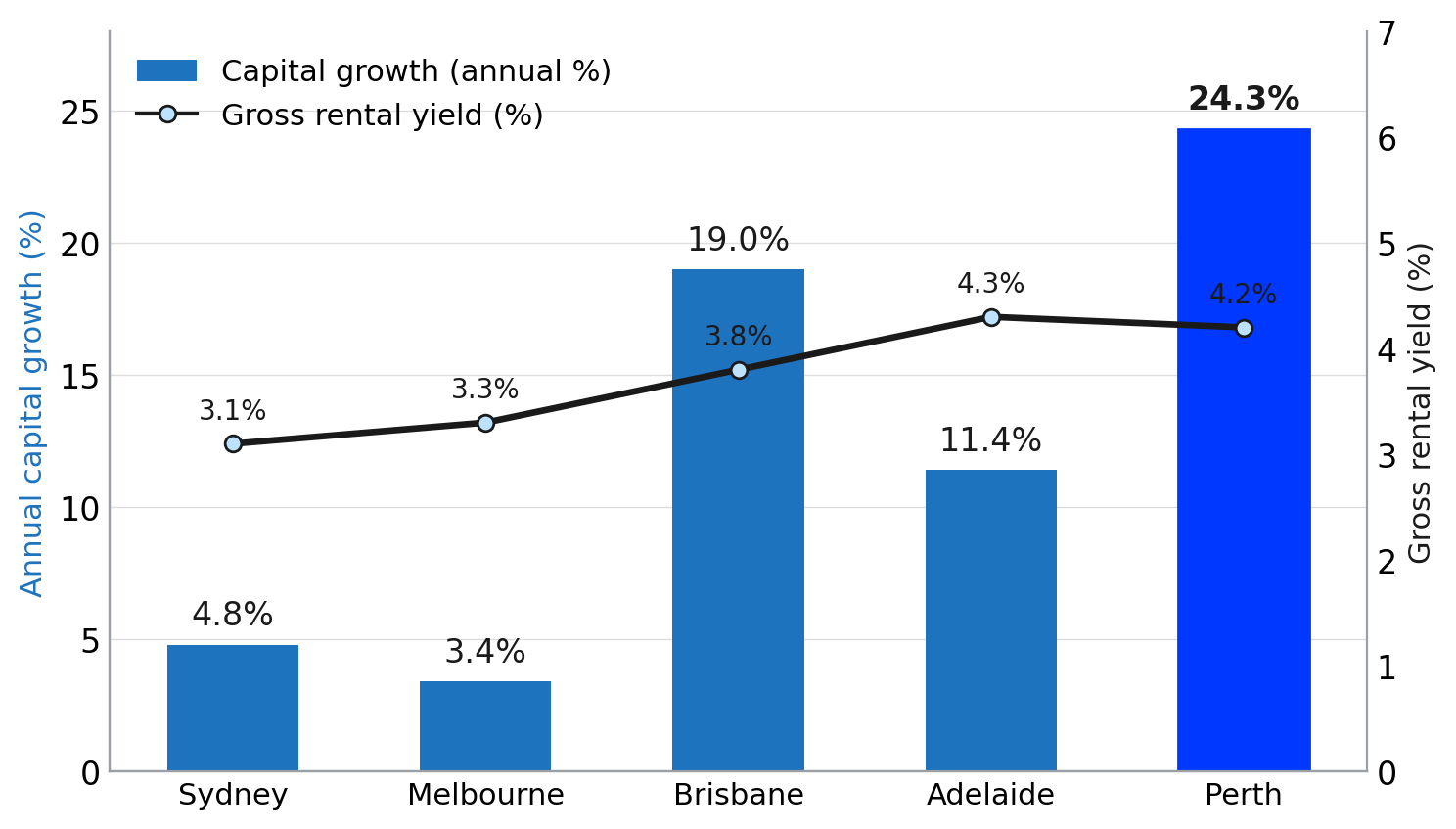
Investors spend enormous energy trying to pick the bottom of the market. In practice, which property you buy matters far more than the month you buy it. Australian dwelling values rose 9.9% in the year to March 2026, yet annual growth ranged from 24.3% in Perth to 3.4% in Melbourne. The gap between the best and worst major capital was roughly 21 percentage points.
Two investors buying in the same week, with the same budget, can end up with wildly different outcomes. The difference is the asset, not the timing.
The Features That Separate a Good Investment Property From a Poor One
Strong investment properties tend to share a short list of features. None of them is a secret. The discipline is insisting on several at once, rather than accepting one and ignoring the rest.
Capital Growth Potential and Sustainable Yield
Capital growth is the long-term engine of property wealth. Yield is what keeps you in the game while that growth compounds. The old assumption was that you trade one for the other, but the current cycle has complicated that rule.
The chart below shows annual capital growth against gross rental yield across the five largest capitals. The supply-short markets are pulling ahead on both measures at once, which reshapes the usual trade-off between rental yield and capital growth.
Capital Growth vs Rental Yield by Capital City
Source: Cotality (CoreLogic) Monthly Housing Chart Pack, 2026
Tenant and Buyer Appeal
A property that appeals to a wide pool of tenants today and a wide pool of buyers tomorrow carries less risk. Broad appeal means functional layouts, parking or proximity to transport, and a location people actively choose. Narrow, unusual or heavily compromised properties tend to underperform on both rent and resale.
FOR EXAMPLE
A three-bedroom house near schools, shops and a train line will draw families, downsizers and future buyers. A studio above a busy main road serves one narrow tenant type, which weakens both rent stability and resale demand.
Holding costs matter too. Before you fall for a yield figure, understand what you can sustainably borrow and repay, because lenders test your loan well above the rate you actually pay. Our guide on how banks calculate your borrowing power explains why approval and affordability are not the same thing.
Why Location Still Decides Most of Your Return
Location is not a slogan. It is the single variable that explains most of the variation in property performance, because it bundles together jobs, population growth and the supply of new housing.
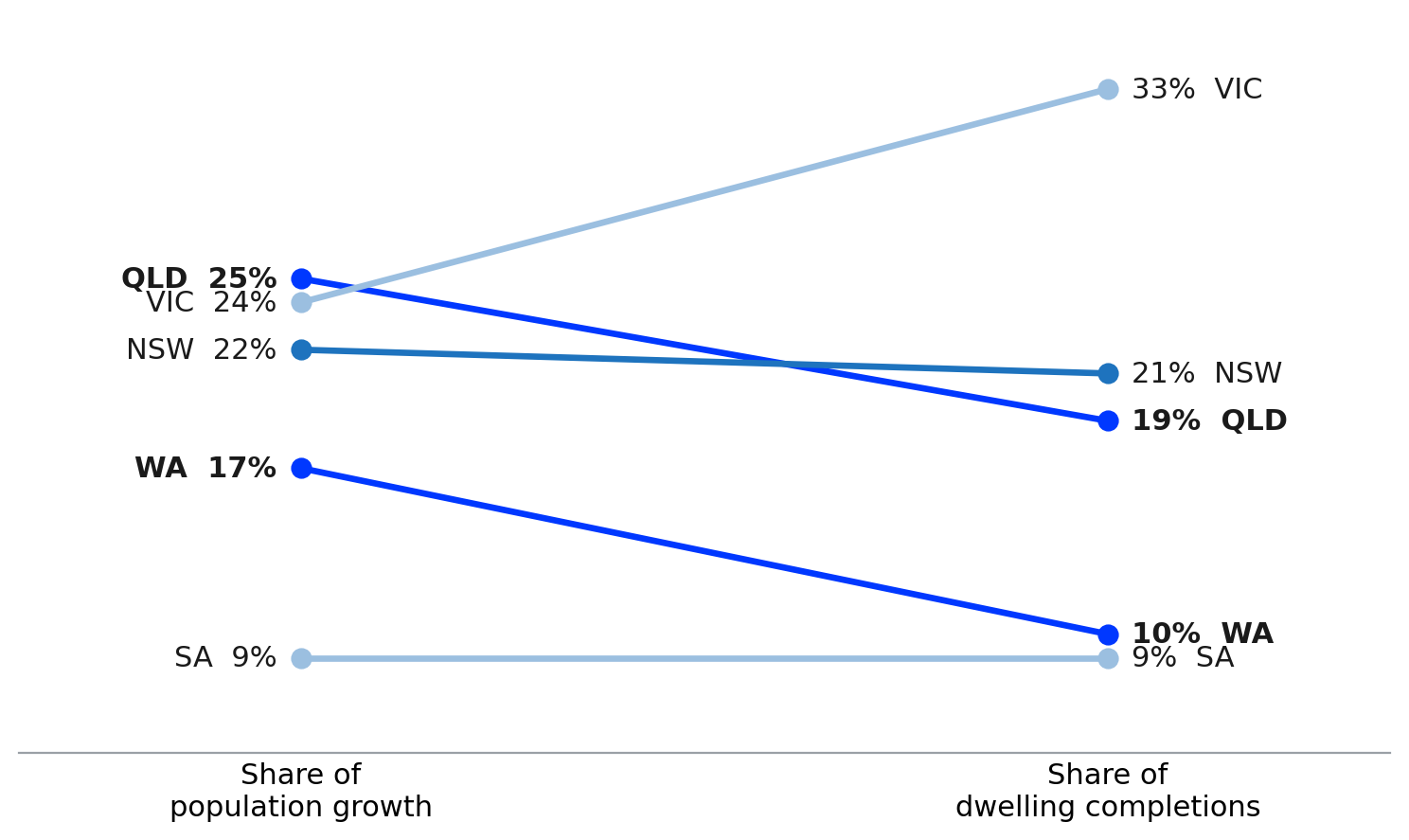
Between early 2020 and late 2025, the states where home building fell furthest behind population growth recorded the strongest value gains. Queensland and Western Australia are the clearest examples. Each absorbed a large share of national population growth while completing far fewer dwellings than that growth demanded.
Share of Population Growth vs Dwelling Completions by State
Source: Cotality (CoreLogic) Housing Chart Pack, April 2026
This is why employment, infrastructure and migration trends deserve more of your research time than the property itself. A good house in a structurally undersupplied location will usually outperform a better house in an oversupplied one.
How to Read Rental Demand Before You Buy
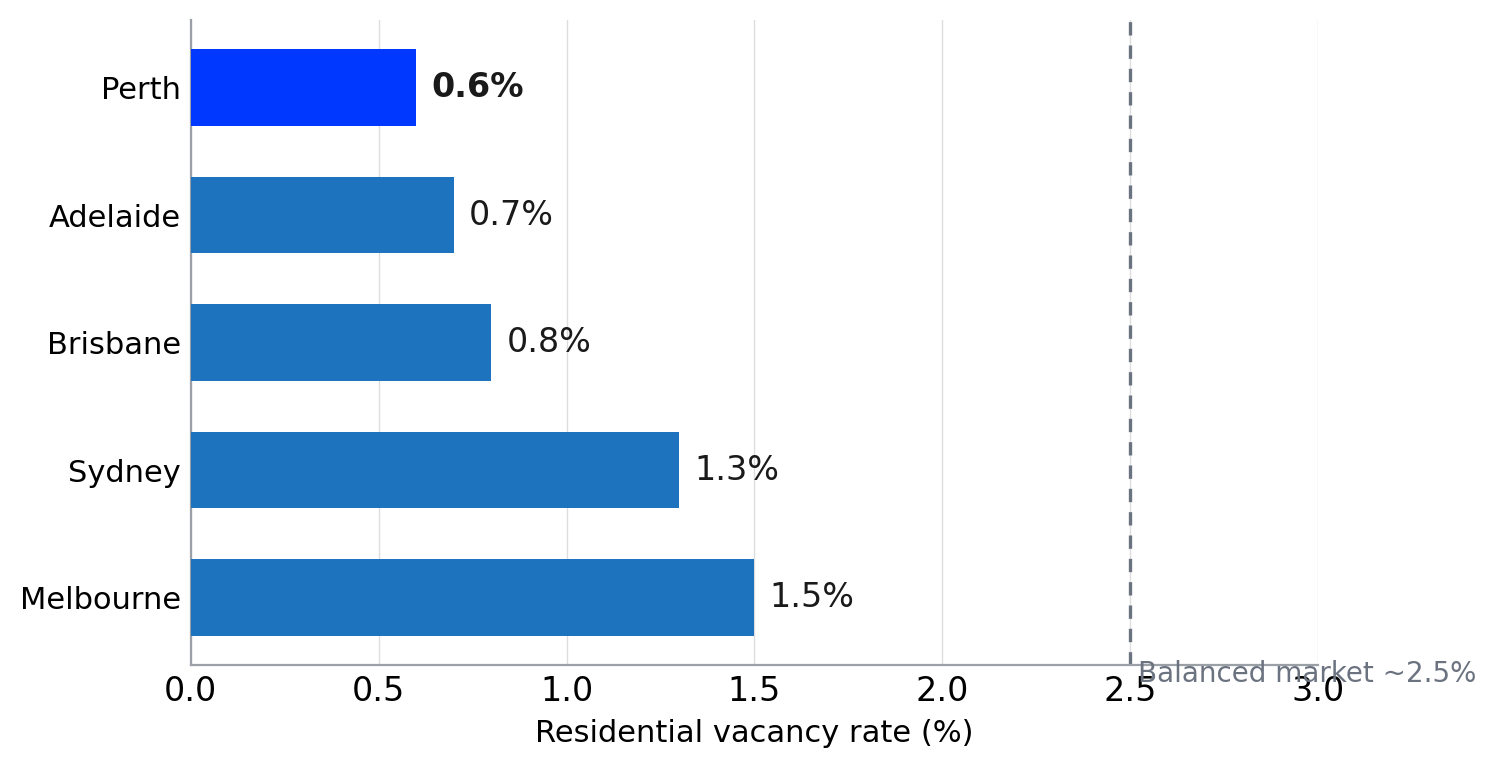
Rental demand is the safety net under your investment. When vacancy is low, you face minimal time without a tenant and steady upward pressure on rent. The simplest gauge is the local vacancy rate.
Nationally, vacancy sat at 1.2% in April 2026, around half the long-run balanced level of roughly 2.5%. Several capitals were far tighter again.
Residential Vacancy Rates by Capital City
Source: SQM Research, National Vacancy Rates, April 2026
A word of caution. A very high yield paired with high vacancy is usually a trap, not a bargain. The yield looks generous because prices are stagnant and tenants are scarce. Genuine demand shows up as low vacancy and steady rent growth together.
How to Identify a Good Investment Property: A Simple Framework
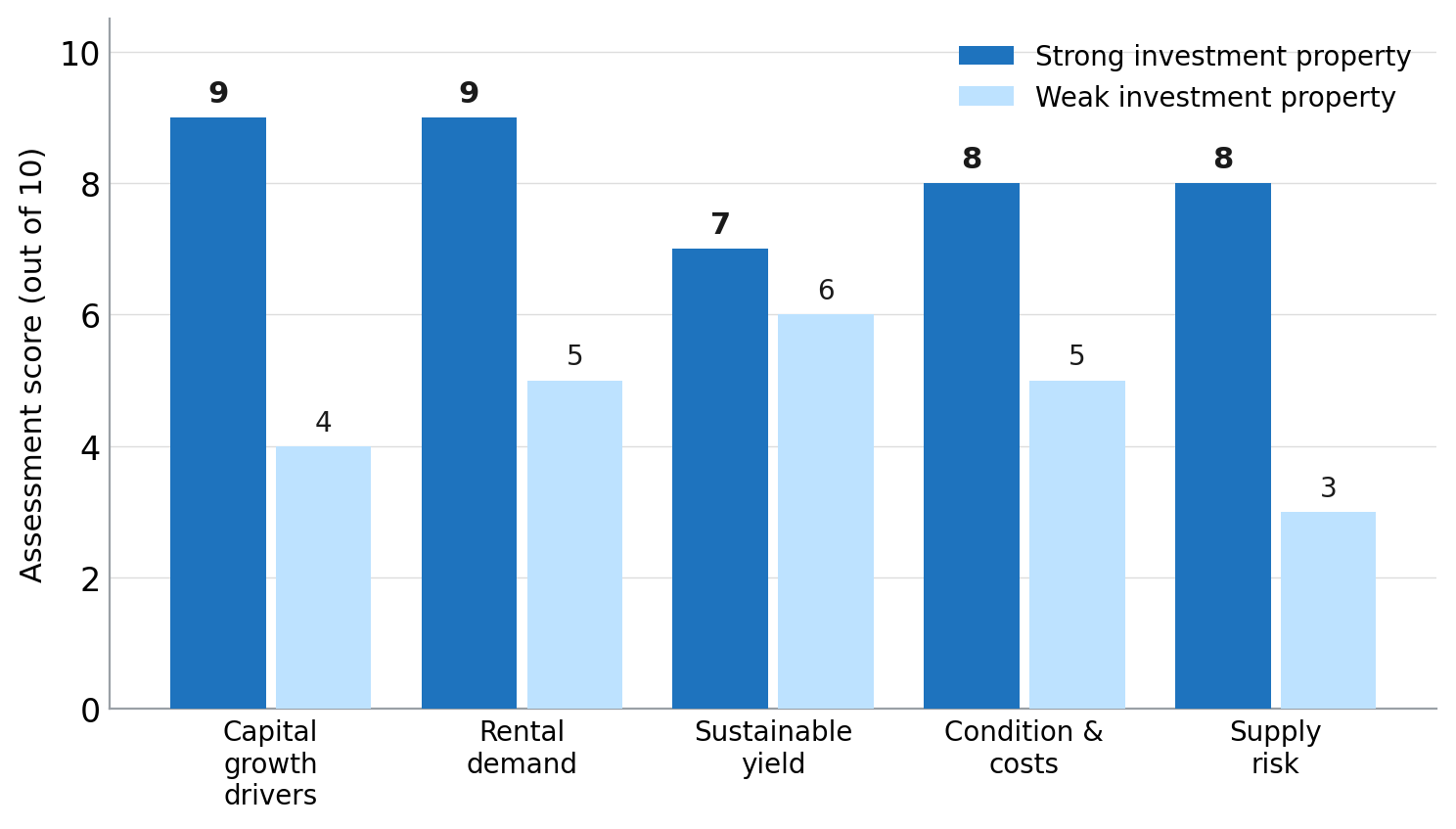
Strong investors do not rely on instinct. They score properties against the same criteria every time, which removes emotion and makes comparison honest. Five factors do most of the work.
Capital growth drivers: jobs, population and infrastructure in the area.
Rental demand: vacancy rate, rent trend and tenant pool.
Sustainable yield: real income after holding costs, not the listing figure.
Condition and costs: maintenance, body corporate and any major works.
Supply risk: how much new stock could compete with you.
Score each factor out of ten, then compare. The exercise turns a vague feeling into a decision you can defend. The chart below shows how a strong and a weak property typically separate once scored.
Investment Property Scorecard: Strong vs Weak
Source: FPW Group framework; indicative scoring
If you would rather build the skill yourself first, a disciplined framework and a good buyer's agent are not mutually exclusive. Many investors use both, especially when buying interstate.
Common Mistakes Investors Make When Choosing a Property
Most poor outcomes trace back to a handful of repeatable errors. Knowing them in advance is half the defence.
Chasing the cheapest property and mistaking a low price for value.
Fixating on yield alone, then watching the asset fail to grow.
Ignoring local supply and buying into an oversupplied corridor.
Buying on emotion, as if it were a home rather than an asset.
Underestimating ongoing costs, which quietly erode the real return.
None of these is exotic. They persist because each one feels reasonable in the moment. A scoring framework is what keeps a single attractive feature from overriding the fundamentals.
Final Thoughts
What makes a good investment property comes down to fundamentals that hold up over time, not short-term trends or a single flattering number. The strongest performers combine real capital growth drivers, genuine rental demand, a sustainable yield and a location where supply struggles to keep up with the people who want to live there.
Score every property against the same criteria. Treat location as the decision, not the backdrop. And be honest about holding costs before the yield seduces you. Do that consistently, and you remove most of the risk that catches less disciplined investors. A good investment property is built on evidence, and the evidence is available if you choose to look for it.
Frequently Asked Questions
Recommended Reading
Two pages selected based on what readers of this article are most likely to need next.
Recommended Video
You’ll hear why scarcity matters more than lifestyle features, why oversupply destroys long-term growth, and why information overload is now one of the biggest risks for investors.