

Why Different Banks Give Different Borrowing Capacity Results
Two lenders can look at the same payslip, the same debts and the same deposit, then return borrowing capacity results that differ by more than one hundred thousand dollars. Same borrower and numbers, but a different answer.
For an investor planning a purchase, that gap is confusing and expensive. The reason is rarely a calculation error. Borrowing power is not a fixed figure sitting inside your finances. It is a modelling outcome, and every bank runs its own model with its own assumptions. Working out how those models diverge is the first step to choosing the right lender, and to reading the borrowing capacity position you are genuinely working with rather than the one a single calculator suggests.
Why two lenders approve different amounts for the same borrower
Most people assume borrowing power is a property of their income. Earn a certain amount, carry a certain level of debt, and a single number should fall out the other side. It does not work that way.
Ask three banks and you can get three different figures. The spread is not random, and it is not a glitch. Each lender is quietly answering a slightly different question about the same applicant.
That experience, three calculators and three answers, is usually where the frustration starts. It is also the clearest sign that a borrowing result is something a bank builds, not something it simply reads off your file.
The four reasons borrowing capacity changes between banks
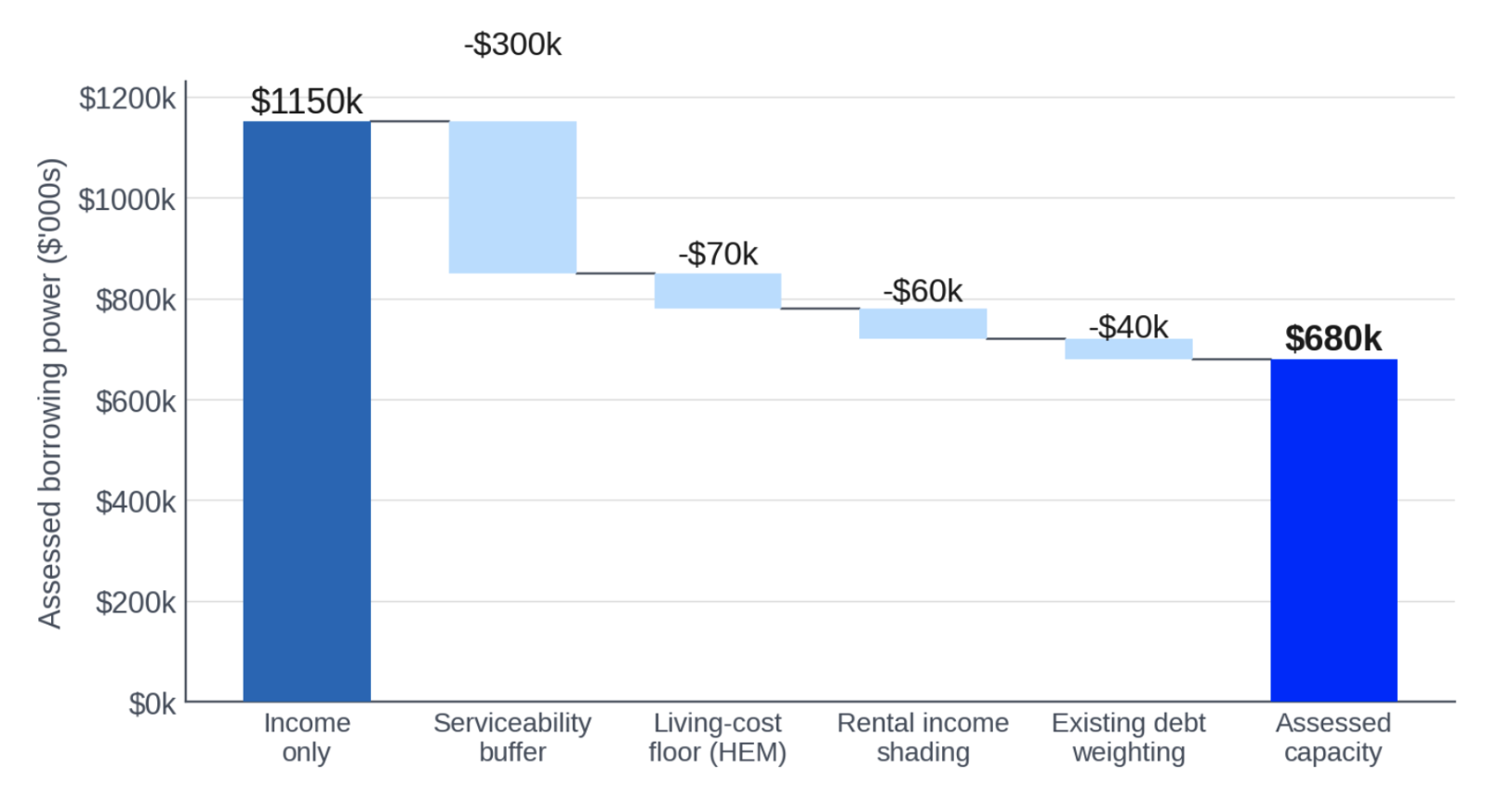
Four inputs do most of the work behind the gap. Each bank treats them in its own way, and small differences at each step compound into a large difference at the end.
Different serviceability buffers
Every Australian lender tests your loan at a rate well above the rate you actually pay. APRA sets a minimum buffer of three percentage points, and most banks assess at that floor. Some add a little more on certain products or borrower types. A buffer of 3.0 against 3.5 per cent sounds minor. Spread across a thirty year loan, it can move the approved figure by tens of thousands of dollars.
Different living expense assumptions, the HEM factor
Banks compare your declared spending against a benchmark called the Household Expenditure Measure, then use whichever number is higher. The benchmark is applied differently from lender to lender, and some scale it up more sharply as income rises. A household that looks frugal at one bank can read as average at another, purely because of how the benchmark is set.
Different income treatment rules
Not all income counts at full value. Rental income is commonly accepted at 70 to 80 per cent, and the exact shading varies by lender and by how many properties you hold. Bonus, overtime and self employed income are treated with similar caution, and the discount each bank applies is rarely the same. Two investors with identical rent rolls can be assessed on materially different figures.
Different debt weighting models
Existing commitments enter the model at the lender's chosen weighting, not your real repayment. Credit card limits are usually counted in full, even when the balance is zero. How each bank treats a HECS balance, a car loan or an interest only investment loan changes the surplus left to service new debt, which is also why debt to income ratios can bind before serviceability does.
How each modelling input chips away at borrowing power
Source: Modelled scenario using APRA serviceability and HEM benchmarks, 2026.
Banks do not calculate borrowing power, they model risk
Here is the shift that explains everything above. A bank is not really trying to measure how much you can afford. It is estimating how much risk it is comfortable carrying, given its own appetite, its current loan book and its regulatory limits.
Each lender sets its own risk tolerance. Each adjusts the inputs to match it. Each stress tests the result against its own assumptions. The output looks like a borrowing figure, but underneath it is a risk decision, which is exactly what the borrowing capacity formula is built to produce.
That is why the same applicant can be a comfortable yes at one bank and a marginal no at another. Nothing about the borrower changed. The risk model did.
Same borrower across CBA, Westpac and NAB
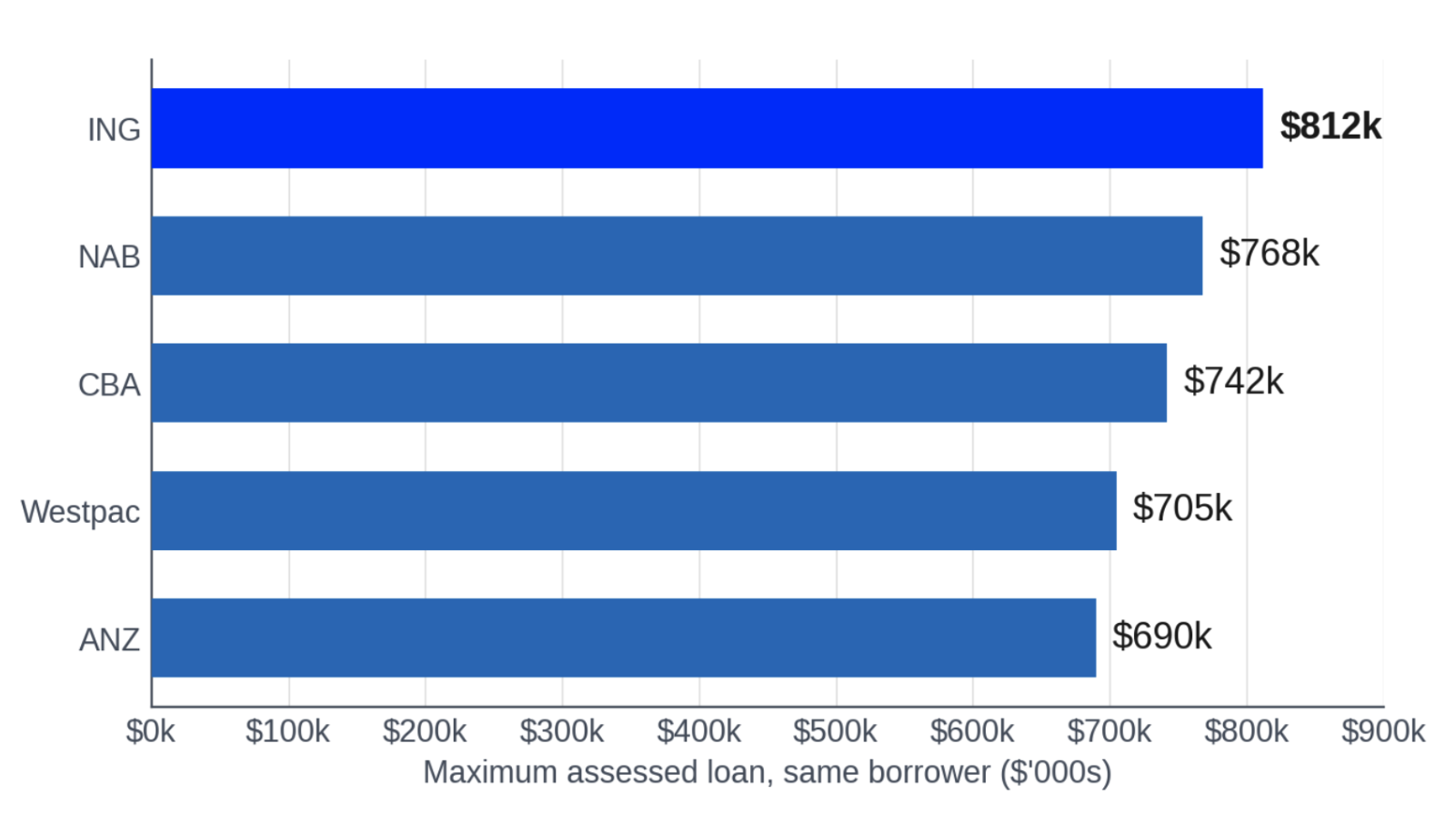
Picture one investor: a stable salary, one existing investment loan, modest credit card limits and a clear deposit. Send that identical profile to the Commonwealth Bank of Australia, Westpac Banking Corporation and National Australia Bank, then add a couple of second tier lenders, and the approved figures separate.
The cause is the stack of settings described above, applied in different combinations. One bank shades rental income harder but uses a lower expense benchmark. Another is generous on income but strict on existing debt. The order and size of those choices decides who lands highest.
Same borrower, different maximum loan by lender
Source: Illustrative scenario based on lender serviceability ranges and APRA assessment settings, 2026.
FOR EXAMPLE
A couple on a combined $165,000 with one investment loan and $40,000 in unused card limits model an assessed capacity of roughly $690,000 at one major bank and about $812,000 at a more income friendly lender. Same couple, same week, a $122,000 difference driven entirely by how each model reads them.
Why a calculator result is not a loan approval
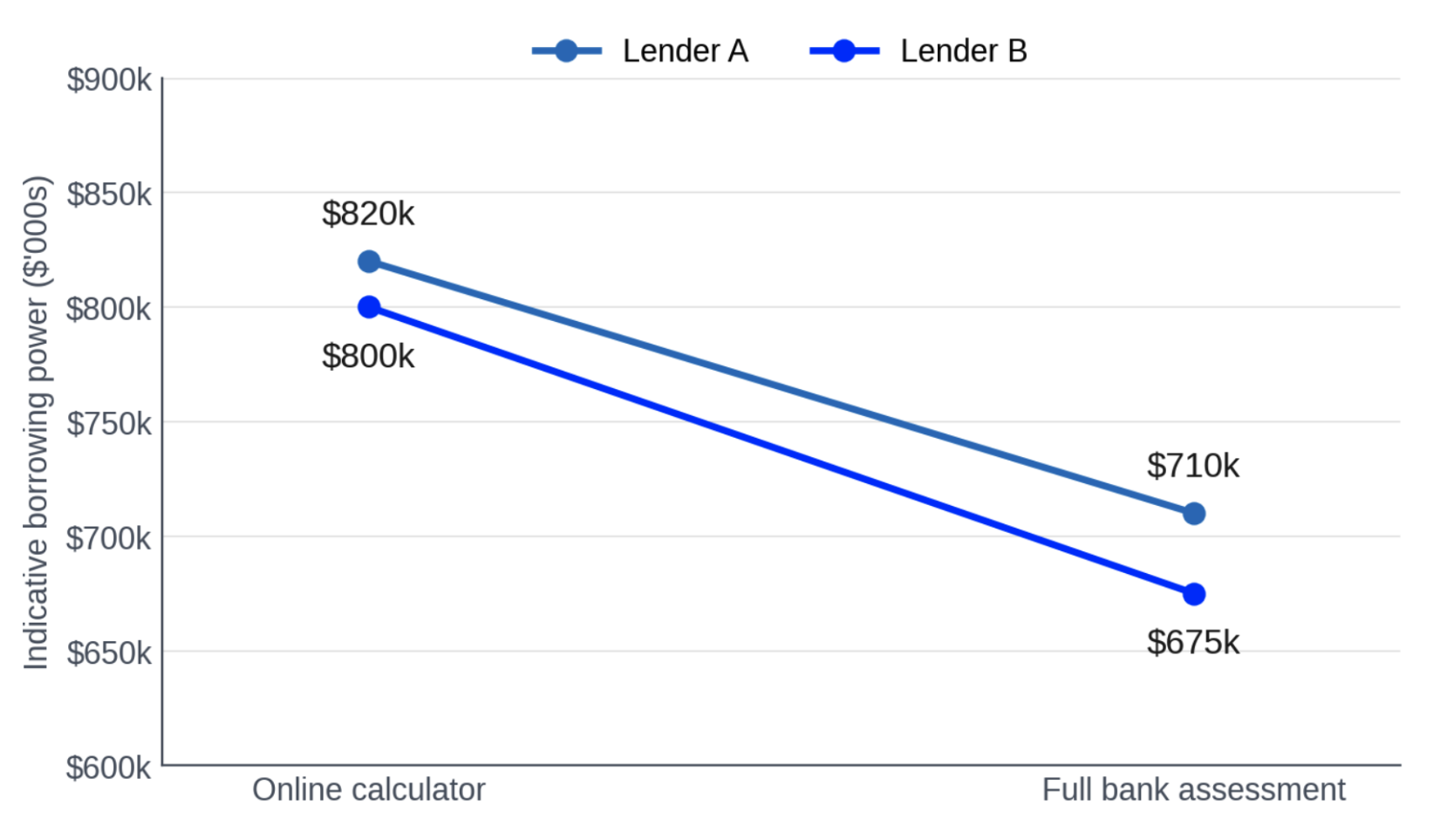
Online borrowing power calculators are useful for a rough position, but they are deliberately simple. They ask for a handful of inputs and apply broad assumptions. A full serviceability assessment runs your real income mix, every liability, the lender's expense benchmark and its current credit policy.
That is why the figure on a website is almost always higher than the figure on an approval. The calculator cannot see the policy layers that sit behind it.
Calculator estimate against full bank assessment
Source: Illustrative scenario, online calculator against full serviceability assessment, drawn on MoneySmart calculator assumptions, 2026.
How to get a stronger borrowing capacity result
You cannot change the buffer, and waiting for the cash rate to fall tends to help less than people expect. You can, however, change much of what the model sees. A few targeted moves before you apply usually matter more than timing the market.
• Reduce or consolidate debt. Clearing personal loans and car finance frees up assessed surplus quickly.
• Trim unused credit limits. Cards are counted at their limit, not their balance, so cancelling idle limits is a free win.
• Test several lenders. The right model for your income mix can be worth a five figure difference.
• Get a broker assessment. Brokers can read the policy matrices a calculator never shows and improve your borrowing position by matching you to the lender that suits your profile.
Final Thoughts
Different borrowing capacity results are not a sign that one bank is right and another is wrong. They are the visible output of different risk models reading the same borrower. Once you see borrowing power as something a lender builds rather than something you possess, the next move becomes clearer. Tidy the liabilities the model can see, understand how your income is treated, and compare lenders before you commit to one. The goal is not the highest number on a calculator. It is the strongest real approval for the property you actually want to buy.
Recommended Reading
Two pages selected based on what readers of this article are most likely to need next.
Watch: What Actually Stops you from Buying your Second and Third Property
While many investors spend time researching growth areas and property types, this discussion highlights a different reality, your ability to continue investing is often determined not by what you buy, but by how your loans are structured and how your borrowing power is managed over time.