

Why Do Banks Calculate Borrowing Capacity Differently?
You apply to one bank and they offer $720,000. You apply to another with the exact same income and the exact same debts, and they offer $840,000. Nothing about you changed. Your home loan borrowing capacity did.
It is one of the most confusing parts of buying property. Lenders all start from similar information, yet they reach very different answers. The gap is not random, and it is not a mistake. It comes from how each bank chooses to assess risk. Understanding that is far more useful than another borrowing capacity calculator.
This article explains why results vary between lenders, shows the difference with a real example, and covers what you can do to land with the bank that suits you.
What Home Loan Borrowing Capacity Means
Borrowing capacity is the maximum a lender will let you borrow based on your ability to repay. It is not the same as your deposit or the property price. It is the bank's view of how much debt your income can safely carry.
Lenders work this out through a process called serviceability. We will not rebuild the full borrowing capacity formula here. The point worth holding onto is simpler. Two banks can run the same borrower through serviceability and still disagree, because the assumptions they feed into it are not the same.
How Banks Calculate Your Home Loan Borrowing Capacity
Every lender starts with three broad inputs. Your income, your living expenses, and your existing debts. From there, the assessment gets more specific.
First, they do not use your actual loan rate. They add a buffer on top. The Australian Prudential Regulation Authority expects lenders to assess new borrowers at at least 3 percentage points above the actual rate, so a 6% loan is tested closer to 9%. That higher assessment rate lowers the loan your income can support.
Second, they estimate your living costs. Most lenders use a benchmark figure rather than your real spending, and they pick the higher of the two. Third, they weigh your existing commitments, including credit card limits, personal loans, and other mortgages.
So far, this is fairly standard. The differences appear in how each bank sets those numbers.
Why Banks Calculate Borrowing Capacity Differently
This is where the real gap opens up. The buffer is set by the regulator, but almost everything it is applied to is a choice each lender makes. Five levers explain most of the variation.
Assessment and floor rates
Lenders must apply at least the 3% buffer, but they set their own floor rate as well. A lender with a higher floor tests you at a tougher rate, which lowers your limit before any other factor is considered.
Income shading
Not all income is counted in full. Overtime, bonuses, commission, and rental income are often discounted, and lenders disagree on how much. One bank might count 80% of your bonus while another counts half of it. For people with variable income, this single difference can move borrowing power substantially.
How lenders treat different income types
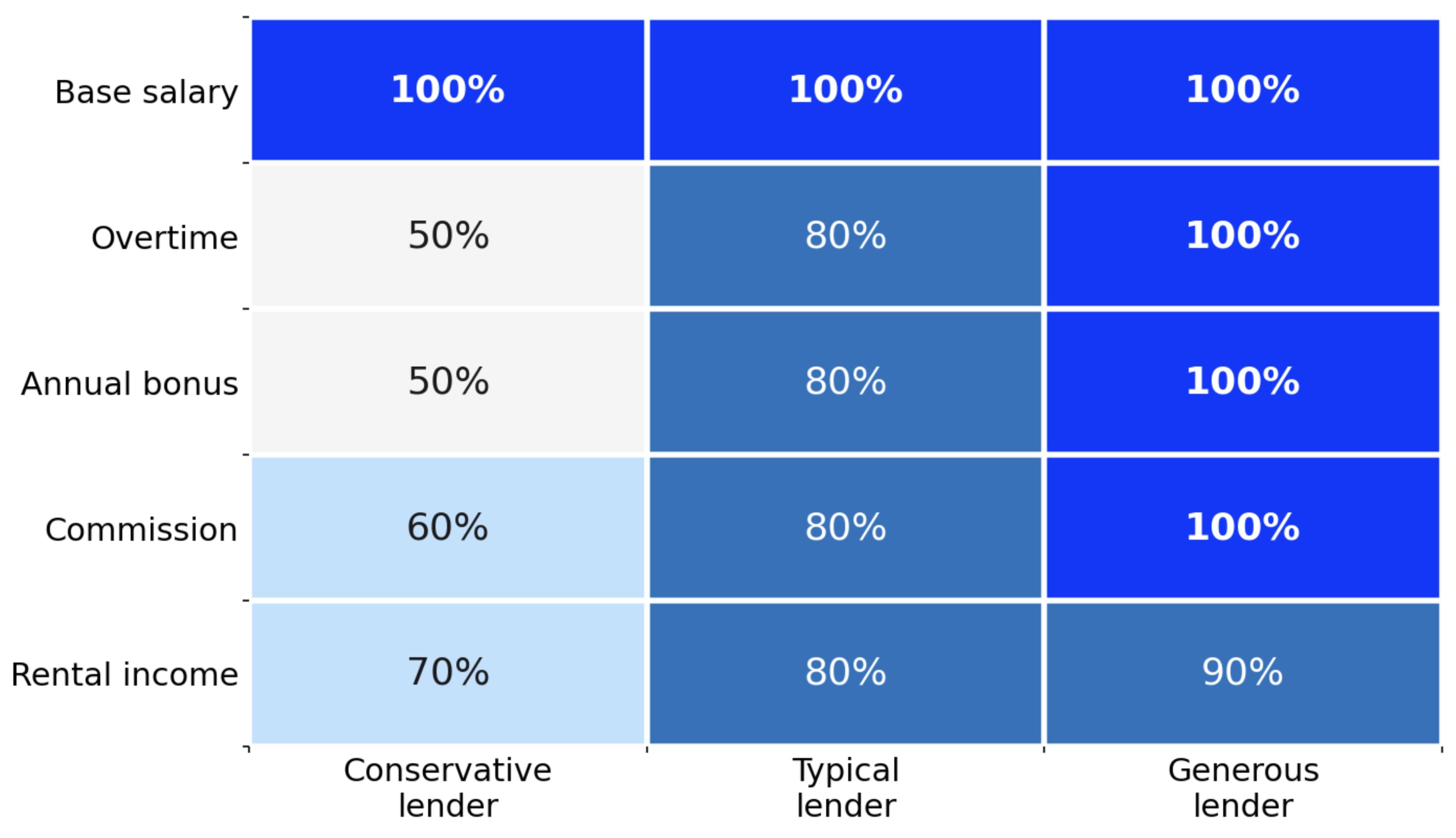
Source: FPW analysis based on common lender serviceability policies, 2026
Expense benchmarks
Banks apply a minimum living cost figure based on household size and income. These benchmarks differ between lenders, and a higher assumed expense leaves less income to service the loan.
How existing debts are counted
Credit cards are a common trap. Many lenders count your full card limit as a liability even when the balance is zero. A $20,000 limit you never use can still reduce your borrowing power. Lenders also differ on how they assess other home loans, which matters most for investors.
Risk appetite
Finally, lenders have different appetites for risk. Conservative lenders shade income harder, assume higher expenses, and stay well clear of high debt to income ratio lending. More generous lenders push closer to the limits. From 2026, APRA also caps how much banks can write at very high debt to income levels, which tightens the most generous end of the market.
How conservative policies stack up against a generous lender
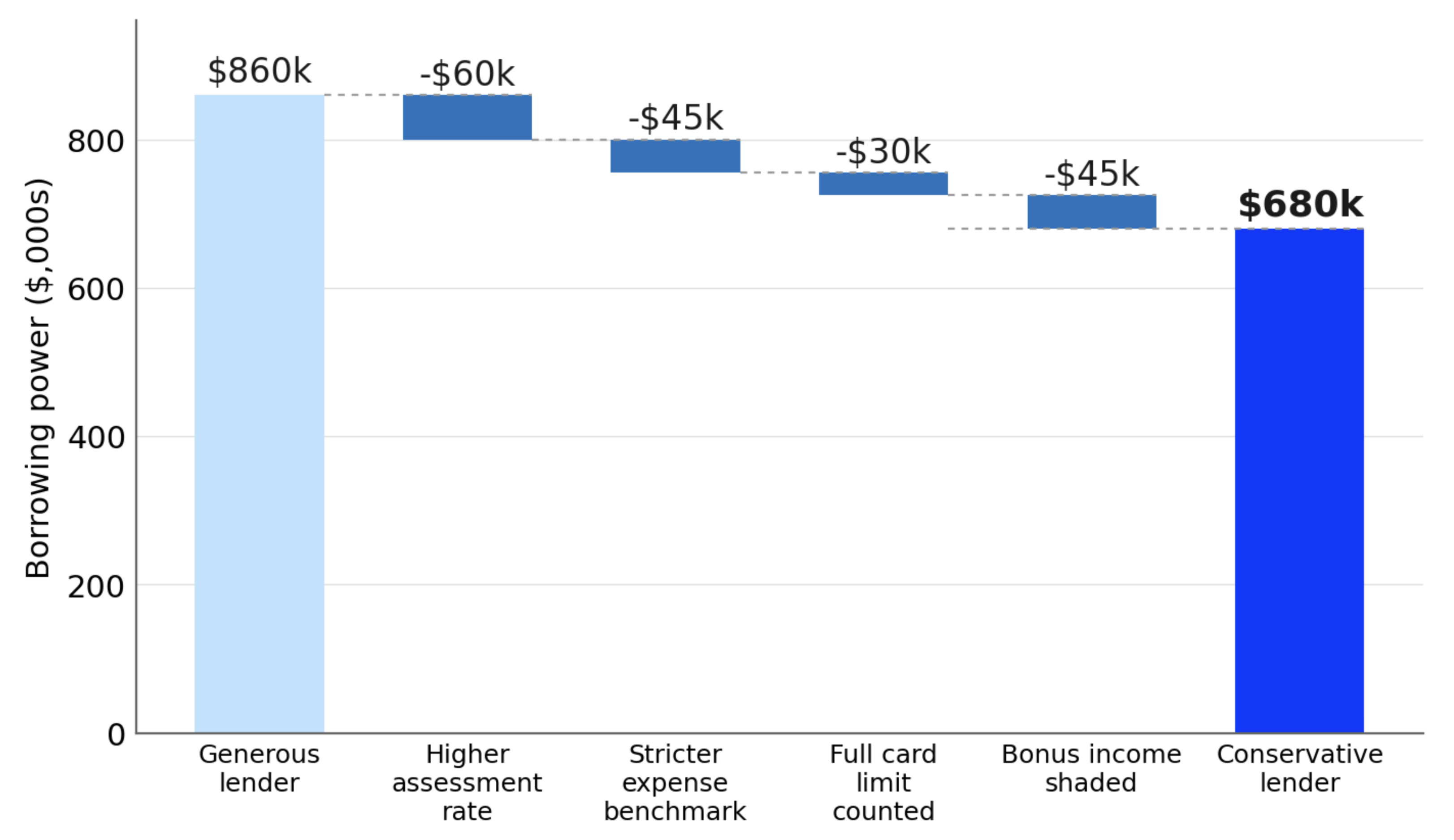
Source: FPW analysis, illustrative policy comparison, 2026
A Real Borrower Example Across Lenders
Take a borrower on $120,000 a year, no dependents, with one credit card. On paper, a simple profile. In practice, the answers vary widely.
FOR EXAMPLE
Borrower: $120,000 income, no dependents, one $15,000 credit card limit. Lender A assesses overtime and counts the card lightly and offers about $860,000. Lender E shades the same income harder and counts the full card limit and offers about $680,000. Same borrower. A gap of around $180,000.
Same borrower, five lenders, five different limits
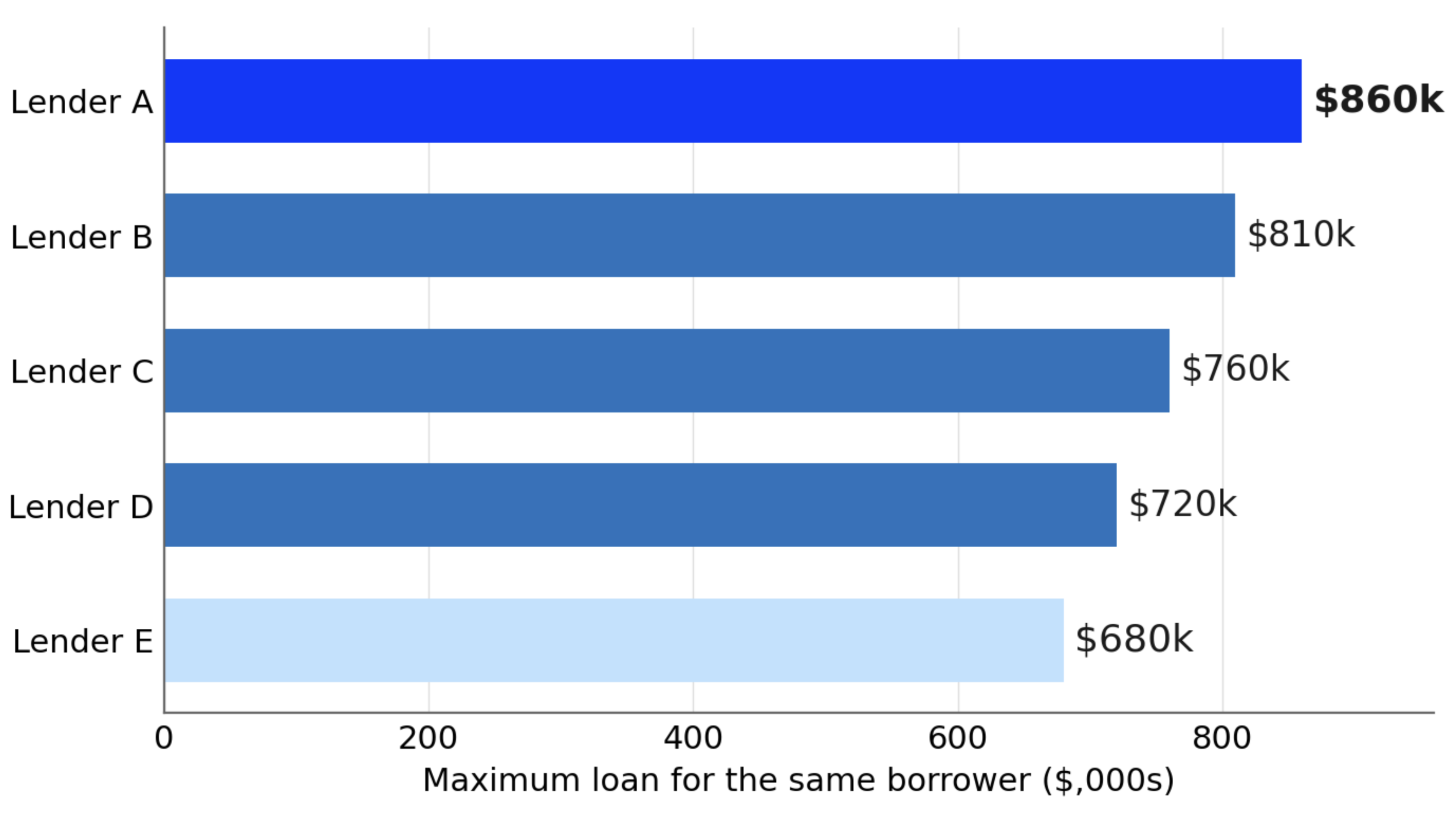
Source: FPW analysis, illustrative lender comparison, 2026
Why Investors See Bigger Differences Between Lenders
If the spread is wide for owner occupiers, it is wider still for investors. Two things drive that. Rental income is shaded, and lenders disagree on how much of it to count. Existing investment loans are stress tested at the buffer rate, and some lenders treat that debt more harshly than others.
The result is that an investor with several properties can be near their ceiling at one bank and still have room at another. The properties did not change. The lending policy did.
Owner occupiers and investors see different gaps between lenders
Source: FPW analysis, illustrative comparison, 2026
How to Improve and Compare Your Borrowing Capacity
You cannot change the buffer, but you can change much of what each lender tests, and you can choose where you apply. The work to increase borrowing capacity usually starts with a few practical moves.
Reduce or close unused credit card limits before you apply.
Clear small personal and car loans that drag on serviceability.
Match variable income, like bonuses or rental, to lenders that count it generously.
Check your position early using a debt-to-income calculator before lodging.
That last step matters. A quick debt to income calculator gives you a sense of where you sit before a lender runs a credit check. From there, the real value is matching your profile to the right bank, which is exactly what a broker does across dozens of lenders at once.
Final Thoughts
Banks calculate borrowing capacity differently because they make different choices about risk. The regulator sets the buffer, but each lender decides how to shade your income, what to assume about your expenses, and how to treat your existing debts. Stacked together, those choices can move your home loan borrowing capacity by well over a hundred thousand dollars.
That is frustrating when you are knocked back, but it is also an opportunity. A no from one bank is not a no from the market. The lender that suits your income type and situation may value the same profile far more generously.
The smartest move is not to chase the highest number. It is to understand which lender reads your situation best, then structure your application around it.
Recommended Video
Watch: What Actually Stops you from Buying your Second and Third Property
While many investors spend time researching growth areas and property types, this discussion highlights a different reality—your ability to continue investing is often determined not by what you buy, but by how your loans are structured and how your borrowing power is managed over time.
Frequently Asked Questions
Recommended Reading
Two pages selected based on what readers of this article are most likely to need next.