

Why More Australians Are Becoming "Accidental Investors"
For most of Australia's history, becoming a property investor was a deliberate choice. You saved, you planned, and you bought an investment property on purpose.
Today, a growing number of first-time property investors in Australia got there by accident. They hold onto a home they used to live in, inherit a property, or buy in a cheaper area while renting where they want to live. None of it starts as an investment plan, yet each one turns an ordinary person into a landlord.
The trend shows up clearly in the data: ABS figures show 8,283 first-home buyers took out investment loans in 2024, up 12% in a single year. This article explains what an accidental investor is, why it is happening, and what it means for your money.
What Is an Accidental Investor?
An accidental investor is someone who ends up owning a property that earns rent without ever planning to invest. They didn't research a market or set out to build wealth through property. Life simply led them there.
The label covers a wide range of people: a couple who upgrade to a bigger home and rent out the old one, a person who inherits a house from a parent, or a buyer who purchases in an affordable suburb while renting closer to work. What they all share is that the property became an investment by circumstance, not by design.
This is now the typical investor, not the exception. ATO data shows about 2.2 million Australians own an investment property, and around 71% of them own just one. Most investors are everyday people with a single property —exactly the profile an accidental investor fits.
Why More Australians Are Becoming Accidental Investors
Four common situations are turning everyday Australians into landlords. Each one starts somewhere other than an investment plan.
When a Former Home Becomes an Investment
The most common path is keeping a home you used to live in. When people upgrade to a bigger place or move in with a partner, selling the first home isn't always the obvious choice. Renting it out can feel easier because it keeps the asset, brings in income, and avoids the cost of selling.
This fits the wider picture of who owns rentals in Australia. Because around 71% of investors own just one property, many of those single properties are former homes that were never meant to be rentals.
The decision is often made quickly, around a move or a life change, rather than as a careful plan. The catch is that a former home is still a financial position: once it earns rent, the ATO taxes that income and lenders treat the loan under stricter investor rules even if you still think of it as "the old house."
Rentvesting
Rentvesting means renting where you want to live while buying an investment property somewhere more affordable. It has shifted from a niche idea to a mainstream strategy, especially among younger buyers.

The data shows rentvesting is no longer a niche strategy. More than half of first-home buyers now consider purchasing an investment property in a more affordable location while renting where they want to live. Interest is even higher among NSW buyers, reflecting the affordability challenges in Australia's most expensive housing markets.
The numbers show how fast it has grown. The Westpac 2025 Home Ownership Report found 54% of first-home buyers are now considering rentvesting, up from 50% a year earlier, rising to 61% in NSW.
Among Gen Z first-home buyers, the figure is 55%. Lending data tells the same story: in the March 2025 quarter, about $955 million of first-home-buyer investor loans were settled well above the $659 million settled in March 2020, when interest rates were near zero.
How fast is Rentvesting Growing in Australia
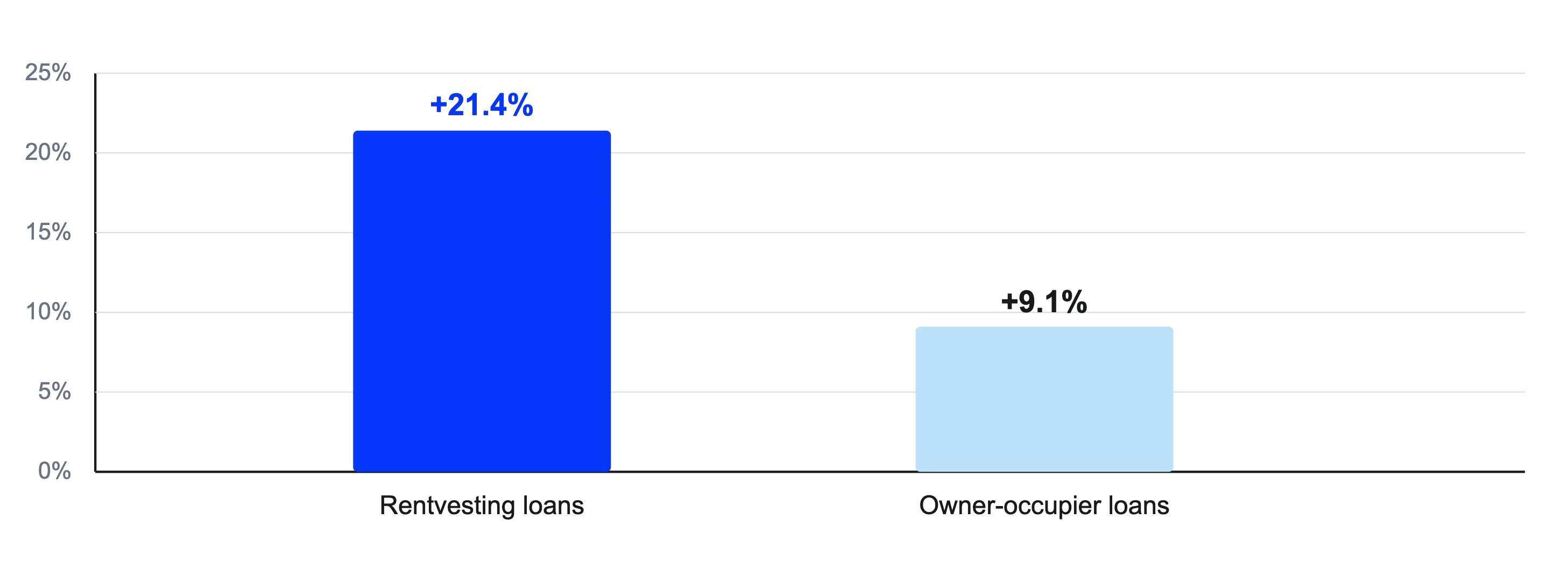
Source: Australian Bureau of Statistics lending data, 2024 (year-on-year growth, first-home buyers).
Inheriting a Property
Inheritance is another route into accidental ownership. As older Australians pass on homes they bought decades ago, their children often receive a property outright or as part of an estate. Selling can mean paying capital gains tax and losing a long-held family asset, so many keep the home and rent it out instead.
This is part of one of the largest transfers of wealth in Australian history, much of it tied up in housing. An inherited rental can be a genuine benefit, but it also brings tax, maintenance, and lending questions that the new owner almost never planned for.
Moving for Lifestyle or Work
The fourth path is relocation. A job transfer or a switch to remote work can lead someone to move cities while holding onto their existing home. Rather than sell in a rush, they rent it out and become a landlord in a city they no longer live in.
These lifestyle moves have become more common as remote and hybrid work let people live further from the office. The result is the same as the other paths: a property quietly turns into an investment, with all the tax and lending effects that come with it.
The Benefits and Risks
Becoming an investor by accident isn't automatically good or bad, but it does need managing.
On the benefit side, you hold a growing asset. The property can rise in value over time, the rent helps cover the loan, and you may be able to claim deductions against the rental income. An extra property can also build equity you can use toward future goals.
The risks are easy to miss, because no one planned for them. The ATO taxes your rental income. Lenders judge the loan under investor rules, so they count only 70–80% of the rent and apply a safety buffer to both your loans.
This becomes even more important when managing debt when expanding a property portfolio.
APRA has also tightened investor lending since 2021 with stricter debt-to-income limits. The effect is that your borrowing power for a future home can be far lower than you expect.
For Example
A buyer keeps a $520,000 property in Brisbane as a rental while moving to Sydney. Two years later they apply for a Sydney home loan. The Brisbane loan now counts at investor rules — the bank counts only 70–80% of the rent, and the safety buffer applies to both loans. Their Sydney borrowing power comes back about $140,000 lower than expected.
The biggest risk, though, is simply not having a plan. A property held out of habit is often rented too cheaply, looked after poorly, and kept long after the money could be working harder somewhere else.
Final Word
Most accidental investors never chose to invest, but they still own a real financial position. The good news is that an accidental start doesn't have to mean an accidental result.
The good news is that you can turn the situation around by learning how accidental investors build a strategy.
Turning that position into a successful one starts with understanding property investment fundamentals.
The difference between drifting and deciding comes down to knowing three things: what the property is worth, what it earns, and how much you can still borrow. Once you have those, you can choose with confidence whether to hold, improve, refinance, or sell and reinvest. However your property arrived, whether through an upgrade, an inheritance, a move, or a rentvesting purchase, the next step is the same: turn an accident into a smart strategy.
Frequently Asked Questions
Recommended Reading
Two pages selected based on what readers of this article are most likely to need next.
The Real Reason Most Investors Get Stuck at One Property
Refinancing is no longer about chasing a lower rate, it’s about building wealth, structuring smarter, and making your portfolio work harder every single year.