

How Do Interest Rates Affect House Prices in Australia?

Interest rates affect Australian house prices mainly by changing how much buyers can borrow, not just by making mortgage repayments bigger. When the Reserve Bank lifts the cash rate, lenders cut how much they will approve for a given income, buyer budgets shrink, and prices come under the most pressure in the most leveraged markets.
That mechanism is playing out across the country right now. The Cotality Home Value Index has fallen for five straight months, with national values sitting well below the peak reached in March 2026, after the Reserve Bank lifted the cash rate three times through the year.
The story is not uniform, though. Some capital cities are recording their steepest monthly declines in years, while others are still posting double-digit annual growth. Understanding why one national interest rate produces such different outcomes is the key to reading this market, and to deciding what to do next.
What Is Happening to House Prices in Australia Right Now?
National dwelling values fell 0.9 percent in August 2026, the fifth consecutive monthly decline, according to Cotality data widely reported this week. That took the national median down to $912,885, sitting 3.6 percent below the record high set in March 2026.
The downturn has widened quickly. Around 93 percent of capital city suburbs recorded a fall in values through winter, up from under half in autumn. The upper end of the market is absorbing most of the damage, with premium properties down more than 3 percent over three months while cheaper stock has held up far better.
This shift follows a run of tightening from the Reserve Bank. The cash rate sits at 4.35 percent after three increases earlier in 2026. FPW's coverage of the RBA's August 2026 interest rate decision breaks down what economists expect next. NAB is forecasting another rise in September, while Westpac expects the Reserve Bank to hold for the rest of the year.
The pace of decline has accelerated every month since the March peak, moving from a solid gain in February to the steepest fall in years by August. That trajectory lines up closely with the timing of the Reserve Bank's rate rises earlier in the year.
National Home Value Index, Monthly Change, 2026
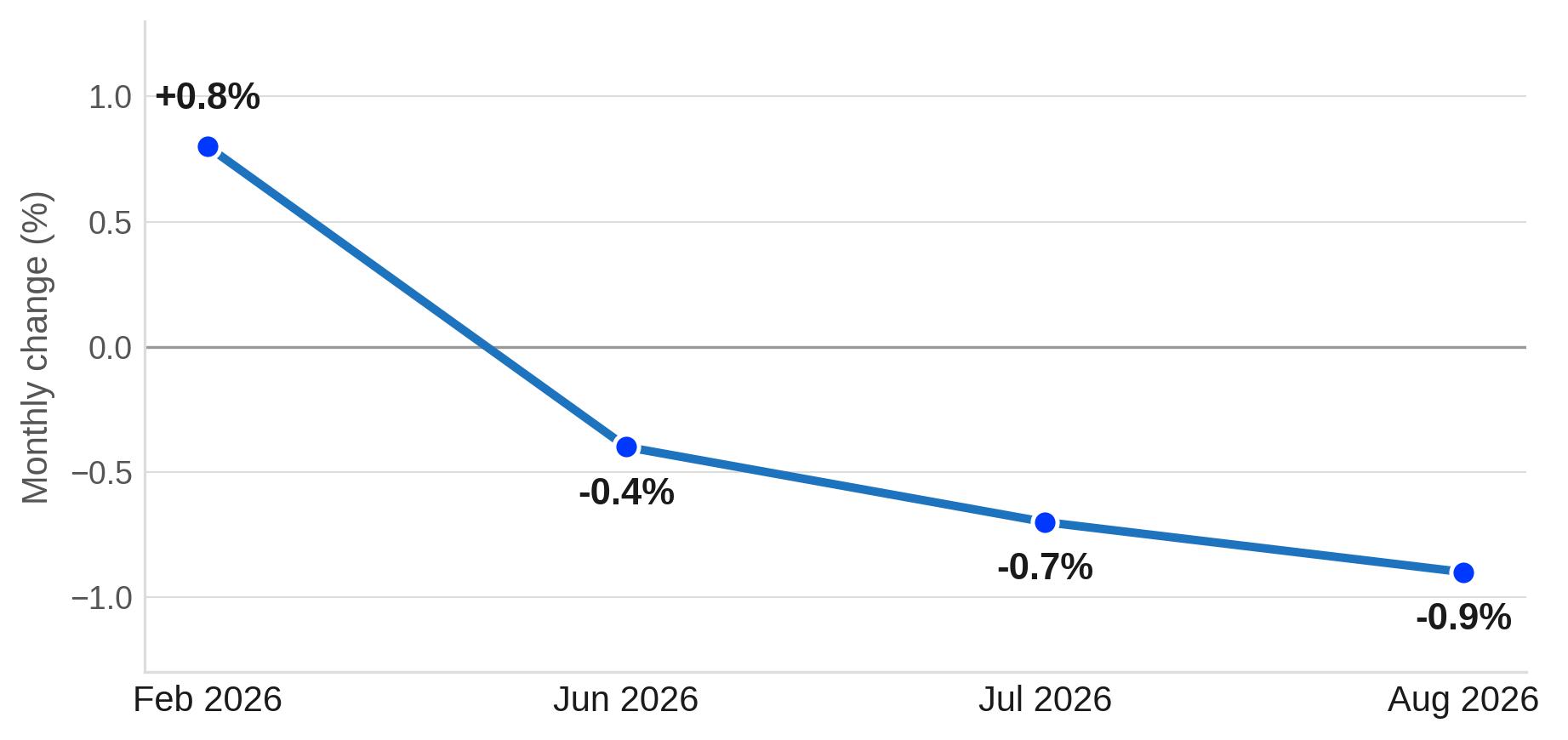
Source: ABC News, September 2026
How Do Interest Rates Actually Affect House Prices?
Higher interest rates do not push prices down directly. They work through a chain that starts with borrowing capacity, not the sale price itself.
When the Reserve Bank lifts the cash rate, banks pass the increase on through variable mortgage rates. Lenders then apply their own serviceability buffer, typically around 3 percentage points above the actual rate, when deciding how much a household can borrow. FPW's borrowing capacity formula guide breaks down exactly how lenders run that calculation.
That reduced borrowing capacity then shows up in the property market as smaller buyer budgets. Fewer buyers can stretch to the asking price, competition for each listing eases, and vendors face longer selling times and wider price discounts to secure a sale.
This is why the effect is slow rather than instant. Borrowing capacity changes the moment a rate rise is announced, but it can take months for that constraint to filter through into fewer sales, longer time on market and, eventually, lower prices.
Why Don't All Property Markets Respond the Same Way to Rate Rises?
The cash rate is national, but the property market is not. Capital city results for August 2026 show exactly how differently the same interest rate settings can land.
Capital City Home Values, Monthly Change, August 2026
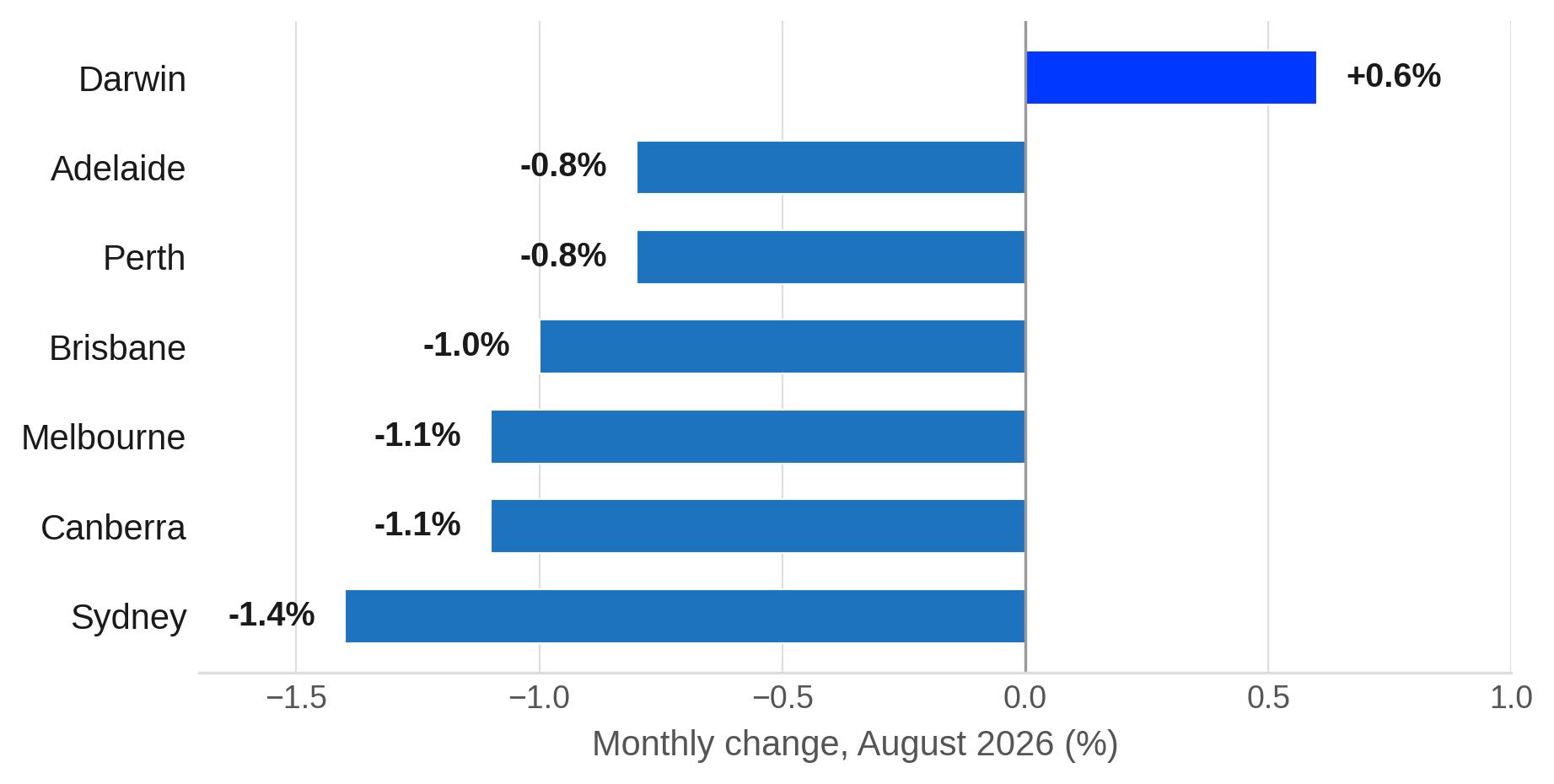
Source: ABC News, September 2026
FPW's guide to reading the Australian property market explains how to look past these city-wide averages to the suburb level that matters for a purchase decision. The annual figures tell an even sharper story, with Sydney and Melbourne both going backwards over the past year while other capitals are still climbing.
Annual Dwelling Value Growth by Capital City, Year to August 2026
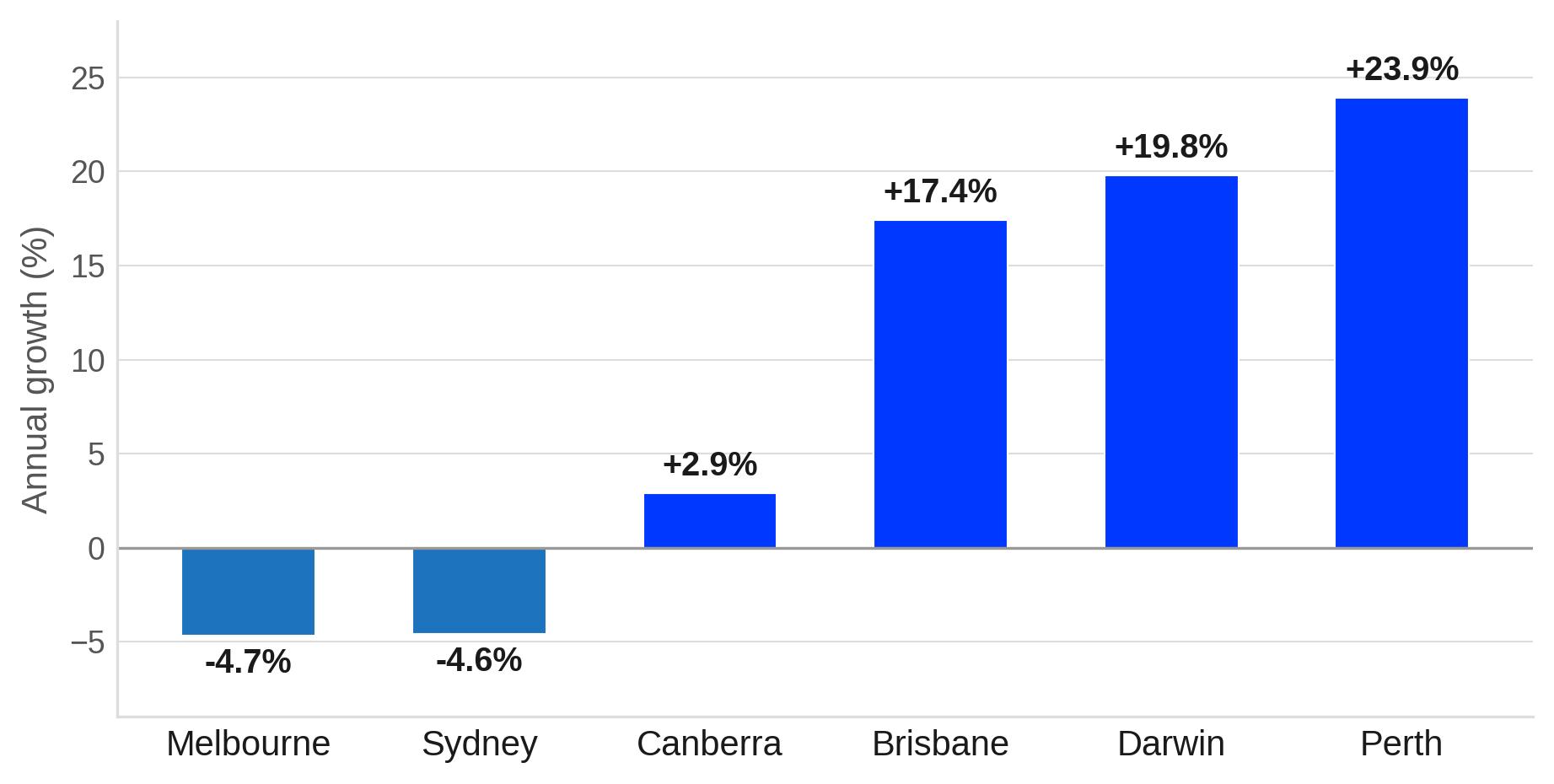
Source: Cotality Home Value Index, August 2026
The difference comes down to how much borrowing capacity each market depends on. Sydney and Melbourne carry the largest average mortgages relative to income, so a smaller assessment rate buffer removes a bigger share of local buyer budgets.
Perth, Brisbane and Darwin have lower price points and, in Perth's case, a period of undersupply that has kept demand ahead of listings despite the same national rate. FPW's broader look at property investment and interest rates covers this pattern across previous cycles as well.
Do Higher Interest Rates Always Cause House Prices to Fall?
No. Interest rates create pressure on prices, but supply, population growth and local demand can offset or even overwhelm that pressure.
Perth is the clearest example. The city has recorded a run of undersupply relative to population growth, and despite carrying the same 4.35 percent cash rate as every other capital, values are still up close to 24 percent over the year. Brisbane and Darwin show a similar pattern, supported by comparatively tight rental markets and buyers moving from more expensive cities.
Employment also matters. A household in a market with strong job security can often absorb a higher assessment rate more comfortably than one facing job losses, even if both face the identical cash rate. That is one reason the downturn has concentrated so heavily in Sydney and Melbourne, where affordability was already stretched. FPW's 2026 buy, wait or hold analysis walks through how to weigh these local factors against the national headline.
What Happens to House Prices When Interest Rates Fall?
The mechanism runs in reverse when the Reserve Bank cuts the cash rate. Lower rates reduce the serviceability buffer calculation, which increases how much a given income can borrow, and that extra borrowing capacity typically flows into stronger buyer demand.
That does not automatically produce a boom, though. If new housing supply keeps pace with the extra demand, or population growth slows at the same time rates fall, prices can rise only modestly despite easier borrowing conditions. Rate cuts widen what buyers can afford. They do not, on their own, decide what a market does with that extra capacity.
What Should Property Investors Do When House Prices Are Falling?
Falling national prices are not automatically a buying signal. A cheaper purchase price only matters if the property still performs as an investment once it is bought.
Start with borrowing capacity rather than the listing price. Understanding what a lender will approve, including how the current 4.35 percent cash rate and serviceability buffer apply to your income, avoids the risk of negotiating a good price on a property you cannot finance. FPW's overview of property investment strategy sets out the broader framework for weighing a purchase in a softening market.
Then look past the discount to the fundamentals that decide whether the price fall is temporary or structural. Vacancy rates, rental demand, population growth and the local supply pipeline matter more than the size of the reduction off the original asking price. A property in a market with rising vacancy is not a bargain just because it is cheaper than it was six months ago.
Finally, treat the national headline as context, not a decision. The gap between Sydney's decline and Perth's continued growth this year shows why a city specific, fundamentals first approach beats reacting to a single national number. FPW's buyers agent service exists to apply that process to an actual shortlist rather than a headline.
Final Thoughts
Interest rates move house prices mainly by changing borrowing capacity, and the current downturn is a clear demonstration of that mechanism at work. Five straight months of national declines, concentrated most heavily in Sydney and Melbourne, line up closely with three Reserve Bank rate rises earlier in 2026.
But a single cash rate does not produce a single outcome. Perth, Brisbane and Darwin are still recording strong annual growth, proof that supply, population and local demand can outweigh even a sustained tightening cycle.
For property investors, the practical lesson is to treat national headlines as context rather than a signal, and to check borrowing capacity, vacancy and yield at the suburb level before deciding whether a falling price is an opportunity.
Frequently Asked Questions
Recommended Reading
Two pages selected based on what readers of this article are most likely to need next.
Recommended Video
As rates rise, many people immediately assume it is no longer a good time to invest. But in reality, the opportunity has not disappeared—it has simply shifted. This episode explains why higher interest rates do not automatically remove your ability to invest, but they do change your borrowing power, your cash flow, and the price point that makes sense for you.