

Property Investment and Interest Rates: What Investors Need to Know in 2026
Interest rates have reshaped the investment landscape more significantly in the past three years than in the previous decade. Many investors are now asking whether property investment still makes sense when borrowing costs are elevated, or whether high interest rates have fundamentally changed the case for residential property.
Rates affect holding costs, borrowing capacity, and cash flow in real and measurable ways. They do not change why well-selected property builds wealth over time, and this article explains how to think through that distinction clearly in 2026.
How Interest Rates Affect Property Investors
When interest rates rise, the cost of borrowing increases directly and immediately. An investor with a $600,000 interest-only loan at 4.5% pays approximately $27,000 per year in interest, while the same loan at 6.5% costs $39,000. This is an increase of $12,000 annually with no change in the underlying asset.
The second effect is on borrowing capacity, which is less visible but equally significant. Lenders apply a serviceability buffer of 3% above the actual lending rate, meaning a loan offered at 6.5% is assessed as though repayments were calculated at 9.5%. This is a threshold that has materially reduced what most investors can borrow compared to the 2020 to 2021 cycle.
This directly impacts borrowing power in a higher-rate environment.
Borrowing Capacity: 2021 vs 2026 Across Income Brackets
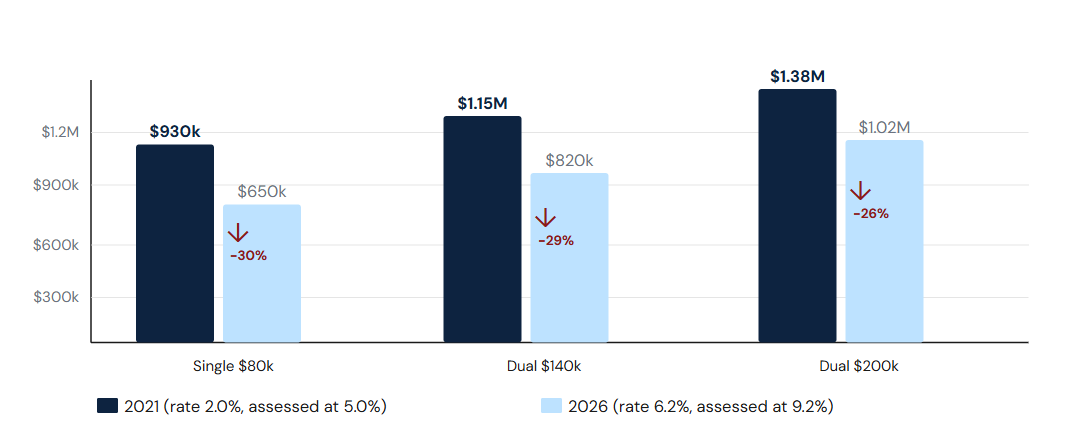
Borrowing capacity has contracted by 25 to 30% across income brackets between the 2021 low-rate environment and current 2026 conditions, driven by the serviceability buffer applied to a much higher base rate.
Source: RBA cash rate data; APRA serviceability buffer guidelines; FPW Group modelled scenarios. Figures illustrative, 2025 to 2026.
The third effect is on weekly cash flow, where higher repayments can turn a previously neutral or positive property into one that costs the investor money each month. Investors need to model holding costs at current rates before purchase, not based on the rate environment that existed when they began researching.
Property Investing in High-Rate Environments
The most important thing to understand about property investment interest rates is that the two have coexisted productively throughout Australian property history. Higher rates increase costs. They do not stop well-selected property from generating long-term returns.
A property in a strong market with solid rental demand and a realistic yield will perform materially better through a rate cycle than a low-yield speculative purchase justified entirely by capital growth expectations. The strategy needs to hold at current rates, not anticipated future ones.
What History Shows About Rate Cycles and Property
Australian property has experienced multiple high-rate environments over the past four decades. The early 1990s saw mortgage rates above 17%, and the mid-2000s saw rates climb steadily toward 9%, yet investors who held well-selected properties through both periods accumulated significant wealth by the time rates normalised.
The practical lesson from history is not that rates do not matter, but that trying to time entry around rate cycles is an unreliable strategy. Markets rarely pause while investors wait for ideal borrowing conditions, and properties that appear expensive at 6% often look inexpensive by the time rates fall to 4%, because prices have already moved to reflect the improved affordability.
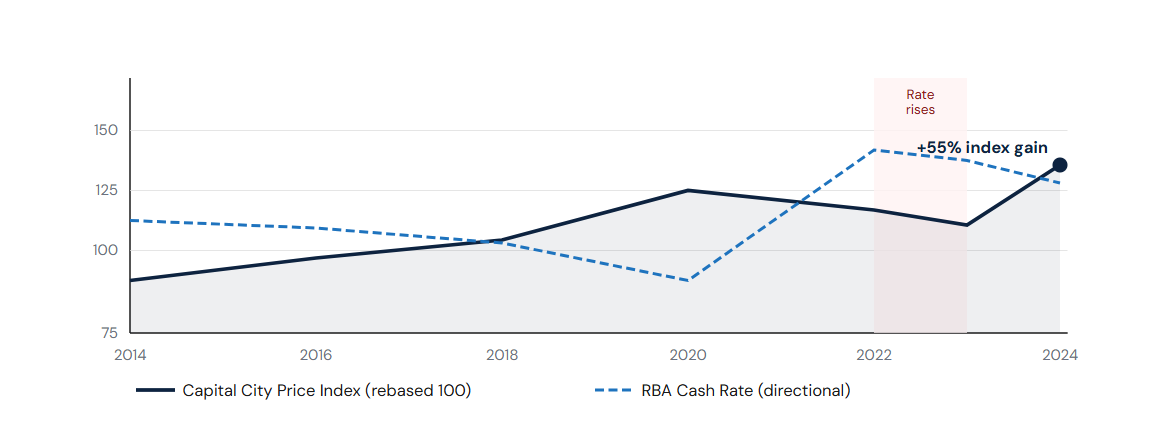
RBA Cash Rate Direction vs Capital City Property Price Index: 10 Years
Opportunities in a High-Rate Market
What most commentary misses is that high-interest rate environments also create conditions that experienced investors actively look for. Reduced buyer competition, more motivated vendors, and stronger rental demand are all byproducts of a market where many potential buyers are sitting on the sidelines.
This is closely connected to how supply shortages interact with rates — tight supply helps support rents and prices even when borrowing costs are higher.
Despite the challenges, there are still strong property investment opportunities in Australia for well-prepared investors.
Rental vacancy rates across Australia's major capital cities are near historic lows in 2026, partly because higher rates have pushed potential buyers back into the rental market. That dynamic directly supports rental income for investors and partially offsets the higher cost of debt.
For Example
An investor who purchased a $650,000 property in Brisbane in mid-2023 at the peak of the rate cycle secured a yield of approximately 5.1% at the time of purchase. By mid-2024, rents in that market had increased further, pushing the effective yield on cost to 5.6%, the higher rate environment that deterred other buyers also drove the rental demand that strengthened the investor's return.
Investment Strategies for High-Interest Rate Conditions
The strategies that perform best in a high-rate environment are built around cash flow resilience, not capital growth alone. That does not mean abandoning growth markets, but being deliberate about the yield profile of every acquisition and its cumulative effect on serviceability across a portfolio.
FPW works with investors across a range of approaches in the current market, and the patterns that emerge consistently among those who continue acquiring are the same. Deliberate yield targeting, conservative debt structures, and modelling holding costs before purchase rather than after are the disciplines that separate investors who keep building from those who stall.
Cash Flow Profile: Low-Yield Growth Market vs High-Yield Rental Market at 6.2% Rate
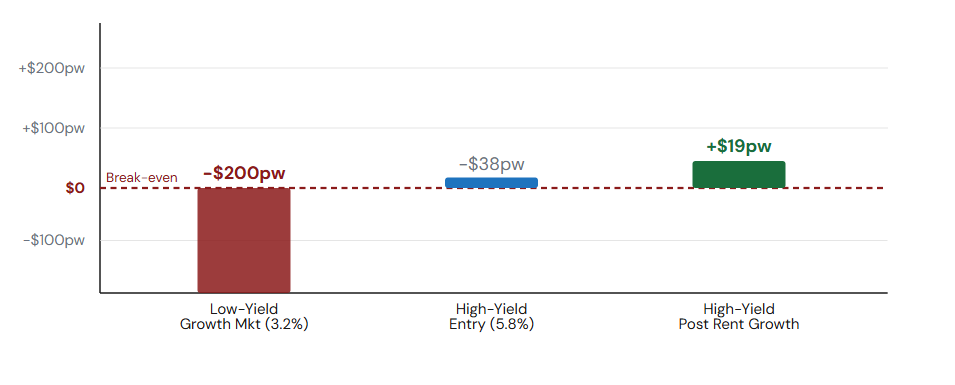
At a 6.2% interest rate, a low-yield growth market property runs at a significant weekly deficit. A high-yield rental market property starts near breakeven and crosses into positive territory as rents grow without requiring any change in interest rates.
Source: FPW Group modelled scenarios; RBA lending rate data; SQM Research rental data, 2025 to 2026. Interest-only repayments assumed. Scenarios illustrative only.
Waiting for Rates to Fall: The Real Trade-Off
The most common response to a high-rate environment is to wait, and the logic appears straightforward: if rates fall, repayments drop, borrowing capacity increases, and the cash flow problem resolves. The issue is that every other buyer in the market is running the same calculation.
This highlights the difficulty of timing property purchases during changing rates.
When rates do fall, competition typically intensifies quickly and prices reflect the improved affordability before most waiting investors have acted. The negotiating advantage that existed during the high-rate period disappears, and the investors who waited find themselves competing with more buyers for the same stock at prices that have already moved.
Final Thoughts: Property Investment Interest Rates in 2026
The relationship between property investment and interest rates is real but not deterministic. Higher rates increase costs, reduce capacity, and create cash flow pressure, but they do not change the fundamental logic of owning well-located residential property in a supply-constrained, demand-supported market.
What 2026 requires of investors is more precision than previous cycles demanded, and less reliance on favourable conditions doing the work for them. The investors who navigate high-rate environments successfully are not those who predicted the rate cycle. They are those who built portfolios structured to withstand it.
Frequently Asked Questions
Recommended Reading
Two pages selected based on what readers of this article are most likely to need next.
Watch: RBA rate hikes
In this episode of Smart Property Moves by FPW Group, we unpack one of the biggest questions property investors are asking right now