

Land Tax Changes 2026: Land Tax by State for Australian Property Investors

Land tax by state is one of the most inconsistent recurring costs in Australian property investment, and 2026 has made the differences sharper. NSW investors pay nothing below $1,075,000 in combined land value, while Victorian investors face liability from $300,000, a difference that reshapes the math on every multi-property portfolio.
What makes this consequential is that most states now aggregate all investment land holdings when setting the taxable value. A second or third property can push an investor past the threshold even if each individual property sits comfortably below it, and the rate structures, exemption rules, and 2026 updates vary enough between states that where you buy and whose name it is held in are now active land-tax decisions.
This guide covers land tax rates and thresholds across all eight states and territories, the key 2026 changes, and the specific implications for investors building or scaling a portfolio. For context on how holding costs like this interact with property investment in Australia, land tax sits alongside mortgage costs, depreciation, and vacancy risk as a baseline input into any realistic return calculation.
What Is Land Tax and Why Does It Matter for Investors?
Land tax is an annual state and territory tax levied on the unimproved capital value of land. It applies to investment properties, commercial land, and in some states, land held in trusts, but not to a primary residence in most jurisdictions, which means the full burden falls on investors.
For an investor with one property, land tax may be modest or absent depending on the state and land value. For an investor with two or three properties, aggregation rules can push the combined land value well above the threshold, resulting in a significantly higher annual bill that compounds as the portfolio grows.
Land Tax General Thresholds by State, 2026
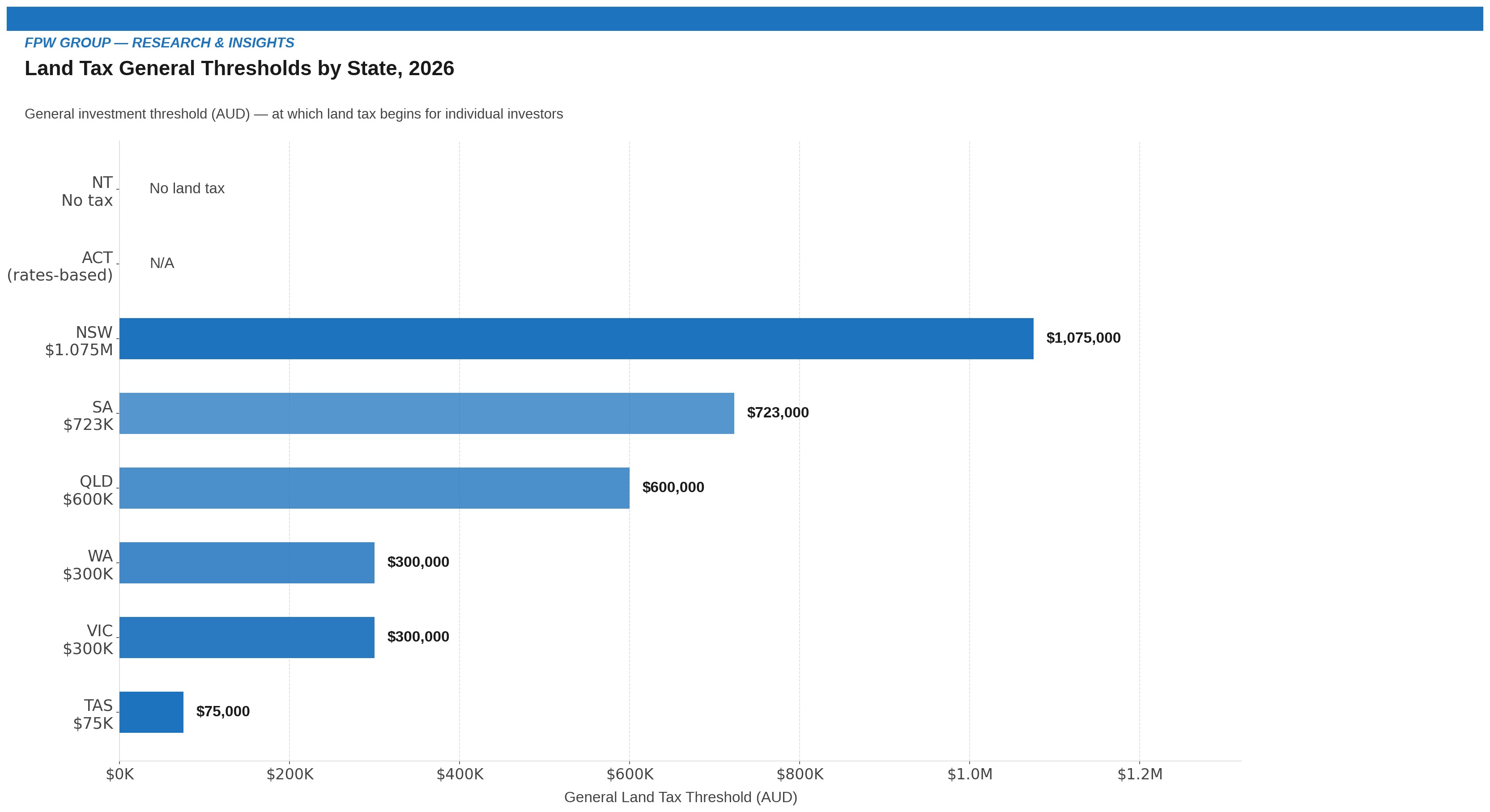
Source: State Revenue Office VIC, Revenue NSW, Queensland Revenue Office, RevenueSA, OSR WA, SRO TAS, ACT Revenue Office, 2026.
Land Tax by State in 2026: Rates, Thresholds, and Investor Impact
The following summaries cover all eight Australian jurisdictions, focusing on the information most relevant to investors holding or considering interstate exposure.
NSW Land Tax
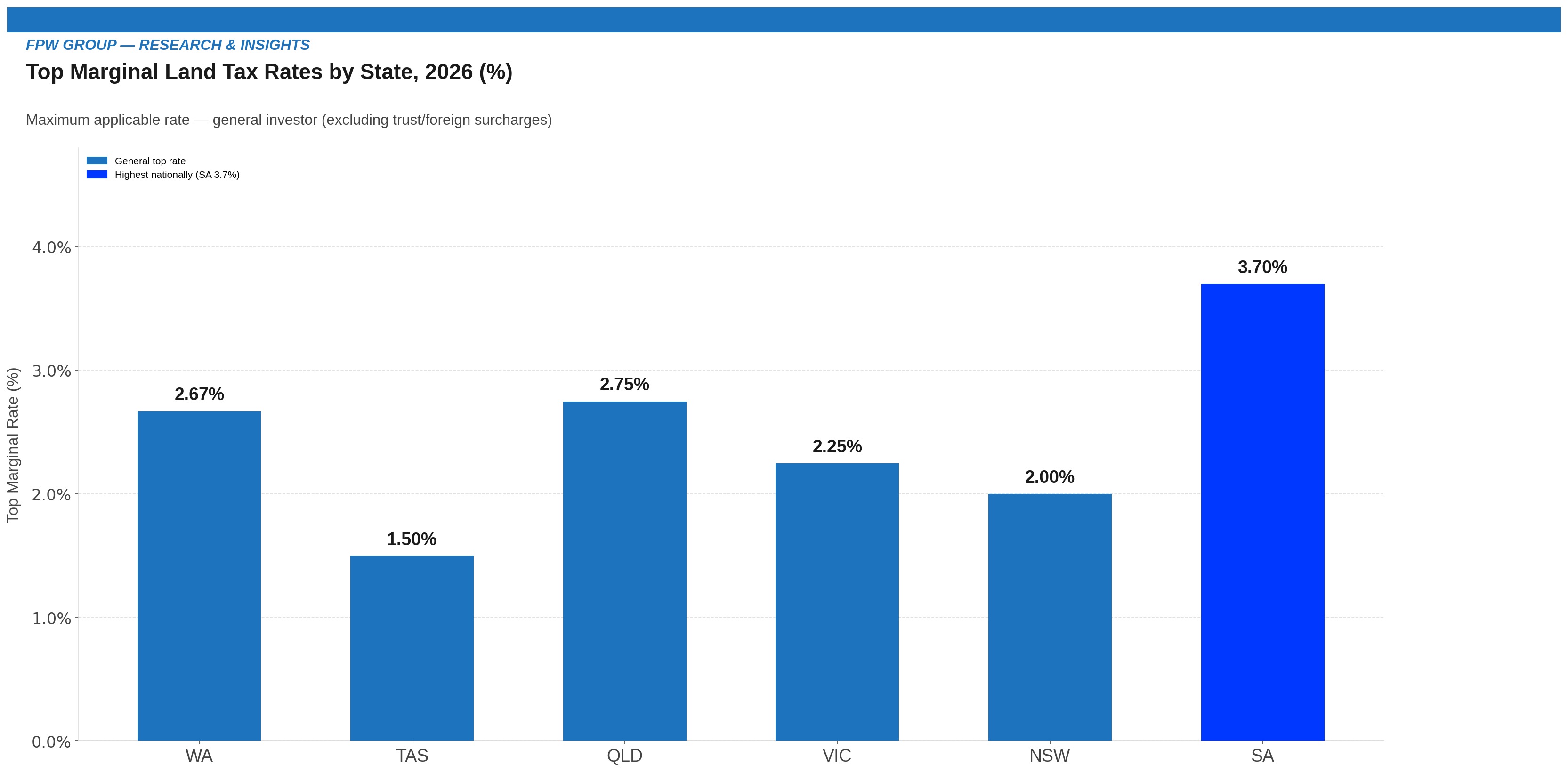
New South Wales applies land tax above a $1,075,000 general threshold (2026), assessed on combined land values across all NSW investment properties. The general rate is 1.6% above the threshold, rising to 2.0% above the premium threshold of $6,571,000. Foreign owners face an additional 4% surcharge applied to all taxable land regardless of the threshold.
Victoria Land Tax
Victoria has the lowest general threshold in the country at $300,000, meaning investors with even a single modest investment property in metropolitan Melbourne often pay land tax. Rates are tiered from 0.2% at the threshold to 2.25% above $3,000,000, and trust and absentee surcharges of 0.5% and 2.0% respectively make ownership structure particularly important.
Queensland Land Tax
Queensland sets its threshold at $600,000 (combined taxable value) with tiered rates from 1.0% to 2.75% above $5,000,000. The principal-place-of-residence exemption does not extend to investment properties, and companies and trustees face a separate flat rate structure. Aggregation rules catch multi-property investors more quickly than the headline threshold suggests.
Western Australia, South Australia, and Tasmania
Western Australia uses site value rather than unimproved capital value, with a $300,000 threshold and rates from 0.15% to 2.67%. South Australia has a $723,000 threshold and carries the highest top marginal rate nationally at 3.7%. Tasmania has the lowest threshold of any state at $75,000, meaning almost all investment land holdings attract land tax.
ACT and NT
The ACT does not levy a separate land tax but incorporates a land-tax component into the general rates system, assessed per property. The Northern Territory is the only Australian jurisdiction with no land tax at all, which makes it notable from a holding-cost perspective, though the NT market is thin and liquidity risk is higher.
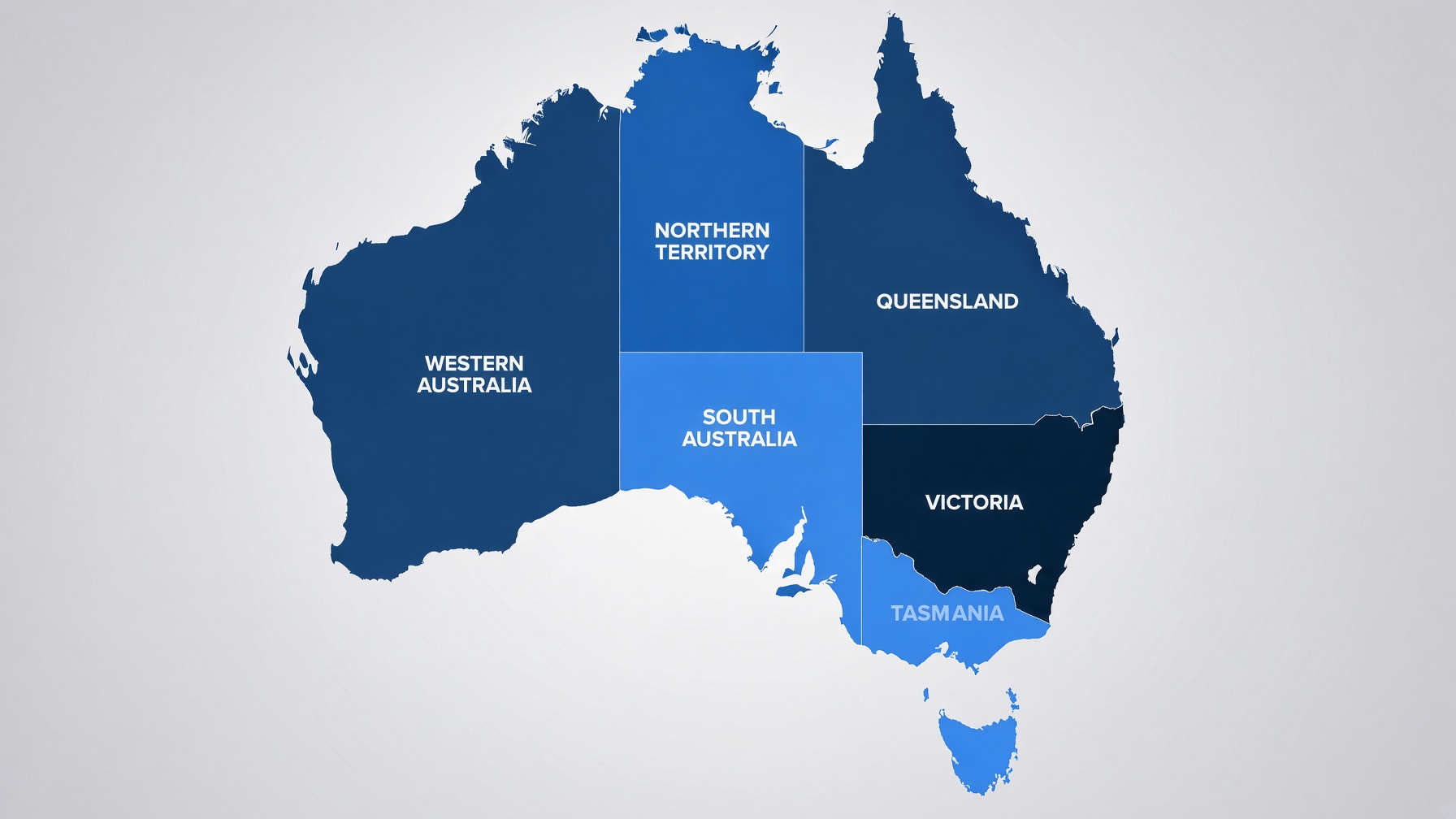
State Land Tax Rates and Thresholds Compared
The table below summarises the key 2026 figures across all eight jurisdictions. Thresholds reflect the general investment rate; trust and foreign-owner surcharges are in addition.
Top Marginal Land Tax Rates by State, 2026
How Land Tax Affects Your Property Portfolio
The most important shift investors miss is that land tax does not stay proportional as a portfolio grows. Because most states aggregate all holdings when assessing taxable value, the marginal land-tax cost of a third or fourth property is often significantly higher than the cost of the first or second, even if each new property has the same land value.
Land tax is generally deductible against rental income, which reduces the after-tax cost. But the deduction only applies in the financial year the tax is paid, and for investors with negative cash-flow properties, the liability arrives as a separate annual bill that must be funded from elsewhere in the portfolio or from personal income.
Annual Land Tax Liability by Portfolio Size: VIC, QLD, and NSW Compared
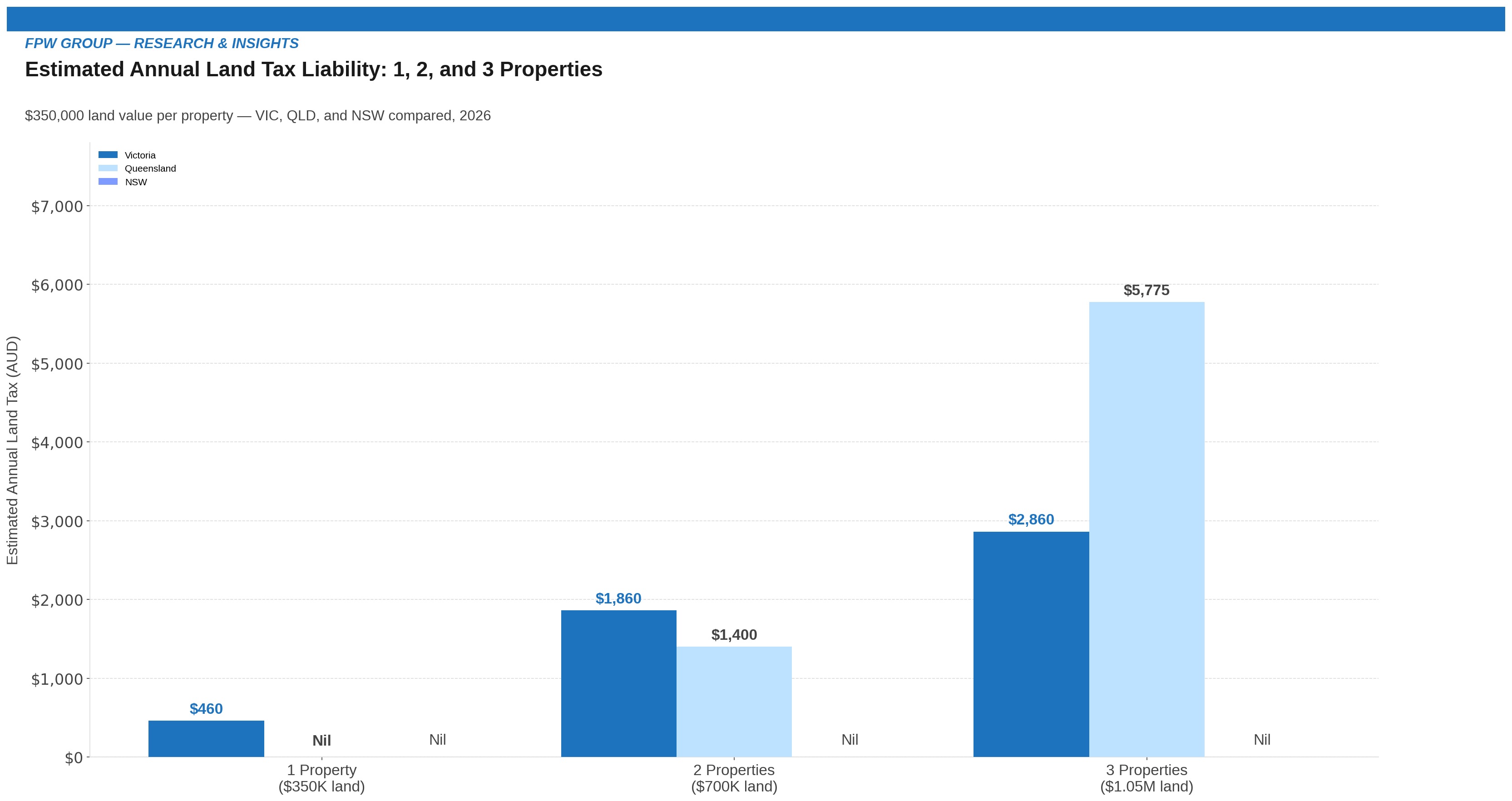
Source: FPW Group analysis using published 2026 state revenue authority thresholds and rate schedules.
Land tax also affects borrowing capacity indirectly but meaningfully. Lenders assess the net rental income of existing properties when calculating serviceability, and land-tax liabilities reduce that net income. An investor with a high land-tax bill across multiple states may find their assessed rental surplus is lower than expected, which tightens the available borrowing room for the next acquisition.
Cumulative Land Tax Cost Over 10 Years: Three-Property Portfolio (VIC, QLD, NSW)
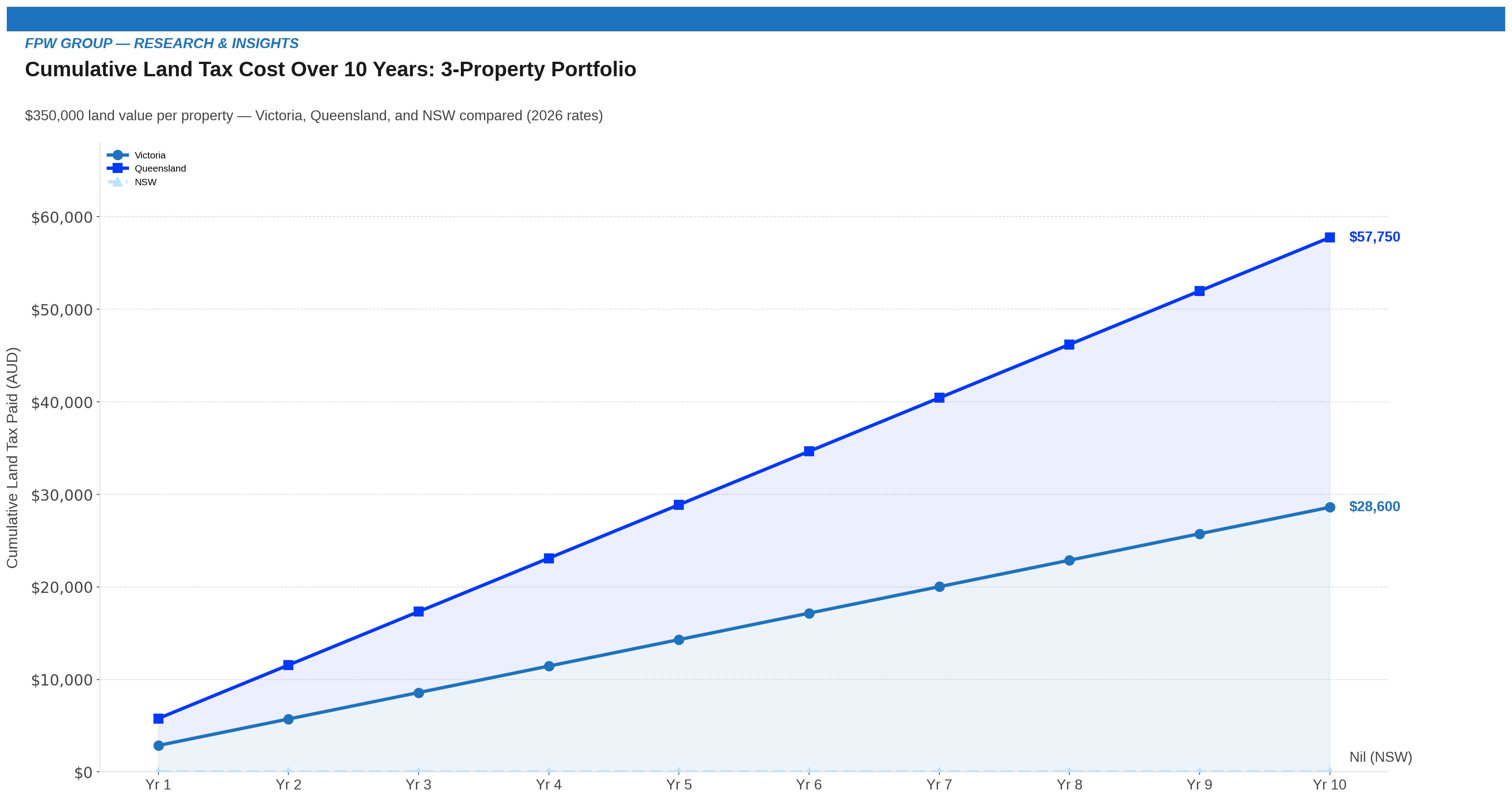
Source: FPW Group analysis using 2026 published rate schedules. Assumes stable land values and no threshold indexation.
What Changed with Land Tax in 2026?
The most significant 2026 changes affect Victoria, NSW, and South Australia. Victoria introduced revised provisions for discretionary trust surcharges, tightening the conditions under which the primary-residence exemption applies to trust beneficiaries. NSW adjusted its general threshold upward to $1,075,000 through annual indexation and clarified the application of the foreign-owner surcharge to newly established entities.
South Australia revised its land-value assessment methodology, aligning it more closely with the most recent general valuation cycle. Queensland did not change its core thresholds but issued updated guidance on the aggregation of properties held across different entity types, which has implications for investors using both personal names and companies within the same portfolio.
For a broader view of how 2026 policy changes are affecting investment returns, the FPW article on the Australia 2026 budget changes covers the intersection of federal tax policy and property investor obligations.
What to Check Before Buying in Any State
Land tax should be calculated before any purchase, not after settlement. The key figure to establish is not the land tax on the new property in isolation, but the combined land-tax liability across the whole portfolio after the new property is added and the threshold of the relevant state is applied.
Investors expanding across state lines need to track each state separately, since aggregation rules only apply within each jurisdiction. A portfolio spread across NSW, Queensland, and Victoria has three separate land-tax calculations, each subject to that state's rules.
Ownership structure matters as much as the state chosen. Holding land in a trust, a company, or jointly with a partner produces different land-tax outcomes in most states, and the most tax-efficient structure for one state may not be optimal for another.
For investors comparing interstate markets, the FPW analysis of Brisbane, Adelaide, and Perth investment conditions covers the full holding-cost context for each of those markets, including land-tax exposure at different portfolio sizes.
Final Thoughts
Land tax by state is not a single number but a calculation that changes with every property added to a portfolio. The 2026 updates have made the differences between states more visible, but the underlying logic has not changed: investors who treat land tax as an afterthought tend to discover it matters when the bill arrives rather than when the strategy is being built.
The states with the most investor activity, Victoria, Queensland, and NSW, all have meaningful land-tax obligations that scale quickly with portfolio size. Understanding the threshold, the aggregation rule, and the surcharge provisions for the relevant state is not specialist knowledge. It is a baseline input for any property decision made at scale.
Land tax is deductible, structurable, and in some cases avoidable through the right ownership arrangement. The point is not to avoid building a portfolio because of it, but to factor it in from the first property so the fourth and fifth do not arrive with unexpected holding costs that reshape the numbers.
Frequently Asked Questions
Recommended Reading
Two pages selected based on what readers of this article are most likely to need next.
Recommended Video
This is not just another policy update. It is a structural shift in how the entire market is being shaped. The 2026 Federal Budget introduces changes across negative gearing, updates to capital gains tax CGT, and a growing tax advantages.