

Ballarat Housing Market Vs Bendigo Which Is Better For Investors
The Ballarat housing market has the stronger growth story right now, while Bendigo offers the better rental return for investors. Neither is the outright winner, because the two cities lead on different numbers, and the right choice depends on whether you need cash flow or capital growth more.
The gap is bigger than the headline prices suggest. Bendigo houses cost less, yet they rent for more, and Ballarat's growth figure changes a lot depending on which dataset you read.
We compared prices, rents, vacancy, population and supply side by side, using the latest data for both cities. If you are weighing up investment locations in Australia, this is where the two markets split.
Ballarat vs Bendigo: What Are We Comparing?
Ballarat and Bendigo are Victoria's two largest inland cities, each with roughly 64,000 to 66,000 dwellings. Investors often treat them as interchangeable, but the data shows they behave quite differently.
The investment metrics that matter
We compared entry price, growth, rent, yield, vacancy, population growth and future housing supply. Each tells you something different, and no single number settles the question.
Why Ballarat property prices differ across datasets
Ballarat house values rose 15.3% over the past year on HtAG’s council-area house data. Cotality's figure for all dwellings across the wider Ballarat region was 8.8% to August 2026, and both can be right because they measure different property types and areas.
Annual Value Growth in Ballarat and Bendigo by Data Source
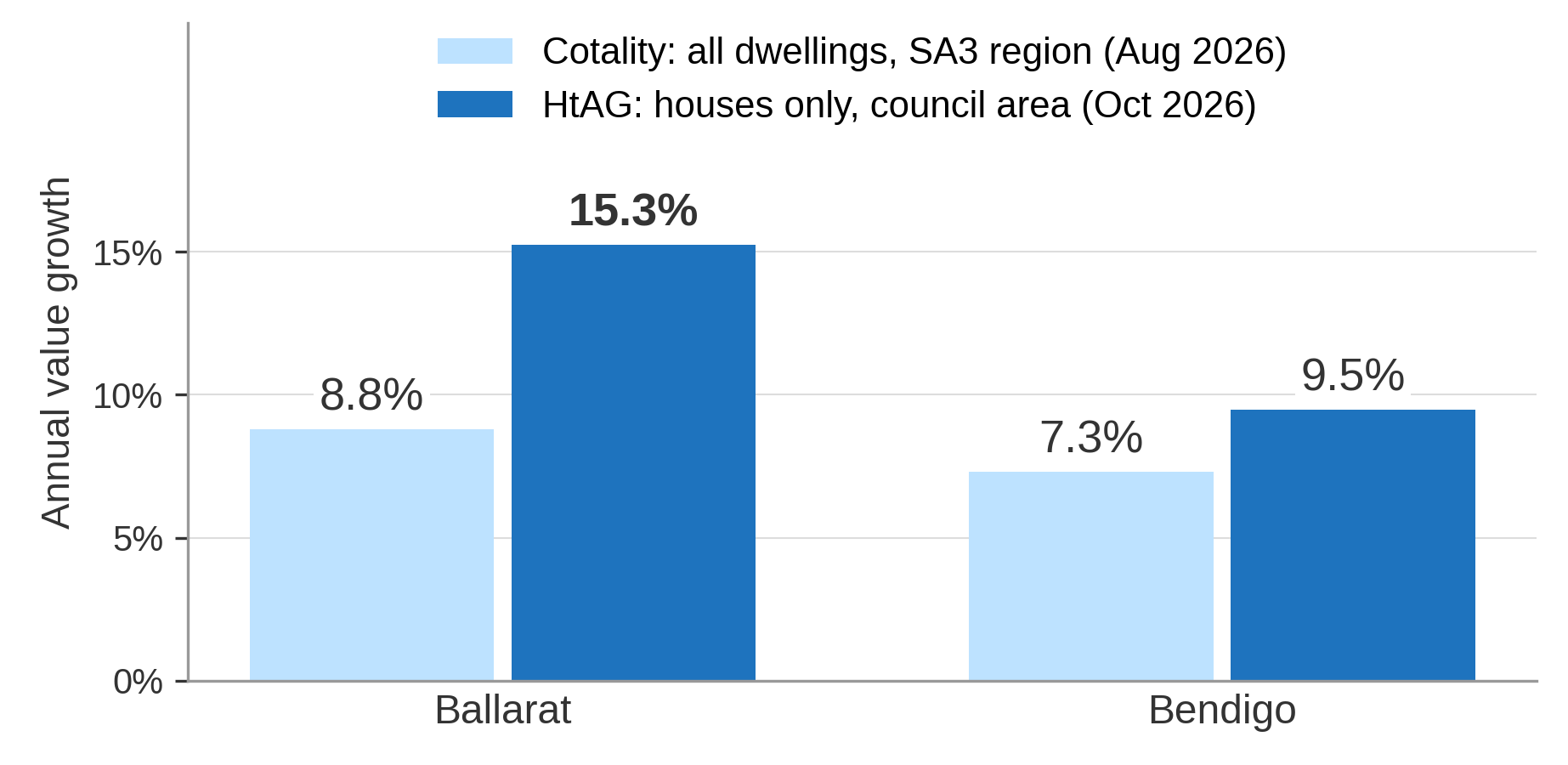
Source: Cotality Home Value Index, September 2026; HtAG Ballarat City; HtAG Greater Bendigo City
The lesson is to compare like with like. From here, every figure uses the same source and method for both cities wherever possible.
Ballarat Housing Market vs Bendigo Housing Market: Prices and Growth
HtAG puts Ballarat's typical house value at $706,000 and Greater Bendigo’s at $673,000. That $33,000 gap has opened over the past year, as Ballarat's growth ran well ahead.
Two-bedroom houses tell a different story for smaller budgets. They sit at about $479,000 in Ballarat and $506,000 in Bendigo, so the cheaper entry point flips depending on what you buy.
What the price gap means for investors
Over ten years, both markets have roughly doubled, with house values up about 100% in Ballarat and 99% in Bendigo. Both also beat regional Victoria over the past year, where Cotality recorded 4.6% growth to August 2026.
Recent momentum favours Ballarat, but the long-run result is almost identical. That matters if you are buying for a 10-year hold rather than a 12-month run.
For more detail on each city on its own, see our Ballarat property market analysis and our Bendigo property market guide.
Which Market Offers the Stronger Rental Fundamentals?
This is where Bendigo pulls ahead. Its typical house rents for $511 a week, compared with $438 in Ballarat, giving a gross yield of 3.94% against 3.22%.
Vacancy rates are tight in both, at 1.24% in Bendigo and 1.03% in Ballarat, according to HtAG. A low vacancy rate supports rents, but it does not tell you how fast they can keep rising.
Ten-Year Change in House Prices and Rents
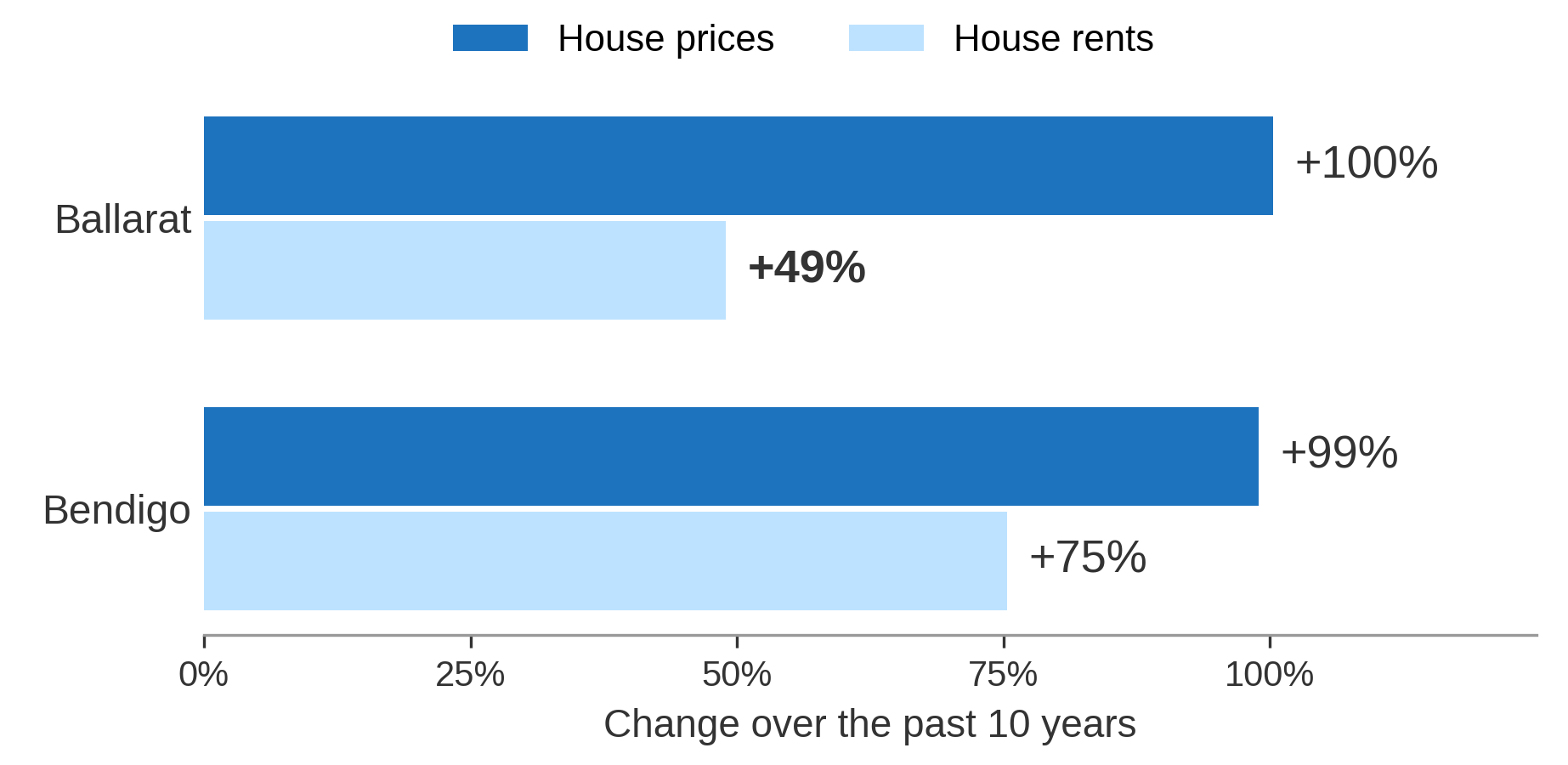
Source: HtAG Ballarat City; HtAG Greater Bendigo City
What the rental data tells investors
Higher rent on a cheaper house means a smaller weekly shortfall to cover. It also helps your borrowing capacity, because lenders count part of the rent as income when you apply.
This is the classic yield vs growth trade-off. Ballarat asks you to carry more cost for stronger recent growth, while Bendigo pays more of its own way.
Ballarat vs Bendigo: Where Is Demand Coming From?
Population growth is the clearest demand signal, and Ballarat leads. Victorian Government data shows the Ballarat region grew 1.39% in the year to June 2025, compared with 0.96% for the Bendigo region.
Annual Population Growth in the Ballarat and Bendigo Regions
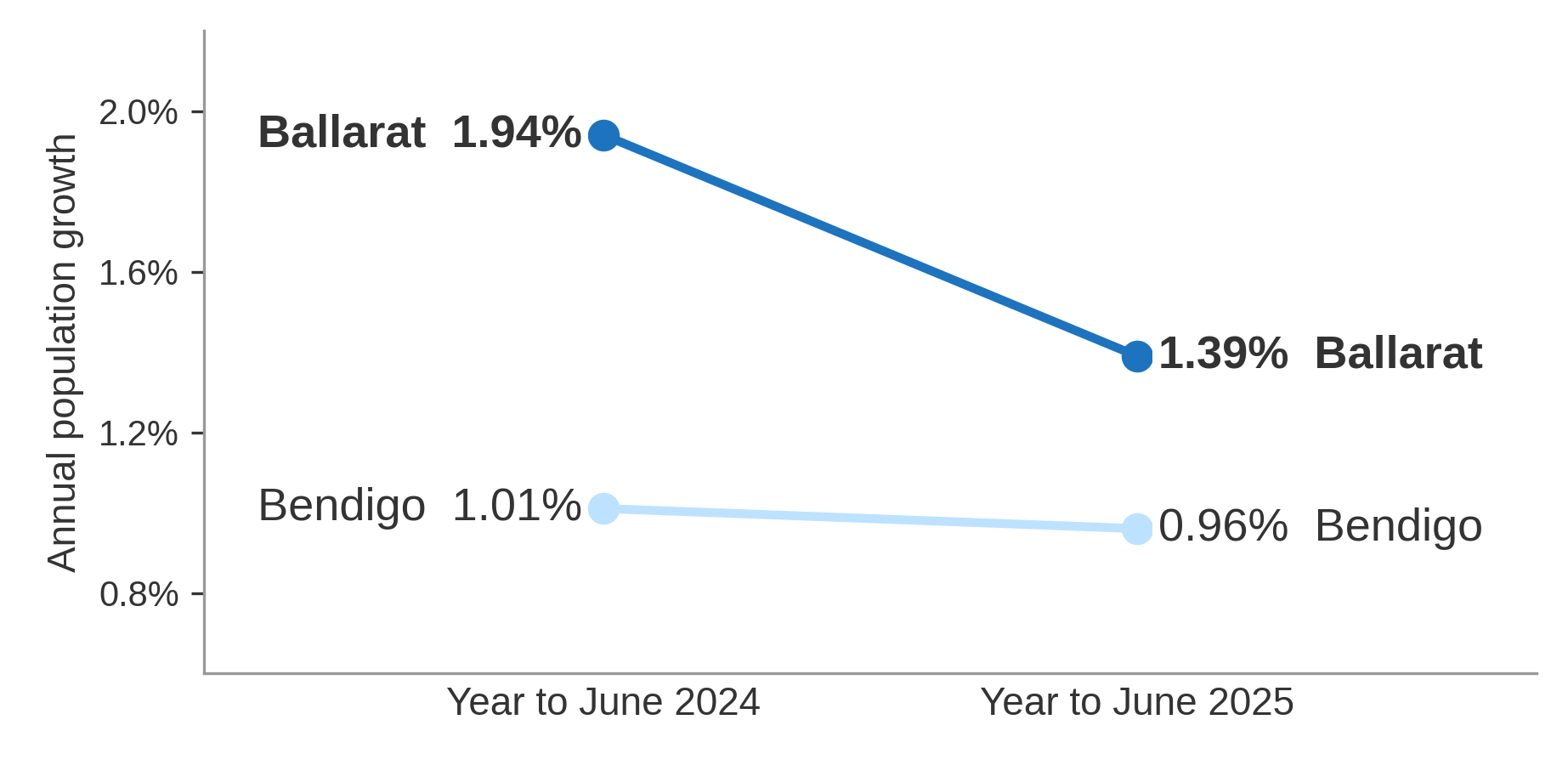
Source: Victorian Department of Jobs, Skills, Industry and Regions, regional population growth, 2025
The City of Ballarat plans for even more. Its Housing Strategy 2041 includes a high-growth scenario that lifts the population from 113,482 in 2021 to 171,429 by 2041.
Moves from Melbourne and other regions drive much of the demand in both cities, a trend our look at lifestyle migration explores. Bendigo draws on the same trend, but at a steadier pace.
Ballarat vs Bendigo: Where Is Demand Coming From?
Population growth only lifts prices if supply lags behind. Both cities are tight today, with HtAG recording about 1.5 months of house stock in Ballarat and 1.7 months in Bendigo, well below a balanced level of around three months.
Victoria's 2051 Housing Targets for Ballarat and Greater Bendigo
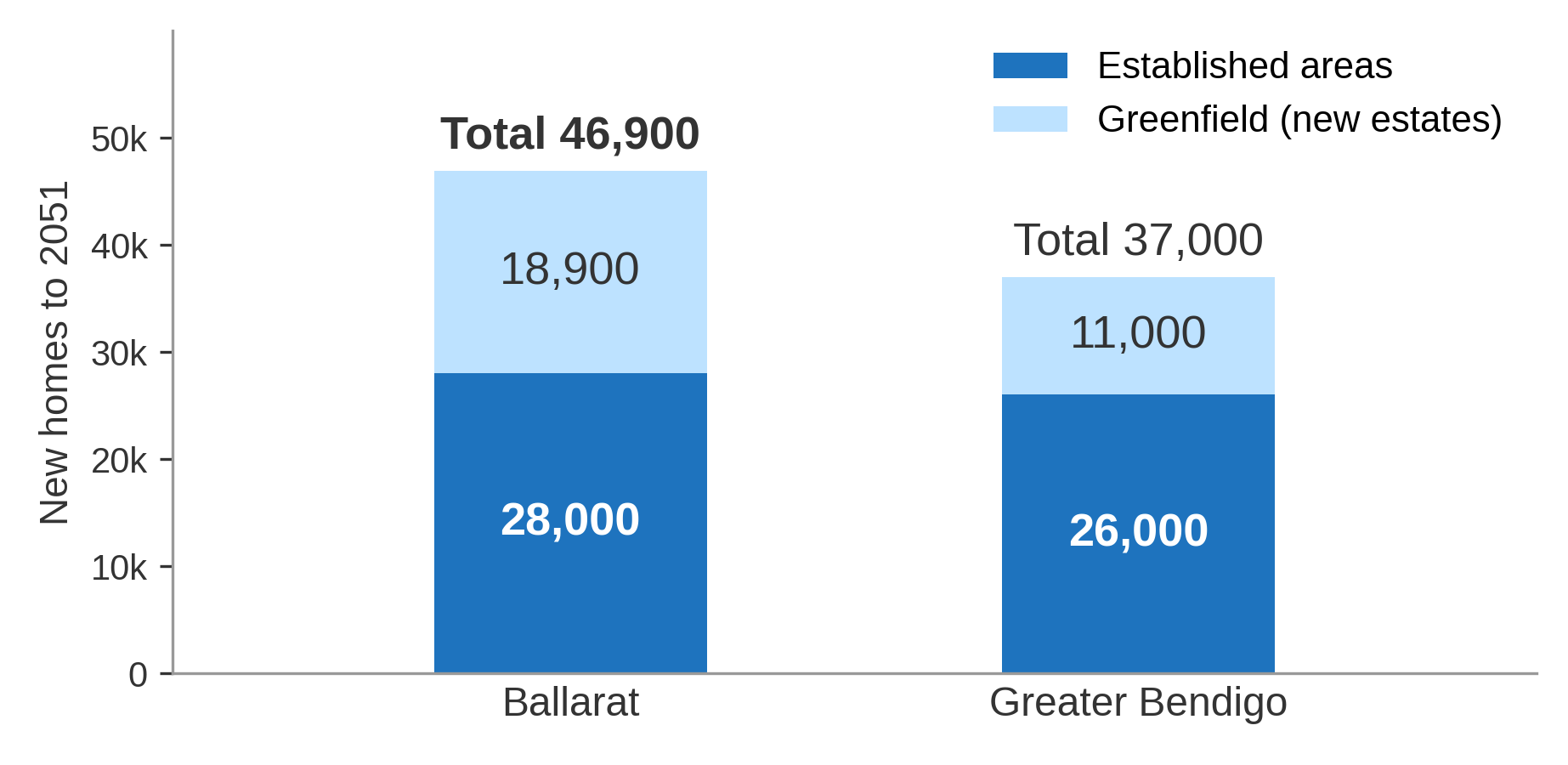
Source: Victorian Government, Plan for Victoria housing targets; HtAG dwelling counts
More new estates mean more choice for tenants and buyers, which can slow rent and price growth nearby. Investors looking at Ballarat's growth corridors should check how many new homes are due close by before they buy.
Bendigo's smaller greenfield target of 11,000 homes points to more growth through infill in established suburbs. That can support values in well-located existing areas, although targets are plans, not guarantees.
What Could Investors Get Wrong About Each Market?
Ballarat: momentum is not a guarantee
A 15% year of house growth can tempt buyers to chase the trend. With a lower yield and a large pipeline of new estates, buying at the wrong price in the wrong pocket could mean years of weak returns.
Bendigo: a higher yield is not the whole story
Bendigo's stronger rent can hide weaker growth in some suburbs. A higher yield helps cash flow, but it does not make up for a property that future buyers will not want.
Why city-level data can hide suburb-level differences
Both cities include inner suburbs, outer estates and small towns, and their numbers can move in opposite directions. Knowing how to read a suburb profile helps you test the street, not just the city.
Ballarat vs Bendigo: What Does the Data Show?
Side by side, the two markets lead on different measures. The table below sums up the key numbers and what each one means for an investor.
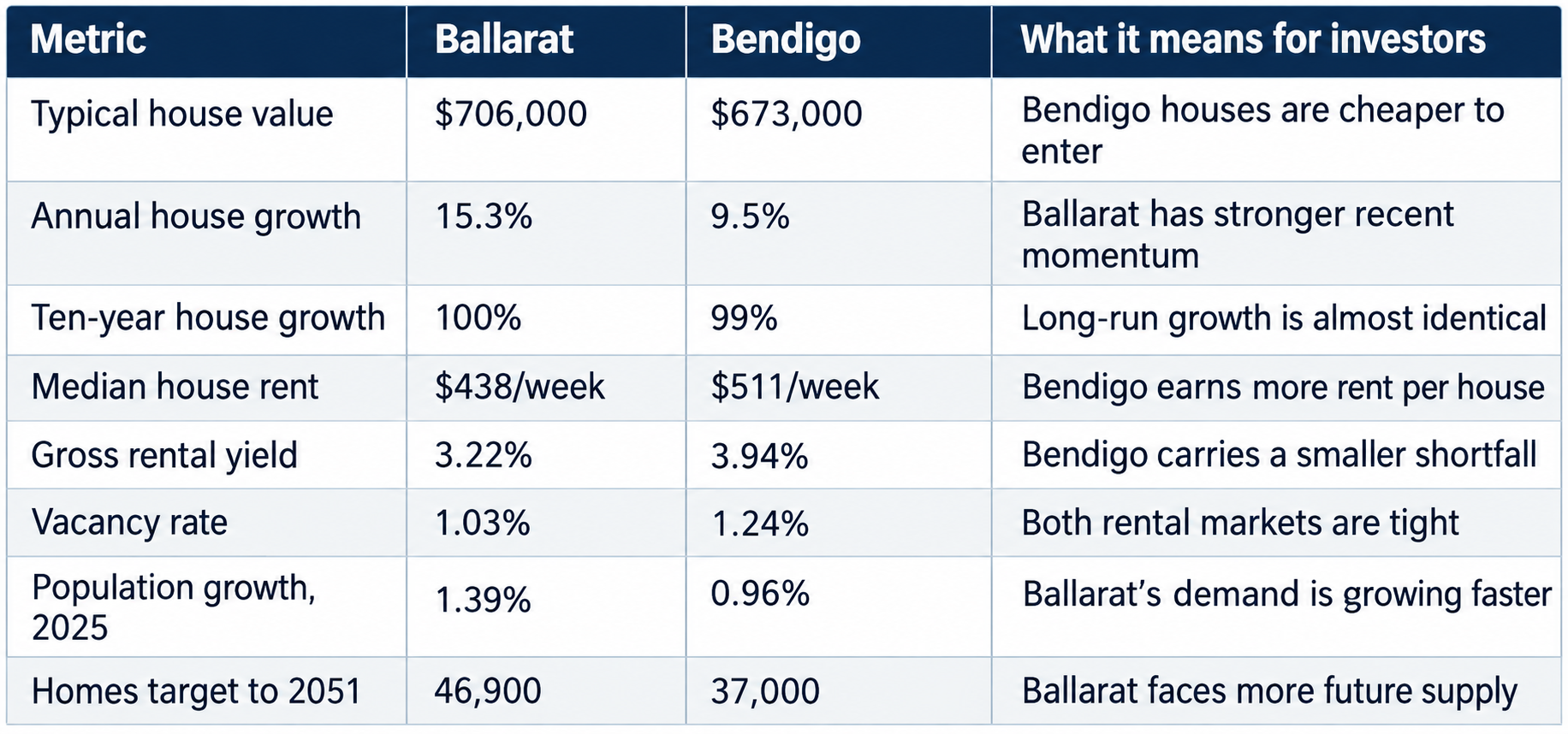
Price, rent, yield, vacancy and growth figures are HtAG house data for each council area as at October 2026. Population and targets come from the Victorian Government sources above.
Where each market has the advantage
Ballarat leads on recent growth and population, which suits investors focused on capital growth who can carry the cost. Bendigo leads on rent, yield and a smaller supply pipeline, which suits investors who need the property to pay more of its own way.
What Should Investors Check Before Buying in Ballarat or Bendigo?
Compare the property, not just the city: recent sales, land size and street appeal matter more than the median.
Check rents for the exact property type, not the city average.
Look at new estates and lots planned within a few kilometres.
Stress-test the numbers at a higher interest rate and with a few weeks of vacancy.
Getting investment property advice before you choose a city can save you from buying in the right market at the wrong address.
Final Thoughts
The Ballarat housing market has the stronger momentum and population growth, while Bendigo has the stronger rental return and a smaller pipeline of new homes. Over ten years, both cities have roughly doubled in value, so the real difference sits in cash flow and future supply.
For a growth-focused investor with room in their budget, Ballarat's demand story is hard to ignore. For an investor who needs the rent to carry more of the cost, Bendigo's numbers are easier to hold.
Either way, the city is only the first decision. The suburb, the street and the price you pay will decide whether the investment works.

Recommended Reading
Two pages selected based on what readers of this article are most likely to need next.
Recommended Video
Most buyers think success comes from timing the market, but the real difference between people who build wealth and people who get stuck comes from buying the right asset with the right strategy, structure and support.