

Property Market in Australia: Do Buyers Have the Upper Hand Now?

The property market in Australia has shifted materially in favour of buyers over the past six months, and the evidence is showing up in the numbers that matter most. Vendor discounting has widened, properties are sitting on the market longer, and auction clearance rates have fallen well below the levels associated with balanced conditions.
But gaining leverage over a seller and making a good investment are two different things. A softening market creates negotiating room, but it does not automatically turn every discounted property into a sound acquisition.
The investors who will use this environment well are those who understand both where the leverage exists and whether a lower price genuinely improves the investment case for a specific property in a specific location. Our broader analysis of property investment in Australia sets out the fundamentals that need to hold regardless of market conditions.
This article works through each layer: market conditions, property-level negotiability, financial readiness, and investment quality.
Is the Property Market in Australia Finally Shifting Towards Buyers?
What the current data is showing
The market data for August 2026 describes conditions that investors have not had access to since well before the 2020-21 boom. Cotality's August 2026 Housing Chart Pack shows median vendor discounting across the combined capital cities reached 3.9%, up from 3.0% in the March quarter and 3.2% in June. The national median time on market rose to 35 days in August, up from 32 days in June, with capital city selling times jumping from 26 to 33 days in the same period.
Total residential listings increased 12.4% nationally during July 2026, according to SQM Research, reaching 278,984 properties. Auction clearance rates across the combined capital cities came in at 53.2% in the week ending 25 August, comfortably below the 65-70% range that analysts associate with balanced market conditions.
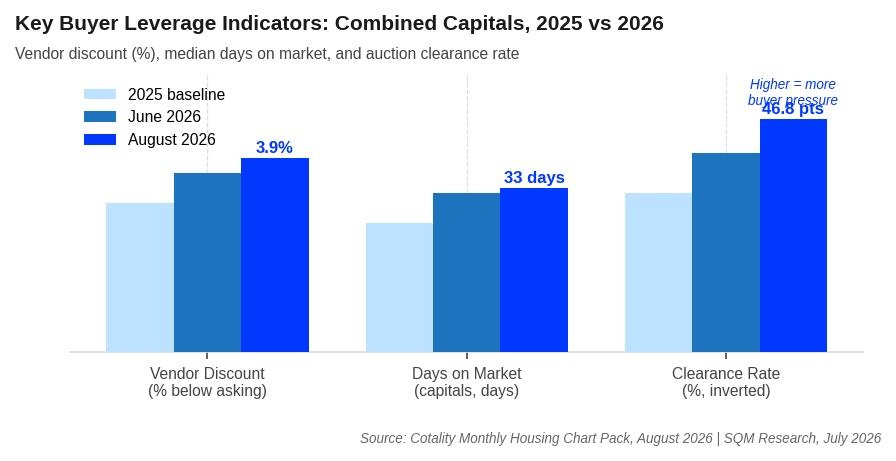
Source: Cotality Monthly Housing Chart Pack, August 2026 | SQM Research, July 2026
Why rising stock changes the negotiating equation
When listings accumulate faster than buyers absorb them, the balance of power shifts. A buyer who sees 12 comparable properties on the market has a fundamentally different negotiating position than one who sees 3. They can take longer, compare more, and make an offer without the emotional pressure of missing out.
As Cotality research director Tim Lawless noted, 'higher advertised stock levels are simply a factor of a slower rate of absorption.' That absorption slowdown, combined with longer days on market, gives buyers not just negotiating power but time to perform proper due diligence before committing.
Australia is not one property market
The national figure masks very different conditions at the city and suburb level. Sydney's vendor discount reached 4.2% in August 2026, with total listings up 14.3% year-on-year. Brisbane's discount widened to 3.7%, with listings up 39.5% and selling times rising from 19 to 28 days. Perth's vendor discount widened to 4.0%, even as its vacancy rate remained tight at 0.6%.
Not every city or suburb is equally negotiable. In some supply-constrained markets and price brackets, competition still exists. Canberra's clearance rate of 60% in August sits closer to balance than Sydney's 55.6%. The leverage available to an investor depends on the specific market they are operating in, not the national headline.
What Is Giving Property Buyers More Bargaining Power?
Four market forces are driving the current shift in negotiating conditions. Understanding each one helps investors identify where genuine leverage exists rather than assuming it applies uniformly across every property.
Longer selling periods signal motivated vendors
A property that has been on the market for 60 days has a different vendor dynamic than one listed last week. The longer a property sits unsold, the more likely the vendor is to revise their price expectations downward. In August 2026, the national median selling time is 35 days. Any property sitting materially above that figure is a candidate for more active negotiation.
Wider vendor discounting shows sellers are adjusting
Vendor discounting measures the gap between the initial asking price and the final sale price. A 3.9% median discount across the combined capitals means sellers are, on average, accepting offers 3.9% below their first listed price. That figure has risen steadily from 3.0% in March.
In Melbourne, 35% of all listed properties had been discounted from their original asking price as at June 2026, up sharply from 19% just one month earlier. That is a dramatic change in vendor behaviour over a short period.
Clearance rates below 55% mean buyers are not competing hard
When fewer than 55% of properties sell under the hammer, vendors cannot rely on auction competition to drive the price up. Properties that pass in at auction or are withdrawn before auction become negotiable assets where a private buyer can make an offer without bidding pressure.
The Real Estate Buyers Agents Association of Australia noted that 'for buyers who can read the market accurately, this is the most favourable environment we've seen in a long time.' That assessment reflects conditions across most major markets, not just individual suburbs.
Where Are Investors Most Likely to Have Negotiating Leverage?

Properties with extended market presence
Any property sitting on the market for more than 45-50 days in the current environment has likely already attracted and lost potential buyers. The vendor has typically had at least one price discussion. That history gives a new buyer a starting point that is already below the original ask.
Checking listing history through platforms that track price reductions and relisting activity gives investors a clear picture of vendor motivation before making contact. A property listed at $890,000 that started at $940,000 has already had two price reductions. The vendor is moving.
Markets with high listing growth and soft demand
Brisbane's total listings rose 39.5% year-on-year in August 2026. Sydney's rose 14.3%. In markets where listing stock has grown faster than buyer demand, the negotiating environment is structurally weaker for vendors. This is particularly the case in higher-priced segments, where Cotality data shows the upper-quartile falling 3.2% over the past three months compared to 0.3% growth at the lower end.
Property types with fewer competing buyers
Units and apartments in investor-heavy precincts face the thinnest buyer competition when investor sentiment weakens. Owner-occupiers are less likely to consider these properties, meaning vendors selling to an investment-only market face a smaller pool of offers. That thin pool translates to meaningful negotiating room for the buyer who has done the due diligence.
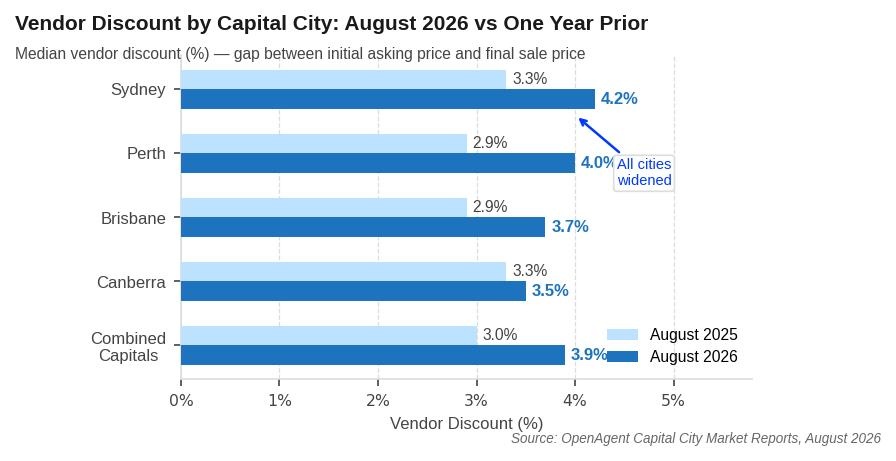
Source: OpenAgent Capital City Market Reports, August 2026
Does a Lower Purchase Price Automatically Make a Better Investment?
This is the question most buyers’ market articles skip. The answer matters because the investment arithmetic is more complicated than a discounted entry price.
Cheap and good value are not the same thing
A property discounted from $800,000 to $750,000 looks better on paper. But if the rental income supporting that property has also fallen, or the vacancy rate in the suburb has risen from 1.5% to 3.5%, or the comparable sales trajectory suggests further softening, the $50,000 saving may not compensate for the income and capital risk.
A discounted price improves yield only if the rental income has not declined proportionally. If rents in the suburb have softened alongside sale prices, the yield calculation may be similar to what it was at the higher price. The entry cost is lower, but so is the return.
Rental demand does not change because the purchase price fell
The fundamentals that drive a property's long-term performance operate independently of what the investor paid for it. Vacancy rate, employment base, population trends, infrastructure investment, and competing supply are not affected by the negotiated sale price. An investor who negotiates $40,000 off a property in a suburb with rising vacancy has saved $40,000 on day one and accepted ongoing income risk every year thereafter.
The rental crisis in Australia continues to vary significantly between markets. Suburbs with vacancy below 2% in markets like Brisbane (0.9%) and Perth (0.6%) carry very different income risk than suburbs where vacancy is rising toward 4%.
How Investors Can Use Their Bargaining Power
Research comparable sales before making an offer
The foundation of any successful negotiation is knowing what comparable properties have sold for, not what they are listed at. Recent comparable sales within 1km of the property, for similar land size, dwelling type, and condition, give an investor a defensible number to anchor their offer.
In a softening market, comparable sales from 6-12 months ago may overstate current value. Using only the most recent 3-month sales data gives a more accurate read on where the market is now.
Understand the vendor's position before negotiating
Vendor motivation matters as much as market conditions. A vendor who bought in 2015 and is selling for lifestyle reasons has different price flexibility than one who paid peak 2021 prices and is carrying a mortgage above current market value. Settlement history, listing timeline, and whether the property has had previous price reductions all provide insight into how much flexibility is available.
Negotiate terms, not just price
Purchase price is only one negotiable variable. Settlement timing, inclusions, subject to building and pest inspection conditions, and requests for specific repairs can all form part of a negotiated outcome. A vendor unwilling to move on price may accept an extended settlement, which gives the investor more time to arrange finance or dispose of an existing asset.
Know when to walk away. In a market with 278,000+ listings nationally, there is no single irreplaceable property. An investor who anchors emotionally to one property loses the leverage that the current market provides.
What Investors Should Check Before Making an Offer
Rental demand, vacancy, and competing supply
Confirm the suburb-level vacancy rate through SQM Research or REIA state data. A vacancy rate below 2% signals genuine tenant competition. Above 3%, the investor is entering a market where rents are under pressure. Check whether new residential supply is entering the suburb within the next 12-24 months, which would further dilute rental demand.
Borrowing capacity at current and higher rates
With investor variable rates running near 6.65% and lenders assessing serviceability at 9.65%, investors need to model cash flow not just at today's rate but at a higher scenario. Understanding your borrowing capacity before entering negotiation prevents the risk of agreeing a price the finance cannot support.
Stress-test the holding cost at 8.5%, allow 4 weeks of vacancy per year, and confirm the monthly shortfall is manageable for 12 months without financial strain. The borrowing capacity formula explains exactly how lenders assess these scenarios.
Property condition and future capital costs
A discount that covers the cost of deferred maintenance is not a discount. Older properties can carry hidden costs in roofing, plumbing, electrical, and structural items that a building inspection will identify. The inspection report should inform the negotiating position, not just confirm safety.
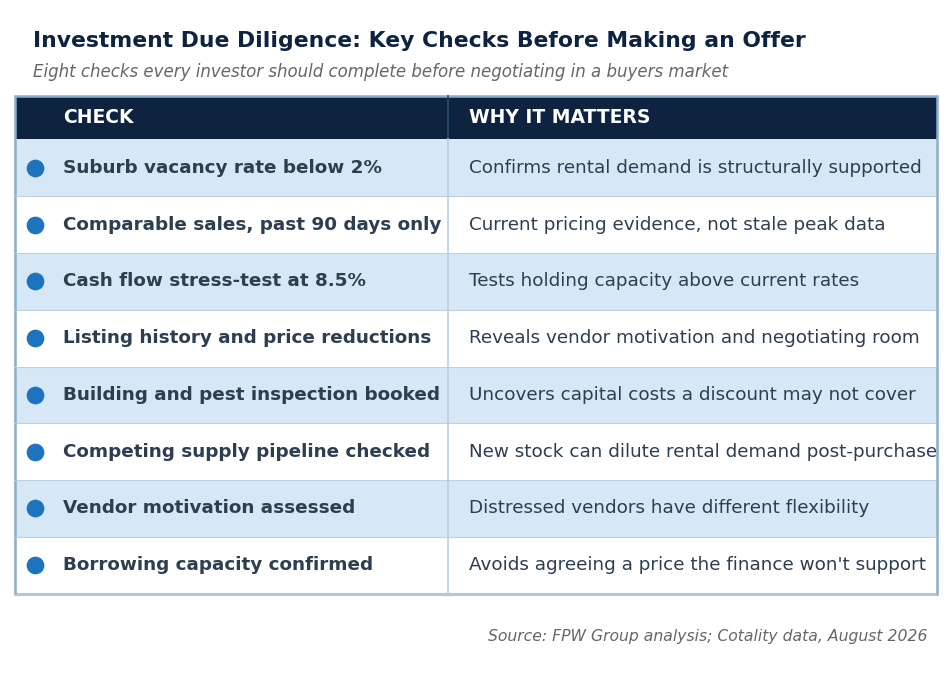
Source: FPW Group analysis; Cotality data, August 2026.
Does a Buyers’ Market Mean Investors Should Buy Now?
Not automatically. The current market conditions create opportunity for investors who have strong fundamentals in place, but they do not make every property a good investment or every investor ready to act.
When greater bargaining power creates a real opportunity
An investor with confirmed borrowing capacity, cash flow that holds under a stress scenario, and a clear picture of rental demand in the target suburb is well-positioned to use the current market. Longer selling times and wider vendor discounting mean they can take the time to find the right property at a negotiated price, rather than compromising on quality under competitive pressure.
When a discount is not enough
If the property's rental fundamentals are deteriorating alongside the price, the discount may be the market correctly reflecting reduced value rather than a pricing inefficiency to exploit. A suburb with rising vacancy, declining rents, and increasing stock is likely to continue softening. A lower entry price in that environment defers the problem rather than eliminating it.
When investors should wait or walk away
If borrowing capacity is already stretched at current rates, if the property's cash flow only works under optimistic assumptions, or if the suburb's employment and population fundamentals are weakening, waiting or walking away is the right decision. The current market has enough properties available that holding out for one that genuinely works is a realistic option, not a missed opportunity.

The Bottom Line: Investors Finally Have More Leverage
The property market in Australia has shifted more decisively in favour of buyers in 2026 than at any point in the past four years. Vendor discounting at 3.9%, national selling times at 35 days, auction clearance rates at 53.2%, and listings up more than 12% in a single month are not minor fluctuations. They describe a structural change in buyer and seller power.
But leverage over a seller and a good investment are still different things. A softer market gives disciplined investors something they have had less of: more choice, more time, and more negotiating room. It does not change the fundamentals that determine whether a property performs. Rental demand, vacancy, cash flow, and location still drive long-term returns regardless of the entry price.
The opportunity in the current property market in Australia is not simply to buy because prices have fallen. It is to use better negotiating conditions to buy the right property at a price that makes the numbers work.
Frequently Asked Questions
Recommended Reading
Two pages selected based on what readers of this article are most likely to need next.
Recommended Video
Australia's record migration surge — peaking at over 528,000 people in a single year — created unprecedented housing demand almost overnight. We explain why the government used population growth as a deliberate tool to avoid recession, how that decision flows directly into property prices Australia-wide, and why rents have surged to record highs as a result.