

Why Borrowing Capacity Drops When Interest Rates Rise
Your salary did not change. Your spending did not blow out. Yet the bank now says you can borrow less than you could a year ago. When interest rates rise in Australia, this happens to thousands of buyers, and most never see the reason coming.
The cause is not your finances. It is the way lenders test them. Banks do not assess your loan at the rate you pay. They add a safety margin on top, then check whether you could still cope. As rates climb, that test gets harder, and your borrowing capacity quietly shrinks.
This article explains the mechanism behind that drop, how a 3% buffer can erase well over a hundred thousand dollars in borrowing power, and what investors can do about it.
What Is an Interest Rate Buffer?
An interest rate buffer is a safety margin lender added to your loan rate before they test whether you can afford the repayments. If your home loan rate is around 6%, the bank assesses you as if you were paying closer to 9%.
The margin is not random. The Australian Prudential Regulation Authority, the regulator that oversees banks, expects lenders to assess new borrowers at at least 3 percentage points above the actual loan rate. That figure has sat at 3% since late 2021.
So, the rate on your contract is one number. The rate the bank uses to decide how much you can have is another, and it is always higher.
Why Do Banks Use Interest Rate Buffers?
The logic is simple. Rates move. A loan that feels comfortable at 6% can hurt at 8%, and lenders do not want borrowers defaulting the moment conditions shift.
The buffer is a shock absorber. It checks that you could still meet repayments if rates climbed well beyond today's level. The Reserve Bank lifted the cash rate to 4.35% by May 2026, after three increases that year, which is exactly the kind of move the buffer is designed to absorb.
There is a system wide reason too. When households borrow at the very edge of their capacity, a single rate cycle can turn into widespread stress. The buffer keeps default rates low, which is part of why Australian mortgage arrears stay relatively contained even after a run of hikes.
How the Interest Rate Buffer Lowers Your Borrowing Power
Borrowing power comes down to one question the bank keeps asking. Can your income comfortably cover the assessed repayment, on top of your living costs and existing debts? Raise the rate used in that calculation and the assessed repayment jumps. Your income has not moved, so the only thing that can give is the loan size.
This is why the borrowing capacity formula is so sensitive to rates. A small change in the assessment rate produces a large change in the loan you qualify for, because the repayment is compounded across a 30-year term.
How the 3% buffer changes borrowing capacity by income
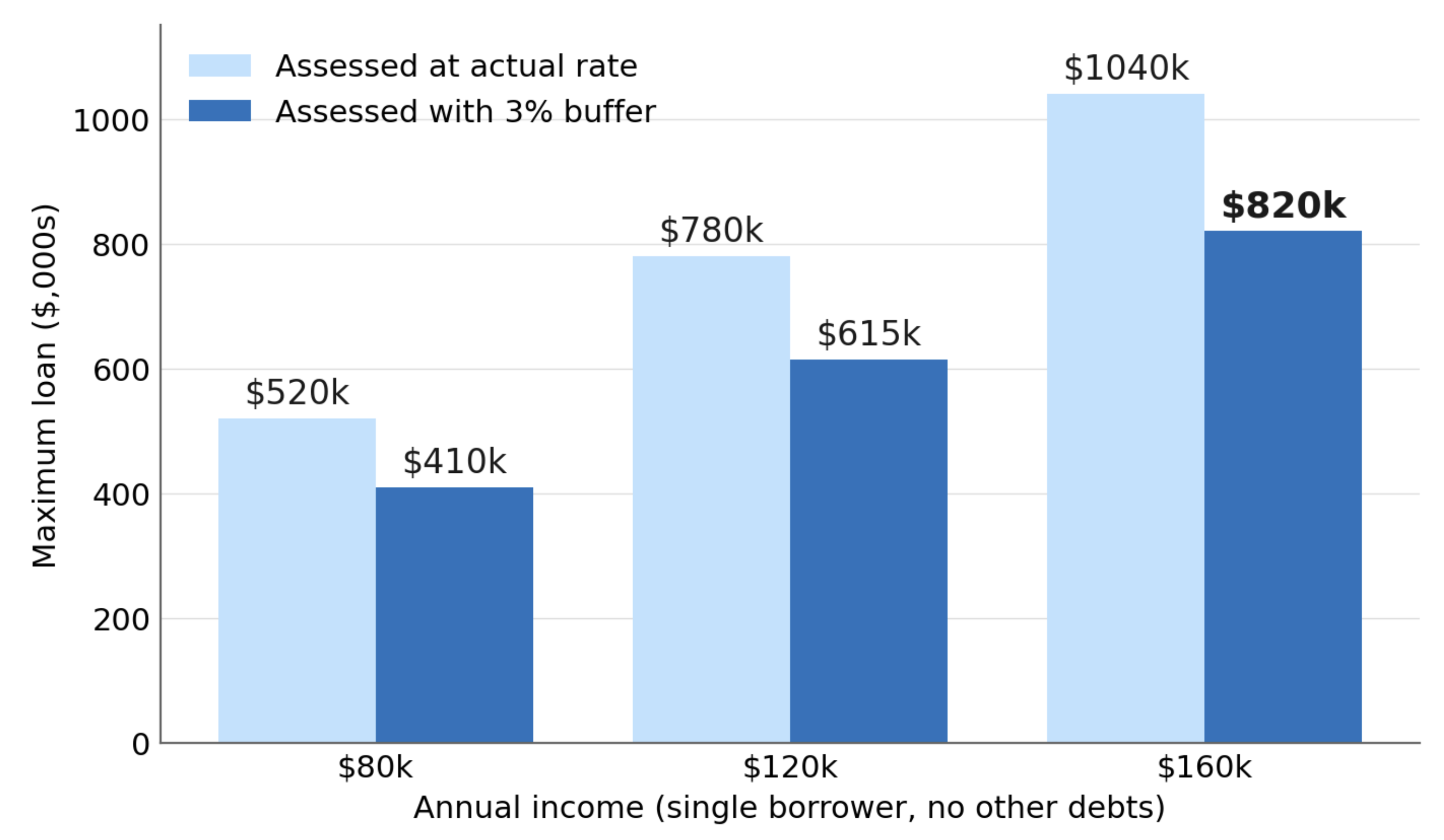
Source: FPW analysis based on APRA serviceability guidance, 2026
Worked Example: How a 3% Buffer Can Cost You Hundreds of Thousands
Take a couple with a combined income of around $150,000, no children, and modest living costs. Assessed at their actual rate, their maximum loan might sit near $860,000. The repayments look manageable and the numbers work.
Now apply the buffer. The bank assesses them at roughly 9% instead of 6%. The assessed repayment rises sharply, and their maximum loan falls to somewhere near $700,000. Same couple. Same income. A gap of around $160,000, created entirely by the test.
Borrowing power falls as the assessment rate climbs
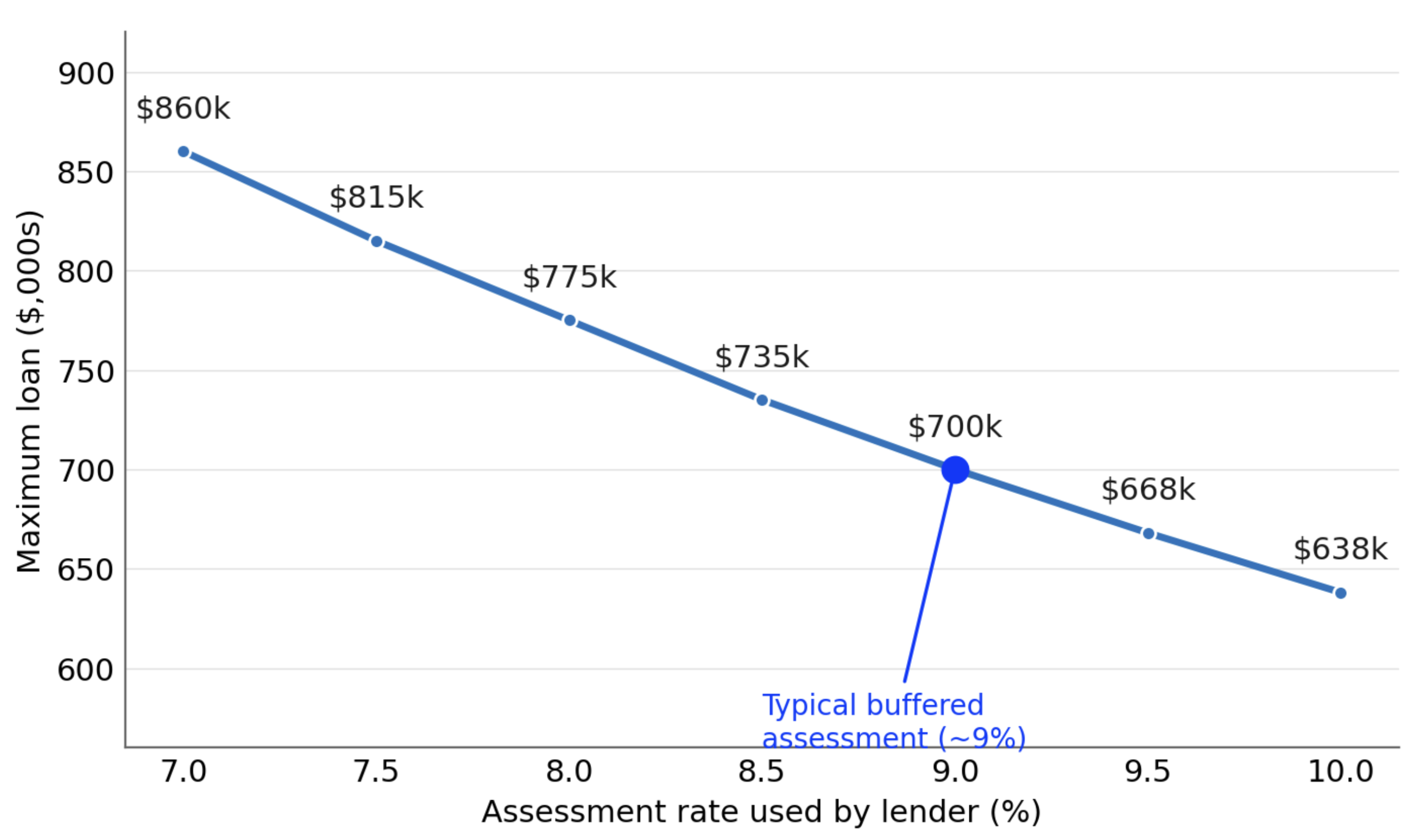
Source: FPW analysis, based on a standard 30 year serviceability assessment, 2026
Why Two Lenders Give You Different Borrowing Power Results
Two banks can look at the same borrower and arrive at very different numbers. The buffer is consistent, but everything it is applied to is not.
Lenders set their own floor rates above the APRA minimum. They treat overtime, bonuses, and rental income differently. Some count your full credit card limit as a liability even when the balance is zero. Others are more generous with certain expenses.
In practice, the spread between the most and least generous lender for the same borrower can run into hundreds of thousands of dollars. A knock back from one bank is not the end of the conversation.
Same borrower, three lenders, three different limits
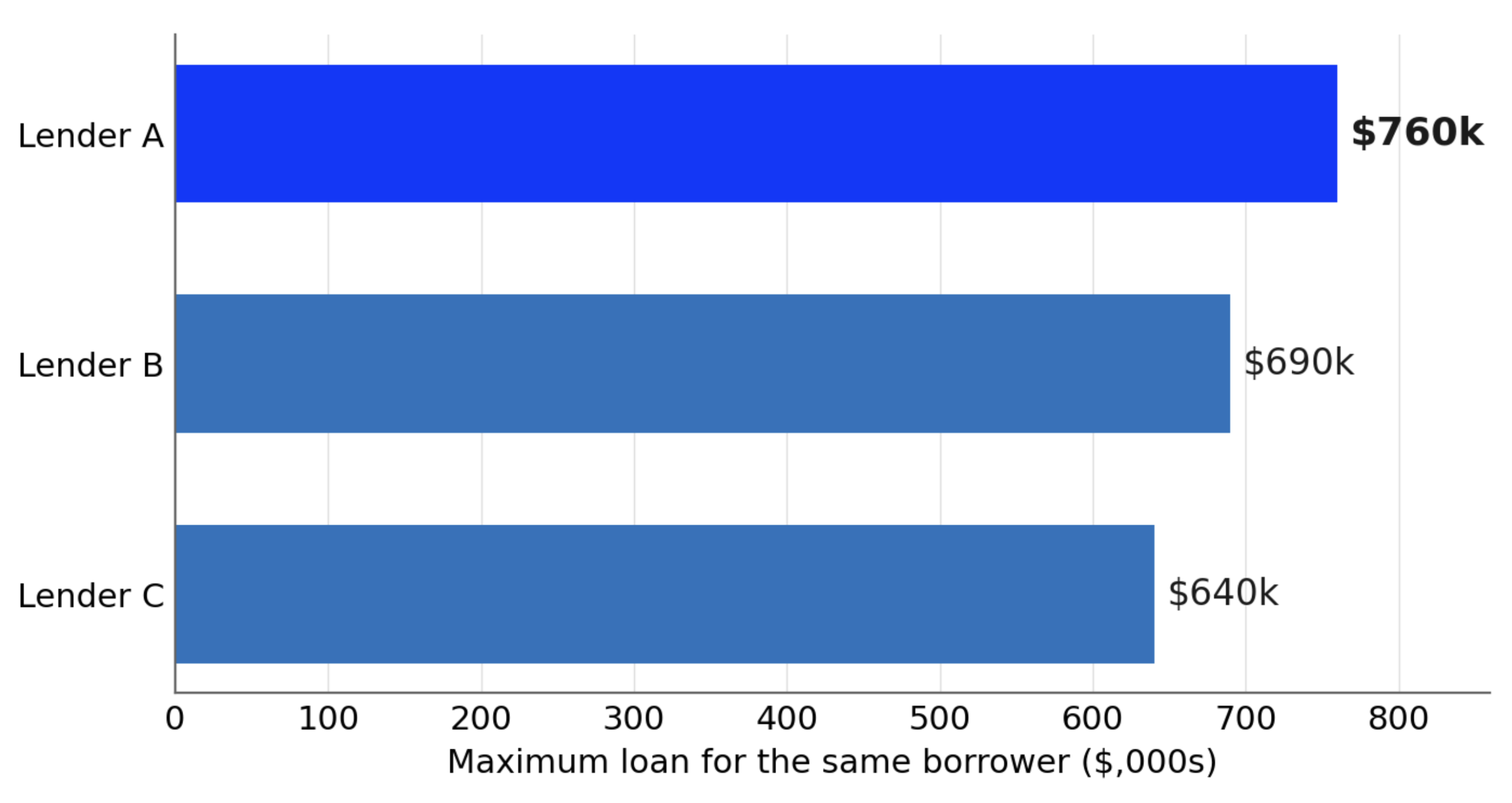
Source: FPW analysis, illustrative lender comparison, 2026
What Interest Rate Buffers Mean for Property Investors
Investors feel the buffer more than owner occupiers, and the regulator has said as much. Investors usually carry more debt and often hold existing loans, and the buffer is applied to all of it, not just the new purchase.
That has a compounding effect on a portfolio. Each property you already hold is stress tested at the higher rate, so your existing commitments consume more of your assessed income before the new loan is even considered. This is the wall many investors hit at their second or third purchase.
How to Improve Your Borrowing Power Despite the Buffer
You cannot remove the buffer, but you can improve almost everything it tests. The work to increase borrowing capacity starts with the inputs, not the rule.
Reduce your actual interest rate where possible, since a lower rate plus the 3% margin produces a lower assessment rate.
Close or lower unused credit card limits, because banks count the full limit as a liability.
Clear small personal and car loans to free up assessed income.
Match your application to a lender whose policies suit your income type.
None of these moves is dramatic on its own. Together, they can shift your limit by a meaningful margin.
Other Factors That Affect Your Borrowing Capacity
The buffer is the headline, but it is not the only thing shaping your limit. Banks also weigh your debt to income ratio, which compares your total borrowing to your income. From 2026, APRA also caps how much banks can lend at very high debt to income ratios, which adds another ceiling on top of the buffer.
Existing loans, credit card limits, and everyday living expenses all reduce the income available to service a new loan. If you want to see where you stand, a debt to income calculator is a quick way to estimate your ratio before you apply.
What chips away at your borrowing power
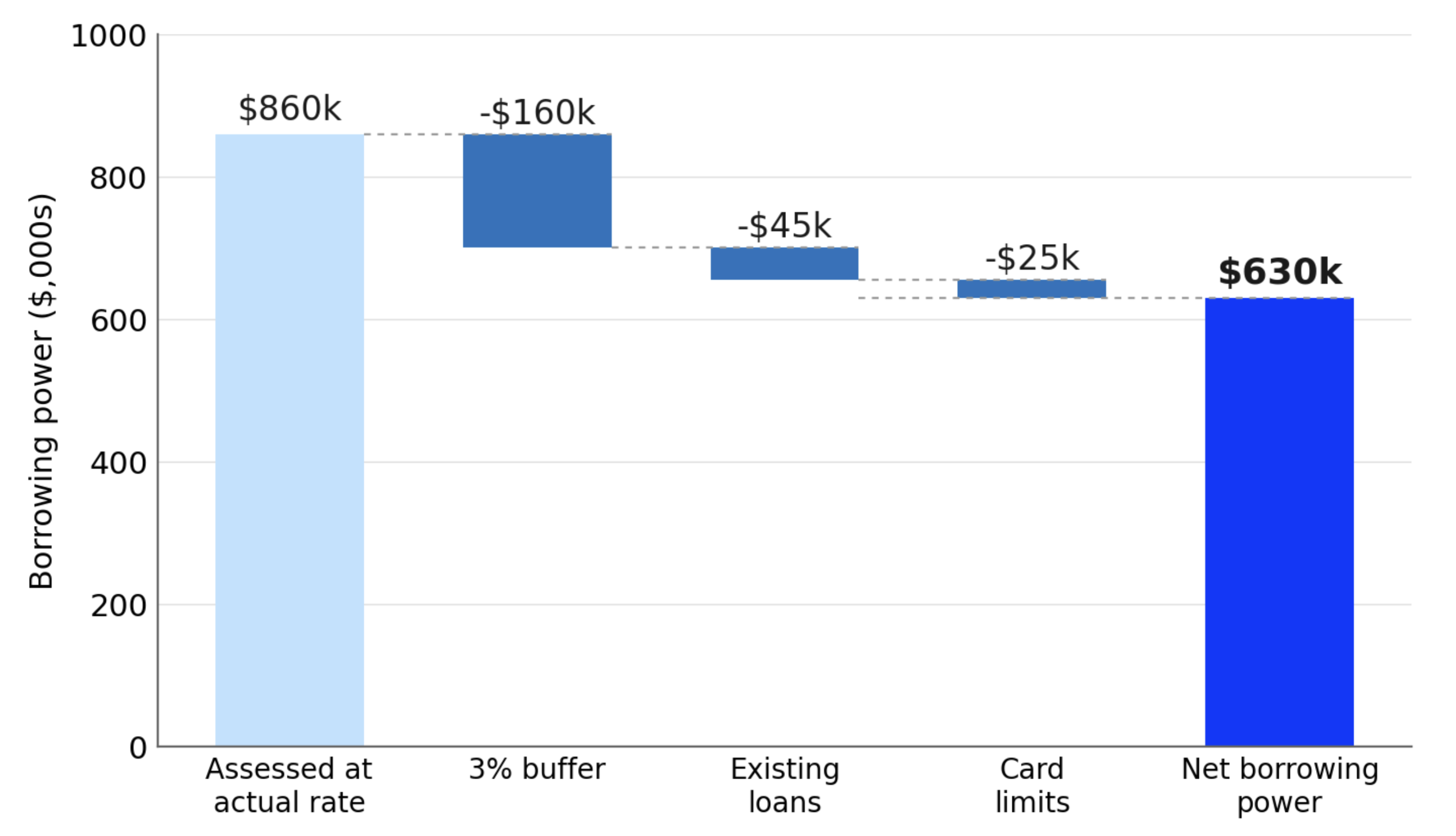
Source: FPW analysis based on APRA serviceability guidance, 2026
Should You Trust an Online Borrowing Power Calculator?
Online calculators are useful for a rough sense of scale, and tools like the MoneySmart mortgage calculator are a sensible starting point. They are not a substitute for a real assessment.
Most calculators use generic assumptions. They rarely reflect a specific lender's assessment rate, how that lender treats your income, or how your existing debts are counted. The number you get is an estimate, not an approval.
Treat a calculator as a first look, then confirm with a broker who can run your profile against actual lender policies.
Final Thoughts
When interest rates rise in Australia, borrowing power falls for reasons that have little to do with you. The interest rate buffer tests your loan at a rate well above the one you pay, and a 3% margin can quietly remove a large slice of what you could otherwise borrow.
The buffer is not going away. APRA has signaled it is now a settled feature of the lending system. What you can change is everything it tests, from your actual rate to your debts to the lender you choose.
For investors, understanding the buffer is the difference between feeling stuck at one property and building a portfolio that keeps growing. The numbers are not fixed. They respond to how well your finances are structured around the test.
Frequently Asked Questions
Recommended Reading
Two pages selected based on what readers of this article are most likely to need next.
Recommended Video
As rates rise, many people immediately assume it is no longer a good time to invest. But in reality, the opportunity has not disappeared—it has simply shifted. This episode explains why higher interest rates do not automatically remove your ability to invest, but they do change your borrowing power, your cash flow, and the price point that makes sense for you.