

Top 5 Costly Mistakes to Avoid When Choosing Australian Suburbs for Property Investment
Most property investment losses are not caused by a bad property. They are caused by a bad suburb. The roof, the kitchen, and the floorplan can all be fixed after settlement. The suburb cannot.
Investors searching for Australian suburbs worth buying into are rarely after a directory of names. They want to know how to avoid an expensive location mistake. This guide walks through the five mistakes that cost investors the most, and what professionals check instead. For the full framework, see our guide on how to choose investment grade suburbs in Australia.
Why Suburb Selection Matters More Than the Property Itself
Two identical properties in two different suburbs can produce wildly different outcomes over a decade. The bricks and the floorplan are largely fixed costs. The location is the variable that compounds, for better or worse, every single year you hold the asset.
Capital growth is a location story before it is a property story. A renovated kitchen might add a small premium at resale. A suburb with constrained supply and rising demand adds value every year, automatically, without you lifting a finger. Much of that constrained supply ties directly back to the broader housing shortage across Australia, which continues to underpin demand in well-located suburbs nationwide.
Investment-Grade vs Non-Investment-Grade: A 10-Year Comparison
How Buying Your First Home Builds Wealth
Every mortgage repayment on your own home has two components: interest and principal. The principal repayments reduce your debt and increase your equity. Over 25 to 30 years, that equity accumulates into a significant asset that you own outright.
Capital growth adds to that. If you buy a home in a well-chosen location, the property value typically grows at 5% to 8% annually over the long run. Combined with principal repayments, that creates a compounding wealth effect.
Government Incentives That Favour Home Buyers
First home buyers in Australia can access a range of government incentives that are not available to investors. The First Home Owner Grant (FHOG), stamp duty concessions, and schemes like the First Home Guarantee can collectively reduce the upfront cost of buying your first home by tens of thousands of dollars.
These incentives exist specifically to help owner-occupiers enter the market. Using them well is part of a smart wealth strategy. Ignoring them because you are focused on investment returns is often a mathematical mistake.
First Home Owner Grant and Stamp Duty Concessions by State (2025)
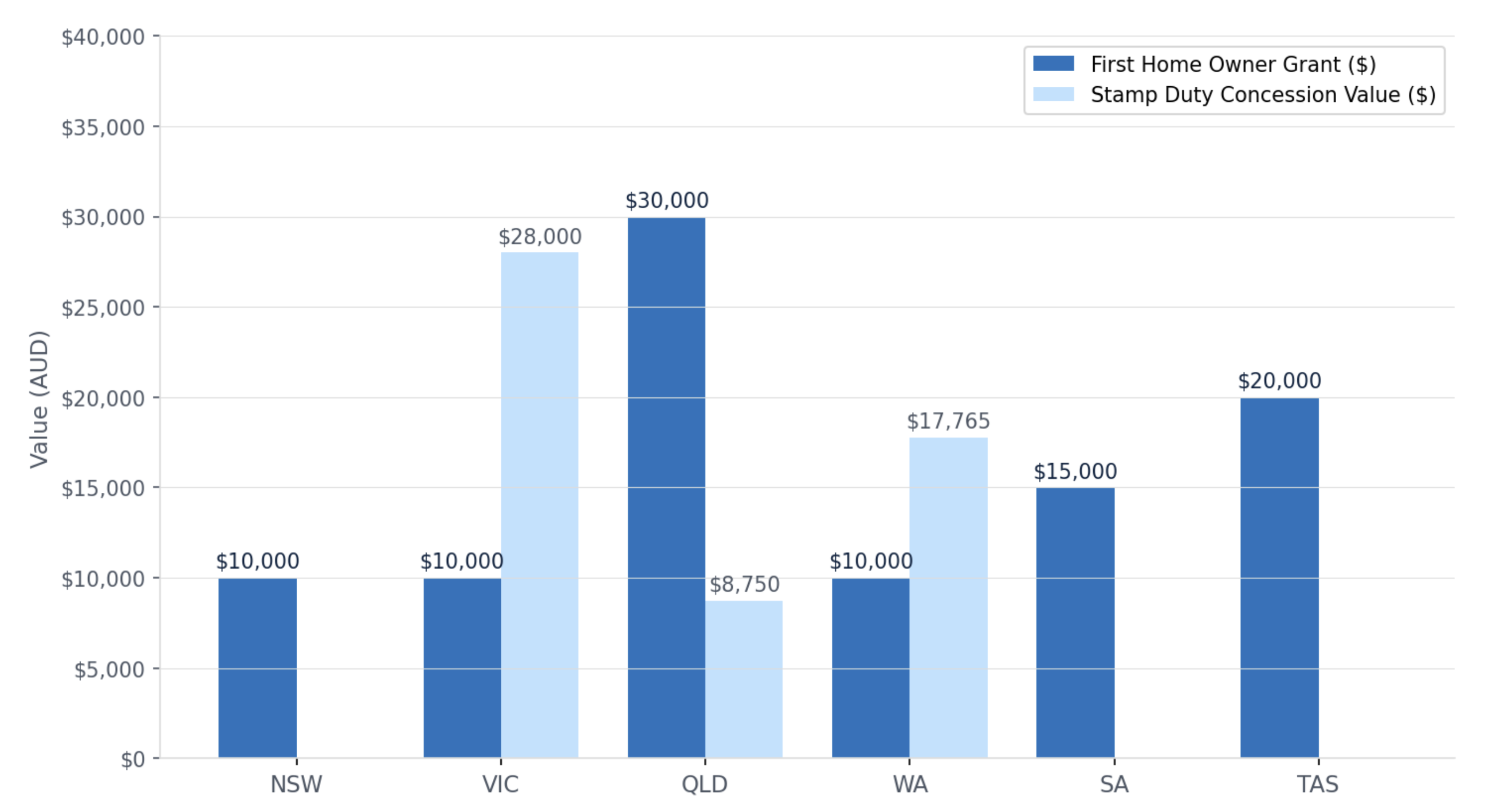
Source: Australian Government, First Home Owner Grant Schemes & State Revenue Offices, 2025
Drawbacks of Buying Your Home First
A home is not a pure investment. You tend to buy it based on lifestyle preferences: school zones, commute times, proximity to friends and family. These factors do not always align with strong investment fundamentals like rental demand, capital growth drivers, or vacancy rates.
The result is often a property that builds equity slowly and delivers below-average capital growth compared with purpose-selected investment properties. You pay a lifestyle premium and accept a lower financial return.
How Buying an Investment Property First Builds Wealth
Buying an investment property before your home allows you to choose the asset purely on financial merit: rental yield, capital growth potential, vacancy rates, and suburb fundamentals. You are not constrained by school zones or commuting distance.
You also retain access to negative gearing benefits if the property runs at a loss, and the 50% capital gains tax discount on properties held for more than 12 months. These tax advantages do not apply to your principal place of residence.
The Leverage and Equity Advantage
Investment properties allow you to leverage a relatively small deposit into a larger asset. As the property grows in value, you can use that equity to finance a second purchase without selling. This compounding strategy is how most serious property portfolios are built.
Understanding your borrowing capacity before you start is essential. Lenders assess investment loans and owner-occupier loans differently, and your strategy should account for how your borrowing capacity changes over time under each approach.
Equity Growth: Home vs Investment Property Over 10 Years
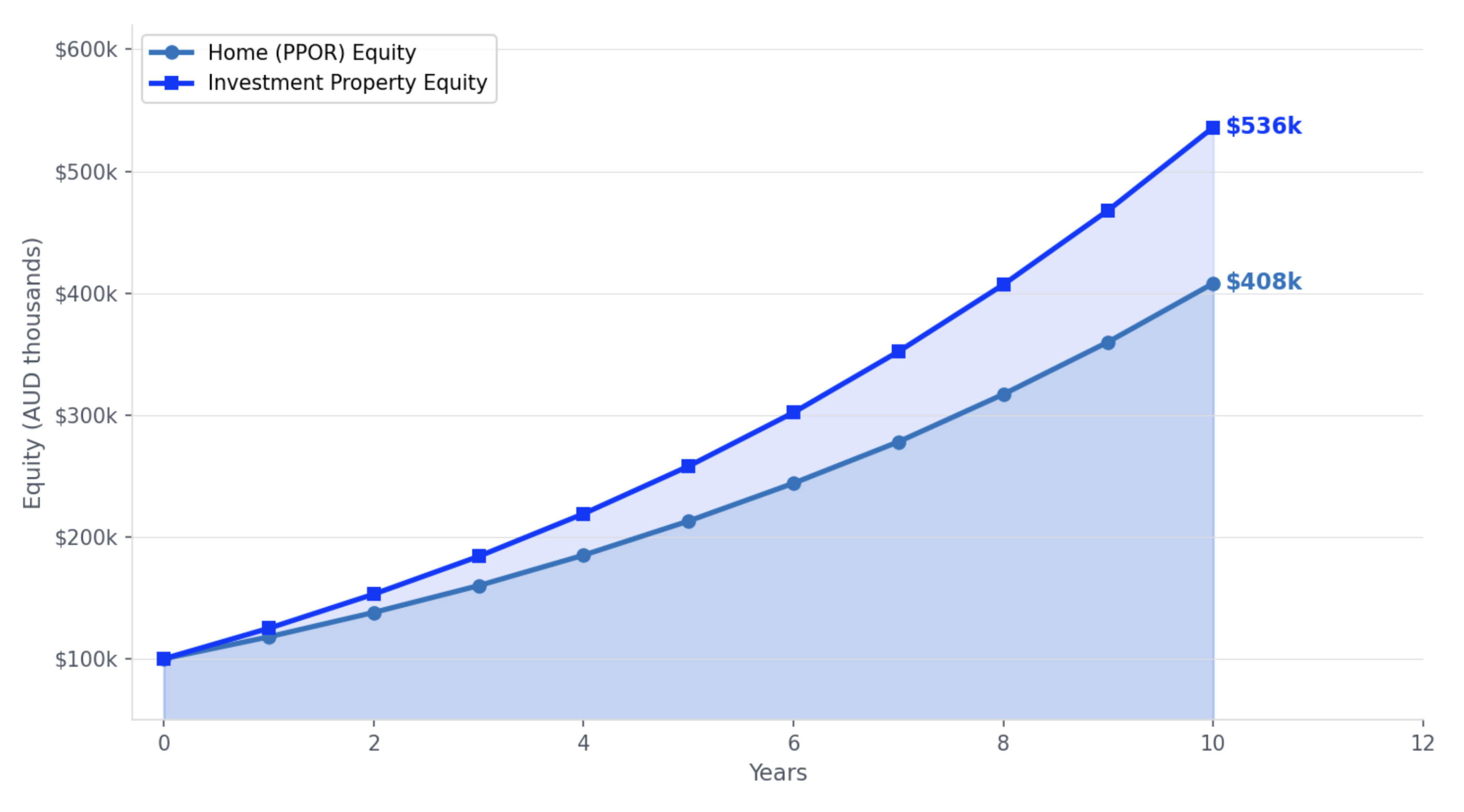
Source: CoreLogic, Home Value Index and Long-Run Capital Growth Data, 2025
Drawbacks of Buying an Investment Property First
Buying an investment property before your home means you continue renting where you live. That is not inherently a problem, but it does mean your living costs are not building equity for you in the same direct way that a home mortgage would.
You also carry landlord responsibilities: managing tenants, dealing with vacancies, covering maintenance and repairs. These are manageable with good property management, but they add complexity that first-time buyers sometimes underestimate.
FOR EXAMPLE
Two buyers. Same $120,000 deposit. Buyer A purchases a $650,000 home in a suburb they love. Buyer B purchases a $600,000 investment property in a high-demand rental suburb and continues renting a $2,000 per month apartment. After 10 years, Buyer B's investment has grown at 7.5% annually and generated $24,000 in rental income per year. Buyer A's home grew at 5.8% annually with no rental income. The difference in net wealth at the 10-year mark is approximately $128,000 in Buyer B's favour.
First Home Buyer Grants and What Happens If You Invest First
This is where the strategy choice gets complicated. In most Australian states, the First Home Owner Grant requires you to live in the property as your principal place of residence for at least 12 months after purchase. If you buy an investment property first, you typically forfeit your eligibility for the grant on that purchase.
Some states allow you to claim the grant on a subsequent purchase if you have never owned and lived in a property as your principal place of residence. But the rules are state-specific and change regularly. The safest approach is to confirm your eligibility directly with the relevant state revenue office before committing to a strategy.
Key Eligibility Rules to Know Before You Decide
The First Home Guarantee (previously First Home Loan Deposit Scheme) allows eligible first home buyers to purchase with a 5% deposit without paying Lenders Mortgage Insurance. This scheme is reserved for owner-occupiers, not investors.
The stamp duty concessions available in most states are also typically restricted to buyers who will occupy the property. If you buy as an investor first, you pay full stamp duty. That can be a cost of $20,000 to $40,000 depending on the purchase price and state, which changes your entry-cost comparison significantly. The 2026 budget changes introduced some adjustments to thresholds worth checking before you buy.
Rentvesting: Is It the Best of Both Worlds?
Rentvesting means renting where you want to live and buying an investment property in a suburb where the numbers make financial sense. It is the middle path between buying a home first and investing in isolation.
Rentvesting has grown significantly in popularity among younger buyers who want to live in expensive inner-city areas but cannot afford to buy there. Rather than compromise their lifestyle or overextend their borrowing, they rent at their preferred location and build wealth through a lower-priced investment property in a high-growth or high-yield suburb.
Rentvesting Cash Flow Profile Over 10 Years
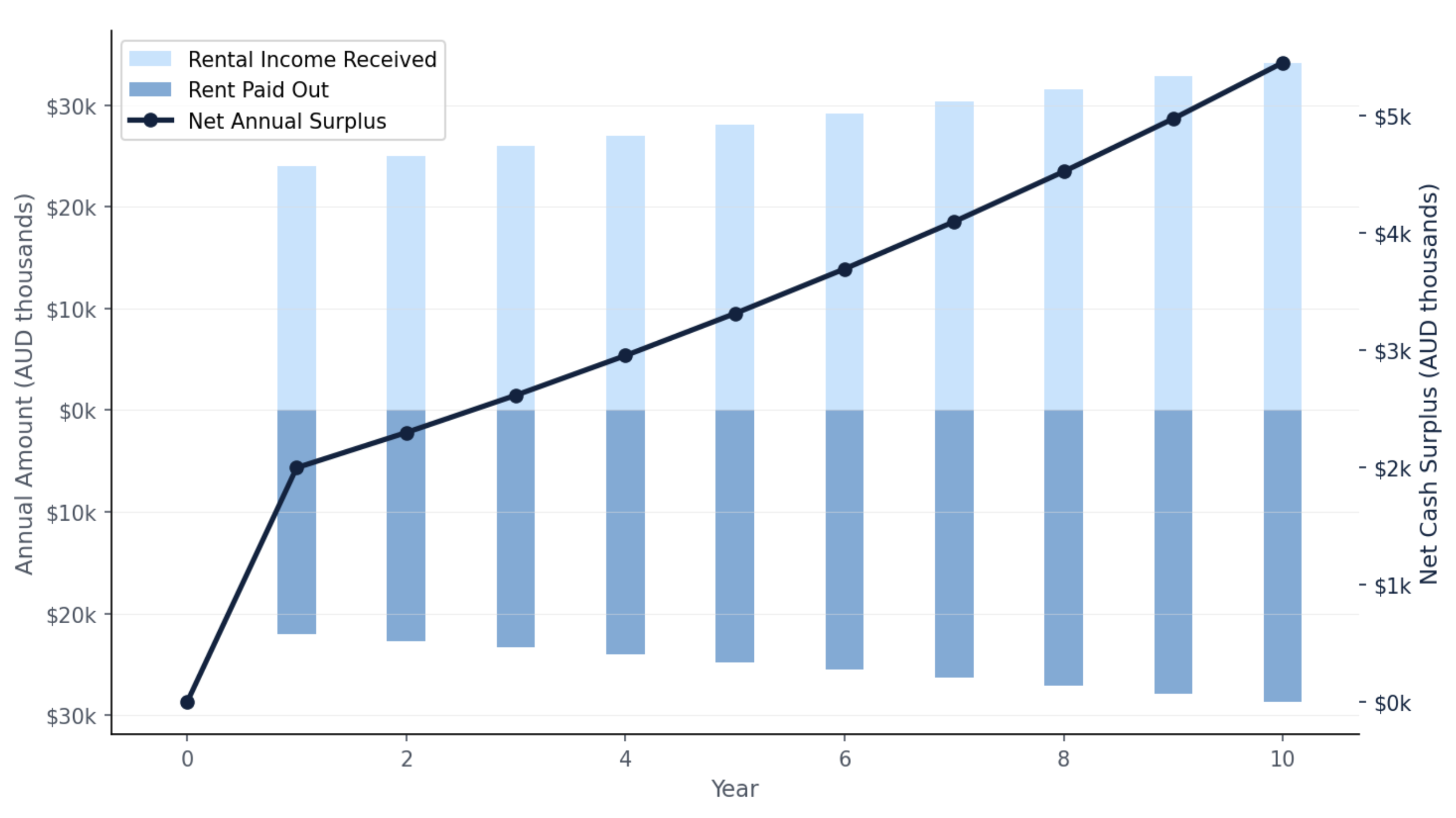
Source: REIA, Real Estate Market Facts and Rental Data, Q1 2025
Who Rentvesting Suits and Who It Doesn't
Rentvesting works best for buyers who genuinely want to live in an area where buying is unaffordable or financially inefficient, who are disciplined about treating their investment property as a financial asset rather than an emotional one, and who are comfortable with the ongoing responsibilities of being a landlord.
It is less suitable for buyers who need the security of owning their home, who have family commitments that require stability in a specific area, or who are likely to need access to home equity quickly. Rentvesting also does not eliminate the stress of renting: leases can end, landlords can sell and rent increases can disrupt your cash flow.
Which Strategy Builds More Wealth Over 20 Years?
The honest answer is: it depends. But the data consistently shows that buyers who purchase with an investment mindset from the start, whether by buying an investment property first or rentvesting, tend to build more financial wealth than those who prioritise lifestyle when selecting their first purchase.
Net Wealth Comparison: Three Strategies Over 20 Years
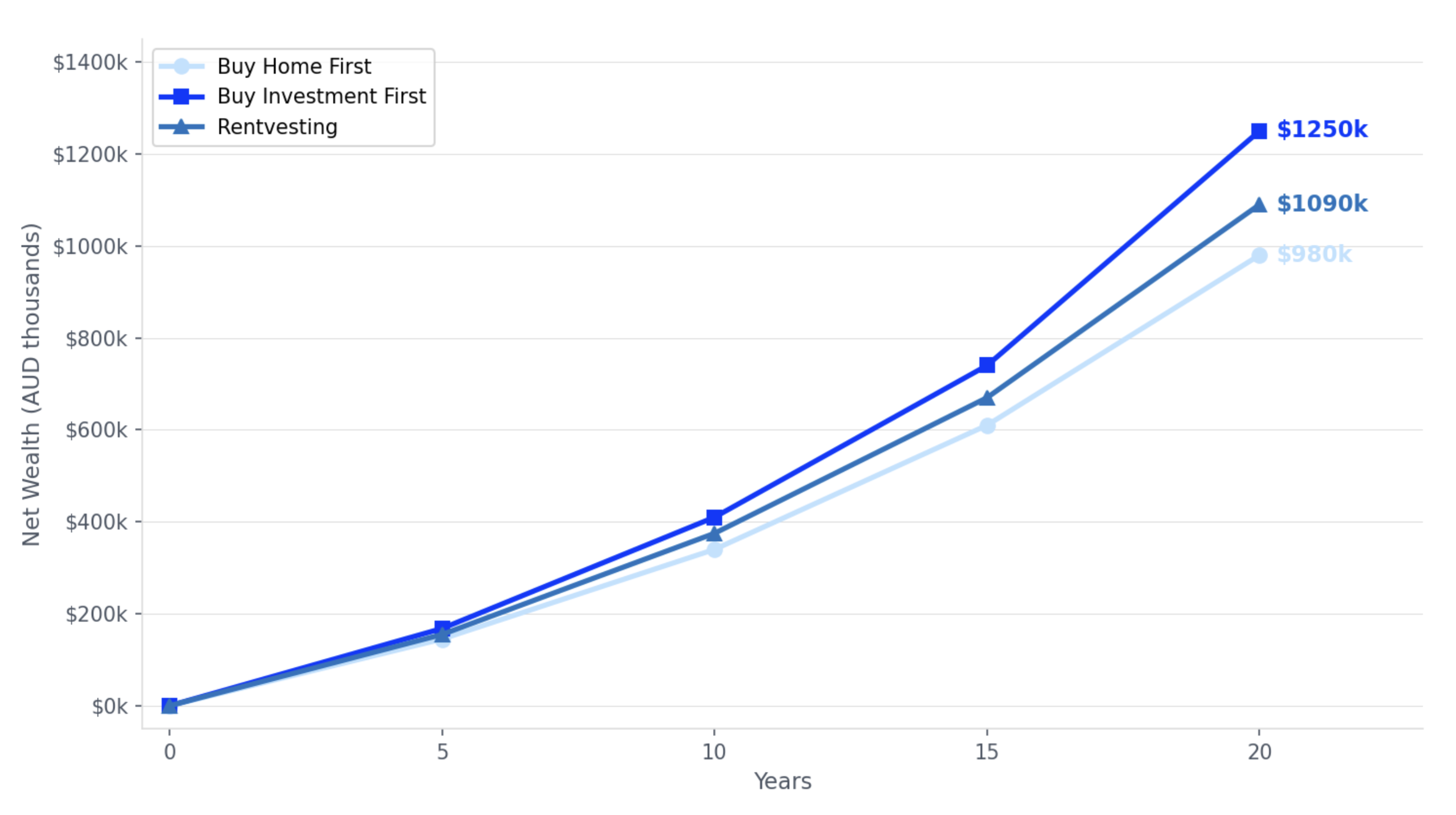
Source: PropTrack, Property Market Outlook and Long-Run Return Modelling, 2025
20-Year Comparison: Home First vs Invest First vs Rentvest
The comparison above uses indicative assumptions. Your actual outcome depends on the specific properties you buy, the locations you choose, how you manage cash flow, and how interest rates move over the holding period. The purpose of the comparison is to illustrate the structural financial differences, not to provide a precise prediction.
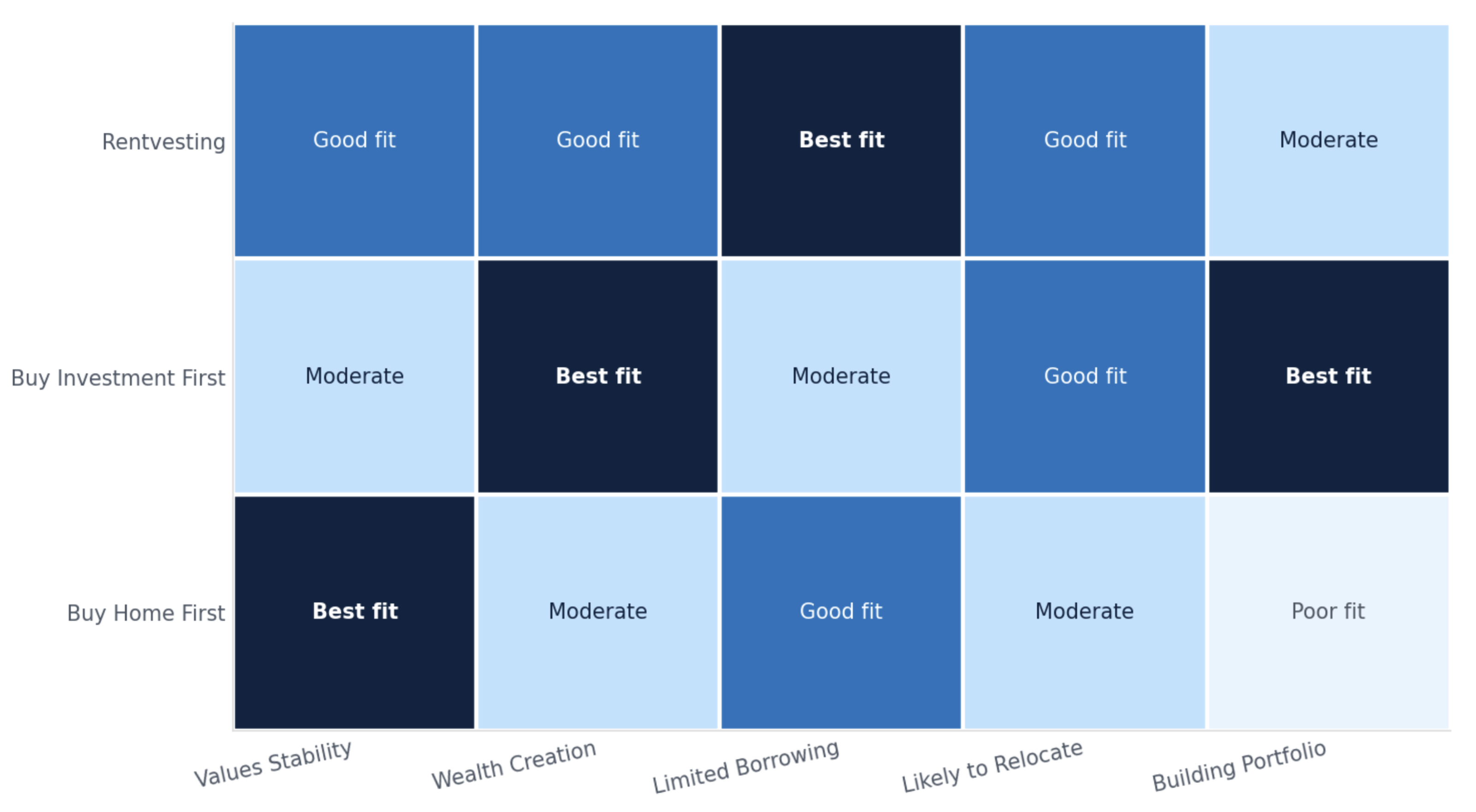
Which Strategy Suits Which Type of Buyer?
Strategy Fit by Buyer Profile
Source: ABS, Lending Indicators: Owner Occupier vs Investor Lending Data, 2025
The matrix above is a guide, not a rule. Most buyers sit across multiple profiles. A buyer who values stability but also wants to build a portfolio eventually needs to think about when the transition from home-buying to investment buying will happen, and how they will use the equity in their home to fund the next purchase.
Common Mistakes First Home Buyers Make When Choosing a Strategy
The most common mistake is making the first purchase emotionally and calling it a strategy. Buying a property you love in an area you want to live in is a legitimate lifestyle decision. Calling it a wealth-building strategy when the fundamentals do not support that claim is not.
Ignoring borrowing capacity implications is the second biggest error. Many first home buyers choose a strategy without understanding how it affects their ability to borrow for a second property later. A large home loan in an expensive suburb can cap your borrowing capacity for years.
Overestimating tax benefits is also common. Negative gearing reduces your tax bill, but it does not make a bad property good. A property generating poor capital growth with high vacancy risk is still a bad investment, even after tax.
Finally, many first home buyers do not think beyond their first purchase at all. The real reason most investors get stuck at one property is often a first purchase that was not structured to enable a second one.
First Home Buyer Investment Property Tips for Australian Buyers
Get your finance sorted before you start inspecting. Know your borrowing capacity under each strategy before you fall in love with a suburb or a property. The numbers will tell you which door is open.
Understand the grant rules in your state before you choose. In Queensland, the $30,000 First Home Owner Grant for new builds is material. In Victoria, the stamp duty concession can be worth more than $28,000. These numbers belong in your strategy comparison, not as an afterthought.
Buy based on the strategy, not the property. Identify your strategy first. Then find properties that fit it. Doing it in reverse is how lifestyle purchases masquerade as investment decisions.
Focus on quality locations with real demand drivers: population growth, employment diversity, transport infrastructure, and low vacancy rates. These fundamentals hold up across market cycles in ways that trendy suburbs often do not.
Plan the second purchase before you make the first. Think about how the equity you build in your first property will fund the deposit on the second. If the first purchase leaves you with no borrowing headroom for five years, it may have been the wrong starting point.
FOR EXAMPLE
A first home buyer in Queensland buys a $550,000 investment property in a high-growth suburb north of Brisbane. She qualifies for $30,000 in FHOG later when she purchases a new build home as her principal place of residence two years later. She uses the equity from the investment property as security. By year five, she owns both an investment property and a home, with combined equity exceeding $380,000. The sequenced strategy was the key.
Final Thoughts
The first home buyer investment property decision is not about which option sounds better. It is about which option aligns with your income, your goals, and your timeline. Both paths can build significant wealth. The key is being deliberate about which one you choose and understanding the trade-offs before you commit.
If your goal is maximum wealth over 20 years and you have the discipline to manage an investment property while renting, the data consistently favours buying an investment property first or rentvesting. If you need stability, have a family, or cannot service an investment loan while paying rent, buying a home first is the right call.
Either way, the decision deserves more analysis than most buyers give it.
Frequently Asked Questions
Recommended Reading
Two pages selected based on what readers of this article are most likely to need next.
Recommended Video
While many investors spend time researching growth areas and property types, this discussion highlights a different reality, your ability to continue investing is often determined not by what you buy, but by how your loans are structured and how your borrowing power is managed over time.