

How Investors Use Equity to Buy Investment Property in Australia
Most investors do not stall because they run out of ambition. They stall because they run out of deposit. The ability to buy investment property with equity is what separates people who own one property from people who build a portfolio. Equity lets you reuse the growth in a property you already own as the deposit for the next one, without selling and without saving for years.
The catch is that equity only works when your borrowing capacity supports it. This guide explains how Australian investors turn equity into a repeatable growth engine, when it becomes usable, and where the strategy quietly breaks down.
How equity becomes a property investment strategy
What equity actually represents in a portfolio
Equity is the share of your property you own outright. If your home is worth $800,000 and you owe $400,000, you hold $400,000 of equity on paper. That figure matters because lenders will let you borrow against it. For investors, equity is not a number to admire. It is capital waiting to be put back to work.
Why investors use equity instead of saving another deposit
Saving a second deposit from income is slow. Property values often rise faster than a household can save, which means the goalpost keeps moving. Equity sidesteps that problem. Instead of waiting years to accumulate $100,000 in cash, an investor can release equity created by capital growth and put it toward the next purchase.
When equity becomes usable: valuation and the 80 percent rule
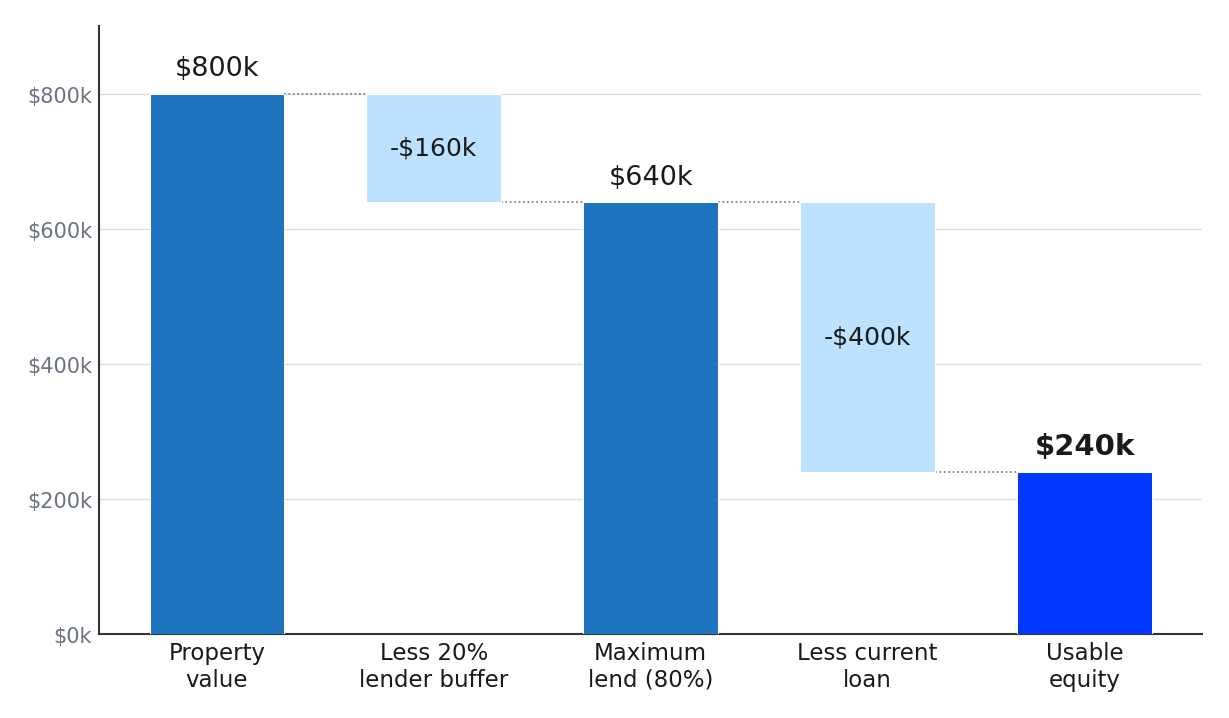
Not all equity is usable equity. Lenders apply a ceiling, usually 80 percent of the property value, before lenders mortgage insurance is triggered. Your usable equity is that 80 percent figure minus what you still owe. The 80 percent figure is the loan to value ratio, or LVR, the proportion of a property a lender is willing to fund.
How usable equity is calculated
Source: APRA, 2026
FOR EXAMPLE
A property valued at $800,000 has an 80 percent lending limit of $640,000. Subtract the existing $400,000 loan and the usable equity is $240,000. At a 20 percent deposit plus costs, that can fund the deposit on a purchase of roughly $700,000 to $750,000.
The property investment growth cycle using equity
Used deliberately, equity creates a cycle. Buy, let the asset grow, release equity, buy again. Each loop adds an asset and, in a rising market, more total equity than the loop before.
How one property funds the next
Acquire the first property and hold it through a growth period.
Equity builds as the value rises and the loan is paid down.
A lender revalues the property and releases usable equity.
That equity becomes the deposit for the next purchase, and the cycle repeats.
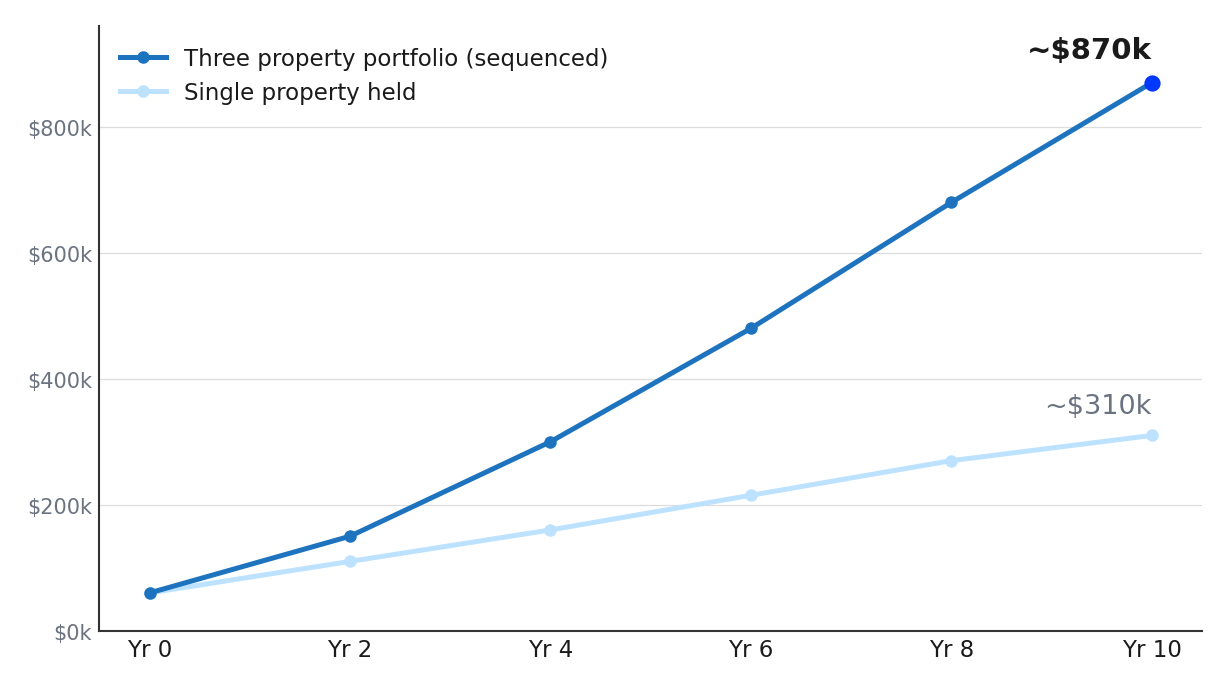
How equity compounds across a sequenced portfolio
Source: CoreLogic, 2026
Worked example: building a two property portfolio with equity
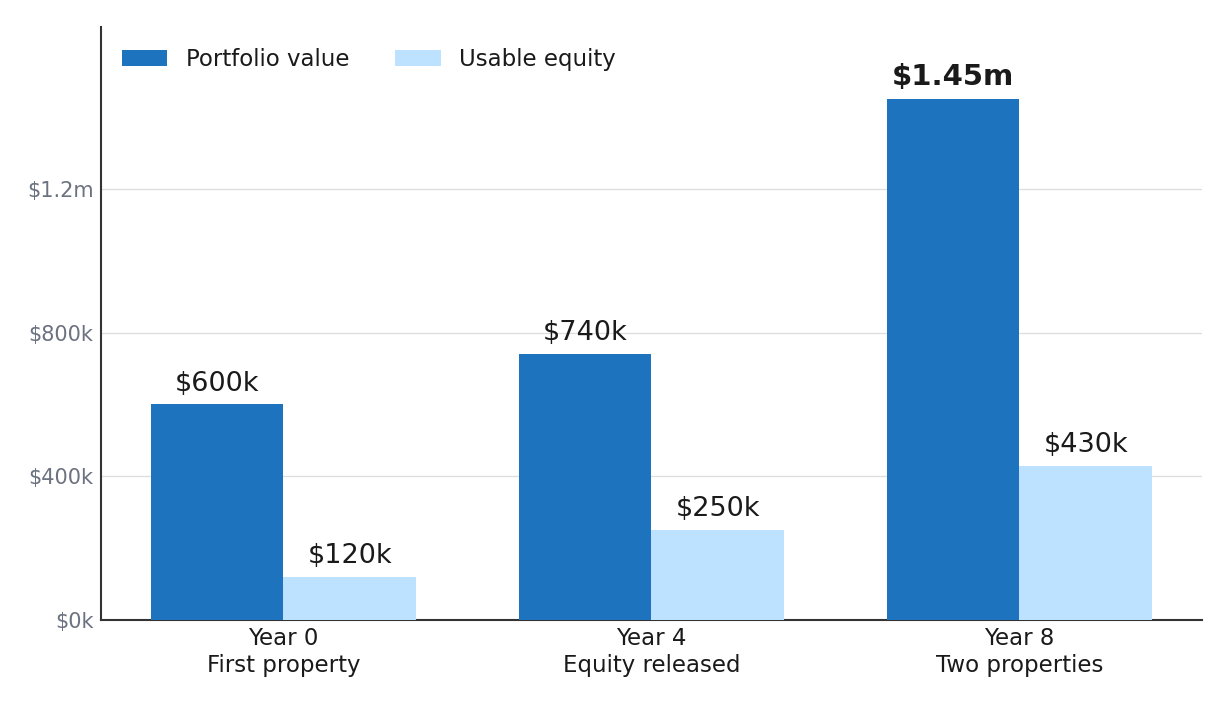
Numbers make the strategy concrete. Picture an investor who buys a $600,000 property, holds it, and releases equity at year four to fund a second purchase.
Building a two property portfolio over eight years
Source: CoreLogic, 2026
FOR EXAMPLE
At year four the first property has grown to about $740,000 with roughly $250,000 of usable equity. Releasing part of that funds the deposit on a second property. By year eight the combined portfolio is worth about $1.45m, with equity working across two assets instead of one.
When using equity is a strong versus weak strategy
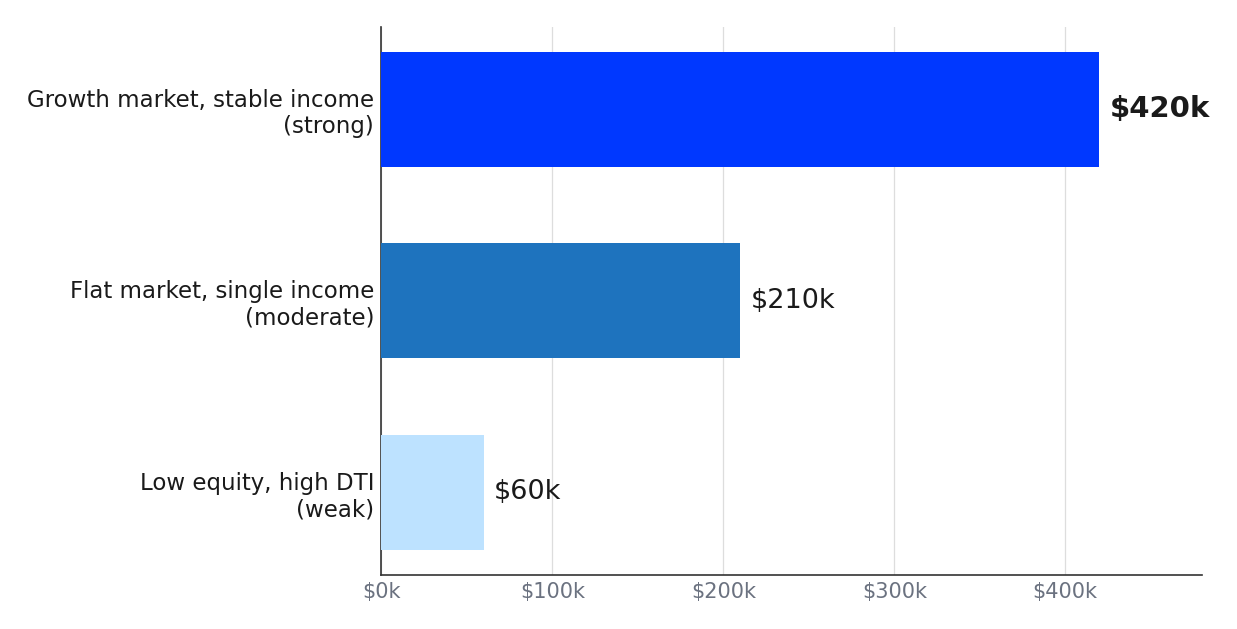
Equity is a tool, not a guarantee. The same approach that builds wealth in a rising market can trap an investor in a flat or falling one.
When equity is a strong versus weak strategy
Source: APRA, 2026
The risks investors underestimate
Borrowing against several properties magnifies both gains and losses. When the Reserve Bank of Australia lifts rates, every loan in the portfolio feels it at once. A market dip can erase paper equity quickly, and equity you cannot access is not equity you can use. Weak rental conditions add pressure too, and Australia's ongoing rental crisis cuts both ways for investors who rely on cash flow. These are the kind of avoidable errors that catch first time investors.
How equity connects to borrowing capacity and lending rules
Equity opens the door. Borrowing capacity decides whether you can walk through it. You can hold substantial usable equity and still be declined if your income does not service the new loan.
Lenders separate two questions. Do you have the deposit, which equity answers, and can you service the repayments, which your income and existing debts answer. Your debt-to-income ratio is central to the second. Under APRA serviceability rules, lenders assess new loans at an interest rate buffer above the rate you actually pay, which lowers the amount you can borrow.
Final Thoughts
Using equity to buy investment property is the most common way Australians move from one property to several. The mechanics are simple. Reuse the growth you have already earned as the deposit for your next purchase.
The discipline is harder. Usable equity is capped at the 80 percent lending limit, compounding only rewards those who redeploy with intent, and borrowing capacity, not equity, is usually the ceiling that decides how far you scale.
Treat equity as a repeatable engine rather than a one-off windfall, plan for the flat years as well as the growth, and the path from one property to a portfolio becomes a sequence you can actually follow.
Frequently Asked Questions
Recommended Reading
Two pages selected based on what readers of this article are most likely to need next.
Recommended Video
Using realistic Australian numbers, we break down exactly how a home worth $1.1M with a $550K loan can unlock around $330K of usable equity, and how that can fully fund the deposit and costs on an $800K investment property—while still leaving a buffer in place.