

Property Tax Changes: What Investors Need to Do Now

Introduction
Investment property tax changes take effect from 1 July 2027, and the biggest shift is who can still offset a rental loss against their salary. Properties bought after 7:30pm AEST on 12 May 2026 lose that option once the new rules start, while properties bought earlier and eligible new builds are treated differently again.
Treating this as purely a tax problem misses the point. The real question is whether a specific property still stacks up once the tax treatment changes, and that depends on cash flow, borrowing capacity and the growth case, not the deduction alone.
What Are the New Investment Property Tax Changes
The Treasury Laws Amendment (Tax Reform No. 1) Act 2026 passed Parliament on 25 June 2026 and received royal assent the next day. It reforms negative gearing and capital gains tax for residential property, with both changes starting on 1 July 2027.
The key date for negative gearing is not 1 July 2027. It is 7:30pm AEST on 12 May 2026, the moment the Budget was handed down. Properties bought, or under a binding contract, before that time are grandfathered under the existing negative gearing rules, and keep them for as long as the property is held.
Established properties bought after that cutoff can still be negatively geared normally until 30 June 2027. From 1 July 2027, the restricted rules apply to them. Eligible new builds are treated separately again, and keep full access to negative gearing regardless of when they are purchased.
Key Dates for the 2026 Tax Reforms
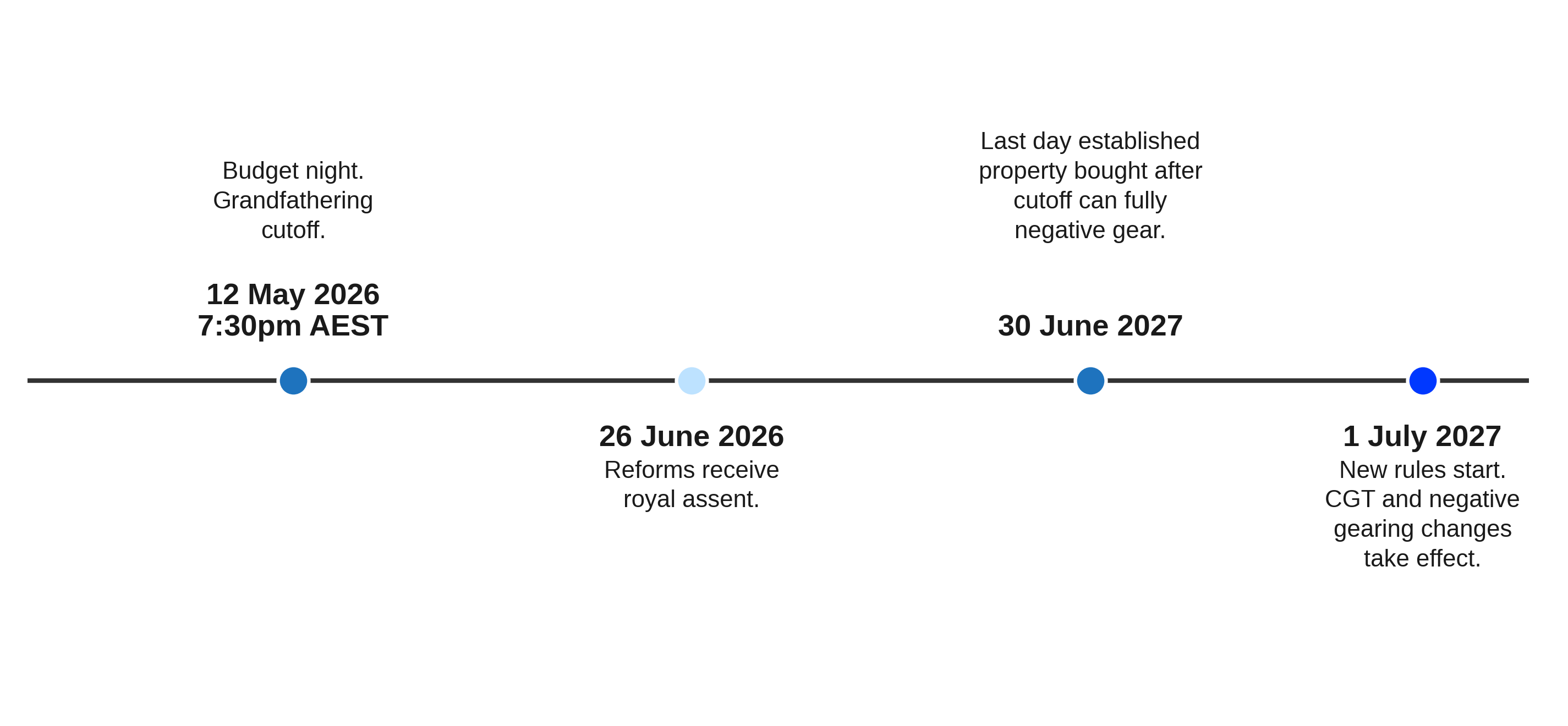
Source: Australian Taxation Office, June 2026
How Negative Gearing Rules Are Changing
Negative gearing lets an investor deduct a net rental loss, where deductible expenses exceed rental income, against other income such as salary. From 1 July 2027, that is no longer available on every established property.
For an established property bought after the 12 May 2026 cutoff, a rental loss can only be deducted against rental income or future capital gains from residential property. It can no longer reduce your salary or wages. Any loss you cannot use in a given year is carried forward to future years, not lost.
Eligible new builds sit outside this restriction entirely. A new build compared with an established property for negative gearing purposes keeps full salary offset, but the definition is narrow: dwellings built on vacant land, or a knock-down rebuild that adds more dwellings than before. A substantial renovation or a granny flat addition does not qualify, and only the first investor to buy the property gets the benefit.
What Happens to a $10,000 Rental Loss
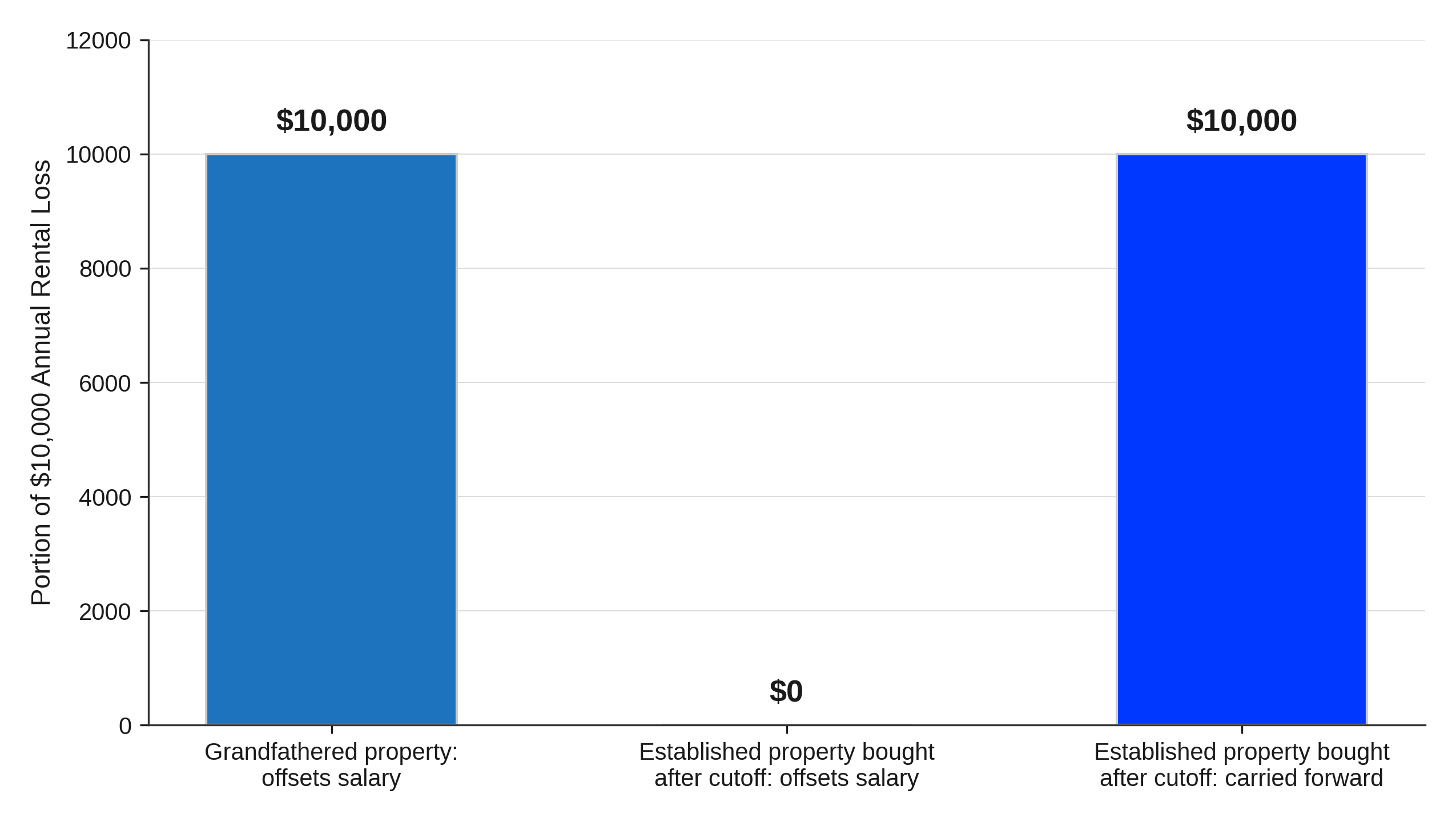
Source: Australian Taxation Office, June 2026
What Is Changing with Capital Gains Tax
From 1 July 2027, the 50 per cent CGT discount for individuals, trusts and partnerships is replaced with cost base indexation and a 30 per cent minimum tax on the gain. This applies across CGT assets generally, not only residential property.
Gains that accrued before 1 July 2027 keep the current 50 per cent discount. Gains accruing after that date are assessed under the new regime instead, which means most investors selling after the changeover will need a valuation at 1 July 2027 to split the gain into its old and new portions.
Eligible new build investors get a genuine choice on sale: apply the existing 50 per cent discount, or use the new indexation and minimum tax regime, whichever suits their circumstances at the time.
What the Tax Changes Mean for Cash Flow
A tax deduction is not the same as a good investment. It has always been possible to hold a property that only makes sense once the tax benefit is added back, and that is exactly the group of properties this reform puts under pressure.
Losing the salary offset on an established property changes the cash flow an investor feels each year, even though the underlying rent, interest and expenses have not moved. Reviewing whether rental income genuinely supports your borrowing position matters more once that offset is gone, not less.
The properties most exposed are the ones bought mainly for the deduction, on thin yield, in a location with a weaker growth case. Strip the tax benefit out of the numbers and ask whether the property still earns its place in a portfolio on rent and growth alone.
New Build vs Established: What Matters Most
The tax treatment now genuinely differs between new build and established property investment, so it is a real input to the decision for the first time in years. It is still only one input.
New builds often carry a price premium over an equivalent established home in the same suburb, along with weaker land content and more exposure to construction and settlement risk. The tax advantage needs to be large enough to outweigh those factors, not simply present.
A tax advantage cannot fix a weak location. Rental demand, population growth and supply in the area still decide most of the long-term return, and a new build in the wrong suburb is still a new build in the wrong suburb.
New Build vs Established Property Under the New Rules
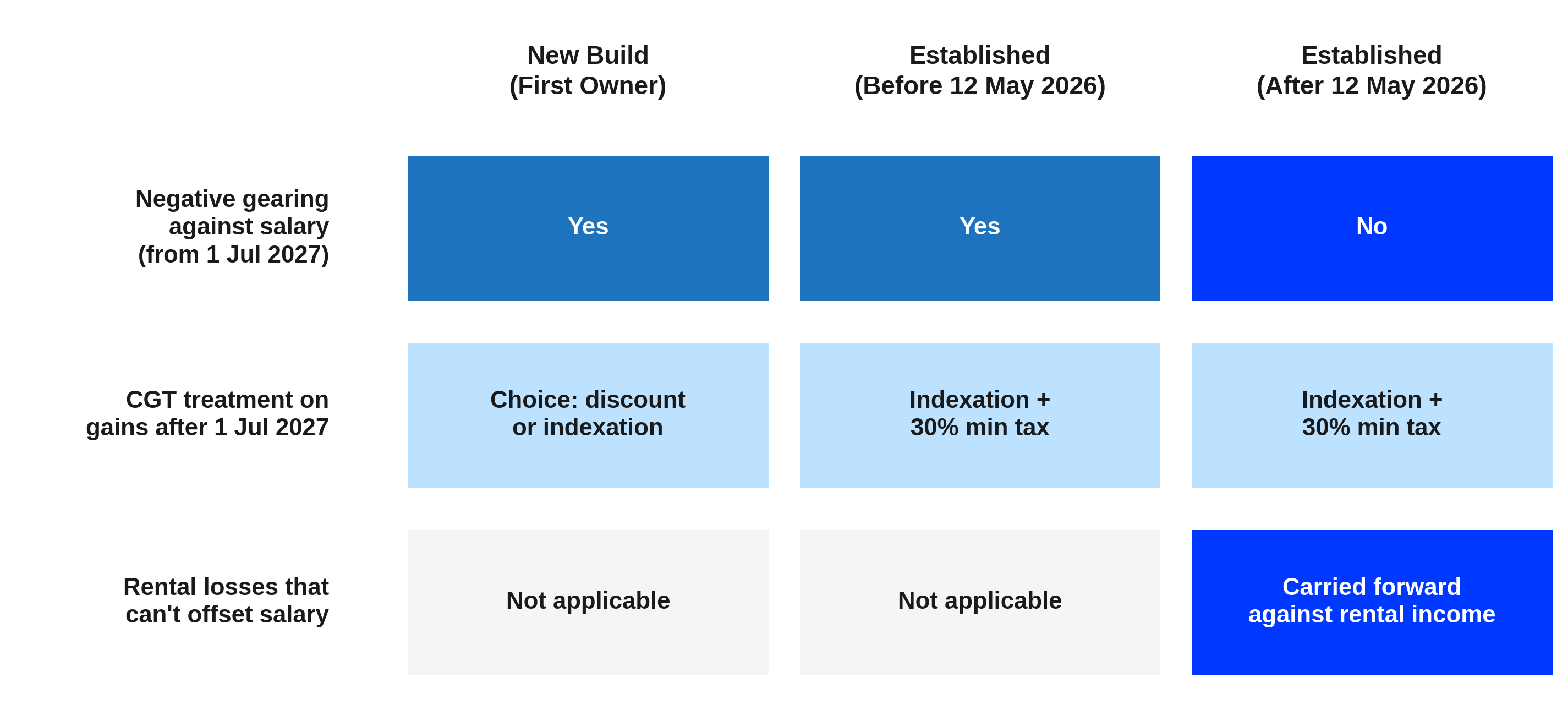
Source: Australian Taxation Office, June 2026

What Investors Should Do Now
If you already own an investment property
Check your contract date against 7:30pm AEST on 12 May 2026. If you are grandfathered, nothing changes while you hold the property. If you bought after the cutoff, model your cash flow under the restricted rules before 1 July 2027 arrives, not after.
If you are planning to buy
Model the after-tax return under the rules that apply to your purchase date, not the rules you are used to reading about. Reviewing your borrowing capacity formula alongside the new tax treatment matters, since a smaller effective deduction changes serviceable cash flow, not just your tax return.
Do not buy for the tax benefit alone
This was always poor practice and the reforms make it worse, not better. A property that only works because of a deduction was never a strong investment. Keeping tax as one input within a broader property investment strategy is what separates a considered purchase from a tax position wearing an investment's clothing.
Final Thoughts: Tax Is the Trigger, Not the Decision
These changes are real, dated and now law, and they do shift the economics of some established properties. But the reform is a trigger to reassess, not a verdict on whether property investment still works.
The investors who come out ahead will not be the ones who found the best tax angle. They will be the ones who checked cash flow, borrowing capacity and the growth case honestly, with the new tax rules as one input among several rather than the reason for the decision.
Frequently Asked Questions

Recommended Reading
Two pages selected based on what readers of this article are most likely to need next.
Recommended Video
As of April 2026, Treasury is actively modelling potential changes ahead of the May Budget. This isn’t speculation—it’s confirmed. In this video, we unpack exactly what’s being proposed, who stands to benefit, who could be impacted, and what it could mean for investors, renters, and first home buyers across Australia.